
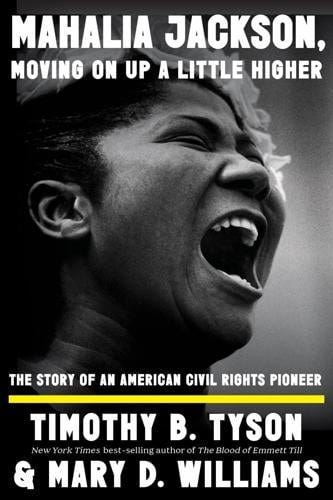
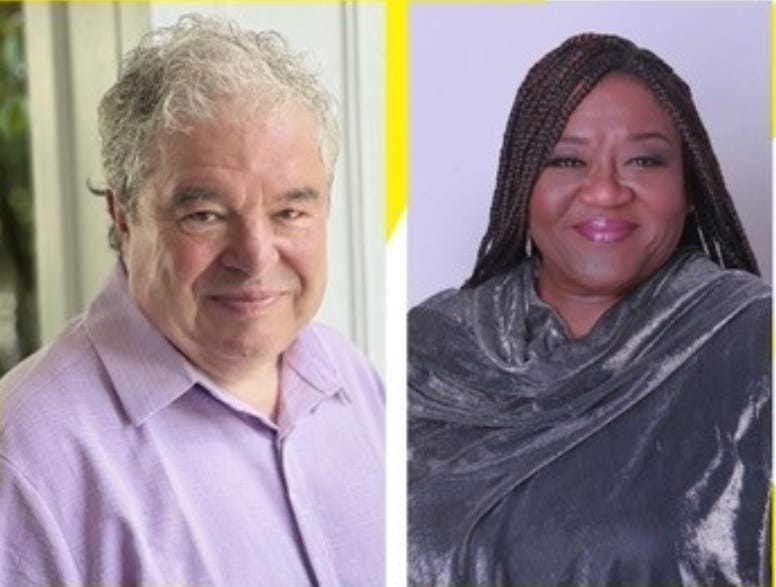
I’ve known Timothy B. Tyson for a long time. We met when he taught an Introduction to African-American History class that I took in 2000 as a young college student and which helped lead me to the work that I’ve done ever since. Since then, he’s been an important teacher, mentor, and friend. His award-winning books on the Black freedom struggle have earned him wide attention and acclaim, and he now turns his attention to the great Mahalia Jackson. Written with singer and educator Mary D. Williams, the new Mahalia Jackson, Moving On Up A Little Higher: The Story of an American Civil Rights Pioneer places the transformative artist at the center of the social, cultural, and political changes of the Civil Rights Era. It also pays careful attention to her artistry, the traditions that informed it, and the influence it still holds across generations. It was a pleasure to speak with him about this important book and why Mahalia Jackson matters so much in this moment and beyond. - CH
Charles Hughes: How did you and Mary D. Williams come to write a book about Mahalia Jackson?
Timothy B. Tyson: I began to listen to Mahalia Jackson when I was in graduate school at Duke University from 1987 to 1994. She helped me stay strong while I got my Ph.D. and afterwards when I landed in the African American Studies Department at the University of Wisconsin-Madison, where I met a brilliant student named Charles Hughes, whom I think you know. While I struggled to learn to teach and labored to turn my dissertation into a book, Mahalia helped me persist. Her rendition of Clara Ward’s “How I Got Over,” an anthem of survival and transcendence for Black Americans, became my standby. Not surprisingly, Mary D. Williams had a much deeper and earlier connection with Mahalia from the time she was growing up with a father who was a gifted gospel singer and Mahalia’s records in the house. Mahalia was her idol.
After my family and I had moved back to our ancestral home in North Carolina, I met Mary. I was on a book tour and did a benefit for an anti-poverty organization in Raleigh. My hosts knew how deeply gospel and the blues spoke to me. As a gift to me, they got Mary, a renowned gospel artist, to open the event. Her voice and her spirit just blew me away. What followed was several years of speaking and singing all over the country about African American culture, race, and America’s tormented racial history. Like Mahalia, Mary grounded herself in the spirituals and the moral vision of the Black church in slavery, the souls that met in secret in barns and woods and fields. The enslaved created a transformative faith that human beings could not be transformed into things, that they were all God’s children and equal before the throne of grace, and that communities of faith could help them survive the nightmare of slavery. Mary rejected contemporary “pop” gospel and hewed to that deeper tradition that Mahalia embodied.
My day job was teaching history at the Center for Documentary Studies at Duke University. Our public collaboration led to Mary and me teaching a community-based class in Durham, “The South in Black and White: History, Politics and Culture Along the Color Line.” Mary brought musical and historical power to the course. We taught undergraduates at Duke and North Carolina Central University, but most of our three hundred students were local community members--activists, writers, ministers, artists and everyday folks. Our notion was to do this for five years as an experiment to see whether the culture and history of the Black South could make a difference in the community. We ended up teaching together for sixteen years. We could see that the community we built in the classroom helped sustain folks and inspired movement energy. Mahalia Jackson was central to the work.
Mary had been performing for decades but had never published anything. I had published four books on African American history and racial politics, but never anything directly about music. I had witnessed Mary give a talk on Mahalia Jackson at a conference that got the musicologists on their feet cheering. That was the first time that in dawned on me that she should consider writing about Mahalia, though I had not included myself in the equation.
About that time, I served on the executive board of the North Carolina NAACP. In 2009, Mary and I became involved in protests after far-right Tea Party ideologues captured the school board in nearby Wake County, where Mary’s children were in school. The extremists immediately began to re-segregate the Wake County public schools and spew old segregationist rhetoric. Mary and I soon got arrested together in a nonviolent direct-action protest at a school board meeting, which helped spark a large local movement. All through that movement, Mary sang Mahalia songs at mass meetings to inspire the protestors. We also taught about race and public education at local churches to gin up turnout for the next school board election. The campaign swept the Tea Party members off the board . Mary’s voice and Mahalia’s vision played a big part in the victory. You can see the story in the fifth segment of Eyes On the Prize III, the latest installment of that documentary saga.
Through my agent, Charlotte Sheedy, an editor at Norton Publishers named Robert Weil had become aware of Mary’s and my collaboration over the years. Over dinner, he asked me if we might want to work together on a book on Mahalia Jackson. I told him he would have to take it up with Mary, and if she wanted to do a book, and if she wanted me to work with her, I might be interested. When he did ask her, Mary saw no question as to whether we would do it. Though we had never written together, the project seemed like a logical extension of our long collaboration.
CH: Although many music fans will have at least heard the name Mahalia Jackson, they are likely unaware of the depth of her work as a leader in the Civil Rights era. At the risk of asking an obvious question, why is it important that those of us who love Mahalia’s music (which is hopefully everyone who’s heard it) remember this crucial side of her legacy?
TBT: First, it was a matter of correcting the historical record. We had not known about Mahalia’s political work, either. A fair number of Americans still remember that Mahalia Jackson was the greatest gospel singer who ever lived. The few who knew a little more were aware that she had sung at the 1963 March on Washington. That story would surely be a part of her biography. But when we began to do deep research on her life, we discovered that Mahalia had become active in civil rights issues in the early 1930s, soon after the Great Migration took her from her childhood home of New Orleans to Chicago.
Back in New Orleans, Mahalia had come to believe in both the necessity of independent Black political power and in interracial coalition-building where it was possible, under the influence of a radical teacher who remained her friend after her family’s poverty forced her to drop out of school. When she got to Chicago at twenty-one, she helped elect a Black alderman, William Anderson. She wanted to nurture independent Black power in the Democratic Party. Soon afterwards, she began to sing at meetings to help build William Dawson’s urban political machine, which became the most powerful Black political organization in America. Throughout the next forty years, she was constantly available to support people organizing strong institutions in Black communities across America--churches, daycare centers, youth organizations, food ministries, whatever. She also worked in political campaigns and civil rights struggles. As we learned, Mahalia’s faith, her politics and her music were inseparable.
In 1936, she sang for FDR’s reelection campaign, “because he was going to put meat on the table.” In the presidential campaign of 1948, Mahalia had begun to perform for Henry Wallace’s independent Progressive Party. But when President Truman defied the Democratic Party’s Southern “Dixiecrats,” put a strong civil rights plank in his platform, and campaigned for Black votes in the North, Mahalia traveled with Truman and was frequently at his side in the Midwest, where Black ballots in Chicago carried Illinois and swung the election.
Though she performed at JFK’s Inaugural Ball in 1961, her devotion to movement politics outmatched her electoral efforts. She was aware of the grassroots civil rights movement in the South before most Americans had any inkling of it; in 1952, Mahalia accompanied Thurgood Marshall to a voter registration symposium in Mound Bayou, Mississippi, where she sang to over 7,000 local people.
She sang for the Montgomery Bus Boycott in 1956; soon after she left, Klan terrorists bombed the room where she had been staying in Rev. Ralph Abernathy’s home.
She used her influence with Chicago’s Mayor Richard Daley to get free access to the city’s municipal venues and raise huge sums for the Freedom Rides in 1961 and again for SCLC’s campaign in Birmingham in 1963. She performed at Carnegie Hall to raise money for the Student Nonviolent Coordinating Committee’s grassroots work in the South.
At the March on Washington in 1963, she performed the gospel anthem “How I Got Over” and the old spiritual “I Been ‘Buked and I Been Scorned” just before MLK’s speech. In fact, the text of Dr. King’s speech that day had not included the “I Have A Dream” section, but Mahalia had heard a version of the riff a few weeks earlier in Detroit. As his speech wound down, she called out to King, “Tell ‘em about the dream, Martin!” He quickly pushed his notes aside and shifted into that sequence to close his speech, which has echoed through world history.
In 1964, she sang at President Lyndon Johnson’s White House at a conference to help persuade Congress to support the Civil Rights Act. Mahalia performed for the Selma March in 1965. Her support was pivotal to Dr. King’s decision to bring the movement north to Chicago in 1966. During that campaign, she opened her home to Dr. King and his colleagues for meetings and relaxation. King and his wife, Coretta, frequently spent the night. In 1968, she sang King’s favorite, “Precious Lord,” at his funeral.
In other words, we did not set out to write about Mahalia’s civil rights work, but our research found it at the center of her life for four decades. And so that became central to our book.
CH: Although the book is obviously, gloriously focused on Mahalia Jackson, you also trace the larger relationship between Black music and Black freedom in the United States. Why has the music mattered so much, whether it’s the gospel anthems that Mahalia brought forward so powerfully, or the blues that – as you point out – she always knew was a crucial element in the larger mix, or all the other traditions from spirituals to hip-hop and beyond?
TBT: A larger but intimately related question is this: Why has the culture of a small minority in one country had such an incredible impact on the world? From the spirituals to the blues, to ragtime and jazz, to R&B and rock and roll, to funk and disco and hip-hop, in religion and slang and style and oratory, in literature, dance and politics, the world has been obsessed with African American culture for a long time. Of course, this never flowed just one way—it might be better to say African American culture has driven a vibrant global call-and-response. This takes up so much space in our mental sky that we probably don’t give it proper attention. But if we were Martian anthropologists, scouting out the Earth, I think we might look at Black America, and in its larger origins the Black South, and ask what on Earth is going on with these people?
My theory is that African American culture, forged in the bottom of a boat, ensnared in a brutal confrontation with what Dr. King called the “thingification” of humanity, emerged as an oppositional response to slavery and white supremacy. It was a living culture that refuted any notion that a human being could be the property of another. It called out the essential self-ownership of every person and the equality of all as equal children of God. From those roots grew all the music you mentioned and the larger Black American culture as well. In ways often veiled and sometimes overt, this has endured as a culture with a revolutionary mission. And the rhythm pounding at its heart, which people can hear from Detroit to Dakar, from Havana to Tokyo, is a drumbeat of freedom. And because the world has been a prison-house, most places, most of the time, ruled by unaccountable potentates, masses of people respond to that musical impulse, which quickens within them hopes and demands for an acknowledgement of their free personhood. That’s why it reverberates the way it has for so long. And that goes double for the freedom struggle in America, in which Black music has done so much to inspire, illuminate, ratify, ignite and preserve. Mahalia distilled that tradition and served it up so that millions of people around the world could become intoxicated by it.
CH: As you trace, Mahalia Jackson was always speaking to her moment, both in the music made and in the other public work she did. Although she’s been gone for a half-century, her voice seems very much relevant today. What do you think Mahalia Jackson’s life teaches us about our own fraught era?
TBT: Mahalia teaches one crucial lesson that applies to any life, any time, anywhere, public or private. From bitter poverty, growing up without a mother or a father, she labored in the elongated shadow of slavery in one of the harshest corners of Jim Crow New Orleans. From there, she lit out for Chicago as the Great Depression settled in to stay. There she scrubbed white people’s floors and styled Black women’s hair, and sang in churches for the joy of it, though she made a little money. Her immense talent and unflagging determination made her first a regional, then a national gospel icon. Her 1947 recording, “Move On Up a Little Higher,” released by Apollo Records without fanfare, transformed the whole gospel music field and sold eight million records in a landscape where a hundred thousand copies was Mount Everest. Now famous in the Black world, she appeared on the Ed Sullivan Show several times and recruited millions of white listeners. She sang on her own nationwide radio show. Her subsequent television show played on stations all over the country. She sang for four presidents and set Carnegie Hall ablaze six times as well as the most prominent venues across Europe. Mahalia accomplished these things at a time when Black performers were not yet welcome in mainstream American media. Those who followed in Mahalia’s footsteps to cross over into the wider culture generally had to alter their style; Sam Cooke, a legendary gospel artist, to cite but one example, had to switch to denatured pop music to make it. Mahalia always hewed to her faith and to a traditional Black art form. Proud to be Black, Southern and working-class, Mahalia saw these roots as neither a limitation nor a boundary but as a source of belonging and strength that helped her transcend lines of color, caste and culture. Mahalia told a reporter, “You must first sing for yourself. When you make that peace within yourself, then you can reach out to the others. If I do nothing else, I hope to teach people that.”
More urgently, perhaps, Mahalia’s politics offer a timely example that resonates in this moment of national reckoning about race and democracy. She invested herself in building strong Black community institutions and believed in Black political independence and the power of Black history and culture. But she also recognized the necessity of interracial coalition politics, grounded in a vision of love and growth for all people, and was willing to do the work to make that happen. She believed in multicultural political power as a way toward love, justice and mercy for all.
CH: Switching gears a little bit, I wonder if you can talk about the process of collaboration with Mary D. Williams. The book feels very much like a conversation between the two of you. Could you describe how you worked together? How did you create such an effective, gospel-rooted call and response as writers?
TBT: Mary and I come from sharply different backgrounds and have lived very different lives. She grew up a Black, rural, working-class woman of faith, firmly planted in the theologically conservative Church of God in Christ. My parents were liberal Methodists and raised me in a middle-class white family. I am several years older than Mary, which is one reason why I was affected by radical politics and the counterculture in ways she was not. My father was a preacher in small-town eastern North Carolina, as were his five brothers and their father before them. Mary was steadfast in her faith tradition, while I fled from the church as a teenager and returned some thirty years later, something of a Christian mystic, heavily influenced by the social gospel of Howard Thurman, and still queasy about the church.
Mary’s father was a gifted quartette singer, and she grew up immersed in gospel music. Her faith and its musical traditions became the center of her life. My parents did not even own any records, though we did sing spirituals and hymns when we rode in the car. The music that touched me was Memphis soul, especially Otis Redding and Al Green. I loved Motown and Aretha Franklin and Marvin Gaye, and Sixties rock bands and folk singers.
Mary became a gospel performer, working hard as a traditional gospel performer in a time when contemporary “pop” gospel dominated the field. Like Mahalia, she stuck with her faith and with the deep traditions of the spirituals and gospel. Mary graduated from high school and attended Fayetteville State University for two years. She spent twenty years as a caseworker helping poor people navigate the Medicaid system. About twenty years after her first stab at college, Mary graduated with honors from the University of North Carolina and earned a graduate degree in Folklore. She raised three remarkable Black sons without much help. I have always said that Mary pulls a big wagon, and she does so with considerable patience and love. She has a genuine spiritual life and we usually pray together before all of our performances.
As a small child, I was obsessed with books and became a writer of sorts almost as soon as I learned the alphabet. I liked sports and girls but inhaled books, among other things. I was consumed by politics and history. School was always like prison to me. I quit high school and read constantly while I earned my living as a construction laborer, cook and bartender for years. I launched a movement life—civil rights, labor, the environment, gender equality, and so on—which lasted from my late teens until today. When I finally went to college in my mid- to late-twenties, I never left, in a sense; I wrangled my way to a diploma from Emory University, got a doctoral fellowship to Duke, and have spent my career teaching and writing.
As you noted earlier, Mary and I have worked together for a long time. Our common passion for what we are doing kept us going. The differences in our lives brought forth a rich conversation that taught both of us a lot. That has given us a rare privilege of speaking honestly about our lives and beliefs and experiences. We have undergone transformative events together. We have watched each other’s children grow up. We have lived through each other’s joys, crises and losses. That has given us a strong bond of trust.
I say all that to say that collaboration on this book just extended the conversations we have been having for more than twenty years. We both did a lot of research, and we talked through the story that began to emerge from what we learned. Mary brought a particularly useful perspective on this Southern Black woman’s life as a singer. She knew has a more intimate understanding of Mahalia’s religious life. I was more comfortable as a writer, but I ran anything I wrote by her for comments, and she put her pen to work, too. We both know how to keep working. When I first read the manuscript in full, I saw exactly what you saw in it, Charles—a conversation, a call-and-response by two deeply engaged friends.
CH: Unfair question: what’s your favorite Mahalia Jackson song, and why?
TBT: That one’s easy for me: “How I Got Over.” It has kept me my heart and soul fighting for life, finding victory and celebrating it with an outpouring of gratitude.
CH: Lastly, when we talk to authors for No Fences Review, we always ask what they’ve been reading recently that has struck them in a positive way. It doesn’t need to be music-related, and it doesn’t need to be new, but it can be either of those things. What’s something you’ve been reading that’s made an impact?
TBT: In the late spring, I read Niall Williams’s This Is Happiness, set in a rural Irish village as electricity begins to arrive. A lively and heartening novel with a glimmer in its eye despite the usual and unusual human hardships. I kicked off the summer by re-reading Walt Whitman’s Leaves of Grass. Its embrace of the world and democratic passion never fail to remind me of what I am living for. Much of it is literally scriptural for me. I recently read Native historian Ned Blackhawk’s The Rediscovery of America: Native Peoples and the Unmaking of U.S. History, and it illuminated many of the misunderstandings Americans, including myself, have had about the history of this country. I had known much about the injustices and brutalities leveled at Native peoples, but I was unaware of the ways their presence and actions drove American policy from before the nation was even born. Then I re-read Isabel Allende’s beautiful and compelling novel, The House of the Spirits, grounded in the history of Chile, which has been a stirring joy. The storytelling is matchless and the book’s rich sense of history runs deep, as do its memorable characters. This is one of the best novels I have ever read. I have also been reading a finished but not yet published history of the 1960s, Craig Werner’s Everyday People. It’s a fascinating and well-considered feat, pulling so many strands of history into a gripping narrative. It will be out with the University of Massachusetts Press before long and I expect many readers to share my respect for and enjoyment of it.
Mahalia Jackson, Moving On Up a Little Higher: The Story of an American Civil Rights Pioneer is available now on Liveright/W.W. Norton & Co.
If you like what you’re reading here, please think of subscribing to No Fences Review! It’s free for now, although we will be adding a paid tier with exclusive content soon. Also, if you’d like to support our work now, you can hit the blue “Pledge” button on the top-right of your screen to pledge your support now, at either monthly, yearly, or founding-member rates. You’ll be billed when we add the paid option. Thanks!
No posts
Comments
Nothing yet. Say the first thing.
Sign in to join the conversation.