
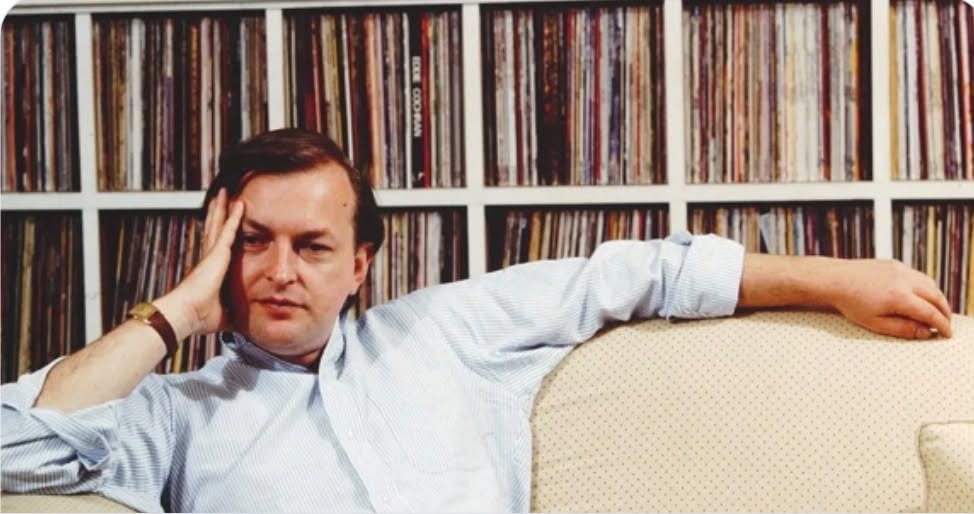
Dave Marsh died last week at age 76 after a long illness. One of the original generation of rock critics and the author or editor of over 20 books, Marsh worked as a writer, editor, broadcaster, activist, and advocate during his long and esteemed career. He was also our friend. David has written about him here before, once in honor of his great book The Heart of Rock and Soul and again to celebrate the 2023 release of his collection Kick Out The Jams. We also both took part as organizers and participants in the 2021 online symposium Land of Hope and Dreams, which featured a truly astonishing group of participants from across Marsh's wide-ranging impact. Many of the participants - including now Dave himself - are no longer with us. All of it's available here.
To mark this sad occasion, we both wanted to share some reflections on Dave Marsh and his legacy. It feels additionally poignant that today is the 3rd anniversary of No Fences Review, which bears the mark of his influence in many ways. Many thanks, Dave.
Charles Hughes: It would not be true if I said that I wouldn’t be a writer without Dave Marsh, but it would be a lot truer than it may seem.
He changed my life long before I ever met him. His writing and editing was some of the first music criticism I ever read, as a teenager growing up in central Wisconsin, and his books – particularly The New Rolling Stone Record Guide (co-edited with John Swenson), The First Rock & Roll Confidential Report, The New Book of Rock Lists (co-edited with the late, great James Bernard), and his masterpiece The Heart of Rock and Soul – were foundational to forming the ideas and style that I’m still working on and working through. (I got to all the other books later, and I’m still exploring the wealth of his shorter work from Creem to Rock and Rap Confidential and beyond.) Dave helped me shape and define my taste, sure, but more than that he was one of the people who got me to think and listen differently, and then to better articulate my feelings about what I liked and what I didn’t. Not because I wanted to agree with Dave Marsh – sometimes I did and sometimes I didn’t – but because I wanted to express myself with as much precision and passion.
Later, when I came to the University of Wisconsin-Madison, I fell by pure fucking luck into the amazing crew of writers, teachers, activists, artists, and listeners who’d formed around him, many of whom became and remain my mentors and friends. (Like David Cantwell. Or like Stewart Francke, to whom some of us paid tribute last year.) Indeed, and again without much hyperbole, it’s hard to imagine what my life would look like without all the people that I met directly through Dave or just one degree removed.
It was through them that I finally met Dave himself, who welcomed me into the circle with warmth, generosity, and a no-bullshit bluntness that sometimes pissed me off but just as often made me even fonder of him. Over the years, we got to do some cool work together and spend some lovely time. He gave me advice and contacts that were crucial to several projects, including what became my first book. He introduced me at a conference once with the best intro I’ve yet received: “Next, we have Charles Hughes. Da doo ron ron.” (This was both a reference to the topic of my comments – Bruce Springsteen’s relationship to early-‘60s pop music – and the amazing email list of that name, started by our friend Alexander Shashko, that helped bring us together.) He supported my work and affirmed that I had a place in the conversation. He seemed to enjoy having me around. He gave me some lovely praise that I hold dear. And he told me when he thought that I was full of shit – even better, I learned how to tell him the same. He taught me so much about music. But he also taught me a lot about justice, and freedom, and family, and care, and community, and work, and trust, and being from the Midwest, and how you make a life, and – in all things – how to stay focused on what really matters. Just like the music taught him to.
In the week since his passing, so many others have filled social media and elsewhere with remembrances and appreciations of Dave Marsh that are rooted in similar experiences. Many of them go far deeper than mine, which reflects how fiercely he supported, helped, and loved those who knew him better and longer than I did. And some of them are brief, with a clarity and heart that I know he would both appreciate and recognize. We’ve collected a few of those appreciations below, but there are many more out there and hopefully still more to come.
I will miss him. I’m grateful to have known him. And I’m even more grateful for all the people who entered my life because Dave brought them together. Brought us together.
If I can paraphrase the artist who Dave wrote about more than anyone else: if we’re here, then he’s here.
Keep rockin’, Dave. It’s too late to stop now.
David Cantwell:
Every one of the Dave Marsh obituaries I read this week identified him, in its lede if not always in the headline, as a “Bruce Springsteen biographer.” I guess we all knew this was how it would be. Still, short-handing Marsh’s life and work like that struck me as off each time I encountered it.
Part of the disconnect for me here was that Dave Marsh wasn’t just some guy whose work I followed. Dave was the key influence on my writing—in the way he valued the material over the abstract and modeled close listening in context, in the way this blue-collar Midwesterner foregrounded class and race in his work and in the way he believed, a la Marx and as I’ve phrased it elsewhere, rock critics have hitherto only interpreted the world; the point is to change it. He supported my writing early on, gave me several of my first opportunities, and then kept on being supportive across the years, making sure I was included in this or that project and reaching out to help or to share a good word when I needed it. I don’t think it’s hyperbolic to suggest that Dave helped shift the trajectory of my life.
Dave was my friend. We fell out there for a few years, not an unprecedented event among those who knew him. But I want to stress that, even when he and I weren’t speaking, I knew that Dave had my back.
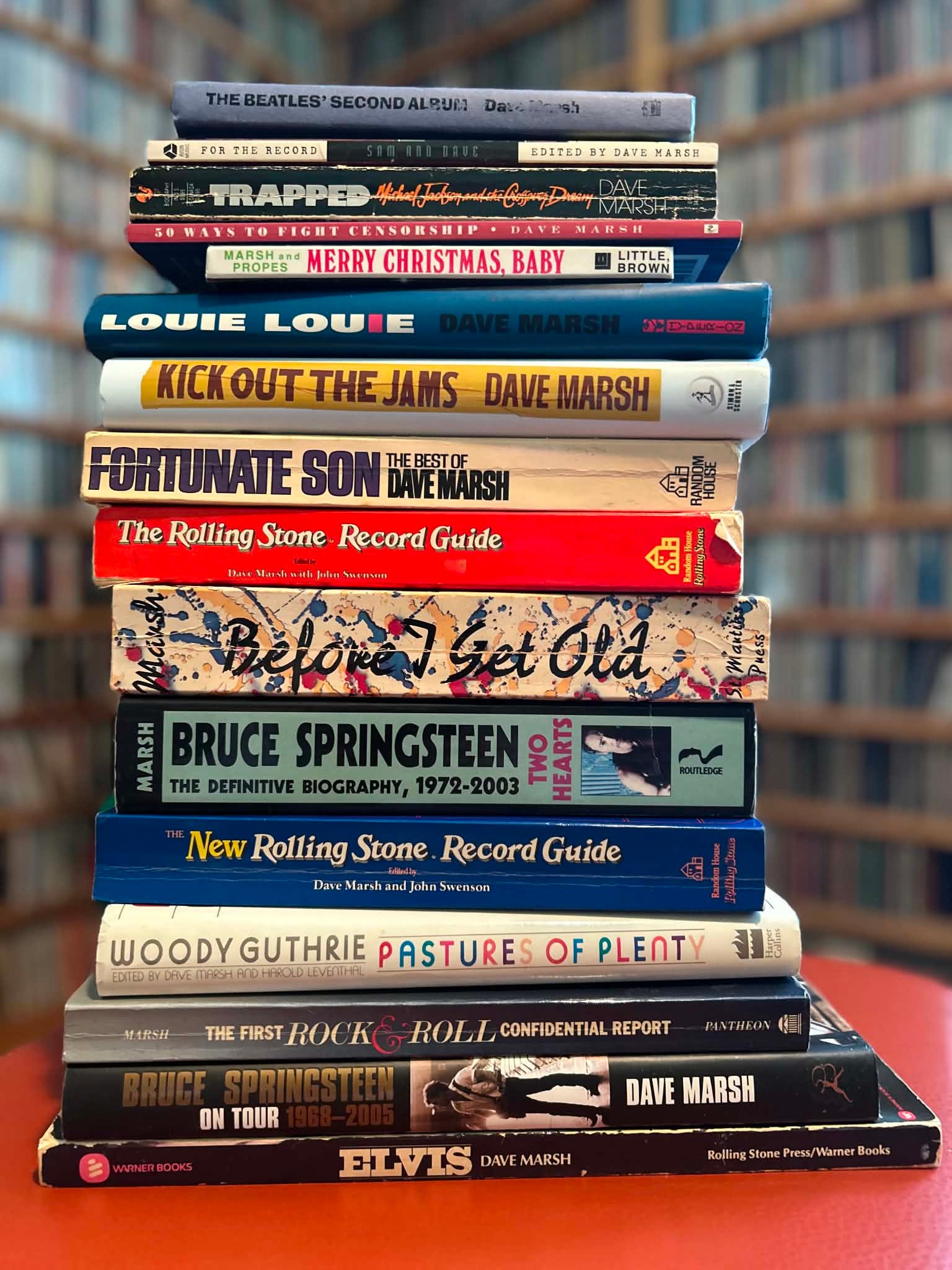
So… I can’t be objective when it comes to assessing Dave Marsh’s legacy. I realize that. But, to the admittedly limited extent I can remove my own story from the equation here, I still feel “Bruce biographer” is not only insufficient but ultimately secondary to what mattered most in his consequential career. Don’t misunderstand me: The Bruce books are a tremendous part of Dave’s legacy. Born to Run: The Bruce Springsteen Story, from 1979, was one of the first serious rock biographies. Two Hearts: Bruce Springsteen, the Definitive Biography, 1972-2003, which combined that first book with its 1987 follow-up Glory Days and also brought the story into the new century, should be considered among the greatest music bios ever. And my personal fave Dave-on-Bruce title is Bruce Springsteen on Tour: 1968-2005. The truth is, though, when I think of Dave Marsh, the critic and music journalist, “The Boss” is hardly the first thing that comes to mind.
Identifying Marsh, more generally, as a “music biographer” would come a bit closer. In addition to all those Bruce books, don’t forget that he also wrote Before I Get Old: The Story of the Who (which I was pleased to see identified more than once last week as the “definitive” Who bio); Trapped: Michael Jackson and the Crossover Dream; Louie, Louie (his biography of a song and its legacy); as well as my favorite of his critical biographies, 1982’s Elvis. If you’re only going to read one Elvis book, that’s the one.
Identifying Dave primarily as a “rock critic” would be better still. He was there at Creem helping to create rock criticism when he was still a Detroit teenager. The countless reviews, columns, features, and other essays he produced over the decades for Rolling Stone, Newsday, Record, Musician, The Real Paper, Addicted to Noise, Circus, ZigZag, Boston Phoenix, his newsletter Rock & Rap nee Roll Confidential (or RRC), among so many other publications, far outstripped the word count of the three dozen or so books he wrote and edited. The cream of the crop of this work, collected in 1985’s Fortunate Son and 2023’s Kick Out the Jams, doesn’t even scratch the surface of the surface of a half-century-long career.
The other inevitable angle on Dave Marsh that came up online this week—a bit in the official obits, pervasively in more personal remembrances—was that Dave could be a real stubborn, opinionated and argumentative son-of-a-bitch, both one-on-one (believe me, I know) and on the page. That’s not wrong. Yet, again, when I consider Dave and his influence and contributions, it is not, to cite a commonly cited example, the time when he identified Queen and “We Are the Champions” as “fascist” at the dawn of the Thatcher era that springs first to mind—or even 100th. Nor is it anything like his oft-noted hatred of Kiss or his inexplicable dismissal of X, one of my favorite bands, in The New Rolling Stone Record Guide (the blue one), that stands for me as anything like representative of his work. (In years that followed the RS Guides, Dave earned a rep’ for his strenuous disinterest in post-punk and other indie rocks. I came to understand that notoriety as a critical counterpart to the strenuous disinterest in anything remotely adjacent to roots rock and country music so often exhibited by post-punk and indie rock-favoring critics.)
One quality of the Guides that did prove to be representative of his overall work was that it was a collaboration, a team project between Marsh, co-editor Jon Swenson (“Oh Dave! Such a sweet man,” he once told me), and fifty contributors. Scan Dave’s career and see how many of his books and articles were actually co-written, how many dozens of young writers he actively encouraged and assisted in one manner or another, including assigning them books he then edited. Part of Dave’s reputation was that he couldn’t play well with others. At the same time, though, he spent decades generously nurturing young talent, seeking collaborations, sharing credit, nurturing connections between himself and others that made a difference.
I’d estimate that the Record Guides are a greater part of his critical legacy than all the Springsteen stuff. That legacy, it should be said, isn’t entirely favorable either—though I think the complaints about those books have often been confused. The problem with the Guides isn’t that some of Dave’s evaluations are arguably wrong. For critics, getting it arguably wrong is in the job description. (And, in any case, the appeal and enduring usefulness of those books was mostly bound up in how overwhelmingly often they got things right.) I don’t think the problem with the guides has anything to do with how strident and combative, even mean-spirited, Dave’s capsules could be either. Maybe we’re better positioned to tolerate, if not entirely appreciate, such vociferous takes here in 2026, when “Whatever happened to negative reviews?” has become such a common lament. This will summarize the complaints much too simply, I know, but whatever detrimental effect the books had was in their assumption that albums, not singles, are the defining rock form and that presumed album artists are therefore more serious and superior to so-called singles acts by definition—and then following that flawed logic into star-rankings and assessments. This way of doing rock criticism was hardly limited to the Record Guides, of course, but they helped codify the approach, still all-too pervasive I’d say, and they have taken much of the blame.
As I’ve noted elsewhere, however, Dave also wrote The Heart of Rock & Soul: The 1,001 Greatest Singles Ever Made (“a book, not a list,” as he said, and also, I’d add, an argument) as a deliberate corrective to those tendencies in his work and as a necessary intervention to music criticism generally. That’s the takeaway I’d emphasize to those considering Marsh’s legacy. The Heart of Rock & Soul, not the RS Guides, and not even Born to Run, is the title that gets name-checked most often by his fellow music writers, fans and haters alike, as the most important, and the just plain best, of his books.
From Reagan’s administrations on into this century, Dave devoted more of his time to political activism, free-speech issues most of all. That’s how I met him. In 1987, he came to speak at the University of Missouri-Columbia, where I was a graduate student, to spread the word about the Parents Music Resource Center, record labeling, and other dangers. I finagled my way into a dinner held before his talk, and when I introduced myself, he recognized my name immediately from a letter I’d written to RRC about how I was using the introduction to his Fortunate Son as a narrative model for my composition students. As I was walking home after his presentation, he pulled up in his car beside me, handed a copy of Glory Days to me out the window, and told me to keep in touch. Which I did, one of the smarter decisions of my life. Over the next several years, fueled both by Dave’s model as much by his encouragement, I became involved in anti-censorship efforts here in Kansas City. Much of that work was in collaboration with my now-longtime friend Danny Alexander who I only met because Dave told him to cold call me. All that work, in turn, became intertwined with my first professional local writing gigs, my first national publications, my first book and so on. I know so many others who can tell versions of the same story about Dave and their lives.
Across his 76 years, Dave didn’t just dream of a better world but set to work hearing and arguing the connections, on the page and one-on-one, to make it real. The work will outlive him, but when I think of Dave Marsh, it’s all the connections that I’ll never forget.
Nothing mattered more to Dave than the work of the Kristen Ann Carr Fund, which supports cancer research and works to improve the lives of those living with cancer. Please learn more about this organization here.
Recommended tributes/appreciations:
-Jack Hamilton, 2023
-Caryn Rose, 2023
-Holly Gleason, 2026
-Alfred Soto, 2026
-Chuck Eddy, 2026
-Amy Speace, 2026
-Stephen Thomas Erlewine, 2026
If you like what you’re reading here, please think of subscribing to No Fences Review! It’s free for now, although we will be adding a paid tier with exclusive content soon. Also, if you’d like to support our work now, you can hit the blue “Pledge” button on the top-right of your screen to pledge your support now, at either monthly, yearly, or founding-member rates. You’ll be billed when we add the paid option. Thanks!
No posts
Comments
Nothing yet. Say the first thing.
Sign in to join the conversation.