
[“Country Style!” is an occasional series devoted to that subgenre where a presumably “non-country” artist records an album full of country standards and then, often as not, titles it something like So and So Visits the Country! Or …Sings Golden Country Hits or …Sings Country Style! Please think of these entries more as notes for further study than definitive statements.]
Paul Carrack turned 75 earlier this year. For someone who’s probably never been a household name, the English performer has had quite a remarkable career. That’s him singing on Ace’s “How Long,” Squeeze’s “Tempted,” and Mike + The Mechanics’ “Silent Running (On Dangerous Ground)” and “The Living Years.” He scored a couple hits under his own name, biggest of all the urgent “Don’t Shed A Tear,” which made the U.S. Top 10 in 1987. His albums are often great, and always at least very good, both in his pop-star prime and when settled into the familiar pleasures of his later period. His songs have been recorded by artists from Linda Ronstadt to Diana Ross. He’s played with Nick Lowe, Roxy Music, Roger Waters, B.B. King, The Pretenders, and many others. He’s even been a member of the All-Starr Band.
Carrack’s a great songwriter and keyboard player, but much of his fame – and the primary reason for his success – is his remarkable voice. There’s good reason for this. In his best performances, Carrack’s smooth and soulful baritone keep its cool before letting the emotional subtext burst through at key moments, a texture that shines through even when he’s just adding expert harmony vocals to others’ leads. Even as age and artistic choice has added just a bit of grain to his sweet fluidity, Carrack remains a flexible and effective interpreter of material across style. (Not to mention a “blue-eyed soul” vocalist who almost never falls into obvious imitations of Black singing traditions.) It’s no surprise that the BBC called him “The Man with the Golden Voice.” Carrack’s extensive, expansive catalog as named artist, band member, and collaborator deserves a lot more attention than I can give it here.
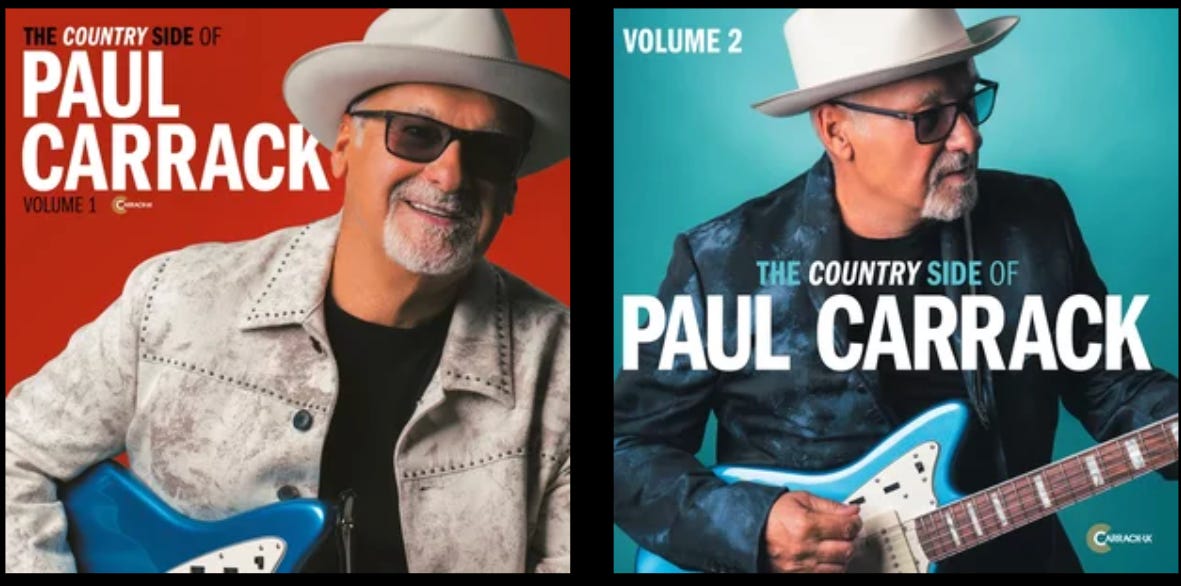
But, in keeping with the occasional NFR series spotlighting country albums by ostensibly non-country artists, I wanted to note that Carrack’s marked his big year by releasing the second volume of The Country Side of Paul Carrack, his first two albums devoted entirely to the genre. (The first came out in 2025.) “I’ve always wanted to make a country album,” Carrack said in advance of the releases. “A lot of people detect the influences of soul in my music but I’ve also always loved country.” He cited favorites like Hank Williams and The Everly Brothers, but – predictably, perhaps, for the R&B-rooted singer – “I particularly loved Ray Charles.” Recorded in Nashville with producer Steven Wood, The Country Side of Paul Carrack is a fitting affirmation of Carrack’s love of the tradition and a glimpse into a side of his talent that he’s never explored to anywhere near this extent.
Carrack doesn’t go crate-digging on Country Side, instead sticking mostly to well-known favorites from canonical figures. This was apparently on purpose: “I didn’t want to pick obscure songs for the sake of it,” he said. “I wanted familiar songs that I’d always loved with [a] 60s-70s vibe.” And that’s exactly what these records are. The highlights, as you’d expect, are the ones that best spotlight Carrack’s voice and blend with his signature style in a manner organic enough to make me (at least) kinda surprised that he’d never recorded a few of the songs before. Like “Always on My Mind,” which closes the second set and is its peak, or the first volume’s “Take Me,” originally recorded by George Jones (and soon after by Jones & Tammy Wynette), where Carrack moseys rather than scales the mountain of the melody over a languid, string-driven arrangement.
It’s not only the ballads that fit like a glove – he opens volume 1 with a jumpy, simmering run through Don Gibson’s “Sea of Heartbreak” that amplifies the song’s desperation and undercurrent of humor, and volume 2 features Hank Williams’ “Baby, We’re Really in Love,” where Carrack gets to dance around a bit with twin fiddles behind him. Avoiding twangy clichés with the same care with which he avoids soul mimicry, the singer doesn’t make the songs his own so much as he gives himself over to them and pays them homage.
A few of the choices step outside the expected favorites, usually to fine effect. Volume 2’s jubilant take of “When God Dips His Pen of Love in My Heart,” which has wound its way from the Blackwood Brothers to O Brother, Where Art Thou? and beyond, was a welcome surprise, for example. Two of the other less recognizable selections nod (intentionally or not) to the work of Nick Lowe, one of Carrack’s most substantial and artistically sympathetic collaborators. (Among other things, they co-wrote one of either’s best songs, which was later covered by Nanci Griffith.) Carrack recalls listening to George Jones, Willie Nelson, and the Osborne Brothers while touring the U.S. as part of Lowe’s band, and Lowe’s own facility with country, R&B, and their hybrids has characterized his acclaimed later work. “My Baby’s Gone,” the Louvin Brothers heartbreaker that Carrack brings into the nightclub with an elegant countrypolitan arrangement, has been an encore for Lowe and Ron Sexsmith when they’ve toured together. And Merle Haggard’s mournful “Shelly’s Winter Love” was recorded back in 2010 by guitarist Bill Kirchen with Lowe and Carrack as guests. The Kirchen, Carrack, and Lowe version is a knockout, with Kirchen’s guitar cradling Carrack and Lowe as they bend around Haggard’s melody. In his solo version, Carrack channels Charlie Rich, with the tinkling piano, cascading strings, and knowing delivery. Both are great, and – somehow – great in different ways.
Carrack twice tips his hat towards his own contributions. These are also two of the highlights. Volume 1 features a jumping version of “Cold Light of Day,” written with Squeeze pal Chris Difford and first issued by Carrack in 2018. Where that earlier cut motorvated alongside a punching horn section, here it’s a steel guitar racing with Carrack as he flips the usual melancholy meaning of the title image into something closer to Dolly Parton’s “Light of a Clear Blue Morning.” (The fact that the versions otherwise sound similar makes his country-soul point as well as anything.) The other Carrack original, and a highlight of Volume 2, is a countryfied take on the ballad “Love Will Keep Us Alive,” which he co-wrote with Jim Capaldi and Peter Vale and became a breakout from Eagles’ 1994 Hell Freezes Over. (Carrack himself recorded a similarly swooning version two years later.) Carrack speeds it up a bit here, making this more about gospel-rooted insistence than the cozy cuddle of the slower versions.
The second volume of Country Side doesn’t measure up to the first, which is perhaps to be expected but is still a bit of a letdown. Too much of it seems merely workmanlike, offering faithful versions of songs like “Is Anybody Goin’ To San Antone?” and “Before The Next Teardrop Falls” that are perfectly fine but don’t stand out in the way of either volume’s highlights. (I hesitate to use the term “Carrack-oake,” but I guess I will.) Even opener Tom T. Hall’s “That’s How I Got to Memphis,” which seems like it should be a slam dunk for Carrack, falls short despite its agreeably strutting rhythm. Part of it (and this is probably my nitpicking) is that the song feels slightly rushed, or at least faster than it should be. The same thing happens on Billy Joe Shaver’s “Old Chunk of Coal,” which is also perhaps the only time on either album when Carrack’s smoothness works against him, as Shaver’s down-but-not-out imagery fades a bit with Carrack’s pure-toned delivery.
But that’s all small stuff. Taken together, The Country Side of Paul Carrack isn’t anything more or less than a well-sung, well-played, loving collection of many songs you might know by heart and a few you may well wish that you did. This type of ramble down the country lane is getting more common for artists of Carrack’s vintage, and the seasoned old pro shows here that he’s well-suited for it. Carrack’s hopefully got a long road ahead of him, so perhaps there’ll be more volumes to come. I know I’ll be happy to hear them, since it’s a pleasure to spend some time on the country side with him. Like a smooth bourbon or a crackling fire, it feels like home to me.
If you like what you’re reading here, please think of subscribing to No Fences Review! It’s free for now, although we will be adding a paid tier with exclusive content soon. Also, if you’d like to support our work now, you can hit the blue “Pledge” button on the top-right of your screen to pledge your support now, at either monthly, yearly, or founding-member rates. You’ll be billed when we add the paid option. Thanks!
No posts
Comments
Nothing yet. Say the first thing.
Sign in to join the conversation.