
My last post was about the Classical Mongolian textbook that I finally finished last week … after possibly starting it thirty years ago. All its readings but the first were based on Indian stories, and the first - the only one written specifically for the book - was so generic that it revealed nothing about native Mongolian culture. I told a friend last night that it was like trying to learn German from a dub of CSI Miami.
“CSI” is left untranslated and even pronounced “see ess eye” English-style rather than as German-style “tseh ess ee” by the German narrator!
Why so much Indian content? It’s not as if Mongolia is India’s next door neighbor. Ulaanbaatar1 is 1,900 miles (3,000 km) from Lumbini, which is thought to be the birthplace of the Buddha.2
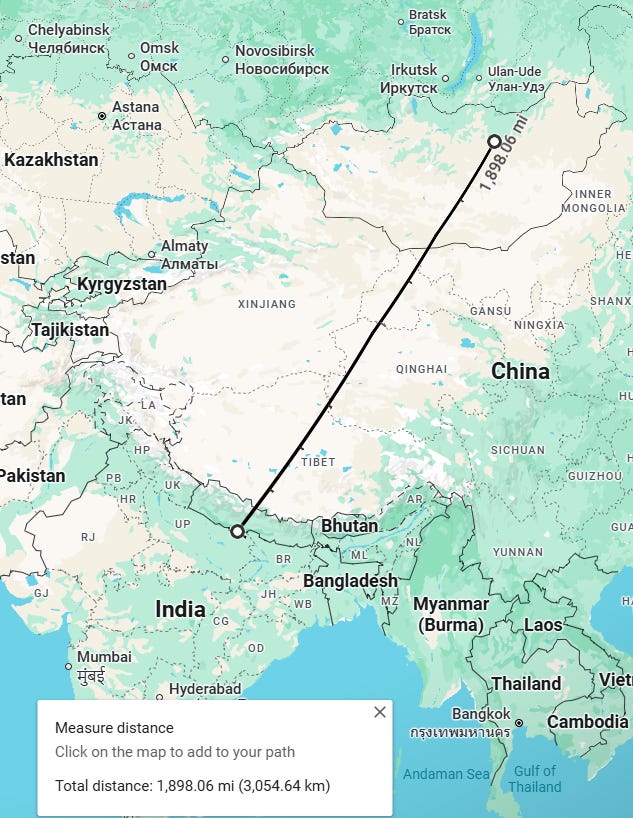
The short answer is the land that is called Töbed in Classical Mongolian - the western land of snows that is India’s neighbor.
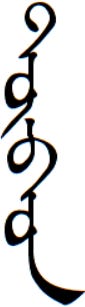
Tibet was the bridge between India and Mongolia. Tibetans translated tons from Sanskrit - including the stories in my Mongolian reader. In Tibet: A History (2011), Sam van Schaik wrote,
One thing we can say for sure is that when it came to translating the Buddha’s words, India, not China, became the great source. How could it be otherwise, when India was itself the home of the thousands of Buddhist scriptures and commentaries translated into Chinese? Now [the Tibetan king] Trisong Detsen [r. 755-797] sent invitations out to more Buddhist teachers from India and Nepal. Once in the Tibetan capital, they teamed up with Tibetans who had learned Sanskrit in order to translate great swathes of Buddhist scriptures into Tibetan. This translation project, undertaken with great seriousness, began to build one of the world’s largest religious canons, the collection of Buddhist scriptures translated into Tibetan. When these were collected together centuries later they filled some three hundred volumes.
This astonishing feat remains, as one modern scholar has put it, among the greatest achievements of the medieval world. It required a transformation of the Tibetan language, as hundreds of new terms were invented for the technical vocabulary of Buddhist Sanskrit, and it resulted in the wholesale import of one culture into another. Tibetan Buddhism would develop its own flavour and individual approaches to the Buddha’s teachings, but all of this flowed from the faithful translation work that began in earnest under Trisong Detsen.
If India can be said to be a primary civilization, Tibet would then be secondary - and poor Mongolia would be tertiary. Charles Bawden, a man who devoted his life to Mongolia studies, penned this harsh assessment in The Modern History of Mongolia (1989):
Mongolia does not seem to have produced great artists. During the past three centuries her craftsmen have spent their skill mainly on the repetitive work of producing religious [i.e., Tibetan Buddhist] banners and icons and on book illumination, treating secular subjects, when they turned to them, in a very formalistic, literal manner. More recently, under Soviet influence, they have been crippled by the primitive demands of socialist realism. Mongol music, too, seems never to have developed, in its native state, beyond a more or less ornamented melodic line. Modern composers, often basing themselves on folk tunes, work as their Soviet training directs them and so far have produced only a few rather pleasing compositions, but nothing of importance.
His words concerning Mongolian literature are kinder:
But in imaginative literature, in theology, history and philology, Mongolia is one of the important secondary cultures of Asia, after the great creative civilizations of India and China from which it has drawn heavily. This cultural development presupposes something more than a primitive nomadism as its background. Epics, tales and lyrics may be the product of a nomad society, but Mongolia shows also such enormous scholarly achievements as the translation between about 1580 and 1629 of the 108 volumes of the Tibetan Kanjur, with preliminary work for a translation of the Tanjur, a collection of scriptures twice the size, which was actually accomplished in the eighteenth century. […] Mongol theologians wrote in Tibetan, the language of the church, and to them we owe the existence of bilingual dictionaries of encyclopedic compass.
Nevertheless, note how
even a Mongolian überfan called Mongolia “secondary” - ouch!
Bawden’s example of a great achievement is a translation from Tibetan, not an original Mongolian composition
he brought up Mongols writing in Tibetan, but what about Mongols writing original content in Mongolian?
I’ll quote Bawden’s Mongolian Traditional Literature (2003) to answer that question:
Mongolian literature begins, abruptly, with a masterpiece. […] The Secret History [1228 or 1240?3] offers us a unique insight into what the Mongols at the time of Genghis Khan (1162-1227) thought of themselves.
By the time that subsequent chronicles came to be composed, in the seventeenth century and later, the Mongols had become converted to the Yellow Faith, Gelugpa Buddhism, emanating from Tibet, and their ways of thought had been thoroughly compromised by this alien cultural importation. But The Secret History preserves, uncorrupted, the essence of life on the steppes of Inner Asia before the new religious ideas, taken from Tibet but harking back to Indian cultural norms, had come in from the south. [… W]e hear, in the pages of The Secret History, the authentic voice of the Mongols of the twelfth and tbirteenth centuries.
While later chronicles trace the royal house of the Mongols back through mythical Tibetan rulers to a mythical first king of India, The Secret History preserves the pre-Buddhist tradition of its anthropomorphic origin. A blue wolf, with a destiny from heaven4, and his wife, a fallow doe, came passing over the so-called Tenggis-water, and they were the ancestors of Genghis Khan.
What if The Secret History were not sui generis? What if Mongolian literature had grown and flourished upon its foundation?
What if Genghis Khan’s distant descendant Altan Khan5 (1508-1582) had not converted?
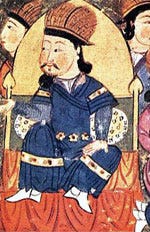
Bawden wrote in his introduction to his Modern History,
Altan Khan’s first contacts with Buddhism occurred in 1573 when he undertook a campaign against the Shira Uighur [‘Yellow Uyghur’; Turks who remain Tibetan Buddhist to this day] and took prisoner three of their chieftains and two lamas. One of the latter preached the doctrines of the Buddha to him and converted him, so that a side result of this military campaign was that Buddhism achieved its first foothold in Mongolia in the court of a powerful prince. From there it was to expand rapidly and confidently, reaching far into Manchuria, into Outer Mongolia, to the west Mongols who were converted before their departure from Mongolia, and took the Yellow Faith with them to Russia, and ultimately to the Buriats.
Growing dissatisfaction was making itself felt [by whom? Altan Khan? Mongol elites?] with the barbaric notions of shamanism, its bloody sacrifices, its primitive cosmology, its unattractive revelations of the world beyond, and its complete lack of organization which made it useless as an instrument of political power and did not provide the careers and dignities offered by a hierarchical church. This dissatisfaction coincided with, and doubtless fed on, the discovery of the existence in Tibet of a superior and more attractive culture.
A culture that Mongols emulated. 蕭大亨 Xiao Daheng wrote in 1594,
The customs of the [Mongol] barbarians used to be savage and cruel, and for a long time it was impossible to civilize them. But since they submitted and began to pay tribute [to Ming dynasty China], they have conceived a great regard for the Buddhist faith. Within their tents they constantly adore an image of the Buddha, and they make him an offering whenever they eat or drink. The rich … invite the lamas to recite prayers, offer incense, and bow reverently. All the money they can get goes for casting statuettes of the Buddha or stupas. Men and women, old and young, always have a rosary in their hands. Some of them make a little box of silver or gold, about two or three inches in height, into which they put amulets. They carry this box beneath the left arm, and are never without it, either sitting or lying, sleeping or eating.
Altan Khan regarded Tibetan Buddhism as a shield against Sinification. To prevent his people from becoming like Xiao, he had them become like the Tibetan lama Sonam Gyatso, whom he declared to be the Dalai Lama.
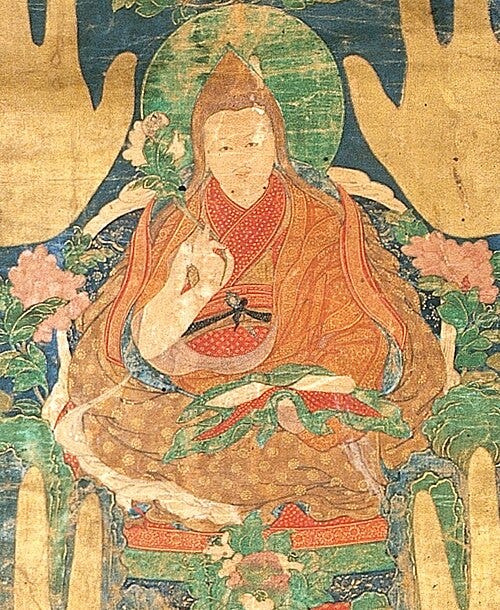
One could argue that Sonam Gyatso was the first Dalai Lama, but Bawden noted that the title
was applied retrospectively to his [Sonam Gyatso’s] two predecessors, so that this powerful line of Tibetan clerics owes its existence, with its mixed Mongol-Tibetan designation [Dalai is Mongolian for ‘ocean’ and Lama is Tibetan] to a Mongol prince.
So Sonam Gyatso was the third Dalai Lama.
Alas, Altan Khan was not the only Mongol elite who embraced the lamas:
Everywhere [in the Mongol world] the process seems to have been the same. The lamas showed themselves superior to the primitive shamans in their theology and their practical abilities, and gained the confidence of the rulers who were not committed to any rival faith likely to be able to challenge Buddhism in its attractiveness. The princes had their people come over to the new faith, even permitting the missionary lamas to use fairly forceful methods. The lama known as the Jaya Pandita [Sanskrit for ‘Victorious Pundit’] […] gave very definite instructions to his co-workers. They were to burn the ongons or family idols of anyone found worshipping them, and to confiscate the horses and sheep of the offenders.
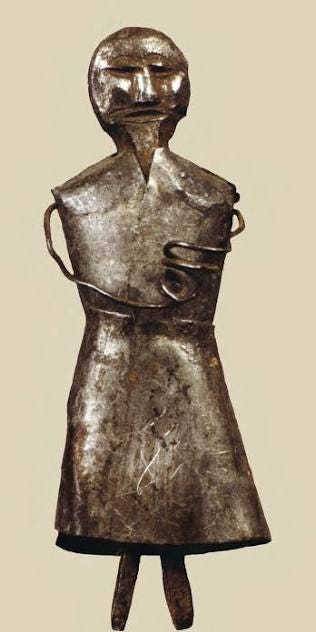
The horses of anyone found inciting male or female shamans to shamanize were likewise to be confiscated, and the shamans and shamanesses themselves to be fumigated with dog-filth. In this uncompromising manner the people were to be turned to the ‘White Direction’ and the religion of the Buddha was to be exalted. Violence against the shamans and their idols was exercised generally. The newly-converted Altan Khan allowed the Dalai Lama to burn up all his ongons in a ritual fire, and he also published decrees ordering his people to refrain from slaughtering their beasts, to reverence the lamas, to burn their ongons and in their place to make meatless sacrifices to the Buddhist deity Mahakala [Sanskrit: ‘Great Black’]. If they did not give up their old customs they would be executed or have their property confiscated or be banished from their pastures. [Mongol missionary] Neichi Toyin too, who gained much of his prestige from his superior medical skill, had the ongons of the people destroyed. Shamanistic practices of course survived, even in high places, as they do in residual form to this day [= 1968].
Given the vastness of Mongolia - the 18th largest and most sparsely populated country in the world - and the dispersal of its small population in the 1.5 million square kilometers (600,000 square miles) outside the city of Ulaanbaatar, I would be surprised if shamanistic practices hadn’t survived in corners inaccessible to commissars.
While missionizing against the shamans the lamas took care to identify themselves with the ruling class, with the result that while Buddhism thoroughly penetrated all levels of Mongol society in the coming centuries, organizationally it developed almost as a state within the state. It was a body distributing high titles, owning enormous wealth in flocks and herds and in serfs, and enjoying such political prestige that the Manchu emperors tacitly recognized the supreme head of the Faith, the Jebtsundamba Khutuktu or ‘Living Buddha’ of Urga [an old name for Ulaanbaatar], as quasi-ruler over the people.
[…]
With its close relations with the nobility, its active and clever proselytizing, and its publicity work, the Church quickly achieved a position of power in Mongolia, and began also to amass the temporal wealth which was to make it a formidable economic power until the ’thirties of the present century [Bawden wrote this in the 1960s], when it was finally dispossessed and destroyed.
Earlier in his history book, Bawden sketched the church on the eve of its destruction:
The collapse of lamaism in this century, when it came into conflict with a communism with which it was incompatible, meant the disappearance of a complete way of life. In its heyday the lamaist church embraced up to half the male population. Not only were there regular lamas in the lamaseries, and lamas who had tacitly left the religious life and taken wives, and so hardly counted, but in addition the shabi [rendered by Bawden as ‘church serf’6] estates contributed their thousands of servants, herdsmen and so on for the upkeep of the church.
Alas, de-Tibetization a century ago was not a return to the pre-Tibetan ways but a rejection of all old ways:
From 1936 onwards nothing was taught in Mongol schools about the country’s pre-revolutionary culture for about twenty years […] The break with the old life was both symbolized and reinforced by the adoption, from 1941 onwards, of the Cyrillic script, which was accompanied by a spelling reform and the progressive abandonment, for all official purposes, of the old script. Children could not read old books even if they could get hold of them, and today [1968] it is still common to meet people around the age of thirty who cannot read their own traditional alphabet. This was part of a deliberate process on the part of the Party to subordinate feelings of Mongolianness to the wider ‘loyalties’ of proletarian internationalism. Between 1936 and 1956, as we have seen, no reprints of old books were issued […] Publishing capacity was turned over in these years to communist literature, translations from Russian, and to new creative writing which fulfilled the narrow demands of socialist realism.
Bawden observed that the Mongolian language was one thread of continuity running through all those changes, providing a relative consistency of form during changes of content:
Perhaps the two most vital qualities which distinguish him from his neighbours, especially the Russians and the Chinese, are the sense of a long national history, and the possession and cherishing of a national language which has shown itself flexible and adaptable enough to encompass the terminology of both Buddhist philosophy and Marxism, as well as the demands of modern science. The Mongol language, even today, is remarkably free from borrowings, and prefers to coin neologisms from Mongol roots rather than import ready made terms.
On the other hand, ‘Communism’ is коммунизм kommunizm, which is even spelled exactly like its Russian equivalent7. But Bawden’s point remains - it’s not as if Mongolian became 50% Russian after it became Communist. Or 50% Tibetan after the great conversion of Buddhism. I studied Tibetan before I studied Mongolian, and I can’t say I see much Tibetan in Mongolian. Or Sanskrit, for that matter. If one deleted the obvious Indian names like Dharmabala from the readings in my textbook, one wouldn’t notice how Indian the stories are at a glance.
Contrast Mongolian with Korean or Japanese which are flooded with borrowings from Chinese and English.
The Tibetan influence was far more in terms of content than form. Toxic content, judging from what Bawden wrote in his history book (emphasis mine):
In any case, the ‘old life’ was not at all calculated to preserve the Mongol race. What foreign travellers saw in Mongolia half a century ago, and much later in Inner Mongolia, was the last stage in the decadence of a fascinating, unique, but doomed way of life. To put it at its bluntest, the Mongol race was dying of inanition and syphilis. Every traveller noted the apathy of the people, their enslavement to a church which at the top level may have produced some fine scholars, but which, where it impinged on daily life, held the people at large in ignorant dependence on itself and on its outdated and corrupt ideals. Filth, disease and ignorance marked the Mongol.
Would Bawden have said the same of Tibetans at the beginning of the twentieth century?
It is all too easy to dismiss these as accompaniments of a romantic survival, and not to see that they were not incidentals at all, but rather the outward expression of the essential rot within. The sores on so many a Mongol body were true symbols of the decay and corruption of the society where they were so common as to be the norm.
Agree or disagree with Bawden, the guy wrote with flavor. No fake objectivity here. I can imagine Wokist scholars fainting at the words “race” and “syphilis”.
It is far more realistic to note what has in fact been done since the revolution of 1921 to assure the actual physical survival of the Mongols as a people, to acknowledge the spread of ideas of hygiene, the development of a medical service, the universal education of the young and their equipment to compete on less unequal terms with world at large, than to lament the disappearance of a way of life which would eventually have reduced the Mongols to the level of the bushmen of South Africa – mere interesting remnants of a lost civilization and otherwise of no account.
OMG WACIST!!
I’ll close by calming down and asking:
What if Mongols had not adopted that Tibetoid way of life?
What if Tibetans had never accepted an Indian implant?
How different would our world be without Big Doctrines like Buddhism?
The name Ulaanbaatar means ‘Red Hero’ and is an artifact of Mongolia’s Communist period. The city had other names before that: e.g., Örgüge ‘Palace’.
Lumbini is in present-day Nepal, near the border with India. So why am I using it to illustrate the distance between Mongolia and India if it’s not in India? Because India the modern state and India as a cultural zone are two overlapping yet distinct entities. Although Lumbini and Nepal as a whole were never part of the modern Indian state or even British India, they were part of the Indian cultural zone.
The Secret History of the Mongols was written in the Year of the Rat, but every twelfth year is the Year of the Rat, so it’s unclear which Year of the Rat was intended. That year, whatever it was, must postdate the death of Genghis Khan in 1227.
I could argue that the Mongolian concept of ‘heaven’ might be an import from the Turks who in turn may have gotten it from the Xiongnu, the first masters of what is now Mongolia. The Classical Mongolian word for ‘heaven’, tngri, is certainly a borrowing from Turkic. Mongolian culture had foreign influences long before getting a Tibetan implant. Nonetheless, the point is that the Mongolian culture as depicted in The Secret History predates that implant, not that it is ‘pure’.
Altan means ‘Gold’. Khan is a title, not a surname.
Shabi ‘church serf’ is ultimately from Sanskrit śrāmaṇera- ‘novice monk’ via northwestern Middle Chinese 沙彌 shambi.
Then again, Wiktionary says that ‘Communism’ in the Mongolian of Inner Mongolia in the PRC is eb qamtu yosu ‘harmony together doctrine’, a string of native Mongolian words. My guess is that the Russian-based word was discouraged after the Sino-Soviet split.
Comments
Nothing yet. Say the first thing.
Sign in to join the conversation.