
Although I have a lot more to say about Hawaii politics, I’m also sick of that topic, so I’m going to take a break from it. I don’t want to run a Substack that covers one and only one topic every day - sometimes even multiple times a day.
There’s nothing wrong with that. In fact, that’s probably necessary for success on Substack, though certainly not sufficient, as there seem to be (or have been1) a zillion anti-CONvid Stacks, and not all of them have over 200,000 subs.
That’s not the way I roll. I can’t focus. Which is the reason I’ve been a failure in life.
Notice the present tense. I could focus … a long time ago.
I used to be obsessed with Japan and the Japanese language. I put all my eggs into the J-basket … where they got crushed. Giving Japanese my all just wasn’t good enough. Pro tip: if you are into something, and if you do not have the innate aptitude for it, all your efforts can only get you so far. ‘I want’ plus ‘I try’ does not necessarily equal ‘I get’.
In the years after I gave up on the J-thing, I did some linguistic wandering. For a time I tried my hand at Mongolian. I didn’t take it seriously. Which is why, decades later, I’m not even sure what textbook I used. I think it was the second edition of Kaare Grønbech and John R. Krueger’s An Introduction to Classical (Literary) Mongolian.
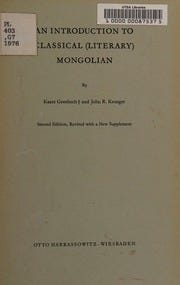
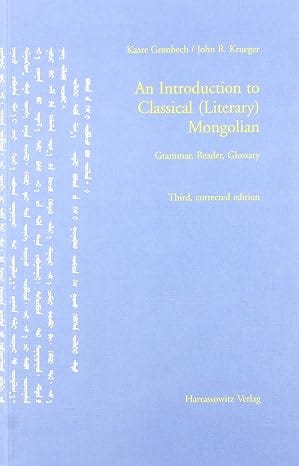
There’s a third 1993 edition that is still available on Amazon today with a new cover, fifty years after the second edition was published - and over seventy years after the first edition appeared in 1955.
I started my way through the second edition again (?) around 2020. I’d put it aside for weeks or months, forget stuff, and have to revisit chapters I had already studied - sometimes more than once.
In April of this year, I finally got serious and started to go through the final seven readings in the book very carefully, taking extensive notes. I finally finished the book on August 7 and have seventy pages of notes to show for it.2
I was going to write this post last week, but then I let myself get derailed by comic book and cartoon anniversaries and the Hawaii primary election. I am so not a one-track person. I do a lot, and what I really do is not on my Substack.
There is a common thread running through my many fields: identity. And Grønbech and Krueger’s Mongolian textbook is interesting from an identity perspective because it’s Mongolian in form but not content. Let’s look at its eleven readings:
is a Dick-and-Jane story presumably written by one or both authors in the early-to-mid 1950s. I assume the authors - a Dane and an American - could not find a passage of real Mongolian that was easy enough for a beginner, unlike Gair and Karunatillake’s A New Course in Reading Pāli (1998) which consists entirely of authentic prose and poetry even in the very first lesson. I might write about the Pali book once I’m done with it.
An Indian story. Sandalwood doesn’t grow in Mongolia. The Mongolian word for ‘sandalwood’, chandan, is from Sanskrit chandana-.
Another Indian story. There are no panthers in Mongolia. The panther is called irbis, a borrowing from Turkic irbish.
Yes, there are hares (taulai) in Mongolia. No, this isn’t a Mongolian story. It’s - you guessed it - Indian.
No lions in Mongolia. Indian again! The Mongolian word for ‘lion’ is arsalan, a borrowing from Turkic arsïlan (the ultimate source of Aslan in The Chronicles of Narnia).
The giveaway here is in the first line - the title character is named Ruto, and no native Mongolian word can begin with R. (Which is why the Classical Mongolian word for ‘Russia’ is Orus or Oros3 with an O- added so that R- wouldn’t be at the beginning of the word.) Moreover, the story is said to take place in Dumda Oron, the ‘Middle Land’, which sounds like it should refer to China. However, the emperor’s sons in the story are named Dharmabala ‘Law-Strength’ and Bala ‘Strength’, suggesting the story actually takes place in India, even though Ruto doesn’t sound like an Indian name. (It doesn’t sound Chinese either.) Yup, another Indian story.
is set in Chambudvib, a Mongolianization of Sanskrit Jambudvīpa-: i.e., the Indian subcontinent. The fact that the king in the story is named Yeke Terge ‘Big Chariot’ - a purely Mongolian phrase - might give you some hope, but nope, that’s just a translation of Sanskrit Mahāratha- ‘Great Chariot’ (cognate to mega- and rotor), and the king’s sons names are still recognizably of Sanskrit origin:
Mahanada (< Skt. Mahānada ‘Great River’)
Mahadiba (< Skt. Mahādeva ‘Great God’; deva is cognate to deus)
Mahasaduva (< Skt. Mahāsattva ‘Great Being’; the root sat- ‘being’ is cognate to Russian суть sut’, German sind, Latin sunt, etc.)
is set in nigen oron ‘a land’ (lit. ‘one4 land’) that has no name, and nobody in it has a name. The toghos ‘peacock’ in the story might give you hope that this is a Mongolian story because Mongolia has peacocks - though the Mongolian word for them, toghos, turns out to be from Turkic and is ultimately from Greek ταώς taṓs.5 Alas, this too is an Indian story.
Do I have to tell you where this is from?
has a biraman. Does that give you a clue? That’s Mongolian for ‘brahmin’. And as if that weren’t enough, there’s a reference to Burqan - the Buddha.6
No comment. Beyond warning you not to be fooled by the Mongolian script which is read from top to bottom, left to right (not right to left like Chinese or Japanese).7
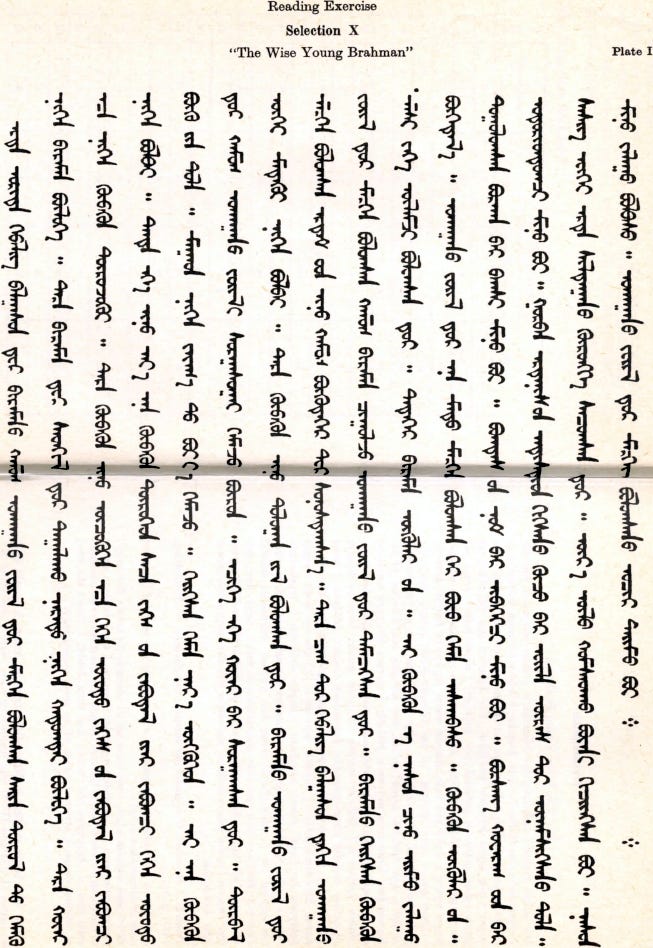
This is an Indian tale in Mongolian clothing. Okay, I did comment after all …
In conclusion, one could master the contents of Grønbech and Krueger’s textbook and know a lot about Classical Mongolian while still not knowing very much about Mongolia itself.
Next: Why is that book almost totally Indian?
I’m not sure because I barely look at any Stack other than my own these days.
Not all the notes are from 2026. I started the notes file in 2023, and added to it in 2024 and 2025, but I wrote most of the notes this year.
Classical Mongolian is an abstract written standard language that does not reflect any particular modern Mongolic language or dialect. Moreover, its alphabet is ambiguous: e.g., there is one letter that can be interpreted as either u or o. So there is disagreement over whether the second u/o letter resembling a loop in the word for ‘Russia’
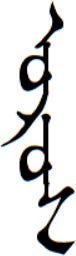
should be romanized as u or o.
The Classical Mongolian situation is a bit like the written English situation in the sense that there is a common, more-or-less standard spelling for English that does not reflect any particular English dialect.
(The small variations in English spelling standards are not related to pronunciation: e.g., a Canadian pronounces colour exactly the way an American pronounces color and not the way a standard British English speaker would pronounce colour.)
Both Classical Mongolian and English spelling are historical in the sense that they reflect premodern pronunciation. So qaghan ‘khan’ is spelled with a q and a gh even though it is pronounced khaan in Khalkha, the standard dialect in Mongolia today. Similarly, gh continues to be used in English spelling in words like night because it once stood for a consonant that is now absent from all modern English dialects.
Mongolian has no true equivalent of English a(n), but the numeral nigen ‘one’ here functions like English a certain. It is not possible to expect nigen in Mongolian where a(n) is used in English.
If the Finnish Mongolist (among many, many other things!) Juha Janhunen is right, the ultimate roots of Mongolian lie in southern Manchuria, west of northern Korea. Hence there would be no native Mongolian word for ‘peacock’ because the Mongols’ ancestors had moved from a homeland where there were no peacocks.
In Janhunen’s view, the ultimate roots of Turkic lie “somewhere between Eastern Mongolia and Northern China” (Manchuria: An Ethnic History, p. 232). I think the pre-Mongols displaced the Turks who in turn spread westward.
Janhunen’s book is amazing and deserves at least one post.
Burqan ‘Buddha’ is a borrowing from Turkic that is literally ‘Buddha-khan’:
Bur- is in turn a borrowing from northwestern Middle Chinese Bur ‘Buddha’, from Late Old Chinese But ‘Buddha’, an abbreviation of 佛陀 But-da ‘Buddha’.
-qan ‘khan’ is a title used by both Turks and Mongols; it may ultimately be of Xiongnu (a.k.a. ‘Hun’) origin. The Xiongnu were the original masters of Mongolia.
Comments
Nothing yet. Say the first thing.
Sign in to join the conversation.