
Thank you, as always, for reading the Devils’ Advocates Substack! If you enjoy the quasi-daily content, please consider subscribing and sharing with your friends, family, and any Devils fan you know. It is completely free of charge and helps out quite a bit!
Consider checking out the Devils’ Advocates Podcast, which features weekly episodes chock-full of in-depth content and exciting guest appearances. They’ll be available on this Substack, but you can also listen on your favorite platforms at the following links:
Arseny Gritsyuk did not receive a single vote for the Calder Memorial Trophy in 2025-26 — not even for fifth place. Part of that is simply because this was an excellent year for rookies: Matthew Schaefer, Ivan Demidov, and Beckett Sennecke headlined the group, and the likes of Ben Kindel, Jimmy Snuggerud, Jakub Dobes, and Jesper Wallstedt rightfully got their flowers. The other part of the equation was pedestrian production. Gritsyuk’s 13 goals and 31 total points across 66 games were… whelming, especially compared to the eye test and underlying numbers.
That’s just the thing, though — if I were voting on how a player actually played instead of how they produced, Gritsyuk likely would have found a way on my ballot (or at least would have been close to it).
The 25-year-old, by all accounts, not including the box score numbers, was sensational in his first season on North American ice. The Devils’ front office agreed, handing him a three-year contract with a very team-friendly $3.25 million annual cap hit. It was a well-earned payday for Gritsyuk, who instantly became a fan favorite by virtue of his on-ice work ethic and off-ice personality, and a worthwhile bet from Sunny Mehta and company.
With that, let’s dive into what, exactly, made Gritsyuk’s rookie campaign such a success and try to use that data to project what he could bring to the table, production-wise, in 2026-27 because of it.
There’s no dancing around it — statistically, what Gritsyuk accomplished in 2025-26 (outside of his box score production) was superb.
His on-ice metrics were spectacular, especially relative to the team around him. He was one of five Devils’ forwards with an expected goal share (xGF%) of over 50%, meaning that the Devils controlled the xG game while he was on the ice. His 52.6% ranked third on the entire team, according to HockeyStats. Gritsyuk also handily led the team in shot attempt share (CF%), with New Jersey controlling 58.16% of the shot attempts while he was on the ice, as per NaturalStatTrick. His scoring chance share (SCF%) was second on the team behind Jack Hughes, and Gritsyuk also ranked 8th on the team in high-danger chance share (HDCF%). By all accounts, the on-ice numbers were fantastic.
Even more impressive, though, are his isolated impacts.
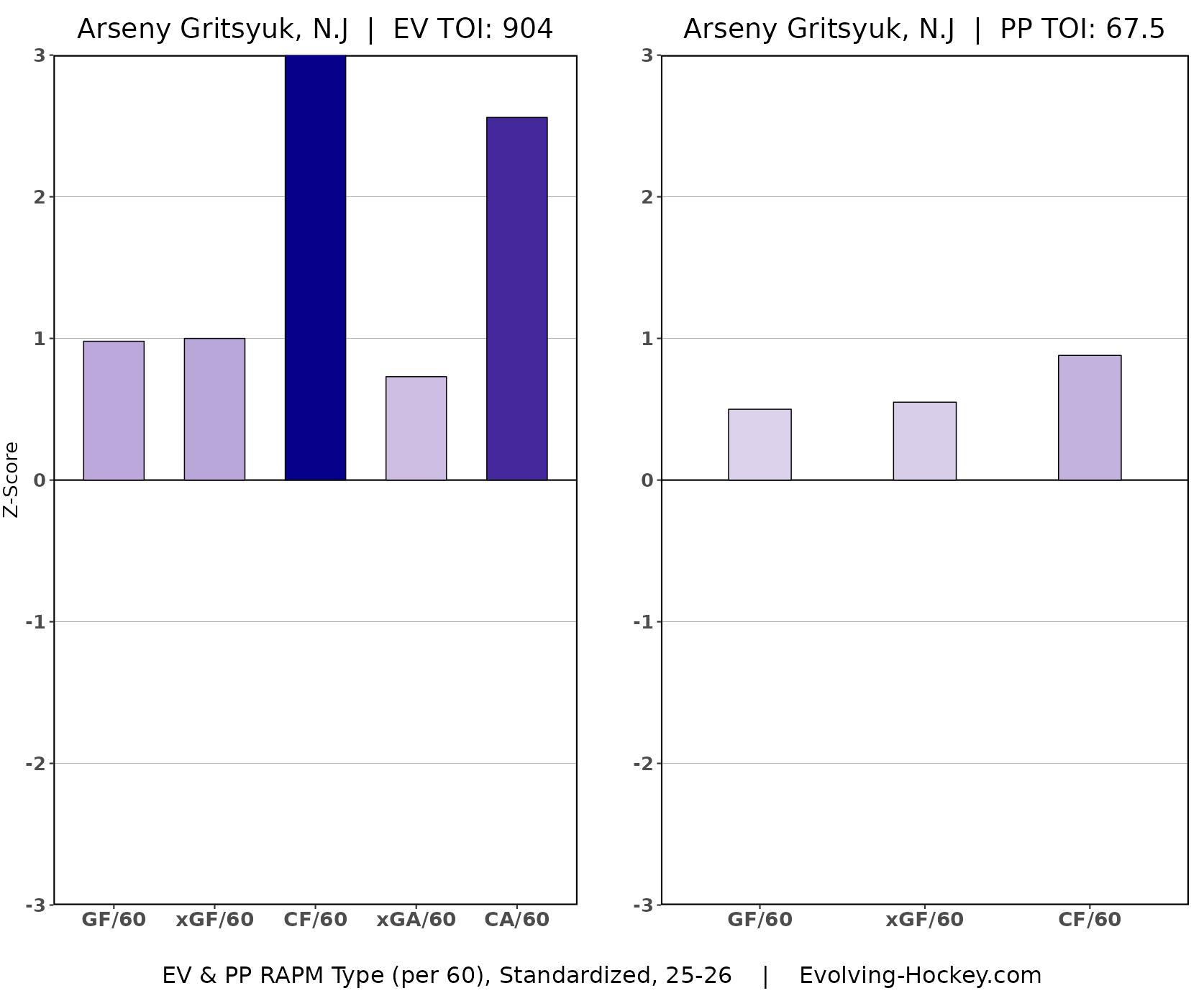
According to Evolving Hockey, Gritsyuk had the second-best isolated impact on shot attempts in the entire National Hockey League. The only player better than his CF+/- of 12.12 was Luke Evangelista, who sported a barely-better 12.16. Of course, Gritsyuk’s isolated impacts on xG and actual goals were also positive, as evidenced by the RAPM chart below:
As a result of this absurd individual influence over the game, Gritsyuk had some of the more absurd with-or-without-you numbers you’ll find. Look at the chart below to see just how positive an impact he had on his teammates:
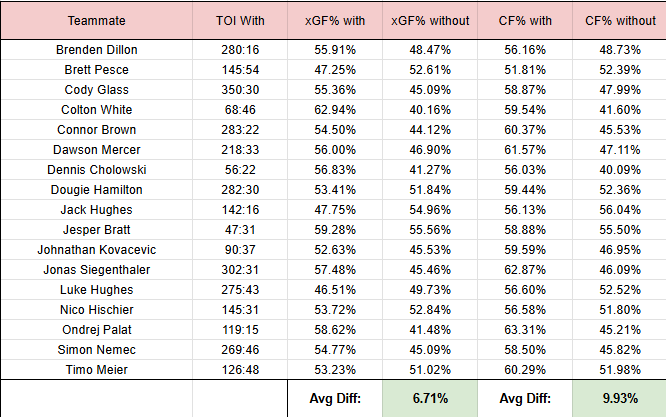
I filtered every single player who played at least 45 minutes with Gritsyuk on NaturalStatTrick and compiled some jarring evidence that he is the type of player who makes just about everybody better. On average, there was a +6.71% xGF% and +9.93% CF% swing when players were playing alongside Gritsyuk versus playing away from him. That’s simply incredible work.
Looking at his microstatistics, there’s pretty clear evidence why.
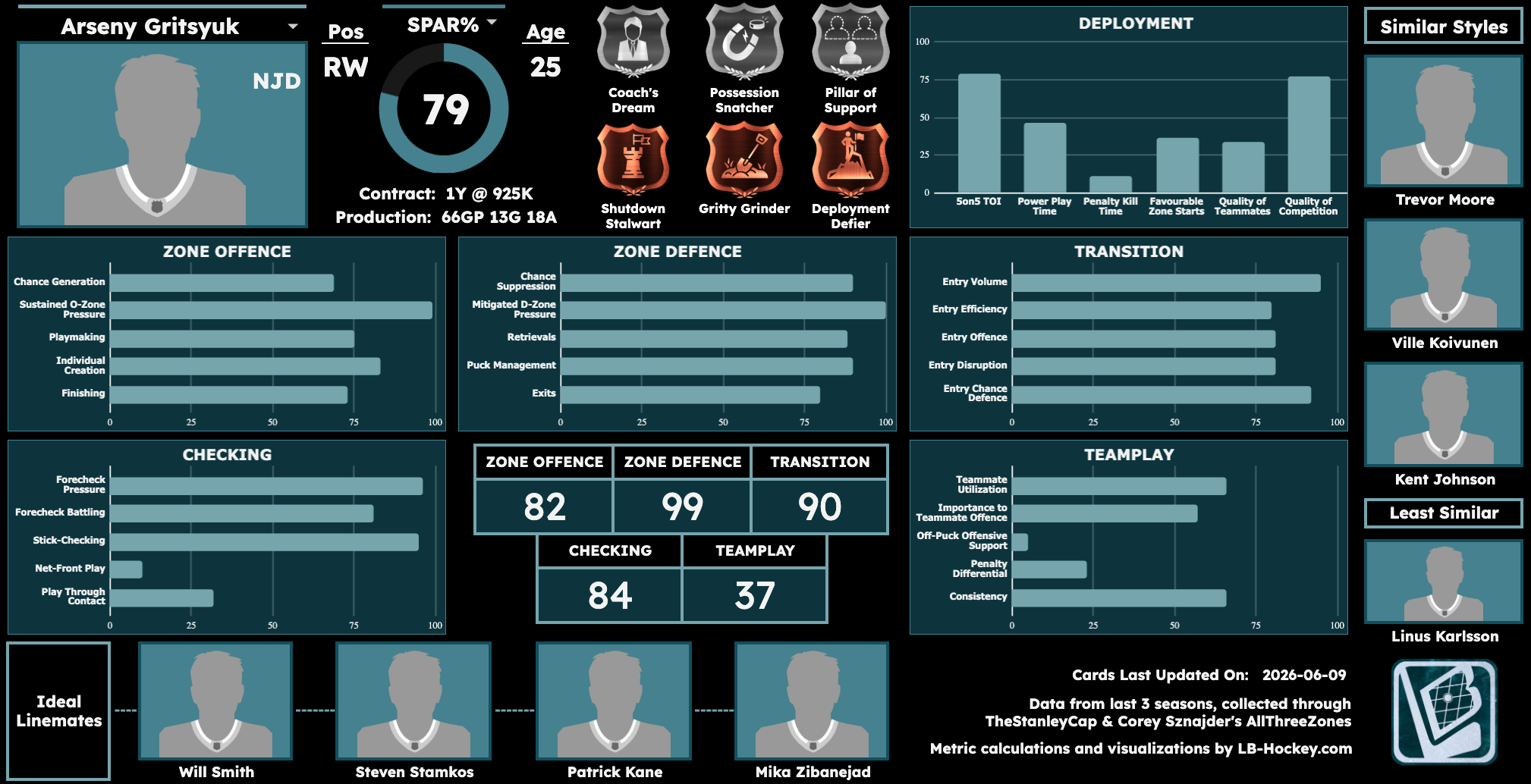
According to LB-Hockey, Gritsyuk ranked in at least the 82nd percentile of all NHL forwards in all of zone offense (82), zone defense (99), transition (90), and checking (84). Let’s break it down further.
In terms of each zone offense statistic tracked, Gritsyuk placed in at least the 69th percentile in every tracked statistic, including a 99th percentile finish for sustained offensive zone pressure. In zone defense, his worst metric was zone exits, and he still finished in the 80th percentile. He ranked in at least the 88th percentile for everything else, including a ridiculous 100th percentile placement in mitigated defensive zone pressure. Those respective 99th and 100th percentile placements absolutely track with Gritsyuk’s previously mentioned CF+/- numbers being top-two in the NHL.
Beyond the in-zone stuff, Gritsyuk was extremely effective both in transition and in, predictably, checking. He finished in at least the 80th percentile in every transition metric: zone entry efficiency (80), zone entry offense (81), zone entry disruption (81), zone entry chance defense (92), and zone entry volume (95). He ranked in the 96th percentile for forecheck pressure and the 95th for stick checking to boot.
By all accounts, he was magnificent in his individual actions on the ice. Those directly translated to superb on-ice impacts, and should result in future success in the NHL.
Finally, simply looking at Gritsyuk’s puck luck should be an indicator that he was deserving of more points than ended up happening. Beyond just the eye-test reaction of “Oh man, I really thought he was going to score that,” there’s luckily a metric that takes that into consideration: PDO. PDO is the combination of a player’s on-ice shooting percentage (oiSH%), which is the shooting percentage of the entire team while X player is on the ice, and a player’s on-ice save percentage (oiSV%), which is the goaltending a player receives while he is on the ice. Every year, league average PDO is exactly 1.000 — either a shot on goal goes in the back of the net or gets saved.
An abnormally low PDO — one where positive regression should be expected moving forward — is roughly 0.980, or a 2% swing from league-average. At that point, the typical fluctuations of the league aren’t really reasonable arguments for lowered production, rather that the player was genuinely due for more production or was due to receive far better goaltending.
Gritsyuk’s PDO last season was 0.977, slightly below the “abnormally low” threshold.
Considering that the league-average save percentage was .896 in 2025-26, and Gritsyuk’s oiSV% was .894, it stands to reason that the bulk of his PDO result has to do with the oiSH%, which would have directly influenced his production. His 8.32% oiSH% ranked in the middle of the pack for New Jersey, but relative to the rest of the league graded out quite poorly. Of course, with average finishing in 2026-27, Gritsyuk will be much, much better off on the scoresheet.
With those underlying numbers out of the way, I wanted to look into NHL forwards who were in similar situations in their rookie campaigns in recent memory. I was able to find three such instances for rookies, and one case study of a sophomore I just could not ignore because the statistics were so similar across the board.

The table above is composed of data from a few different outlets. The CF+/- and xG+/- numbers are from Evolving Hockey, and they are measures of each player’s individual isolated impact (RAPM) on both shot attempts (CF) and xG. The xGF% numbers are from HockeyStats, and the rest of the statistics are from NaturalStatTrick. As noted above, every player except Zach Benson was a rookie in the seasons listed, with it being Benson’s second year in the NHL.
The reason I included Benson’s sophomore campaign on the list is that his statistics are just so similar to what Gritsyuk put up in 2025-26. It’s far and away the closest comparison on the list, with perhaps the only big discrepancy being the xG+/-.
The other three names on the list sported somewhat similar numbers in their own regard, typically being far less effective at individually controlling the shot-attempt game but having better on-ice metrics, specifically in terms of xG impact. Of course, Jackson Blake benefited from the Hurricanes’ system and supporting cast around him being naturally suppressive.
Regardless, each player’s production was not reflective of their on-ice perofrmance. Gritsyuk actually had the highest points per 60 of any player on this list (1.86), with the other four ranging from 1.49 (Foerster) to Blake (1.84). Each of the four comparables had significant output increases in their subsequent season, with Foerster jumping from 1.49 to 1.89, Doan increasing from 1.65 to 2.40, Benson multiplying from 1.51 to 2.50, and Blake moving from 1.84 to 2.38.
It should be noted that each of the comparables (except Foerster) saw their ice time increase from third-liners to second-liners, so the quality of their teammates naturally increased as well. Foerster actually saw his ice time decrease, but was has been given second-line deployment since he joined the NHL.
With that in mind, it seems reasonable to expect Gritsyuk to have a similar production improvement. After all, he’ll be more acclimated to the pace of the NHL and more in-tune with the system he was thrust into. Hell, even being able to communicate better with his teammates and coaches will serve him quite well.
Expecting a point production jump to around the 45-point mark seems reasonable if he ends up staying as a third-line, PP2 player in 2026-27. If he gets put onto the second line, though, I wouldn’t be surprised if he followed in the footsteps of Benson, Doan, and Blake, and turned into a 55-point-pace player. Given that the Devils’ second line is full of more high-level talent than any of his counterparts, potentially surpassing that pace seems like it would be in the cards as well.
From the eye test, it’s clear that Gristyuk had more in the tank production-wise in 2025-26 — what he did on the ice was not typical of a first-year NHLer, and should be treated as specially as it was. His $3.25 million AAV is already a bargain, and will only look better and better as he continues to get comfortable in the NHL and the cap continues to rise. It’s not unreasonable to say that he can, and should, end up as a fixture in the Devils’ top six in due time. I wouldn’t be surprised if that didn’t begin as soon as this upcoming season.
Comments
Nothing yet. Say the first thing.
Sign in to join the conversation.