
Thank you, as always, for reading the Devils’ Advocates Substack! If you enjoy the quasi-daily content, please consider subscribing and sharing with your friends, family, and any Devils fan you know. It is completely free of charge and helps out quite a bit!
Consider checking out the Devils’ Advocates Podcast, which features weekly episodes chock-full of in-depth content and exciting guest appearances. They’ll be available on this Substack, but you can also listen on your favorite platforms at the following links:
In recent days, I have written about how Luke Hughes and Arseny Gritsyuk are both poised for a step forward in their respective games, with Luke potentially breaking out into a top-pair-caliber defenseman and Gritsyuk likely producing far more than he did this past campaign.
On the other side of the spectrum is Cody Glass, a player I have been extremely high on for quite a while. In the past, I have cited him as arguably the best pure third-line center in the league (in the sense that I was not counting 2Cs playing that role in that exercise) and have said that he is one of the premier defensive forwards in the game.
Both of those are still true to some extent. Of course, it is difficult to gauge what the 3C landscape will look like in the midst of the 2026-27 season, but past performance and age make me believe Glass will still be in the upper ranks of the 3C tier list. By most accounts, his defensive game is consistently excellent compared to the average NHLer.
With those in mind, though, there are a couple of reasons to temper expectations. Today, let’s talk about them.
Cody Glass logged 848:40 of 5v5 time in 2025-26, with the vast majority of it on the third line. 350:30 (41.3%) of it was spent next to Gritsyuk, and that figure would have been significantly higher were Gritsyuk and Glass healthier throughout the course of the season — they missed a combined 28 games. Regardless, the point stands that quite a bit of Glass’s time was spent with the rookie.
In their minutes together, the duo was relatively unstoppable. They controlled 58.87% of the shot attempts, 58.57% of the shots on goal, 55.36% of the expected goals (xG), and 53.24% of the scoring chances, all per NaturalStatTrick. Those are all incredible outputs; undeniable testaments to how potent a duo they were, especially when firing on all cylinders.
As noted in yesterday’s piece, Gritsyuk is the type of player who makes everyone better. The problem arises when looking at Glass’s numbers away from his counterpart.
You see, away from Gritsyuk, Glass had the following drop in his statistics:
Shot attempt share (CF%): 58.87% → 47.99% | (-10.88%)
Shot on goal share (SF%): 58.57% → 46.72% | (-11.85%)
xG share (xGF%): 55.36% → 45.09% | (-10.27%)
Scoring chance share (SCF%): 53.24% → 48.05% | (-5.19%)
Pretty jarring, right? Especially considering that Glass spent nearly half of his ice time at 5v5 alongside Gritsyuk, this certainly could and should be considered subpar. What happens if Gritsyuk isn’t his linemate in 2026-27? What happens if Gritsyuk gets hurt? The statistics show a player who seriously struggles without his favorite linemate.
Glass scored a career-high 19 goals in 2025-26, five more than he had ever scored before. While that in and of itself is not worrisome, what is is that he did so while putting just 104 shots on net, producing a shooting percentage (SH%) of 18.3%. That’s obviously unsustainable for a player who has a career SH% of 10.9%. In fact, the only full season Glass shot over 10% was his 35-point 2022-23 campaign. He had a 14.3% SH% year in his sophomore season, but only ended up playing in 27 games that year.
As a result of that and some slightly abnormally strong goaltending, Glass was the only regular on the entire New Jersey roster to have a PDO above 1.000. His PDO was reasonably within the acceptable threshold to believe that his luck level was repeatable, but given the disparity between he and the rest of the Devils roster, I would expect some normalization to the mean from the third-line center.
Regardless, the expectation should be that he doesn’t reach that 18.3% threshold again. Perhaps there’s an abnormal world in which he surpasses 15 goals once again, but he would likely need to increase the volume of his shooting by quite a bit to repeat that performance.
Just because Glass is due for a bit of regression does not mean that he is not still a very capable player. The reality is that, historically, he has won his minutes in the aggregate and has been particularly sound defensively.
HockeyStats has Glass’s xGF% in 2025-26 at 49.6%, which falls slightly below his career average of 50.1% and far below his 2024-25 campaign in which he produced a 55.1% with the Penguins and 57.3% with New Jersey. In that regard, I would expect Glass to actually improve. The goal-scoring production might not match his 2025-26 season, but the underlying statistics very well may.
Most of that minute-winning history is by virtue of his stellar defensive play. By all accounts, Glass has been one of the better defensive players in the league. According to Evolving Hockey, of the 383 NHL forwards to log at least 2,000 minutes of ice time since 2022-23, he ranks 32nd in even strength defensive wins above replacement (EVD WAR. In other words, Glass was in the 92nd percentile of even-strength defensive impact for the last four seasons. There’s no reason to expect any sort of change on that front.
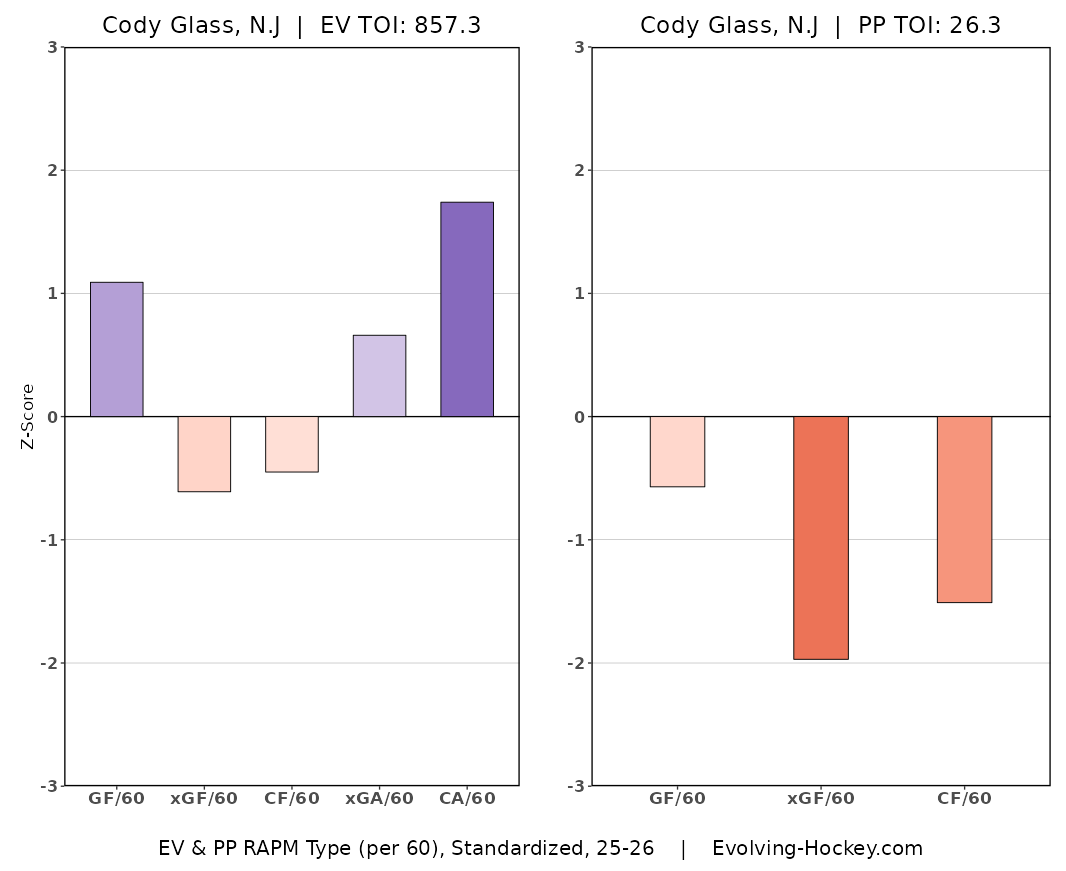
There’s also the fact that Glass only logged a grand total of five assists in 70 games in 2025-26. Based on his microstatistical profiles throughout his career, he has never truly been a playmaker, rather opting to operate as a secondary passer in transition and as a shooter (though he isn’t a sniper, either). That said, though, he had by far the lowest assists per hour of his career since his rookie season in 2025-26 — 0.35 assists per 60 minutes is not typical of his game whatsoever. In fact, it’s just about half of the assist production of his second-lowest season (0.69 assists/60 in 2023-24). By virtue of having a strong support staff around him, he should certainly be a candidate for positive regression in terms of generating assists.
In totality, then, it seems as though Glass is primed for negative regression in terms of his goal-scoring production but will almost certainly be better off in terms of assists and underlying numbers. Sure, there are some orange-at-best flags with respect to his reliance on playing with Gritsyuk, but I have a feeling that’s more to do with the latter making everyone better in a season in which the Devils as a whole had a rough go of it than it is a reflection of Glass himself.
Comments
Nothing yet. Say the first thing.
Sign in to join the conversation.