
Thank you, as always, for reading the Devils’ Advocates Substack! If you enjoy the quasi-daily content, please consider subscribing and sharing with your friends, family, and any Devils fan you know. It is completely free of charge and helps out quite a bit!
Consider checking out the Devils’ Advocates Podcast, which features weekly episodes chock-full of in-depth content and exciting guest appearances. They’ll be available on this Substack, but you can also listen on your favorite platforms at the following links:
For quite some time, the conversation around Luke Hughes has been that he seems poised for a legitimate breakout campaign — a leap toward being a true top-pair defenseman. After all, he was selected fourth overall, and history shows that the vast majority of defensemen selected at that spot turned into that caliber of defenseman by their age-22 season. Hughes has yet to make that jump, though, which is somewhat concerning given his pedigree, team-high $9 million AAV contract, and the fact that Brandt Clarke, who was selected four slots after him in the same draft, has turned into just that.
Yet, 2026-27 does feel like the season this is bound to happen for Hughes.
For one, it’s the first time in three seasons in which Hughes is presumably entering the beginning of the season without issue. In 2024-25, he missed the start of the campaign with a nagging shoulder injury, one that supposedly bugged him for quite some time. In 2025-26, he missed most of training camp for contract negotiations and ultimately didn't get an extension until he was inked to a seven-year deal on October 1st. Missing most of camp certainly slowed his ability to get into the swing of things.
This off-season, though, Luke should be a-okay from the get-go. Yes, he had a shoulder procedure in April, getting shut down for the final four games of the 2025-26 campaign to get it done, but the expectation is that he is 100% good to go. He has already been training alongside his brothers for a couple of weeks and seems perfectly fine.
Hughes also dealt with an injury just before the Olympics, dislocating his shoulder in January and missing time until he was eligible to return from LTIR. Perhaps that injury was for the best, though, as the 22-year-old returned like a man possessed. Post-Olympics, Hughes had a near-55% expected goal share (xGF%), as per HockeyStats. It was the best xGF% among Devils defensemen by 3.2% and fourth on the team in total in that span. Contrary to his archetypal perception, he also had the best expected goals against per hour (xGA/60) among defensemen, with the Devils giving up 0.29 xG fewer per hour with him on the ice than with the second-best blueliner.
Part of the reason a step forward is anticipated is because of that dominance the young defenseman showed when he was feeling healthy and confident after the Olympic break. It was legitimately encouraging — the Devils have lacked a true #1 defenseman for a time (really, since Dougie Hamilton’s second season with the organization), and Hughes is certainly considered their franchise cornerstone on defense at this point in time.
It isn’t the only reason, though — far from it.
The biggest reason why a breakthrough is anticipated, and why it has been the case for a couple of years now, is Hughes’ microstatistical profile. Simply put, Luke does a ton of stuff on the ice with and around the puck, and history typically favors those who do so with strong production and strong on-ice impacts. In the last three seasons, according to LB-Hockey, he ranks in the 83rd percentile for Standings Points Above Replacement (SPAR) by virtue of his microstatistics and xG impact, ultimately ranking 48th in the NHL among defensemen in their model. That’s a first-pair caliber defenseman simply based on the amount of things he contributes to on the ice:
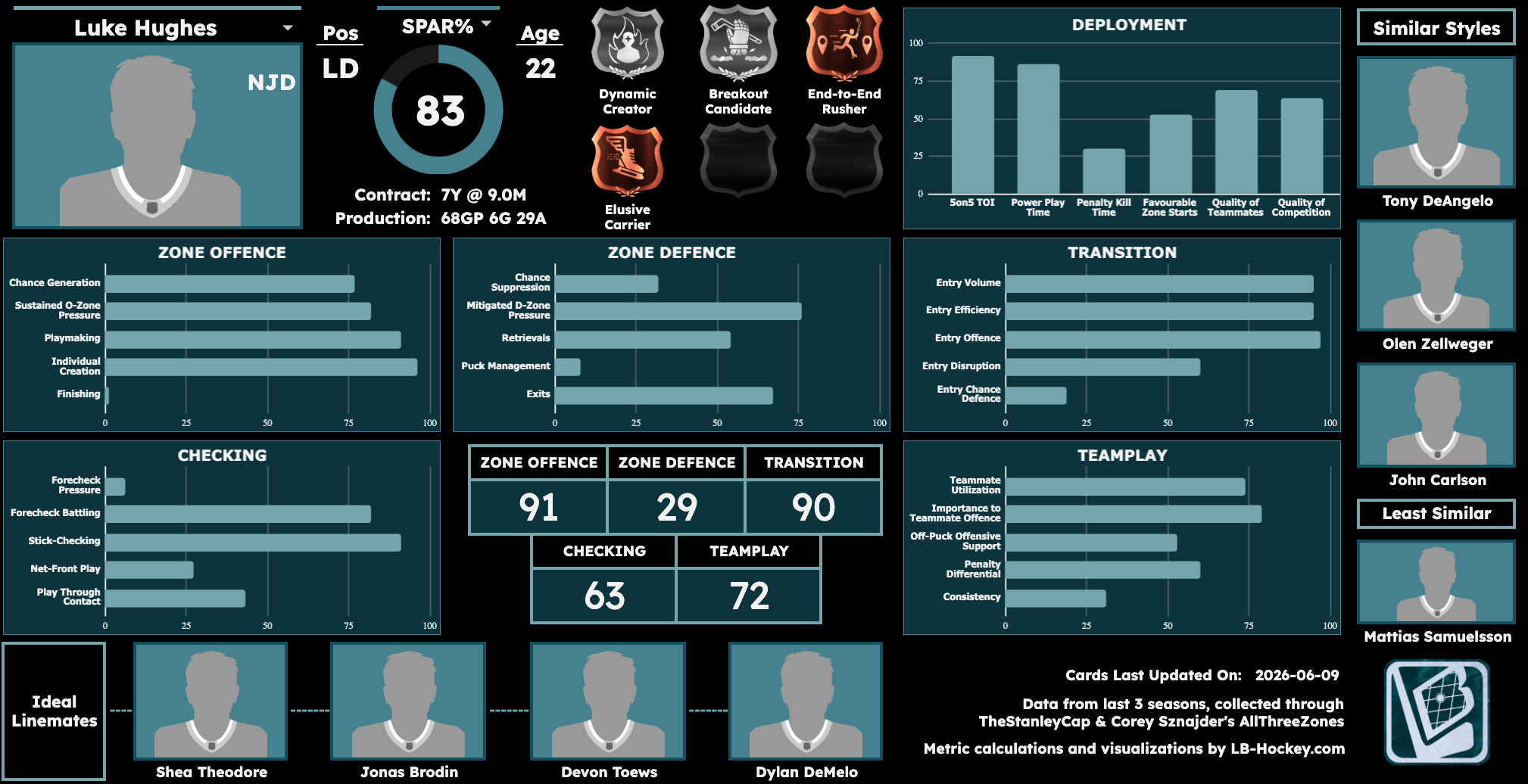
As you can see above, the majority of what he contributes to the game is on the offensive side of the puck. Ranking in the 91st percentile for zone offense and the 90th percentile in transition is no joke, especially considering how poorly Hughes ranks in finishing (1st percentile) and zone entry chance defense (19th percentile). Very few defensemen in the National Hockey League contribute to their team’s offensive game as he does.
Hughes’ 29th percentile placement in zone defense undersells him a bit, too — I don’t think anyone would reasonably call him a good defender right now, but he does rank above-average in all of zone exits (67th percentile), mitigated defensive zone pressure (76th), and puck retrievals (54th). It stands to reason that he’ll only get better, too, given his 91st percentile finish in stick checking and the fact that, when he and Brett Pesce were fully healthy two years ago, there were moments when Luke Hughes was among the best neutral zone defenders in the game by virtue of his mobility.
The framework is there, and Louis Boulet (the creator of LB-Hockey) knows it, too — he’s listed in the silver tier for the Breakout Candidate badge, meaning that he’s a top-13 defenseman in his dataset for being a player who is “projected to see a significant jump in production based on their skill level of various offensive metrics and age.”
That sounds pretty good to me.
It doesn’t stop there, though — looking at family history, there’s additional reason to believe that a true step forward is anticipated. I must note that lineage doesn’t mean everything and development isn’t linear, as we are all aware, but the development arc of Luke and his brother, Quinn, is eerily similar:
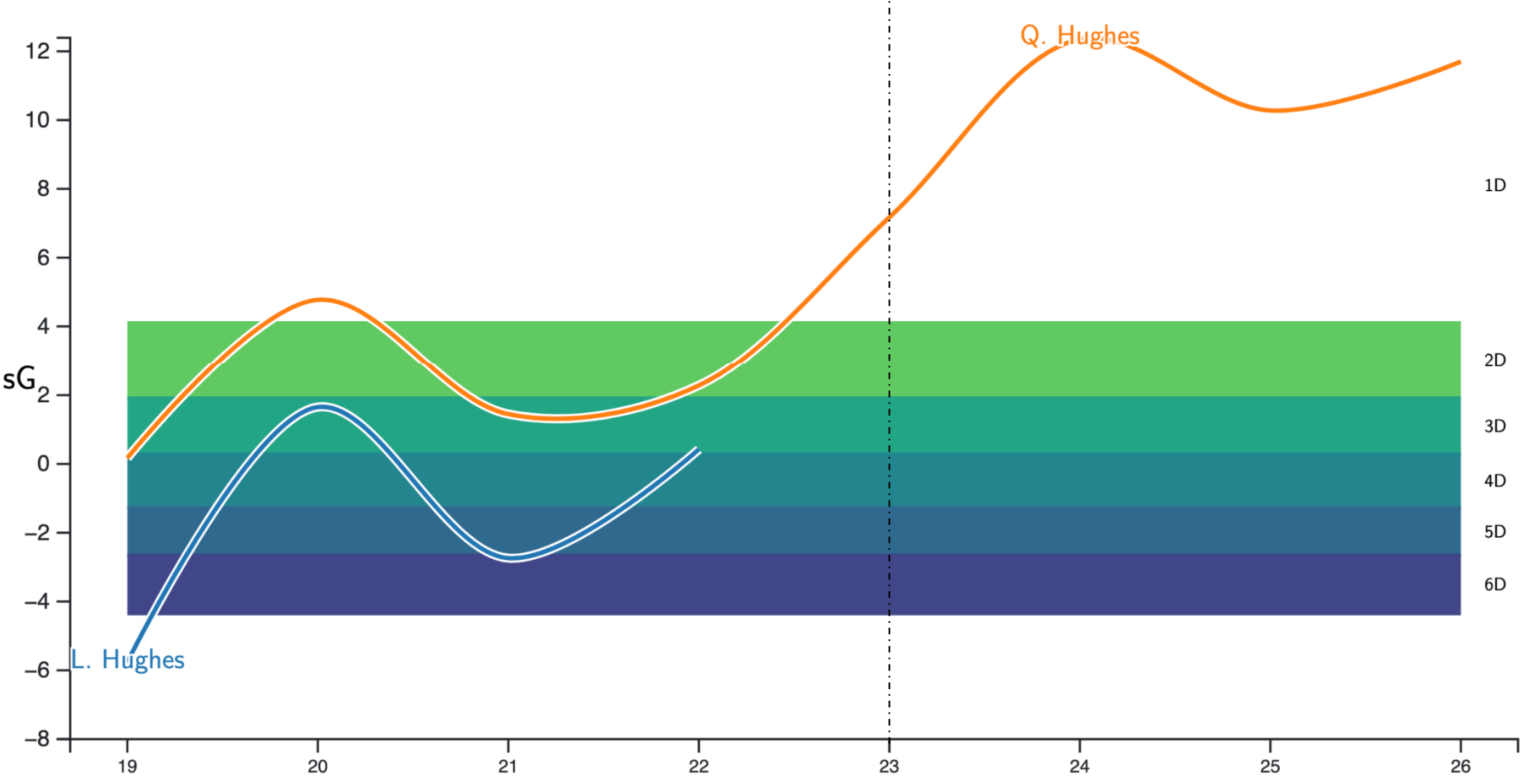
Now, of course, Quinn’s baseline was higher than Luke’s in Micah Blake McCurdy’s Synthetic Goals (sG) model — Quinn entered the league playing at a similar level to how Luke played at his best so far. However, both players saw a pretty significant dip in their age-21 season in terms of on-ice and isolated impact. Both players rebounded a bit in their age-22 seasons, playing somewhere in the 3/4D level.
Quinn really came into his own as a #1 defenseman in his age-23 campaign, the very same one Luke is entering in 2026-27.
I’m not saying that Luke should be expected to do the same, but the trend is clearly upward and clearly mirroring his brother’s trajectory. A player who followed a similar trajectory, but to a lesser extent, was Zach Werenski, who also took a small nosedive at age 21 in terms of sG before rebounding at 22 and blossoming into a top-pair defenseman. The point is, this has happened before multiple times with multiple high-end blueliners, including the best defenseman in the world, who also happens to be Luke’s brother.
A significant jump in production should be expected at the least, given the likelihood that Luke is slated to be the mainstay on the Devils’ top power-play unit for the duration of the season, rather than fighting for custody with Hamilton. In fact, looking at Luke’s under-the-hood numbers for the man advantage should be extremely encouraging.
While both defenders ranked highly in terms of expected goals for per hour (xGF/60) while on the power play — Hamilton ranked 5th and Luke ranked 6th in the NHL among defensemen, as per HockeyStats — no defenseman in the league was on the ice for more shots on goal or scoring chances per hour than Luke was. At this point, it seems like a near-guarantee that Luke quarterbacks the Devils’ top power play, which should greatly help his confidence, his rhythm within the game, and his production.
Between his excellent finish to the 2025-26 campaign, his superb microstatistical profile, his mirroring of his brother’s development path in sG, his likelihood to play more significant time on the power play than he ever has, and the fact that this is the first normal entrance to a season he has enjoyed since his rookie campaign, the writing is on the wall for Luke Hughes to genuinely turn into what the Devils thought he could be when he was drafted: a #1 defenseman. At the very least, the expectation is that he should be a top-pair player. His raw tools are simply too tantalizing not to be one.
Comments
Nothing yet. Say the first thing.
Sign in to join the conversation.