
This is Part II on PIK Debt in football, the hidden leverage behind club takeovers. Part I was a primer on PIK Debt.
·
Jun 8
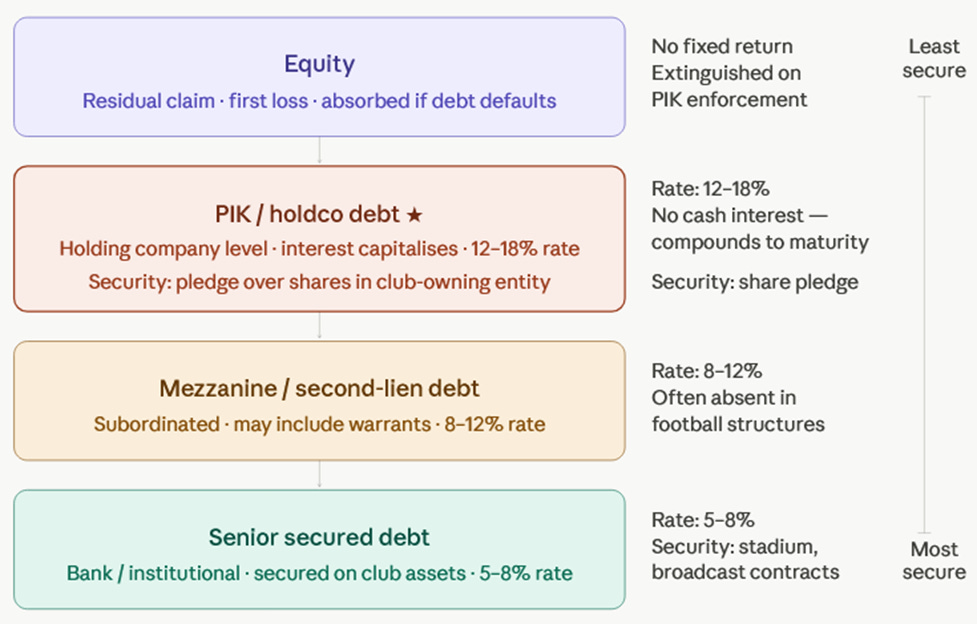
As sport and football have become more financialized (not a great thing), finance acronyms have creeped into more discussions. And none of them is more contentious than PIK (Payment-in-Kind). None of them is also as misunderstood as PIK. Today I want to demystify it.
In this part I will look at real life examples of using PIK debt, highlighting important distinction between Rescue financing (loan-to-own), and Acquisition financing:
Loan-to-own rescue financing – Inter Milan and Oaktree
Acquisition financing Bad PIK – John Textor, Eagle Football Group and Ares
Acquisition financing Good (so far) PIK – Chelsea, BlueCo and Ares
The most famous football Rescue financing loan-to-own transaction unfolded at Inter Milan. I will keep this part relatively short. I wrote a long and detailed piece about it:
In 2016, Chinese electronics and retail giant, Suning acquired a controlling stake in Inter. At the time, Inter was unrecognizable from its glory days with only one 4th place in Serie A in the prior 5 years.
Suning implemented turnaround plan, which seemingly worked. In the first three years of Suning’s ownership Inter finished 4th, 4th and 2nd in Serie A.
They rebuild the squad and between 2016 and 2020, Inter spent nearly €600 million on transfers. The wage bill almost doubled to €262 million, one of the highest in Serie A history. However…
In 2017, the Beijing administration imposed strict capital controls, effectively banning irrational investment in European football teams. As Suning was not able to fund Inter’s losses, they turn to the debt market.
In reality the Chinese owners were largely funding the club with debt - €300 million bond issued in 2017 (€230 million used to refinanced existing debt). And when the COVID obliterated Inter’s and other football clubs’ finances, in 2020 they again borrowed €75 million more.
In 2021 Oaktree Capital stepped in with a €275 million rescue loan. The three-year loan was set to mature in May 2024, with an annual fixed interest rate of 12% and a PIK. The club got money to cover operating costs (Bad PIK), but at a high cost. Over three years PIK accreted to €395 million, due in May 2024.
None of this affected the club on the pitch – in three seasons, from 2021 to 2024, Inter had won one Serie A, two Copa Italia, and played in the Champions League final in 2023.
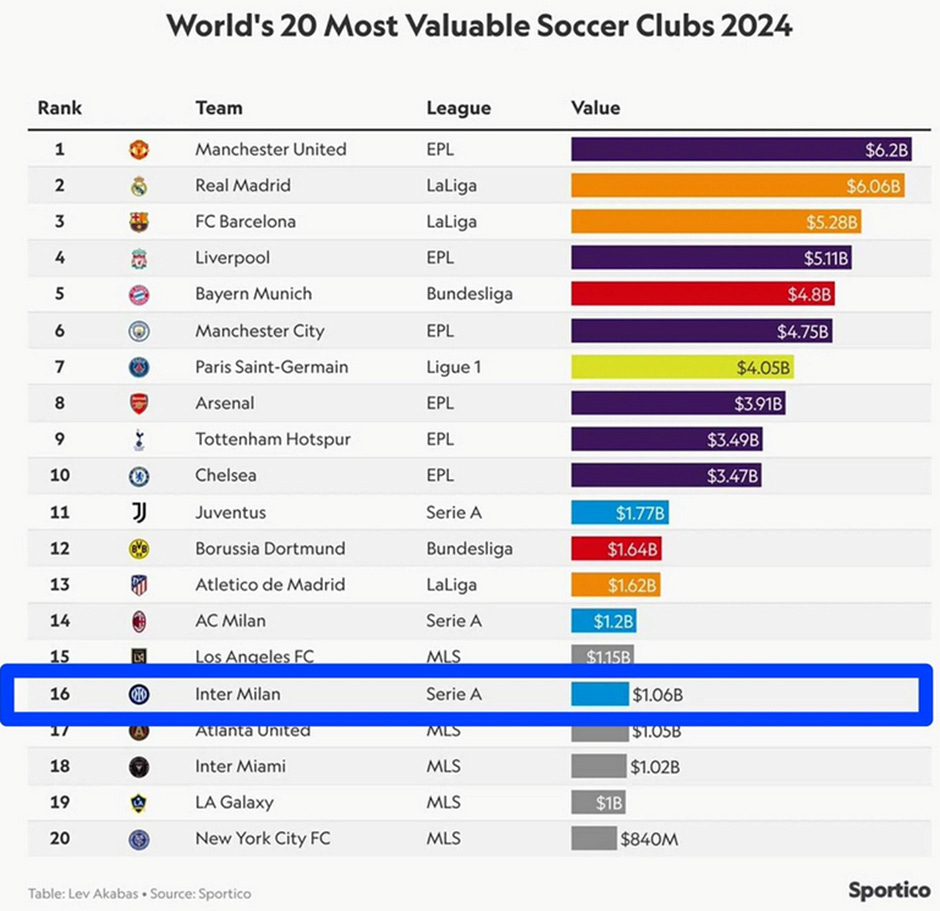
In 2024 when PIK matured Inter was balling and club’s valuation was over €1 billion. Suning negotiated refinancing of the Oaktree’s loan with PIMCO… BUT… due to complicated loan agreement Oaktree was able to block refinancing, and Suning defaulted.
Oaktree enforced on its collateral and took over 99.6% of the shares. And just like that, with €275 million rescue loan they became owners of one of the most iconic clubs in the world valued at over €1 billion!
While Oaktree are sharp-elbowed as lenders, they have been a decent, sensible owners. They injected €50 million of cash, and did not meddle with operations heavily, continuing with strong results on the pitch.
Loan-to-own: Oaktree didn’t lend Suning money in 2021 to just earn 12% PIK interest. They did it to take over the club.
Wrong owners: Chinese owners did not bankroll the club since early in their ownership and did not step in even in the pandemic. Instead, they were indebting it.
Not impacting performance: None of this was disruptive on the pitch.
The biggest lesson here is that Oaktree did not extract value from the club – they extracted value from its owners. I am not saying they should be awarded the Nobel Peace Prize, but also let’s not vent and create false narratives.
In 2021 and 2022, a colourful American businessman John Textor created Eagle Football Group MCO (Multi-Club Ownership) group by acquired four clubs in four countries. It has turned into one of the biggest shitshows in sports and PIK financing is at the heart of it.
Eagle Football Group (EFG) assembled a multi-club portfolio that included:
Crystal Palace: Acquired 43% stake in August 2021
Botafogo: Acquired 90% ownership in January 2022
RWD Molenbeek (RWDM): Acquired 80% stake in January 2022
Lyon: Acquired majority stake in December 2022
Textor utilized a “turnaround” ownership strategy that targeted distressed, historically significant clubs. He aimed to stabilize operations of financially strapped clubs while using a MCO model to trade players and build value.
MCO strategy revolved around unearthing talent globally, grooming them in one of big non-EPL clubs, and then realising handsome profits by selling those players to the Premier League. In a nutshell, savvy and smart use of MCO and player trading.
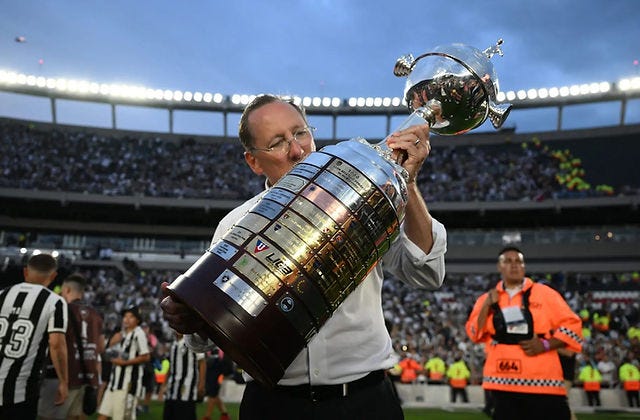
To his credit, his MCO had success on the pitch. Botafogo went from brink of relegation to winning the Brazilian league title and the Copa Libertadores in 2024. Crystal Palace stunned Man City to win 2025 FA Cup (more credit to that go to Steve Parish than Textor).
In practice Textor has treated his club network as a centralized pool of cash, moving money, loans and players between clubs liberally through numerous schemes and maneuvers, when in fact there are strict jurisdictional rules and regulations.
Now here is a nasty part – Textor built MCO with a lot of PIK debt instruments that allowed Textor to not use cash while compounding obligations were deferred.
Specifically, acquisition of Olympique Lyon in December 2022 was largely financed with $425 million in PIK debt raised from Ares at 16% to 20% rates!
In 2025 further $122 million of debt was raised from Ares. At that point EFG was in deep trouble and Ares provided rescue financing.
That is a total of $547 million in compounding PIK debt from Ares. By October 2025, when Eagle Football Group first defaulted, the total debt owed to Ares and its syndicate had ballooned to $1.2 billion!
Remember some of the hallmarks of Bad PIK?
Weak sponsor / owner. Check
Unsustainable compounding. Check
Deteriorating fundamentals. Check
As EFG got deeper into trouble with mounting debt and losses Textor began asset stripping:
In 2023/24 EFG sold a majority stake in legendary Lyon Féminin (8x Champions League winner – most ever) to Michele Kang (NWSL’s Washington Spirit owner). She later helped Ares land a killer punch to Textor.
In 2024 EFG sold 100% ownership of NWSL’s Seattle Reign for $58 million to a group led by Carlyle
In 2024 EFG sold the multipurpose indoors LDLC Arena to former Olympique Lyon president for €160 million.
In summer of 2025 EFG sold its stake in Crystal Palace for £190 million, most of which went to Ares. This sale was forced as both Palace and Lyon qualified for the Europa League, but Palace was demoted to the third-tier Conference League.
By now most of you are asking one simple question – who the fuck is this guy and why was he allowed to buy the historic football clubs?
For the first part you can use Google. I will answer the second part – because they were distressed and they needed money badly. Beggars can’t be choosers!
The fit and proper ownership test: This also highlights that even at the largest football leagues, like the EPL, the fit and proper ownership test is basically a joke. This guy was in the running for Everton and Wolves while EFG was unraveling! This is polar opposite of the NFL, the most successful league in the world, where getting vetted to buy the NFL team is harder than for the Secretary-General of the UN!
Another key lesson here is that this was not loan-to-own rescue financing, but rather acquisition financing gone badly. Stating that it has gone badly because of unsustainable financial structure is speaking the obvious.
But there is a more fundamental lesson here:
In most of football, the owner’s number 1 job is straightforward – to write the checks and bankroll the club. If you don’t have money to do that, you ain’t the right owner.
And here we have the owner who doesn’t even have the money to buy the clubs in the first place, let alone to continue bankrolling them. Which is why he was borrowing at crazy terms. He essentially bought Lyon with Ares’s money.
This is why LBOs of football clubs should be banned by the regulators. Most of the time buyers are borrowing, often at silly terms, because they don’t have the money. Which makes them unsuitable to be the club owners to start with.
By now you have probably reached the conclusion: Not all PIK is created equal – but all PIK is bad!
But there is also an example of Good (or at least Not Bad) PIK – Chelsea, BlueCo and Ares. As they are reading this, Chelsea fans must be scratching their heads. Yes, Chelsea is a shitshow, but that it is not because of capital structure.
More on that in Part III…
Thanks for reading,
Nikola
No posts
Comments
Nothing yet. Say the first thing.
Sign in to join the conversation.