
As sport and football have become more financialized (not a great thing), finance acronyms have creeped into more discussions. And none of them is more contentious than PIK (Payment-in-Kind). None of them is also as misunderstood as PIK. Today I want to demystify it.
Now let me be clear one thing – I am not endorsing these types of transactions. But they are the reality of modern football. And if we are going to analyse them, at least let’s do it correctly.
Payment-in-Kind loan is a form of debt where the borrower does not pay cash interest during the life of the loan. Instead, the interest is capitalised – it is added to the outstanding principal balance. The debt compounds over time, creating significant repayment obligations at maturity.
The result of accruing and compounding PIK interest is that the principal balance of the loan continues to grow (as more and more interest is added), as do the interest payments (as outstanding principal is increasing). It results in potentially rapidly growing outstanding principal.
Compounding period is typically monthly or quarterly, and less often annual or daily.
The lender is effectively running a compounding clock against the borrower. PIK loan is not draining company cash flow, much worse it is eating owner’s equity!
For the borrower, there is no current cash drain from debt service, which is attractive when operating cash flows are thin or uncertain.
For the lender, the absence of cash coupons is compensated by a significantly higher interest rate – in football it is typically mid-teens % per annum versus 5 – 8% on senior debt.
While PIK generally carries a negative connotation, not all PIK is created equal. There are use cases where PIK is a good solution, and plenty where it is a red flag.
Good PIK provides short term flexibility, it’s not a distress tool:
Purposeful cash conservation: The borrower could pay cash but intentionally chooses PIK to preserve cash (i.e. to use for high-return reinvestment)
Strong underlying business: Good free cash flow generation with debt repayment plan
Good structure: Include PIK toggle mechanisms (allow interest payment in cash) or caps principal compounding
Sponsor backed: Strong private equity sponsor able to inject more capital or exit the business
Bad PIK papers over the cracks:
Forced: The borrower can’t pay cash, and PIK is delaying the problem
Unsustainable compounding: Exploding principal where repayment becomes unrealistic
Deteriorating fundamentals: Distressed business with declining revenue, margins, and EBITDA
Poor structure: No toggle rights, caps, or covenants
Weak sponsor: Business owner with liquidity issues, and not a good fit for the asset
PIK loans typically sit at the holding company level, above the operating club. They are structurally subordinated, and are last creditors in line to be repaid. Therefore, PIK lenders accept greater risk than senior lenders and demand significantly higher returns.
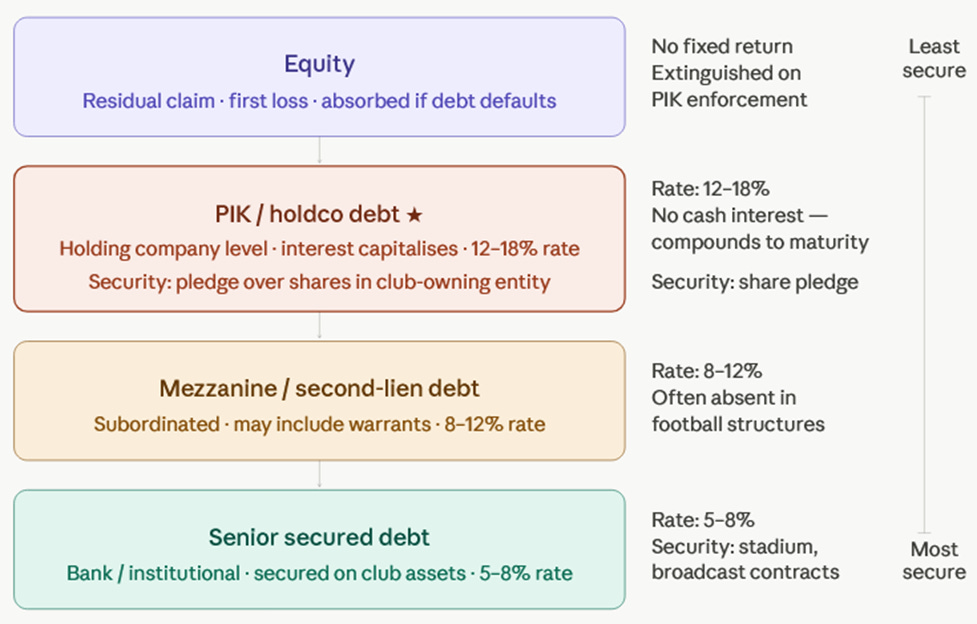
A typical leveraged acquisition creates a layered capital structure that stacks debt from most to least secure:
Senior Secured Debt: most senior, extended directly to the football club by traditional bank or institutions, secured against some of club assets (stadium, different receivables) and cash flows. Senior lenders have first claim on assets and lowest risk, with correspondingly lower interest rates.
Mezzanine / Second-Lien Debt: occupies the middle, extended to entity above football club. Higher yield, weaker security. May include warrants or equity conversion rights. In European football this layer is typically absent.
PIK Debt: Extended to the holding company, structurally subordinated to everything below. The lender cannot directly seize club assets, but it can take the keys of the club from the owners.
Equity: club ownership, bears all residual risk and sits last. In distressed situations it is often wiped out.
Although PIK debt is subordinate to senior secured debt, lenders rarely provide it on an unsecured basis. Common collateral includes:
Shares in the football club
Shares in Holdco
Rights over future sale proceeds
The security, which is typically either the Holdco shares or club shares themselves, creates a powerful mechanism for lenders. If the borrower defaults, the lender can enforce the share pledge and take over ownership of the club.
As a result, PIK financing can serve as a mechanism for loan-to-own transactions.
A point that is widely misunderstood is that there are two fundamentally different ways PIK debt is used in football:
Rescue financing (loan-to-own)
Acquisition financing
In a Loan-to-Own rescue financing, the football club faces liquidity pressure, and the owner has limited financing alternatives. The owners who need to support the club don’t have the money, or are prevented to put money into the club.
The loan-to-own strategy operates on a deceptively simple premise: lend against a distressed or over-levered asset at terms that make default likely, structure the downside tightly, and be prepared to take control if things break.
The lender’s thesis is straightforward:
If the borrower repays, the lender earns a high return
If the borrower defaults, the lender acquires the club
Effectively, the loan is a pathway to club ownership. The lender’s upside is the club itself.
In acquisition financing, the objective is different. The borrower is not distressed; it is the new club owner completing the LBO of a club. Importantly, the new owner usually has a good relationship with the lender. The PIK debt is a financial engineering tool in service of the acquisition, not a trap.
The buyer uses PIK debt to reduce the amount of equity required to complete an acquisition. This enhances equity returns if the investment performs well, but it can also wreck the returns and club owner.
Unlike loan-to-own situations, the lender’s base case is not to acquire the club – they are seeking attractive risk-adjusted yields. Taking over the club is a downside scenario.
Of course, we don’t want to have LBOs and financial engineering in football in the first place, but we should also not be creating false narratives that it is a predatory lending. If anything the onus here is on the new owners who are using PIK instead of their capital.
Loan-to-own rescue financing – Inter Milan and Oaktree: Chinese owner who was not injecting capital in financially distressed club gets a temporary lifeline that ultimately becomes a pathway for lenders to take over the club.
Acquisition financing Bad PIK – John Textor, Eagle Football Group and Ares: Multi-Club Ownership group created with the acquisitions financed with little equity, and a lot of PIK debt at 16% - 20% interest! where the owner doesn’t really have the money. Unsurprisingly it ended as one of the biggest shitshows in sports!
Acquisition financing Good (so far) PIK – Chelsea, BlueCo and Ares: The consortium replaced a chunk of equity with PIK debt at SONIA plus 7.50% (~11.2%) to improve returns. The PIK lenders are not adversaries waiting for a default, and owners are well capitalised. Make no mistake Chelsea’s on the pitch woes have nothing to do with capital structure, but with poor footballing decisions.
Well, the conclusion is simple – the best debt is the cheap debt! And PIK ain’t that for sure.
Thanks for reading,
Nikola
Next: In Part II, I will take a closer look at Inter, Eagle MCO and Chelsea examples.
No posts
Comments
Nothing yet. Say the first thing.
Sign in to join the conversation.