
Most discussions on private equity in sports revolve around capital structures, debt, returns and valuations. To be fair, I am guilty as charged myself. And for a simple reason – those articles consistently attract most interest.
Less understood, and probably more fundamental question is – is private equity’s ownership style geared for success in sport?
Tied to this question is very discussed question – do football managers actually matter? Do they make that much of a difference? I am using football, but you can extrapolate this to (m)any team sports.
A view popularised by FT columnist Simon Kuper and economics professor Simon Szymanski in their book Soccernomics – head coaches barely matter. Their research showed that just 1 in 10 football managers had a statistically significant positive impact on points won. Data shows that wages have much higher impact.
Note: the original book is from 2009 and football has changed since then – I am curious what the data would show today.
A few years after Soccernomics, Chris Anderson and David Sally in The Numbers Game showed that wages only explain about 70% of the variation in league position. If the managers are responsible for a solid part of the other 30% - well then, they do matter.
Michael Broughton made a good argument that it’s the conditions at the club, set up by its leadership that matter the most.
I will make a layman, empirical argument.
Who is by far the most responsible for Man United becoming the most dominant force in modern British football in 90s and 00s? Sir Alex Ferguson
Who is by far the most responsible for Man City becoming the most dominant force in Britain, if not Europe, in the last decade? Pep Guardiola
Who is by far the most responsible for transforming Liverpool from a fallen giant to the EPL and European champions? Jürgen Klopp
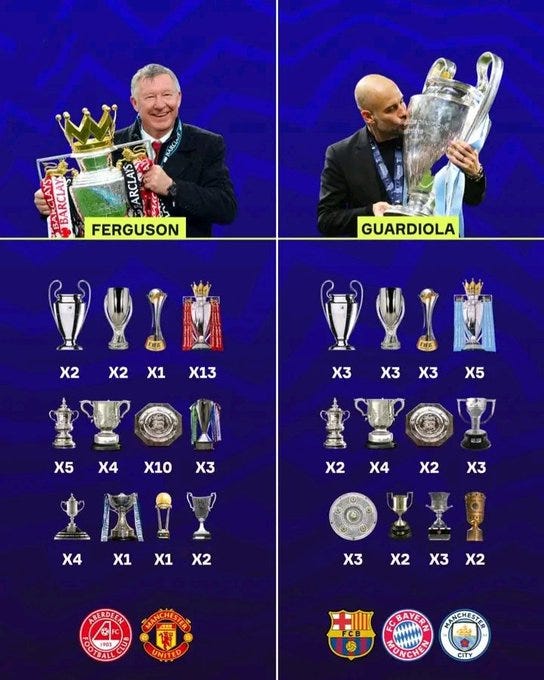
I could go on with Luis Enrique, but no need, you get the picture.
Forget about averages, maybe in many cases the managers barely matter, but to achieve greatness, for the most part, it’s not that the manager matters. He really matters.
And a big reason why this is the case goes back to the point of conditions. Be it the culture, the playing style, the transfer logic, the dressing room dynamics. Fergie, Pep, Klopp were single-handedly most important in setting conditions at their clubs.
Owners’ job has been to enable them, and get out of the way. Of course, none of them got keys to the kingdom when they walked through the doors. It’s a gradual process that takes time.
The way I like to describe PE ownership style is:
“Me Tarzan, you Jane”
In a typical PE-backed business the structure is clear – the PE firm has majority ownership and is clearly in charge. Partners make, or have final say, on the strategic decisions, and the CEO and management team execute. They are capable, well-compensated… and clearly subordinate.
This is a polar opposite of how Pep, Ferguson, or even Klopp have operated. These managers did not work for owners. They worked with owners who understood their primary role was resource provision. That is not the private equity ownership instinct.
Private equity operates under the premise that the most important talent sits in the fund (PE executives), and not in the portfolio company (management team). In sports that is not the case.
That premise also drives relationship dynamic, where PE owners have leverage over management. The difference is that good football managers can have much greater impact on clubs’ results than good CEOs can have on the companies. (Notice I am saying CEOs who are hired, not Founders who build companies).
Given the outsized impact that the great football managers can have, and the fact that there are fewer top managers than Tarzans with checkbook, relationship dynamic is more similar to VC where there are many more funds than amazing founders.
I know, it’s becoming boring that so many newsletters analyse Chelsea, but what can I do when Todd Boehly has run the experiment for us live.
When BlueCo consortium acquired Chelsea in 2022, Boehly appointed himself as interim sporting director. Cynics would say it’s a role for which he had approximately zero prior experience!
I get it, it was a sudden acquisition, and previous long-time director Marina Granovskaia and her team could not continue. But the message was clear – the owner is in charge, or at least deeply involved, in football decisions.
Under the ownership of Todd Boehly and BlueCo, Chelsea has implemented a data-driven, multi-disciplinary sporting structure designed to shift away football decisions from manager toward a collaborative, committee-based decision-making process including the group of directors they installed.
Guess what? Committees can work in large PE-backed businesses. They ain’t working great in football.
This is not to say that there is not a broad group of coaches and executives looking after different areas, but their job should be to support, not to veto the manager.
I should also note that in typical PE portco, partners involved with the company have decades of experience in the underlying industry, which earns them right to be making decisions. PE owners in football often have no industry experience.
Over the last five years, arguably only two managers had success at Chelsea – Thomas Tuchel and Enzo Maresca. Both are strong personalities with convictions. And both had blow-ups with Boehly and the ownership structure.
29th May 2021: Tuchel led Chelsea to improbable Champions League title
30th May 2022: BlueCo completed Chelsea takeover, with Todd Boehly assuming the role of club Chairman and interim sporting director
7th September 2022: Boehly sacked Tuchel due to a fundamental breakdown in their working relationship and different long-term vision
Tuchel is not blameless; Chelsea’s performances dipped during his 100 games in charge. But sacking a Champions League winning coach after 3 months, following conclusion of PE style100-day review (a traditional post-acquisition practice) speaks volume.
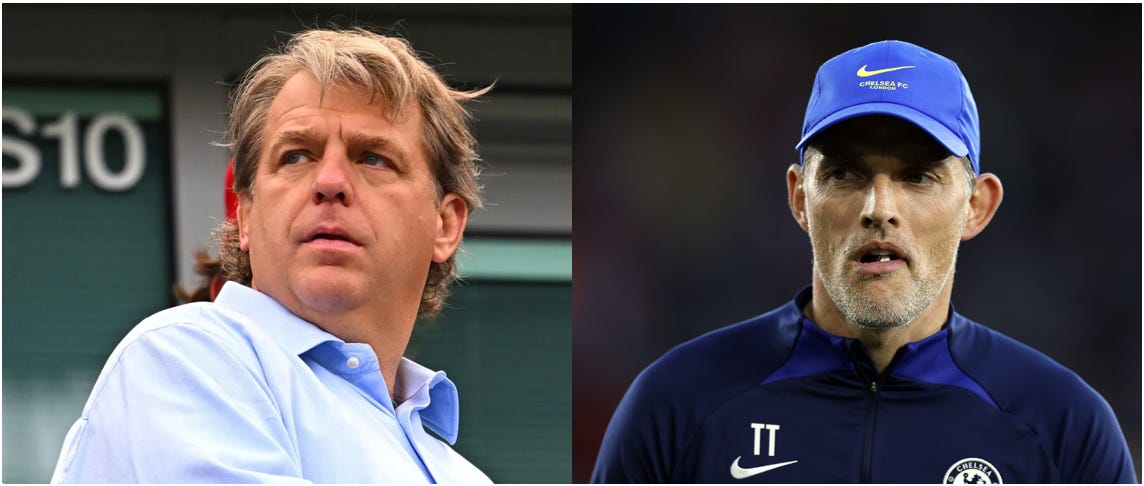
“Our vision for the club was to find a manager who really wanted to collaborate with us. Thomas didn’t saw it the same way” - Boehly
Similar story played out with Maresca, where disagreements over team rotation directives from management, and transfer policy led to relationship meltdown. Funny enough, both Tuchel and Maresca have done ok since leaving the club!
It’s been déjà vu with Mauricio Pochettino, another great, strong minded manager with conviction, who admittedly had average results. Regardless, he was sacked after one year, due to irreconcilable difference with committee of directors and owners over strategy, squad management and the establishment of a specialized set-piece department.
You get the pattern? But who can work with this type of ownership structure? Bring on the YES MAN!
No offense to Graham Potter and Liam Rosenior, but they were not chosen for their commanding personalities. They were, at least in part, chosen because they can work collaboratively and speak corporate jargon.
Unfortunately, as it happens in football those are not winning managerial ingredients.
The key lesson is:
Important role of great managers is to lead setting conditions at their clubs, together with owners. Owners who should understand that unlike in PE, the manager is more important for success than they are. And those conditions usually do not involve PE style management committees. Too many cooks spoil the broth.
To be fair, this problem is not exclusive to PE approach to ownership. In the matter of fact, many individual owners operate in even worse fashion, with more volatile and less professional behaviour.
Evangelos Marinakis, Nottingham Forest, Olympiacos and Rio Ave owner, who is deeply involved in football decisions, is not only questioning managers. He is drilling them!
Unsurprisingly, his clubs oscillate between occasional moments of success and persistent instability. Unsurprisingly, his chest thumping approach will never attract the best managers in the business.
The clubs that win consistently and build dynasties, rather than just spend heavily, often have one thing in common – long term managers who run the football, and owners who run the checkbooks, which is not how PE usually operates.
Thanks for reading,
Nikola
No posts
Comments
Nothing yet. Say the first thing.
Sign in to join the conversation.