
As Norway’s football team put one of the most enjoyable and memorable campaigns in recent memory; sport business community has put one of the most brain rotting campaigns with countless regurgitation of story about unique approach to youth development in Norway.
In the matter of days everyone from Bloomberg to WSJ and countless podcasts and Substacks have been putting out the same stuff. You know the one about participation trophies for all kids and no keeping the scores.
In the beginning it may have been even interesting, but repeating it thousands of times as some deep insight quickly becomes annoying. Especially, as we’ve already heard it hundreds of times when Norway’s athletes topped the Winter Olympics medals table.
At the time I wrote my most read article to date, explaining Norway’s amazing Winter Olympics success with alternative data points. Somehow it upset a few people! Guess what? Let’s run it back and upset a few more folks!
Today I want to discuss a very specific athlete development pathway, that is increasingly common all over Europe and the US – the nepo pathway.
(I don’t use nepo in a derogatory way.)
Believe it or not, it’s been 28 years since Norway last played at a World Cup. 1990s Norwegian team would be unrecognizable today – they were a workmanlike defensive minded bunch, overcoming lack of skills with grit and effort.
So what has changed? It’s the stuff that has been discussed everywhere – an investment in artificial pitches, and establishment of the National Team School.
Since 2000 over 1,100 artificial pitches were built or renovated. Football shifted from a summer sport to a year-round sport. It also allowed for a more technical game.
Crucilly, after failure to qualify for Euro 2012 – in 2013 the Norwegian Football Federation established Landslagsskolen (NTS).
NTS is not a centralised academy, it is a development system in which players are developed at grassroots clubs in coordination with the federation and national talent camps until ~13 years, instead at professional clubs. Only at 13 – 15 years kids move to professional clubs.
This model is not centred around scouting players early, but developing as many players for as long as possible. Coaching is still often done by one of the parents for free, who are doing it out of passion and to support community. It’s a great model and more nations should replicate it. Most of the current team went through the NTS pathway.
Ok, so let’s now get to the point. What is the result of all this casting the net wide, thoughtful inclusion of many kids, no score keeping, and so on?
The result is that many lads playing for the national team are often just the kids of former top division and national team players and managers. In the matter of fact there is probably no other nation with so many nepo kids.
Of course there is nothing wrong with this, you want to have the best players possible, regardless of who their parents are. But it’s interesting to examine it deeper.
A raft of Norway’s best players has footballing fathers who played for the national team or in the top divisions.
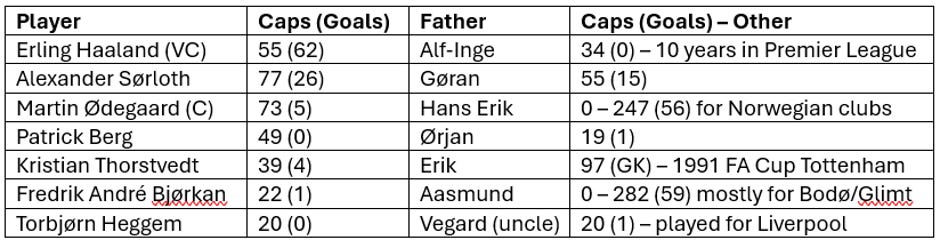
Ødegaard’s father is the manager of Lillestrøm (top division); Bjørkan’s has been manager and assistant manager of Bodø/Glimt (best club); and Berg’s is the current sporting director of Bodø/Glimt.
Genetics of course play a big role in sports, so it isn’t a shock that kids of former national team players are talented. Yet in no other top national team most of the best players and half of the first team are the nepo kids. If anything in nations with much longer and successful football heritage, often not a single international is a child of a former international.
While only 1 in 15,000 Norwegian youths reach the senior national team, about half of Norway’s starting lineup are sons of former internationals or top division players. This has even prompted an academic study.
The study attributes the high success rate to four primary factors:
Inspiration
Training and coaching
Opening doors
Practical help, emotional backing, and expert advice
Hakon Grottland, the head of player development at the Norwegian Football Federation said: “The question is, is it about genes or is it about the environment? I think the answer is that it’s mostly about the environment.”
In that case you would hope that the environment that has been endlessly discussed in the sportbiz articles would close the gap for the other kids. Yet it’s anything but – the world’s most progressive, inclusive system is producing the most exclusive outcomes!
Not that it matters, because the outcome is great.
My mom was an electrical engineer and worked as a programmer at a time when most people didn’t even know what the PC was. She started to work with me and my brother on solving math equations when we were 5. It gave us a head start in school, leading to winning prizes in math, physics and chemistry competitions.
In the same fashion many ex pro players start training their kids when they are toddlers! For every hour spent training with youth teams, kids may spend several hours training with their parents. That matters a lot, you know the 10,000 hours rule. Plus, who’s better to teach the kids various techniques than ex pros.
Yet the biggest benefit may be opening the right doors. Established contacts help sons bypass barriers and access top-tier academies and teams.
If the development is indeed to a large degree a function of environment, then getting into the best possible environment goes a long way.
In the matter of fact there is less nepotism in football than in most other sports. In some, like tennis, very high cost of participation coupled with high technical nature of the sport (which means you need a lot of coaching) is making the sport inaccessible for most kids. Unsurprisingly, many players are increasingly the children of former pros or wealthy families.
In other sports genetics can play a bigger role, like in basketball and volleyball, where top players are often over 200 cm tall. You just can’t teach someone to be 2.05 meters tall.
Coming from a basketball nation, we know examples of talented, but not generationally talented, players being signed by European clubs at 18, and getting a crucial playing time. For this having a good agent helps. But you know what can help even more? If the coach bringing the player is dad’s former teammate and friend.
Yet today in the US informal advantage has scaled into an entire economy worth billions. Wealthy or connected parents pay for private skills trainers, exclusive AAU programs, elite camps, and even influence playing time by funding travel teams or donating to programs. They are effectively buying reps and exposure. The result is a youth system where who your parents are and what they can afford increasingly determines who gets seen by scouts and college coaches.
For parents there is also economic rationale – cost of college has been growing ahead of inflation for decades. In the US, it has now reached nonsensical levels, which has increased value of athletic scholarships. More than that, with NIL the whole college economics have become very lucrative, if not out of touch.
Children of the ‘90s will remember the comedy starring Wesley Snipes and Woody Harrelson. As I googled below photo, I just realised there was a remake made in 2023… I’m getting out of touch.
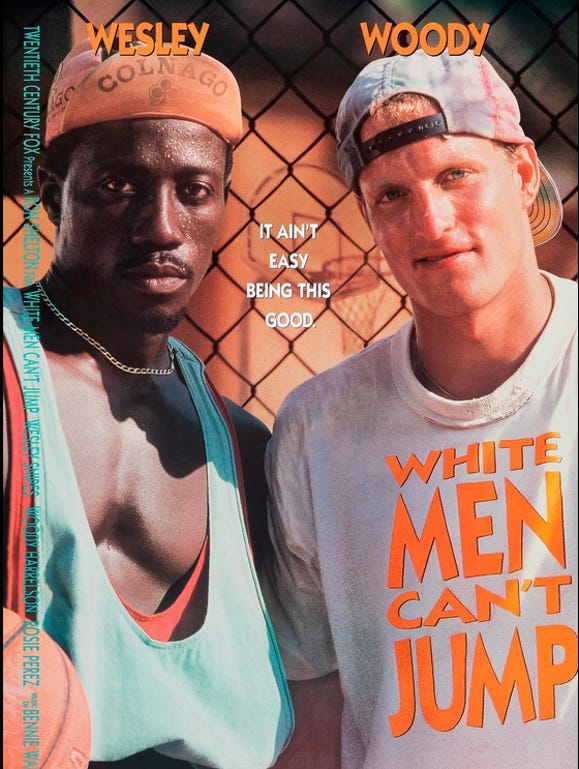
Anyhow, white men can’t jump, or run, and black can’t play QB – are pervasive sports stereotypes that have historically limited athletic opportunities. They have been mostly dismantled in the last two decades.
Today in the NFL arguable the best QB is black / mixed race (Patrick Mahomes), and best RB is white (Christian McCaffrey). What they both share, beside on the field greatness, are dads who were professional players. Maybe fathers’ backgrounds helped them to break the stereotype?
Pat Mahomes was a journeyman pitcher playing in MLB from 1992 to 2003. Ed McCaffrey (CMC’s father) played wide receiver (position requiring great speed, preferably size too) in the NFL for 13 seasons. In his illustrious career he won 3 Super Bowls, including two with John Elway and Broncos and played in Pro Bowl.
You can already reach the conclusion – CMC inherited speed and athleticism from his father, who helped him to not get overlooked. Well, not really…
He has as much inherited speed and athleticism from his mother, who is a daughter of Dave Sime, an American sprinter who won a silver medal in the 100-meter sprint at the 1960 Olympics. As it happens for all the talk about dads, we all inherit half of our chromosomes from our moms.
And he did not get overlooked because he has some of the best legs and ability on the planet. For all the talk about nepotism, athletes that make it to the top have an undeniable talent, coupled with insane work ethic.
A growing trend in 2000s is a story of athletes whose both parents were athletes at a very high level. Realistically, these folks do have a genetic advantage.
Erling Haaland’s mother was a national heptathlon champion. Sander Berge, another stalwart in the Norwegian team with 70 caps, has both father and mother (Swedish) who were basketball players playing for the national teams.
There are countless examples across different sports – just look at some of the younger players in recent NBA All Star games. Deni Avdija, a Serbian-Israeli player’s father was a prominent player in Yugoslavia, and his mother competed in athletics and basketball. Paolo Banchero’s (1st pick in 2022 draft) mother played in the WNBA.
Here is an interesting, if not a provocative question – how comes that pretty much no top women football player has produced a successful offspring?
Speaking of Norway, their women football team is way more decorated than the men’s team. In the first FIFA Women’s World Cup in 1991, Norway won a silver medal. In 1995 they became the World Champions! Add to this multiple European, and an Olympic title.
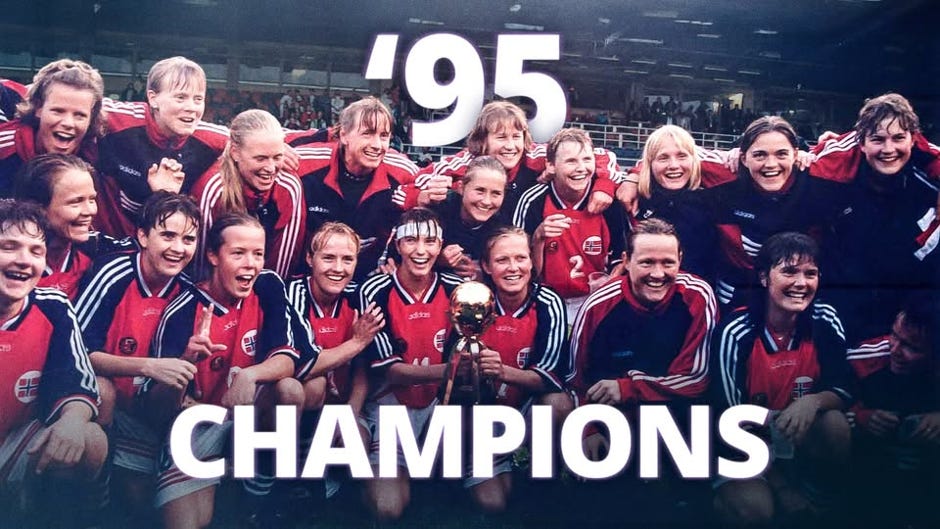
The story is that the key ingredients that footballing dads across Europe and beyond, pass to their kids are not just good genes, but inspiration and love for the game. Well, it’s hard to believe that the ladies winning the World Cups don’t have talent, or can’t inspire and instill love for the game. Or is it maybe the system and environment?
Cynics will say, it’s because most are gay, and don’t have sons in the first place! Whatever the case may be, it’s an interesting question to which I don’t have a definite answer.
I suppose, I now need to conclude with a deeply thoughtful recommendation on what the national federations should be doing to improve the level of their national teams. But avoid the same stuff that everyone else has been putting out.
The best I can come up with is – maybe have your best footballers stop chasing folk singers and Love Island contestants, and start marrying girls winning medals in athletics.
Thanks for reading,
Nikola
No posts
Comments
Nothing yet. Say the first thing.
Sign in to join the conversation.