

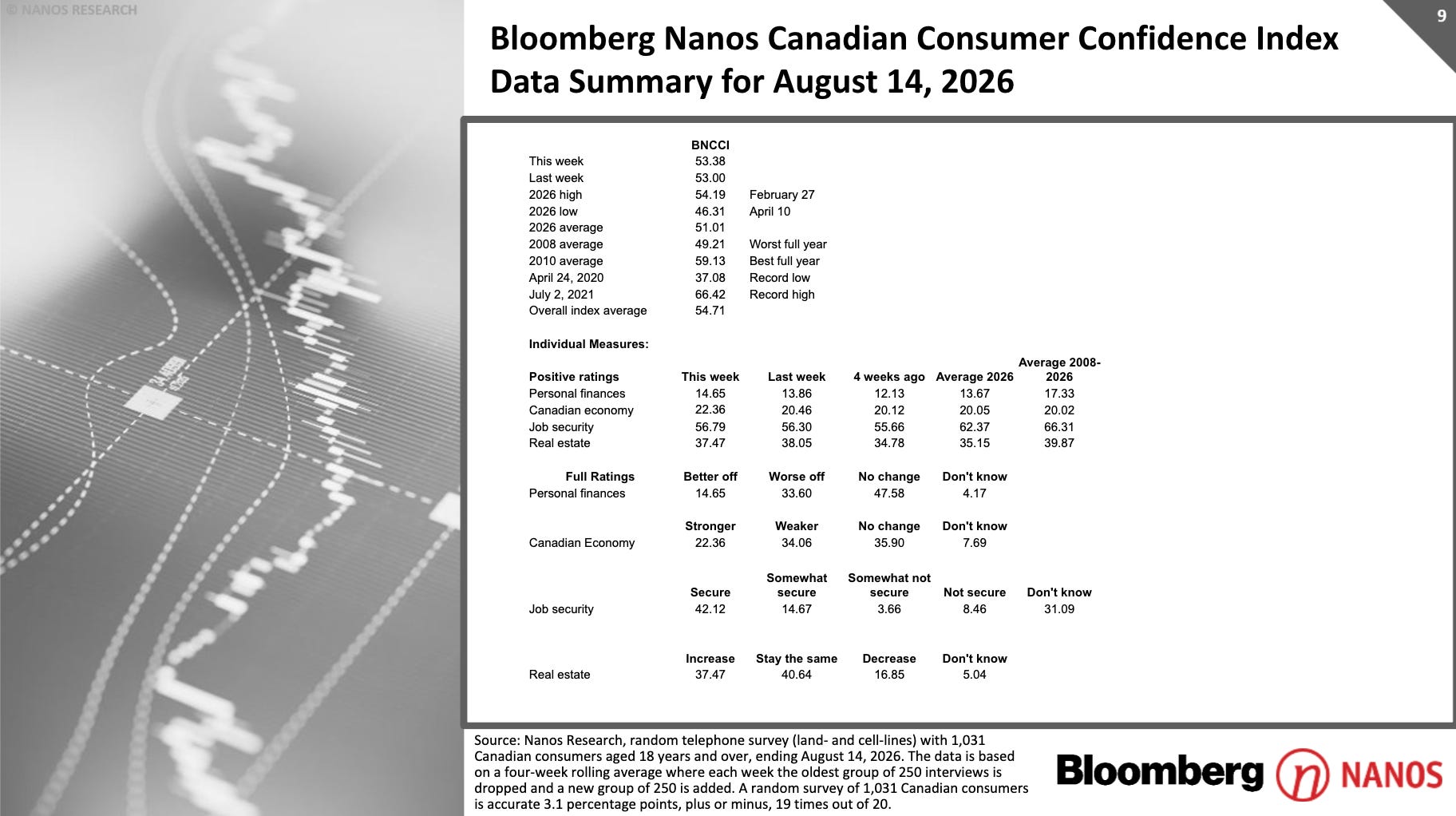
Canadian consumers are showing greater confidence in the economy than they did earlier this spring, though optimism remains cautious rather than exuberant. The Bloomberg Nanos Canadian Confidence Index climbed to 53.4, up from 51.4 four weeks earlier and above the 2026 average, reflecting a gradual improvement in perceptions of both household finances and future economic conditions.
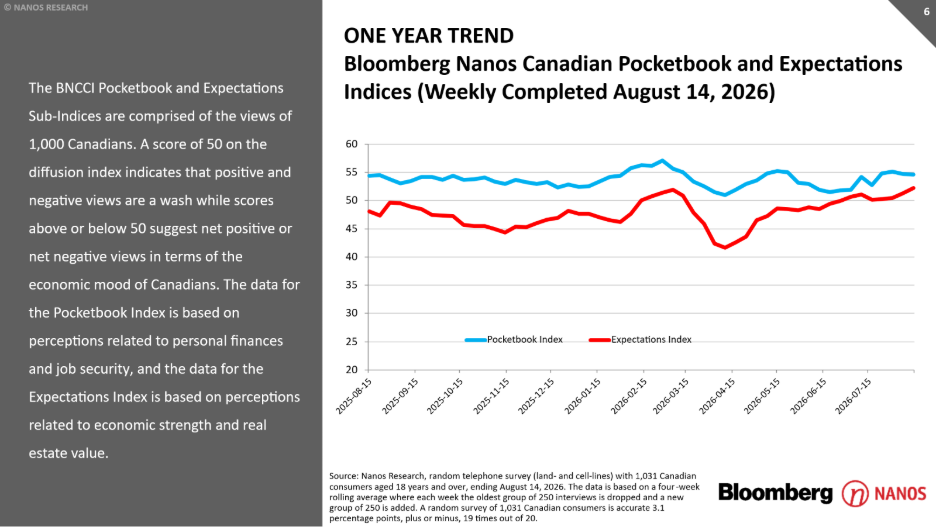
The recovery is being driven by gains in both the Pocketbook Index, which captures views on personal finances and job security, and the Expectations Index, which measures views of the broader economy and housing market. Expectations have strengthened notably in recent months, reaching their highest point of the past year, suggesting Canadians are becoming more confident that economic conditions may stabilize after a period marked by uncertainty.
Yet confidence remains tempered. Canadians are still more likely to believe the national economy will weaken rather than strengthen over the coming months, and more report being financially worse off than better off compared with a year ago. While personal financial assessments have improved, they remain below long-term norms.
The result is an economy that appears to be regaining balance. Confidence is edging higher, expectations are improving, and concerns have eased. But conviction remains elusive, with households still wary of the economic road ahead.
For this report and other Nanos data points visit www.nanos.co.

The BNCCI is produced by the Nanos Research Corporation, headquartered in Canada, which operates in Canada and the United States. The data is based on
random telephone interviews with 1,000 Canadian consumers (land- and cell-lines), using a four week rolling average of 250 respondents each week, 18 years of age and over. The random sample of 1,000 respondents may be weighted using the latest census information for Canada.
The interviews are compiled into a four week rolling average of 1,000 interviews where each week, the oldest group of 250 interviews is dropped and a new group of 250 interviews is added. The views of 1,000 respondents are compiled into a diffusion index from 0 to 100. A score of 50 on the diffusion index indicates that positive and negative views are a wash while scores above 50 suggest net positive views, while those below 50 suggest net negative views in terms of the economic mood of Canadians.
A random telephone survey of 1,031 consumers in Canada is accurate 3.1 percentage points, plus or minus, 19 times out of 20. This report is based on the four waves of tracking ending August 14, 2026.

Data Summary RELEASED for August 14th, 2026.
If you are not on our distribution list and wish to receive automatic poll and media updates by email for free go to the main Nanos site or our Substack and submit your email address. Thanks for your interest in our data. Feel free to forward this email.

Delivering world-class solutions since 1987, we are the leader in high velocity data insights and visualization.
Contact us today or visit our website
Comments
Nothing yet. Say the first thing.
Sign in to join the conversation.