

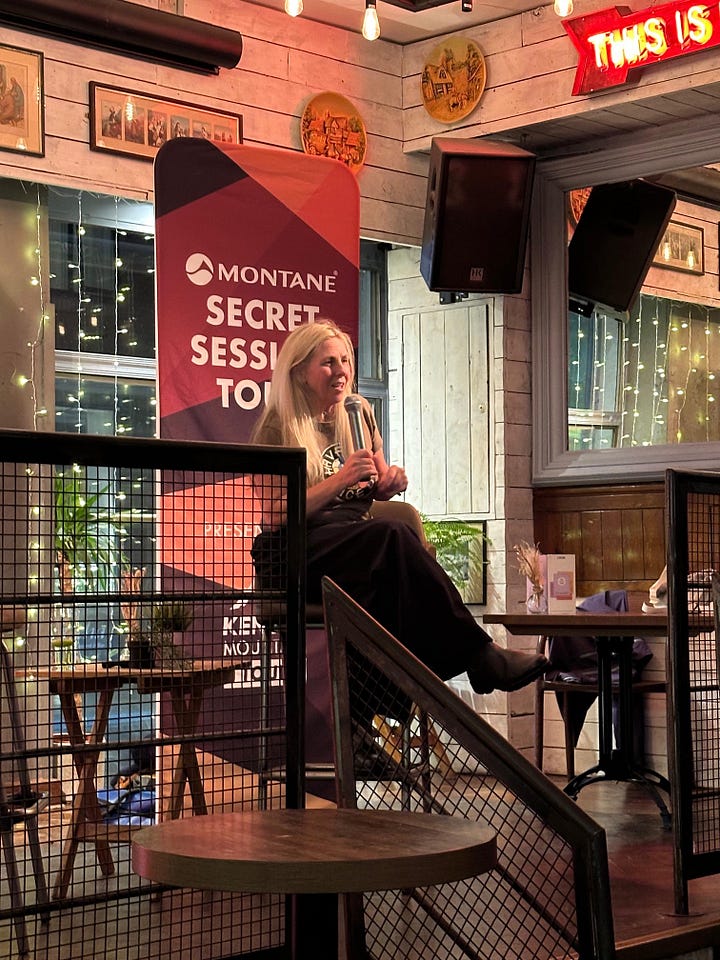
The past weekend I was the secret guest at the Kendal Mountain Festival Secret Session in Sheffield. I spent the evening talking about my love for running and the adventures it’s taken me on — and, inevitably, I mentioned being scared.
More than once.
At the end of the night, someone asked me a simple but powerful question:
“How do you deal with being scared?”
Trust me — sitting in front of a crowd, trying to be articulate while telling an engaging story, is scary in itself.
In the moment, standing there and looking out at the room, there’s a definite flutter in the gut. A brief but convincing thought: maybe I should just run away. Then I remind myself — the crowd is there to hear, not jeer.
Although… the set-up on the night didn’t entirely help. The raised stage where we were sitting had a short fence barrier around it (see happy snaps), and my brain immediately went to The Blues Brothers - that scene in the American roadside pub where the band starts playing and the crowd responds by hurling beer, bottles, furniture, and occasionally people.
Hello, wild imagination. In my head, the audience were moments away from re-enacting that scene.
Settle down, brain. Settle down.
So while I’m sitting there, all of this is happening at once - in my body and in my head.
I start flicking through my mental memory bank: How have talks gone before?
And honestly - it’s been a mixed bag.
I’ve stood in front of hundreds of people and had talks flow smoothly. I’ve enjoyed myself. I’ve had positive feedback afterwards.
I’ve also stood in front of hundreds of people and gone completely blank. That was pre-HRT medication, during perimenopause, when brain fog was doing a real number on me. That experience hurt my head, hurt my ego, and knocked my confidence.
I’ve stood in front of people - felt overwhelmed, jabbered on, and then cried because I couldn’t pull myself together.
So in that moment on stage, all of that flashes through - body sensations, past experiences, emotional memory. Immediate fear responses mixed with more habitual ones. Fear as a moment, and fear as a mood.
That’s just one example of being scared. I’ve got plenty more, but for this piece, I’ll stick with this one.
All of those thoughts, reactions, and memories were there - and I gave an answer to the question in the moment. But it wasn’t as clear as I’d have liked.
Part of what I touched on was immersion therapy - the idea that doing the thing that scares you, again and again, genuinely changes your relationship with fear. You’ve probably heard the phrase “get comfortable being uncomfortable.”
That is part of it.
But it’s not the whole story.
So I wanted to give that question the time it deserves.
Here’s how I actually cope with being scared.
I start by understanding that being scared is an immediate response to the environment.
Someone jumps out and says “boo” - your body reacts.
You’re running along the side of a road and a big road train nearly wipes you out - fear kicks in.
You think about wildlife, you see wildlife, you’re chased by wildlife - it’s scary, and that response is there to tell you something matters.
In those moments, fear is asking you to either stop putting yourself in that situation, or to recognise the fear, make a risk assessment, and decide whether to keep moving or get out.
That scared response is functional. It’s doing its job.
Psychologically, fear is meant to be short-lived and situational. It’s there to protect you in the moment. Problems tend to arise when fear stops being a moment and starts becoming a mood.
That’s where the difference between real, physical risk and imagined risk matters.
Sometimes we’re scared because there’s a genuine danger in front of us. Other times, we’re scared because our imagination has taken a small uncertainty and turned it into a long list of everything that could go wrong. That’s where fear can shift from protecting us to restricting us.
The key question I always come back to is:
Is this fear helping me… or is it stopping me?
When fear becomes a mood rather than a moment - when it stops you going out, putting yourself forward, or trying things - it can slide from functional into dysfunctional. That’s where we see fear of failure, fear of success, avoidance, or even self-sabotage.
The behaviour changes not because you can’t do the thing, but because fear has quietly taken over the decision-making.
So I break it down.
I separate:
Reality risk - what could actually happen
Imagination risk - what my mind is adding on top
Then I ask:
What can I mitigate?
What can I plan for?
What can I problem-solve?
What’s actually within my control?
This is also where immersion therapy often gets misunderstood. It’s not about throwing yourself in at the deep end and hoping for the best. It’s about gradual exposure - choosing to stay with discomfort in manageable doses, long enough to learn that you can cope.
It’s fear, with agency.
Yes - there is always a chance something might go wrong. You might get scared. That’s unavoidable.
But the real skill isn’t eliminating fear.
It’s learning that you can hold the hand of the scared version of yourself and keep going anyway.
You don’t wait for fear to disappear.
You move with it.
Alongside it.
In conjunction with it.
And you learn - through practice - that being scared doesn’t necessarily mean you shouldn’t keep going.
And that’s how I deal with being scared.
No posts
Comments
Nothing yet. Say the first thing.
Sign in to join the conversation.