
The kun (native) reading of 機 is hata. I never knew that, even though it’s actually a Joyo reading. Hata means loom. And from that simple native Japanese word extends a remarkable web of meanings extending from machines, to opportunities, to points in time, to working, and even to secrets.
It shouldn’t be surprising that 機 has the reading hata. We all know 機 from its use in compounds like 機械 (kikai, “machine”). And looms are of course machines, maybe one of the oldest kinds, and were originally made of wood—hence the tree radical in the character.
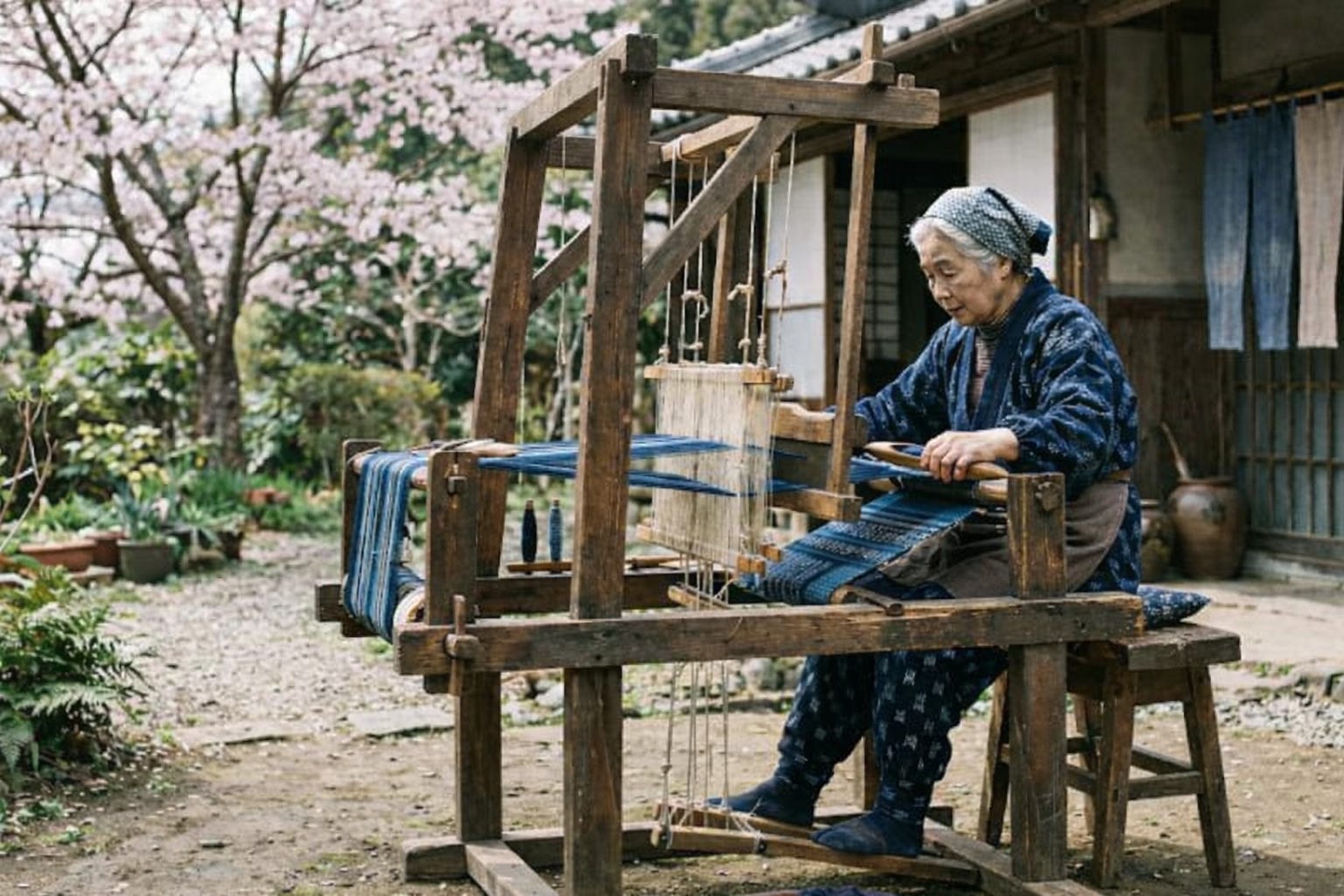
Now we all know another hata, meaning “flag”, usually written 旗. That’s a completely unrelated word, right? Wait…could it be? Yes, these are the “same” word. After all, what is a flag but a piece of woven cloth, as created by a loom? Once again, we see the unique Japanese lexical trick of using the same word for what produces something and the thing produced. Common examples are hana, which can mean both nose and nasal discharge, and chichi, which can mean both breast and breast milk.
And there’s another hata written 幡, meaning banner—a different kind and shape of woven cloth.
And let’s not forget hata-hata—the sound of a flag fluttering in the wind. The word sits on a spectrum: はたはた (light flutter) → ぱたぱた (stronger) → ばたばた (vigorous flapping). We discussed this in a previous article. Then there’s the little-known (to me at least) verb はためく, which means to flutter, and can be applied to flags, of course, but also a bird flapping its wings.

I’m just making this up, but what if pre-proto-Japanese started off with the word hata-hata for the actual sound of the fluttering, and then extended that to hata meaning the flag, the thing that was making that sound, and then extended it further to mean the loom, the thing that was making the flag?
It turns out that banners were often hung by their sides on vertical poles. Historically, flags were long, narrow streamers of cloth that hung or fluttered on the edge of a mast or a pole, effectively acting as the side or fringe of a banner system. And from this derived, or was derived, yet another meaning of hata, namely “side” or “edge” (written as 端).
But Japanese didn’t stop there. It continued relentlessly squeezing additional meanings out of hata. Any idea where I’m going with this? Operating the loom was such an iconic form of work that the “doing of hata work” became a shorthand for work itself, in the form of hataraku! The suffix -raku (らく) is a well-known Old Japanese suffix that could turn a root into a verb — so hataraku literally means to do the work of the hata. The Japanese were so unsatisfied with any of the existing Chinese characters for this quintessentially Japanese concept that they had to come up with their own: 働く, a so-called kokuji, or home-grown character.
And is it a coincidence that the age of twenty (二十歳, hatachi), at which you become a full member of society shares its sound with the word for the loom—the archetypal productive work?
Let’s take a closer look at the character 機.
On the left is the tree radical 木 (*ki*, tree, wood). Looms were built from wood, and the radical tells you so plainly.
On the right we have: 幾 (ki). This component is doing double duty. It supplies the character’s on reading—キ—functioning as the phonetic element. But it also carries meaning. Look closely at 幾 and you’ll find 幺幺, a pair of coiled, twisted silk hreads, one of the oldest graphical elements in Chinese writing, dating back to more than 3,000 years ago. The original sense of 幾 was something like the subtle, the fine, the almost-imperceptible—the moment where things could tip either way, the threshold you can barely see. Today in Japanese it’s used to write words like 幾ら (ikura, some) or 幾分 (ikubun, “somewhat” or “a little”), although hiragana is much more common.
This character in its meaning of “machine” is used in countless compounds, including many instances where English wouldn’t explicitly say “machine”. Examples:
飛行機 (hikōki, lit. “flying machine”)—an airplane). They even use 機 to count them
掃除機 (sōjiki, lit. “cleaning machine”)—a vacuum cleaner)
機械 (kikai)—machine, mechanism (機 + 械, two characters both meaning “mechanical device,” doubling down on the idea)
機能 (kinō)—function, capability
計算機 (keisanki)—calculator, computer (a calculating machine), which believe it or not is what they used to call computers way back when I first got into the field
機械語 (kikaigo)—machine language, for those of a certain generation
But the meaning of 機 goes far beyond “machine”. In fact, it’s one of the most semantically productive characters in the entire language. Think about what a loom actually does. It’s the place where separate threads converge—warp and weft meeting at a precise point to create the pattern. And from that image, Japanese gets an entire vocabulary related to unique points in time, crucial points in time where things converge and something is happening or about to happen or could happen. This was quite a semantic leap. All this time I’d been studying Japanese I had this lingering doubt about why the character for machine also had meanings related to time and opportunity, but now I know. There are innumerable compounds using this meaning:
機会 (kikai)—opportunity. Literally: the moment (機) when things meet (会). The point where the threads of circumstance converge in preparation for something to happen
好機 (kōki)—a good opportunity
転機 (tenki)—a turning point (the pattern shifts)
危機 (kiki)—crisis (the moment where dangerous threads converges)
投機 (tōki)—speculation (throwing yourself at an opportunity)
And then we have 機密 (kimitsu), meaning secrets or classified information. What's the 機 doing in there? What does that have to do with machines or looms? This is another semantic leap. Well, the loom’s pattern isn’t visible until the cloth is woven. You see threads going in, you see fabric coming out, but the design itself emerges only through the process. From this image, 機 extends into the realm of what’s hidden, interior, not yet revealed, giving us 機密, meaning the “sealed internal workings”. Another example is 動機 (dōki), meaning what moves the internal workings.
Taken together:
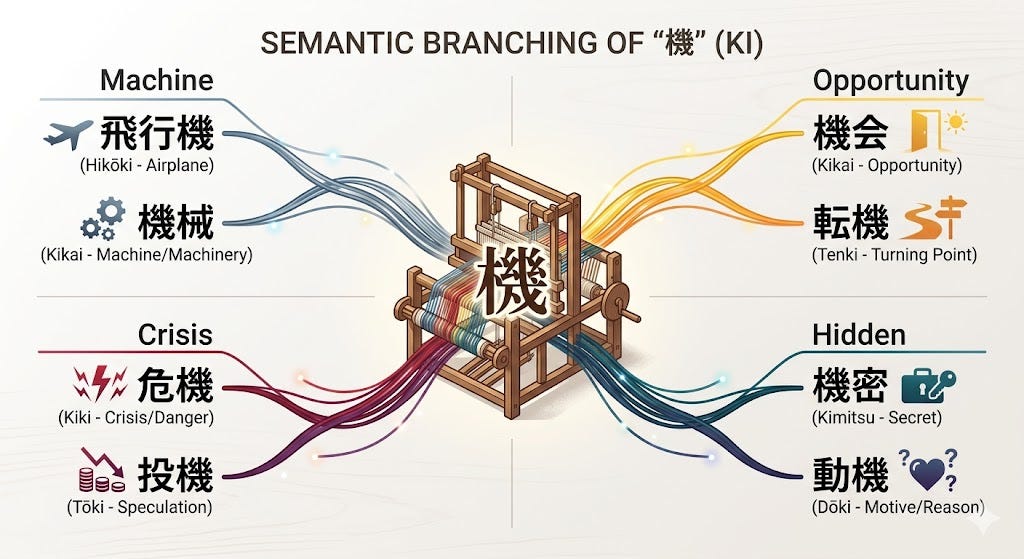
The loom, it turns out, has been weaving time itself.
機嫌 (*kigen*)—mood, humor, disposition—uses 機 alongside 嫌, a character associated with dislike or aversion. Why would “mood” be written as the convergence point (機) of aversion (嫌)? What does that say about how Japanese understands the inner weather of a person?
Comments
Nothing yet. Say the first thing.
Sign in to join the conversation.