
If you’ve been studying Japanese for a while, you may have come across the word くわだてる (kuwadateru), meaning to plan, to scheme, to undertake. It’s not a word most learners encounter early. It’s classified as JLPT N1—the highest level—and it doesn’t show up in everyday conversation the way 計画 (keikaku) or 予定 (yotei) do. You can go years in Japan without hearing it. But when you do encounter it, there’s a wonderful story hiding inside it—actually, two stories, one Japanese and one Chinese, and they arrive at the same meaning from completely different directions.
The basic meaning is to plan, but it leans toward the ambitious end of planning. It’s not about deciding what to have for dinner. It’s about hatching a scheme, launching an undertaking, attempting something significant. The noun form is 企て (くわだて) — a plan, a plot, an enterprise. There’s often a whiff of audacity about it, sometimes even conspiracy. A coup d’état is a 企て. So is a bold business venture.
Now say the word slowly: くわ・だ・て・る. Does that first part—くわ (kuwa)—ring any bells?
くわ is a hoe. It is usually written 鍬. I first learned this character when I met a friend named 鍬守 (Kuwamori). The English word “hoe” is one of those humble, almost invisible words, and so is its Japanese counterpart. The くわ is one of the most fundamental Japanese farming tools, with a flat metal blade set at an angle on a long wooden handle. You use it to break soil, to dig furrows, and to turn earth before planting. Along with the 鎌 (kama, sickle) and the 鋤 (suki, plow), it is one of the iconic implements of Japanese agriculture.
And たてる (tateru)? That’s 立てる—to stand something up, to set something upright.
So くわだてる is, at its root, standing up the hoe. Picture a farmer at dawn, driving the blade of his hoe into the earth, or planting it upright in the soil beside him. This is the first act of the working day—the moment of preparation before the real labor begins. From that concrete agricultural gesture, the meaning expanded: to prepare, to set things in motion, to plan.
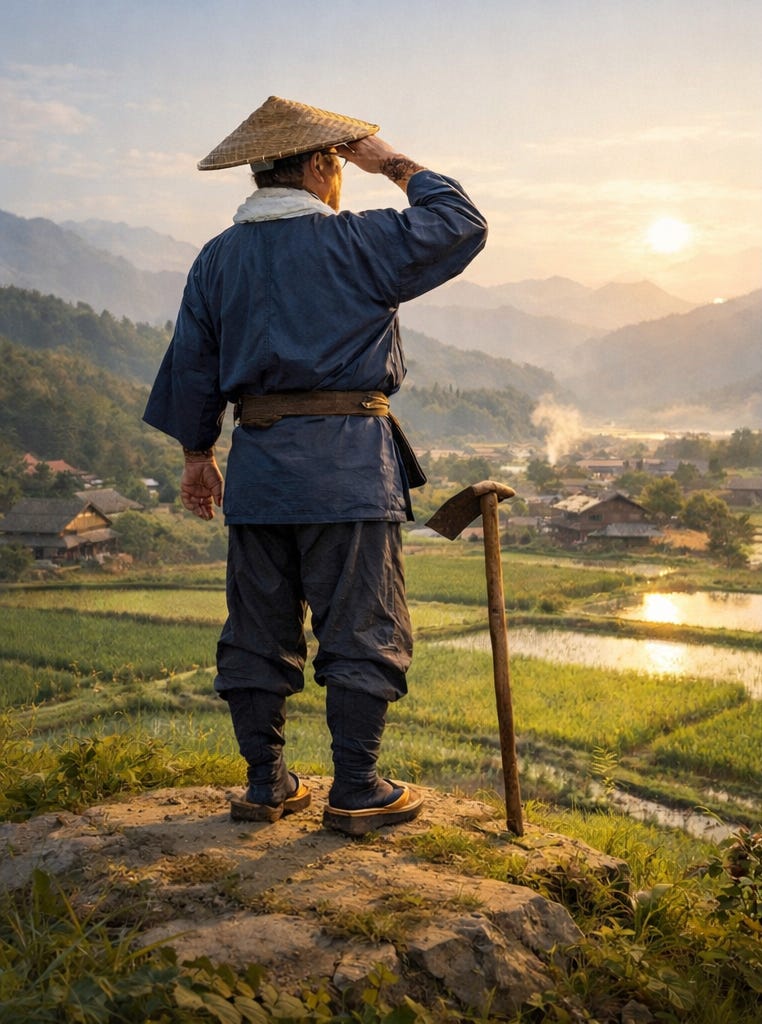
It’s a beautiful etymology, grounded in the physical world the way so many of the best Japanese words are. You don’t just “make a plan”—you stand up your hoe. You commit to the work ahead.
The kanji assigned to this word is 企. Take a look at it. The top part is 人 (person). The bottom part is 止, which in its ancient pictographic form represented a foot. So it’s a person raised up on their feet. Standing on tiptoe, straining to peer into the distance. When you’re looking ahead with intent—anticipating, scheming, trying to see what’s coming — you rise up on the balls of your feet. That physical posture of forward-looking intent became the Chinese meaning: to plan, to scheme.

So the character tells a completely different physical story from the word. The word is about a farmer and a hoe. The character is about someone on tiptoe, craning to see the future. But they both arrive at the same destination: planning.
This is yet another example of the Japanese writing system revealing its layered nature. When scholars were assigning Chinese characters to native Japanese words over a thousand years ago, they didn’t need the character to capture the same physical image as the word. They just needed a character that meant the right thing. 企 meant “plan”—perfect, that’s what くわだてる means. The fact that one is about tiptoes and the other is about hoes didn’t matter. The semantic match was good enough.
This happens all the time with kun’yomi readings, and it’s something worth keeping in mind as a learner, and something we’ve seen over and over again. The kanji and the Japanese word it’s assigned to may have completely independent origin stories that happen to converge on the same meaning. They’re two separate archaeological layers in a single word.
Even though くわだてる itself is relatively uncommon, the character 企 is everywhere — it’s ranked 508th among the most frequently used kanji. You encounter it constantly in its on’yomi reading き (ki), in some of the most common words in modern Japanese:
企業 (きぎょう/kigyō)—enterprise, corporation. This is the standard word for “company” in formal and business contexts. 企業文化 (kigyō bunka) is corporate culture. 中小企業 (chūshō kigyō) are small and medium enterprises. You’ll see this one in newspapers every single day.
企画 (きかく/kikaku) — a plan, a program, a project. If you work in any kind of organization in Japan, you’ll hear this word constantly. It’s the everyday word for planning in a business or creative context—a TV program is a 企画, a marketing campaign is a 企画, a product development initiative is a 企画. There’s even a job title: 企画部 (kikaku-bu), the planning department.
Here’s a question for self-study or to ask your favorite AI chatbot. We said that 企業 means enterprise or corporation. But what does 業 (gyō) contribute? It’s a character with a surprisingly wide range of meanings—from business to karma. What’s the logic that connects a company (企業) to Buddhist karma (業)?
I know $5/month is a large commitment for many of you. But if you’re so inclined you can buy me a coffee here.
Comments
Nothing yet. Say the first thing.
Sign in to join the conversation.