
The Japanese word kangaeru carries an expectation of effortful, transformative cognition—that you haven’t truly 考えた until your understanding has shifted. In Part 1, we traced 考える (kangaeru) from its earliest attested form kamugapu in the Nihon Shoki through three alternative etymological theories, and discussed the visual story of the character 考 used to write it. Now let’s dive deeper into how kangaeru works in practice, starting with a grammar point that has been producing bad translations for decades.
Almost any Japanese academic paper you read—linguistics, history, literary criticism, anthropology—will use the phrase 〜と考えられる (to kangaerareru) within the first few paragraphs, probably more than once. The great majority of English translations will render this as “is thought” (the passive reading of ーられる). That reading is almost always wrong.
The suffix ーられる is genuinely ambiguous: it can mark passive voice or potential (in addition to honorific). The problem is that many translators reach for the passive by default, producing a translation that implies some unnamed collective has already arrived at a conclusion—as though the author were citing consensus rather than providing their own reasoning.
What 〜と考えられる actually signals is a careful claim by the author or authors: they have thought the problem through and reached some defensible conclusion. In other words, the evidence, examined soberly, can support this view. The subject is not some anonymous consensus of scholars but the author—or, by implication, any reader willing to follow the same chain of reasoning. The potential reading is: this conclusion is justified, by someone prepared to apply the effortful cognition that kangaeru implies.

There’s a practical reason this matters beyond accuracy. Japanese academic prose is scrupulously careful about distinguishing personal conclusions from received wisdom, and it has different constructions for each. 〜と言われている (to iwarete-iru, “it is said that”) and 〜とされている (”it is considered that”) are the forms that genuinely cite consensus; 〜と考えられる is not. Translating all three with passive-voice English erases distinctions the author went to some trouble to maintain.
Translations that often work for 〜と考えられる include “it is plausible that,” “one can conclude that,” “conceivably”, “it follows that,” and “the evidence supports the view that.” The right choice depends on context, but all of them correctly convey the sense of a conclusion that has been reasoned toward, rather than passively inherited.
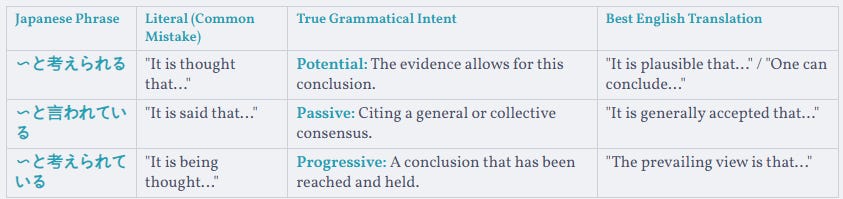
One related form is worth distinguishing. 考えられている (kangaerareteiru) adds the progressive marker teiru, and the meaning shifts. Where the bare potential says that a conclusion is reachable, the progressive says that it has been reached and is being held—the current, settled view. “It is generally held that” or “the prevailing view is that” are closer translations. Japanese keeps that distinction grammatically visible, and of course it should be kept visible in English too.
These alternatives can be summarized as follows:
The best way to sharpen the picture of kangaeru is to compare it to 思う (omou), which also corresponds to English “to think”. But there is a stark distinction with kangaeru.
思う is thinking as arriving: the thought surfaces, presents itself, comes to the front of mind. As I explored in an earlier post on 思う, the word shares its root with omote (面, front/surface): when something comes to mind, it comes forward, and may even show on your face.) You can 思う something in an instant. 考える is thinking as building; you turn toward the problem, exert mental effort, work it through, and ideally emerge with something changed. It takes time by definition.
There is a compound that helps make this clear: : 思考 (shikō, “thought” in its fullest sense) joins both characters. The pairing suggests that neither alone is sufficient—that real thinking requires both the arising (思) and the working-through (考), the thought that comes to you and that you then work through.
Then we have 考えられない (kangaerarenai, unthinkable), It doesn’t mean merely “I can’t think of it”; it means the thing lies outside the range of what deliberate thought can reach. It’s outlandish, it’s inconceivable, no amount of deliberation could possibly produce that conclusion.
The character 考 appears in any number of common words. 参考 (sankō, reference, consultation) is everywhere: 参考書 (sankōsho) is a study guide or reference work, and 参考にする means “to use as a reference.” It literally means “participating in the kangaeru process”. 考慮 (kōryo, consideration, deliberation) is the word of careful weighing. 考察 (kōsatsu, analysis, inquiry) is the vocabulary of sustained investigation—a kōsatsu is not simply an opinion but an examination.
The regard for deep thinking runs deep in Japanese culture. Other examples include 反省 (hansei, reflection, self-examination), which is expected after failures and even after successes—not optional soul-searching but a structured cognitive exercise. The entire 改善 (kaizen, continuous improvement) notion is a commitment to ongoing deep examination.
One phrase worth holding onto is 考える力 (kangaeru chikara, “thinking power”)—the capacity for independent deliberate thought. It appears in debates about education, in corporate training materials, and in books on child-rearing. That it needs to be named at all, that thinking power is understood as something cultivable or losable, tells you something about how effortful, and how valued, this kind of cognition is considered to be.
A language that gives deliberate, transformative thinking its own verb—distinct from mere feeling or impression—has been shaped by a culture which greatly values that approach to thought.
Comments
Nothing yet. Say the first thing.
Sign in to join the conversation.