
“Hey Bob, how much of this stuff are you just making up anyway?”
An entirely reasonable question, which I have been asked in various forms. For example, one reader wondered why I didn’t invite knowledgeable linguists or language learning specialists for guest pieces or discussions. That’s a good idea; I’ll work on it. Let me know if you have any proposals.
Let’s remember, though, that a lot of Nihongoism content is not anything that one could “make up”; it’s about known aspects of vocabulary and grammar that I’m merely presenting hopefully in a more digestible way; translation issues, including snarky comments on other people’s translations; and opinions about things like the relationship between AI and language learning.
But when I veer off into more perilous territory like the relationships between modern Japanese words which people—be they native speakers or language learners—do not typically perceive as connected, but might be, like 鼻 (hana, nose) and 花 (hana, flower), or identify some interconnection between a language phenomenon and Japanese culture, readers do deserve to know the degree of authoritativeness behind such claims, and iundeed I may have been somewhat lax in failing to make that clear. I should, even though the focus of this publication is not historical Japanese linguistics in the scholarly sense; it’s presenting aspects of Japanese with a historical slant which are fun and hopefully helpful.
Full disclosure: I am a scholar of neither Japanese nor of the history of Japanese. I’ve never taken any kind of class about Japanese in my life. I am a complete, unrepentant autodidact. I have read dozens or more likely hundreds of books on these and related topics, and done hours of research online. Yes, some of this research is done by AI these days, but I personally don’t see much difference between sending an AI off to gather information and theories on the word kata (I will avoid giving an English translation here, for reasons to become clear), and write up the results as research notes, versus sending off a human research assistant (except that the AI would probably do a better job). I’m not talking about using AI to draft articles, obviously.
And in the area that I focus on a lot, which is the lexical evolution of Japanese over the centuries, I am familiar with many of the basic concepts. For example, amateur linguists might excitedly identify a possible connection between me meaning sprout (芽) and me meaning eye (目). After all, in English don’t we say “eye of the potato”? And like an eye a sprout is round and opens and closes. But this folk etymology is disproven by the fact that the “e” letters here are different, or rather were different back in the old Japanese period (approximately 400—800 AD). That’s right, back then there were two different “e” sounds! They can be called e1 or e2. Or 乙類 (otsu-rui) and 甲類 (kourui). Or Type A and Type B. There were also two varieties of “i”, and “o”.
Is one of the of those old “e” sounds the one we have today, and then then other one merged into it? Or did two different sounds both a bit different from today’s combine to form the “e” we know today?
And more interesting, how did these old “e” sounds actually sound? There has been more research into this topic than you could imagine. The phonetics reconstructed by Hashimoto, who identified these extra old vowels is that me1 might be closer to “mye”, and me2 might be closer to “mey”.
So impress your friends and drinking buddies and parents-in-law by asking them if they knew that Japanese used to have eight vowels, not five!
There is a fascinating story of how linguists finally figured out that there were two “e”’s and “o”s and “i”s. Perhaps my readers are acquainted with the 万葉集 (Man’yōshū), the book of poems written towards the end of the Old Japanese period. It is notable for being written entirely with Chinese characters used for their phonetic value (as well as some for their logographic value) to represent Japanese words. For instance, the syllable me for eye might have been written 米, while the one for sprout might have been 梅. Now, it’s expected in Man’yōgana (the name of this writing system) for the same syllable to be written using a variety of different kanji, depending on the mood of the writer or the desired poetic effect. But an eagle-eyed scholar in the early 1900s noticed that there was a pattern to which kanjis were chosen, namely that the kanji chosen for a particular syllable for a particular word would inevitably come from one particular set, while that chosen for other the syllable in other words would come from another. Closer examination of the entire corpus (today it would be a quick Python program) then validated this thesis.
If you’re interested in how old Japanese might sound, using these eight vowels (and also more consonants than modern Japanese), search YouTube for “old Japanese”, and you’ll find things like
This bifurcated vowel theory also allows us to disprove armchair guessing that 火 and 日 are cognate: after all, is the sun not “the great fire in the sky”? But no. The first is (was) hi₂ and the second hi₁.
Just one more example before we move on. Let’s consider kami meaning hair and kami meaning god. What could be clearer: both god(s) and your hair are in an upward direction, and by golly, there’s another kami (上) which does mean “upper”! But are these the same mi vowel sound? As it turns out, they’re the same, both mi2!. But that in itself is not proof. The difference in between otsu-rui and kō-rui vowels can be used to disprove lexical descendancies, but not prove them. In this case, these words are not considered cognate, even though they all use the same flavor of “mi”. It was the noted linguist ONO Susumu that explained that a mirror on the wall of a shrine can be a kami, but it is not “above” anything—so it’s a different “word”, a homophone.
The merger of these multiple vowel sounds occurred during what is called the Early Middle Japanese period, from approximately 800—1200 AD.
So: when I present a proposed relationship between Yamato kotoba words and modern Japanese, if I’m hypothesizing, or there is legitimate difference of opinions whether two words are related, I present both sides. If I present a more definitive view, I’ve actually already done the kō/otsu test, or made sure that someone else has, leveraging this century of historical linguistics. When I present such a relationship, I also consult as many available sources as possible to validate the theory. For instance, for kata I consulted dozens of entries in the 日本国語大辞典 (Nihon Kokogo Dai-jiten, also known as Nikkoku. It’s a ridiculous fourteen volumes, the largest Japanese dictionary in existence. You can visit the Japan Knowledge site for more information. Here’s the page for one of the head words it uses for kata. Like other dictionaries of similar lexicographic scope, it is replete with etymological and phonological information. Here’s the entry for one of the kata headwords:
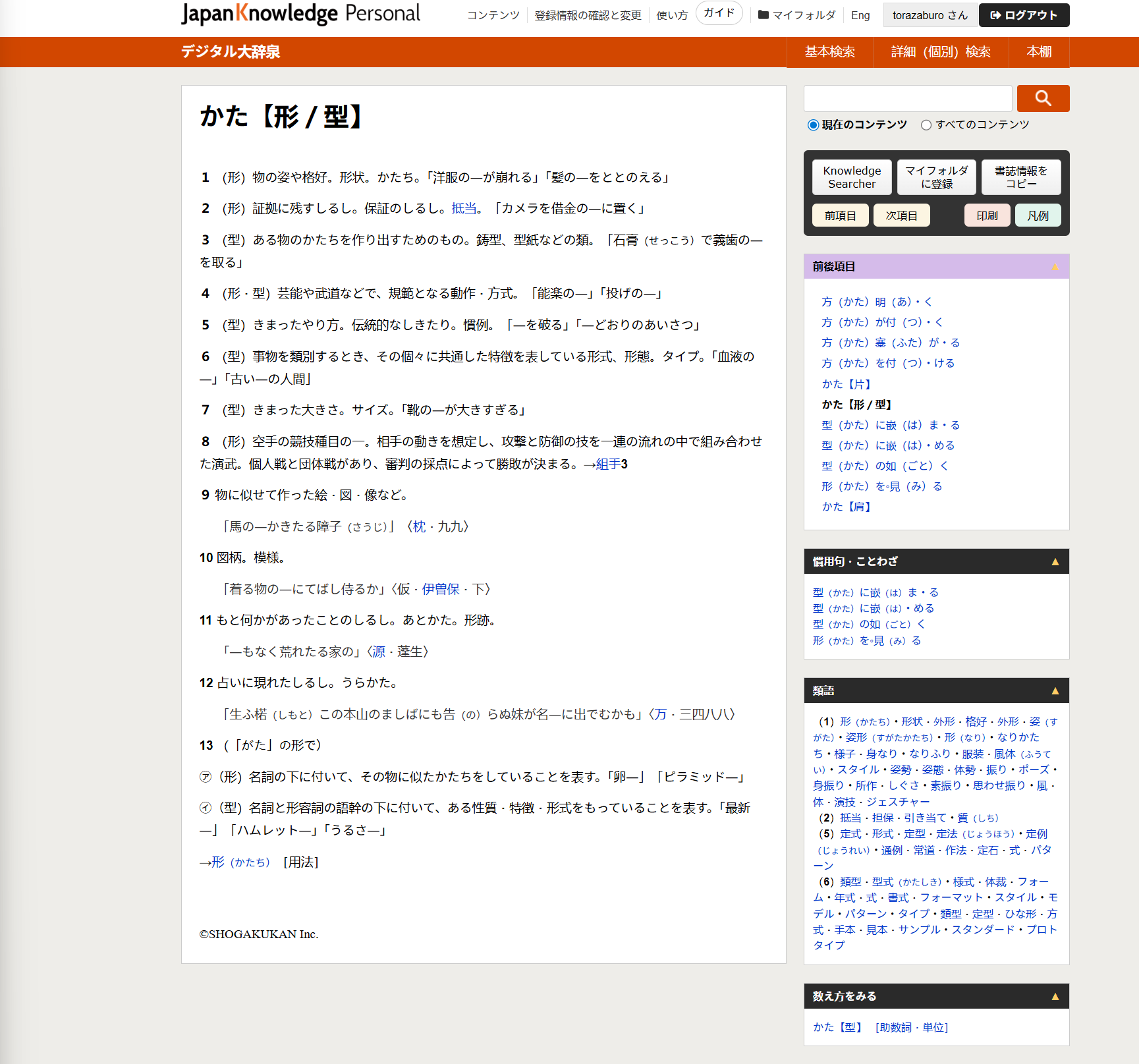
So no, I’m not making it (completely) up.
And now, finally, back to kata — the word I refused to translate above. Kata in modern Japanese sits on top of half a dozen meanings, which in English might be expressed as form, mold, shoulder, side, fragment, person, direction, shape. Some of those may share an Old Japanese root. Some plainly don’t—they’re just homophones. Some are open questions. And just for fun there are a dozen or more Chinese characters used to write all of these meanings (方片肩型潟形容象).
We’ll be digging into kata in the next article(s), from all your favorite Nihongoism perspectives. What surprising words actually are related to or derived from kata (hint: 語る (kataru), 刀 (katana), 姿 (sugata), 片付ける (katazukeru), 固い (katai)). Knowledge like this can make Japanese easier to learn, teach, and remember. What do these lexical groupings tell us about the worldview of the Yamato people, and by extension that of modern Japanese? Knowledge like this can make Japanese culture easier to grasp and relate to. What polyvalent Chinese character assignments were made to the word kata? Knowledge like this can tell us about how the Japanese viewed the semantic graph, and by extension how the Chinese parsed the universe of concepts they were inventing how to write.
Comments
Nothing yet. Say the first thing.
Sign in to join the conversation.