
Note: this is an expanded version of an essay first published on Firstpost.
I spent 40 years in the international shipping industry, in London, Tokyo, Singapore and Dubai. When I decided to write a book on the history of maritime trade, I had no academic position to defend and no orthodoxy to uphold. But I had a working knowledge of how trade actually functions and a professional habit of asking challenging questions and following evidence wherever it led.
When I followed the sea lanes backwards into deep antiquity, I found that they converged on the Indian subcontinent. That was not the book I had intended to write but the book the evidence forced me to write. The more I looked, the more I came to understand that the conventional account of the ancient world had been built on a set of assumptions that nobody had thought to question for a long time.
This essay is about those assumptions.
In the second half of the nineteenth century, European archaeologists made a series of remarkable discoveries in the deserts of Mesopotamia. They unearthed Sumerian cuneiform tablets at Ur and Nineveh, the Code of Hammurabi at Susa, the ziggurat of Eridu, the palaces of Assyria. These were genuine and important finds. They were also conveniently located. The hot, dry climate of Mesopotamia preserves clay, brick and bone beautifully. The biblical and classical sources that European scholars had grown up reading pointed them to this region. The Ottoman authorities permitted excavation, and the political geography of the late nineteenth century made the area accessible to European expeditions.
So they dug there. And what they found became the foundation of the standard account: Mesopotamia as the cradle of civilisation, the birthplace of writing, of urbanism, of law, of mathematics. The story moved from Mesopotamia to Egypt to Greece to Rome to Christendom to modern Europe in a tidy westward arc, with India appearing only as a colonial possession at the end of it.
What they did not do, for reasons that had everything to do with geography and politics and very little to do with evidence, was dig with comparable intensity in northwest India. The first major site at Harappa was identified in 1842 but not seriously explored until the 1920s. Mohenjo-daro was discovered only in 1922. Even after these excavations began, the dominant assumption was already set. Anything found in India had to be explained as derivative, imported, or coincidental.

The Indus-Sarasvati civilisation was not derivative. It was the largest and most economically productive society of the ancient world.
By the middle of the third millennium BC, it supported about three hundred riverine cities, each with populations of over fifty thousand people. Two thirds stood on the banks of the Sarasvati, the central of the seven rivers described in the Rig Veda. A network of canals supplied water to two thousand five hundred dependent settlements, enabling wide cultivation of wheat, barley, peas, rice, sesame, cotton and dates. The Vedic kings ruled territory stretching, in the words of their own texts, from sea to sea, comprising what is today Afghanistan, Pakistan and most of north-western India. That is roughly 1.5 million square miles. Egypt covered about thirteen thousand square miles. Sumer was smaller still. The region may have supported as much as ten per cent of the world’s population.
The cities themselves were laid out with mathematical precision. Streets ran north-south and east-west in a strict grid. Underneath them, covered drains carried wastewater from brick-built houses with bathrooms. Bricks across every site followed a 4:2:1 proportion. Weights followed a binary system: 1, 2, 4, 8, 16, 32. Buildings were constructed in 5:4 ratios. A division on an ivory measuring rod found at Lothal measured 1.704 millimetres, the smallest Bronze Age unit of measurement ever recorded.
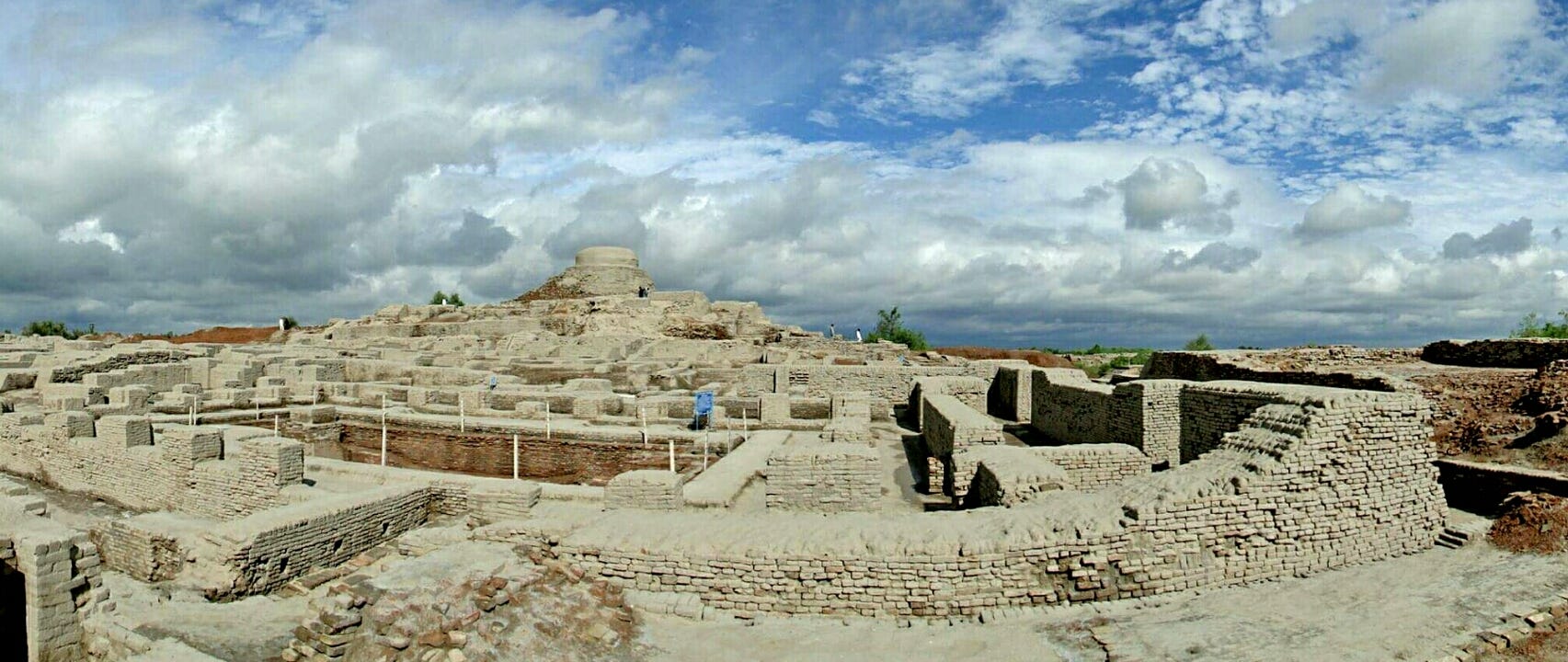
Unlike Egypt and Mesopotamia, money and effort were not lavished on temples, palaces and royal tombs but on civic amenities, manufacturing and trade. This civilisation was not organised around god-kings and mortuary cults. It was organised around commerce. Urban planning and fire altar design required advanced algebraic geometry, preserved in the Shulba Sutras and predating Greek geometry by thousands of years. What we call Pythagoras’s theorem was used to change altar sizes according to the nature of the sacrifice, a thousand years before Pythagoras was born.
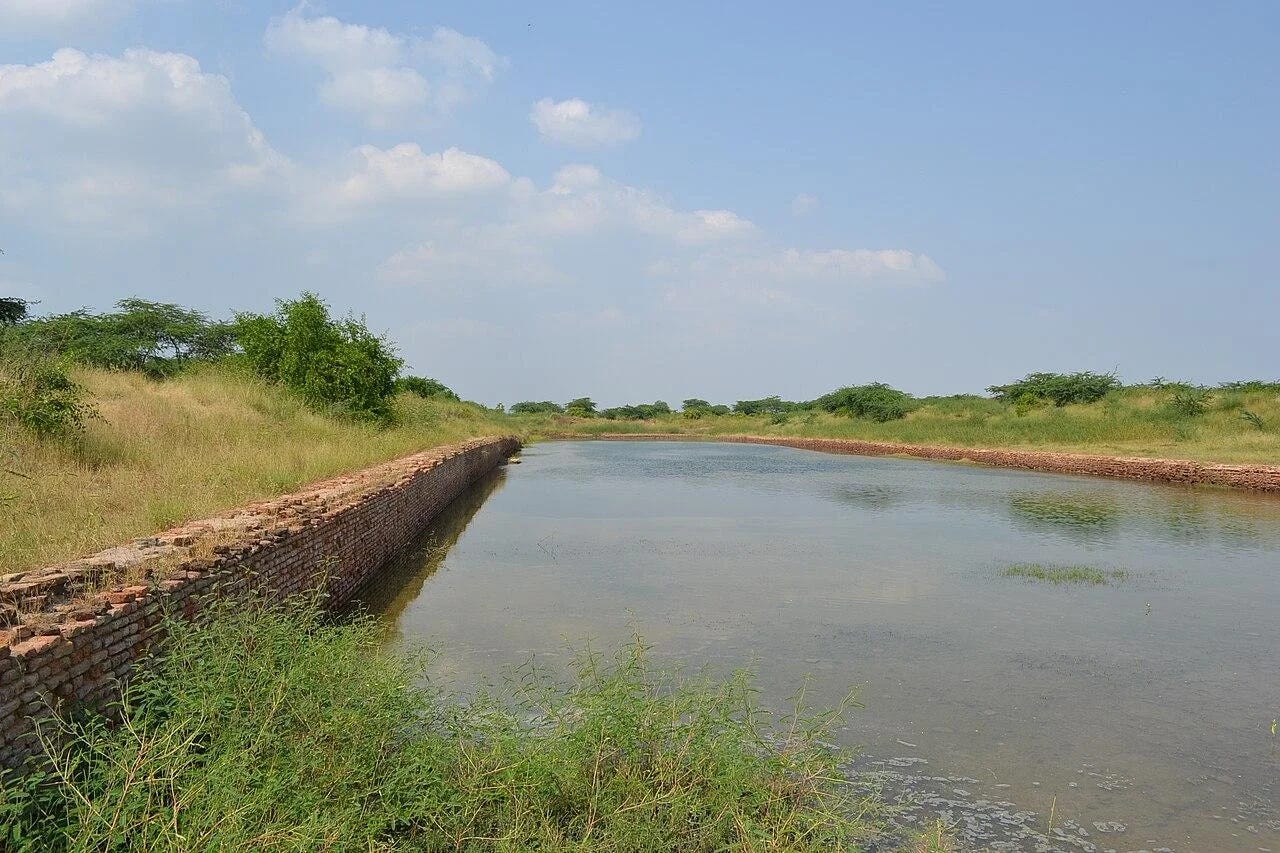
The single most instructive site is the port of Lothal on the Rann of Kutch. It had a dock 214 metres long, 37 metres wide and 4.5 metres deep, built with over a million kiln-dried bricks. Ships eighteen to twenty metres long could enter with two passing each other. Lock gates controlled a channel to the estuary at high tide, positioned away from the main current to avoid siltation. It could hold thirty ships of sixty tons. It may have been the largest dock in the ancient world although other Indus-Sarasvati ports covered more land, thus presumably had more people. Sanjeev Sanyal has plausibly speculated that Lothal acted as a kind of customs station for those other ports. However they interacted, Europe would not match anything like it for four thousand years.
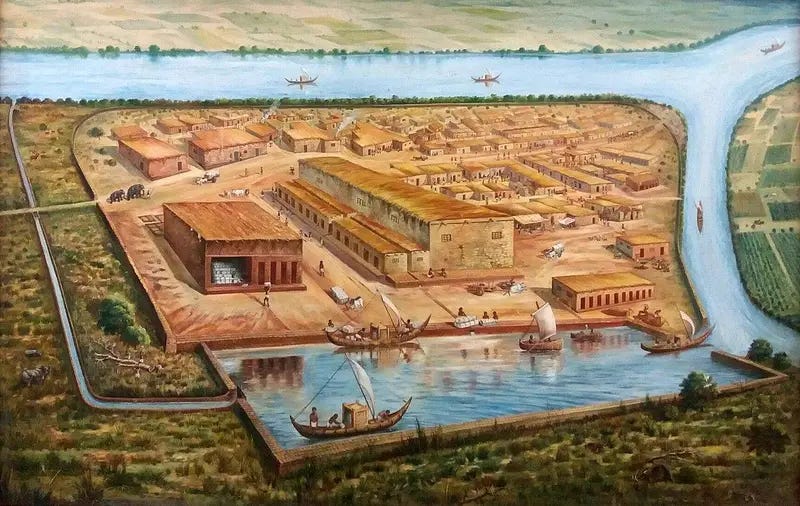
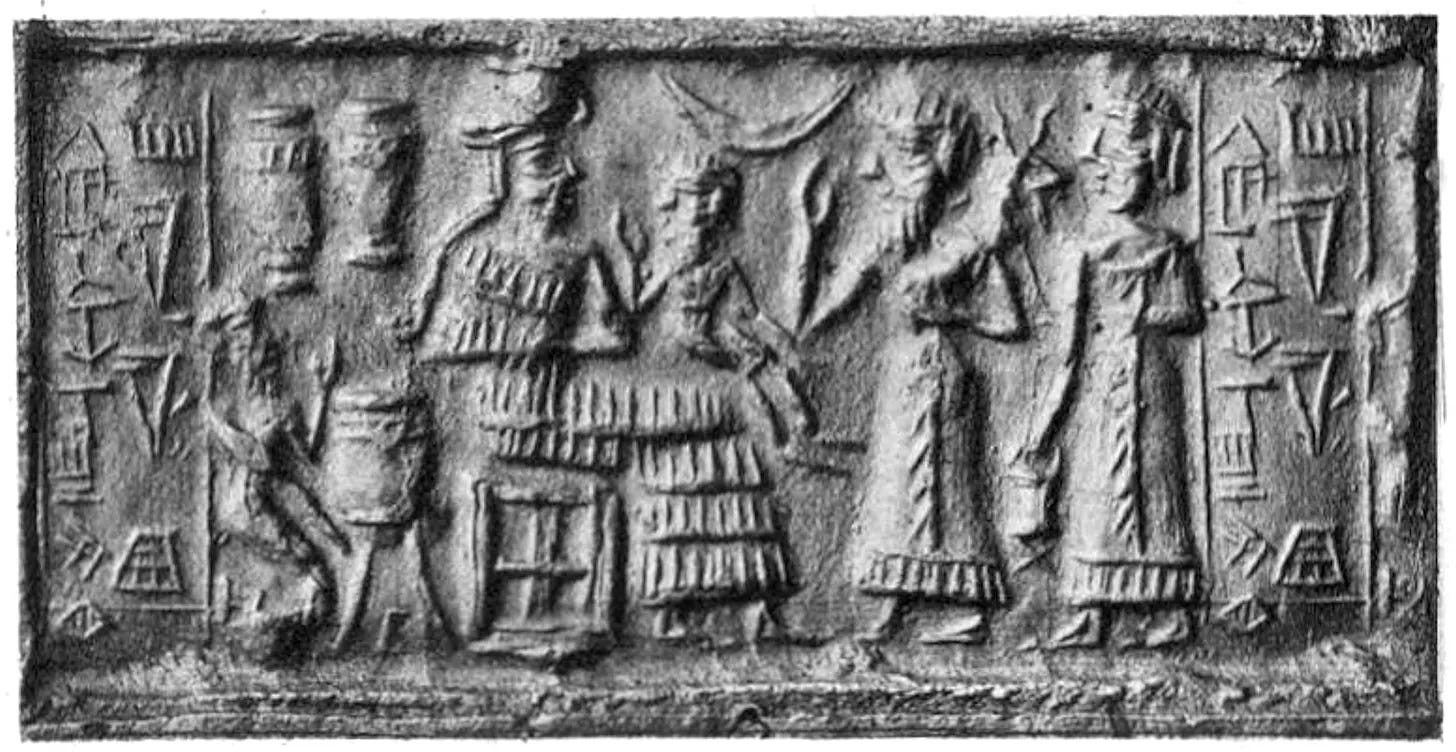
Navigational instruments to measure angles of the horizon and stars were found on site. Stone anchors were found in the dock itself. A wharf raised against flooding connected the dock to a sixty-four-room warehouse containing merchant seals. Each Indus-Sarasvati merchant had a seal to identify and label imports and exports. Many of these seals have been found in Mesopotamia. Lothal manufactured beads, chessmen, gold and silver ornaments, ivory combs, micro-beads a quarter of a millimetre in diameter. Bead necklaces from Lothal graced Queen Puabi in her tomb at Ur around 2450 BC. She wore the same headdress as seen in Indus-Sarasvati figurines. The cultural flow was east to west, not the other way around.
So divorced from maritime trade were the academics who first encountered Lothal that they initially identified the dock as a communal bathing pool.
The Indus-Sarasvati civilisation was not the beginning of the story. It was the mature phase of something considerably older, and much of that older evidence is now underwater.
In 2000, the National Institute of Ocean Technology found a drowned city forty metres beneath the Gulf of Cambay, over thirty kilometres offshore. Sonar photographs of the ocean floor show large rectangular walled structures up to three metres tall, along the banks of an ancient river across an area of roughly nine by two kilometres. A second city sits a little further south on the same ancient river, suggesting two phases of inundation. Dredged material from the site includes fossilised human remains and stone tools suggesting human activity from as early as 29,000 BC. Sonar readings suggest an urban centre from at least the tenth millennium BC, with grid street patterns, canals and citadels reminiscent of later Indus-Sarasvati and Sumerian cities.
At Mahabalipuram in Tamil Nadu, locals believe a great flood consumed the old city in a day. Brahmins say a magnificent city was submerged about six thousand years ago. British traveller John Goldingham wrote the stories down in 1798 as The Seven Pagodas, each built when the previous one was engulfed, the seventh still standing on the shore. Recently a series of submerged structures has been found up to a mile from shore covering several square miles.
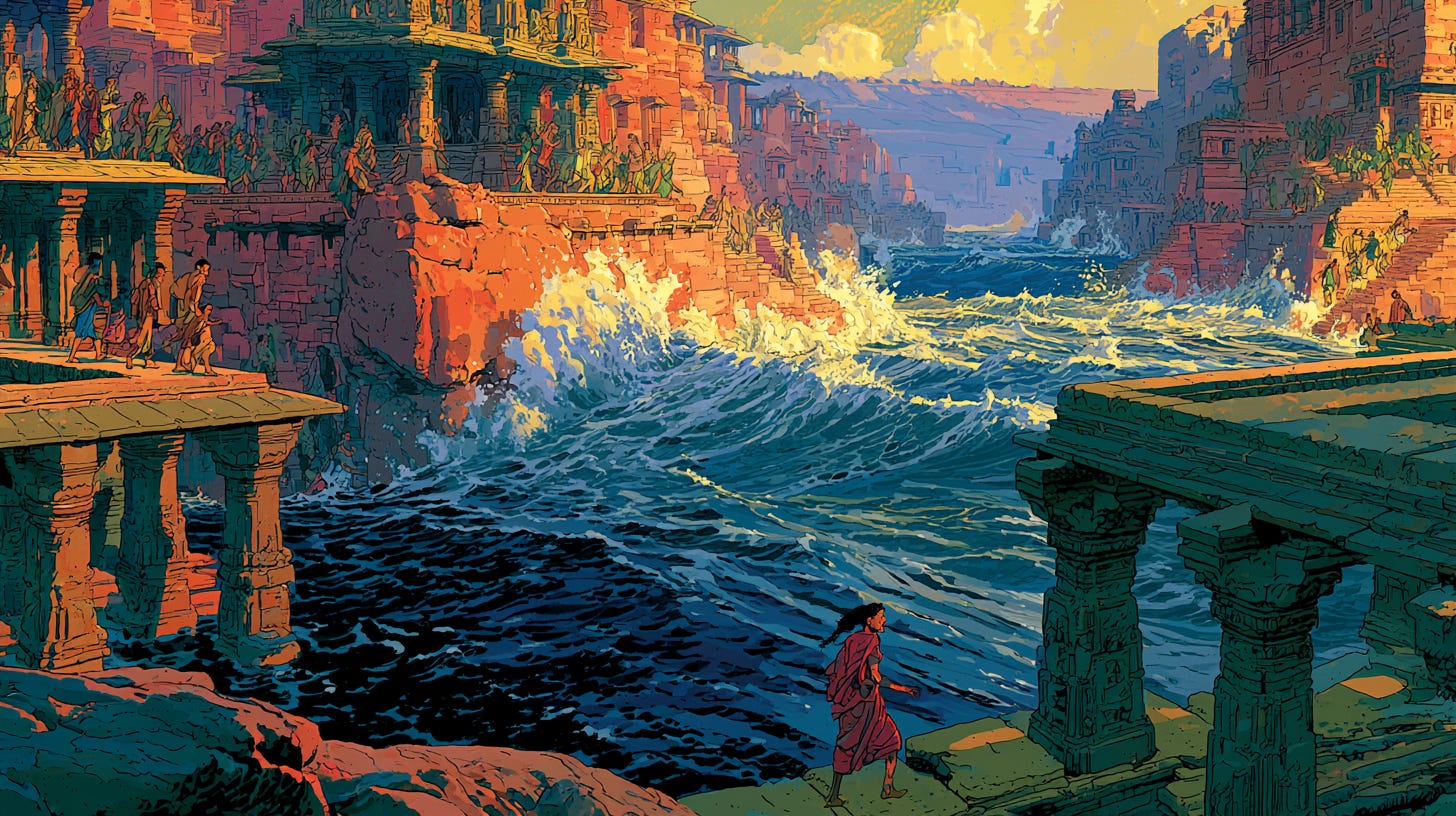
These are not curiosities. They are evidence that the Indus-Sarasvati civilisation was the surviving continuation of a much older India-wide maritime tradition, whose earlier phases were drowned by the post-Ice Age sea level rises around 9,500 BC and 5,600 BC. The Mahabharata itself describes the flooding of the city of Dvarka:
“the sea rushed into the city. It coursed through the streets and covered the city. I saw beautiful buildings becoming submerged one by one. In a matter of a few moments it was all over.”
Once the Indus-Sarasvati cities began to be excavated in the twentieth century, a problem presented itself. They were too sophisticated, too old and too large to fit comfortably into a Mesopotamia-first narrative. So the narrative was adjusted to accommodate them.
The argument, developed in the late nineteenth century by Friedrich Max Müller and others, was that pale-skinned Indo-European nomads, Aryans, from the Eurasian steppe had invaded northern India around 1500 BC, bringing with them literature, mathematics, astronomy and philosophy. The Vedic civilisation was therefore not Indian in origin. It was European, transplanted.
This theory preserved the assumption that complex civilisation must originate from European racial stock. It also conveniently justified the colonial presence in India: the British were merely the latest in a long line of light-skinned Aryans bringing civilisation to the subcontinent.
There was no evidence for any of this. The Vedas do not describe an invasion or refer to a homeland outside India. The rivers, mountains and animals named in them are Indian. No earlier-language place names survive of the kind you would expect if an invasion had occurred. Compare the Americas, where indigenous names like Mississippi, Massachusetts and Miami remain attached to almost every river and region.
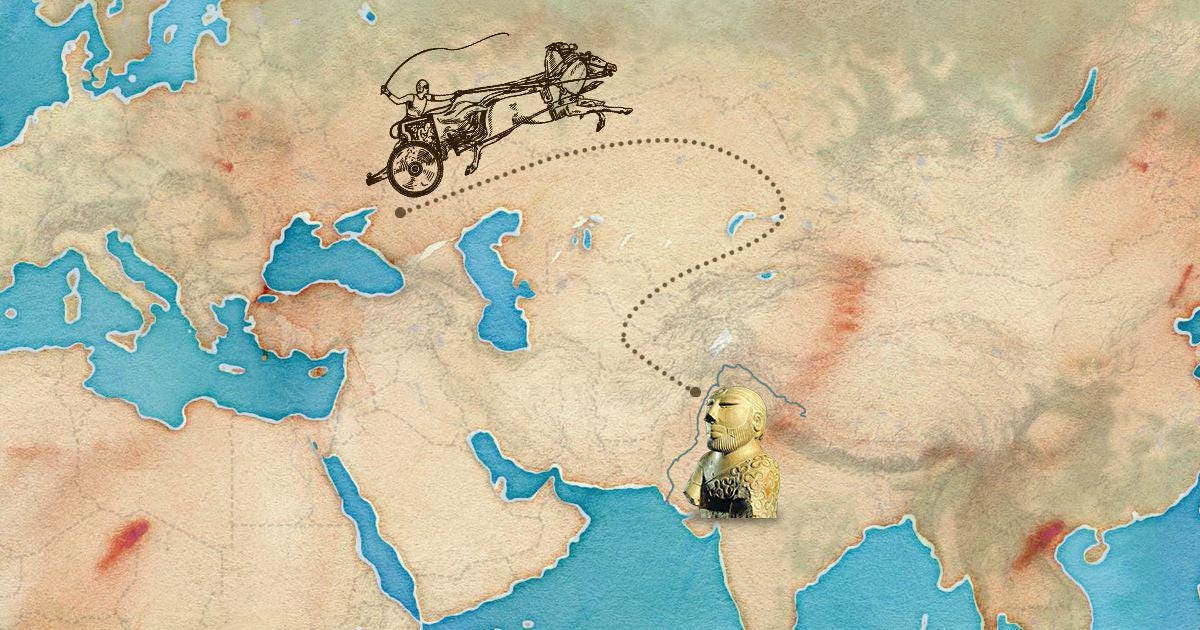
The Rig Veda describes the land of the Sapta Sindhu, the Seven Rivers, mainly the Sarasvati, which dried up around 2,000 to 1,900 BC. This is well before the date Max Müller originally assigned to the composition of the Rig Veda itself. The Sarasvati appears seventy-two times in the text, with three of forty-five hymns wholly dedicated to her. Her banks were lined with cities. When the Sarasvati dried up, the region slowly died. Massive emigration to the Ganges plain followed.
Genetic studies carried out between 1999 and 2006, reviewed by the historian Michel Danino across nine large samples, found no evidence of any invasion. But the case did not end there. In 2019, a major new study revived the argument in a more sophisticated form, rebranded as migration rather than invasion. A team led by geneticists at Harvard, using ancient DNA rather than the modern samples of the earlier studies, reported a genetic signal from Central Asian steppe pastoralists entering northern India from around 2,000 BC. The press reported this as final proof that the old invasion theory was correct. It is not. The same study found that the builders of the Indus-Sarasvati cities were themselves indigenous to the subcontinent, with no steppe ancestry at all. It found that the incoming signal, when it did arrive centuries later, came overwhelmingly through male lineages marrying into a much larger settled population, the genetic signature of a small number of men absorbed into an existing civilisation. In other words it was not a conquest or a replacement. Moreover, a river that had already vanished by 1,900 BC cannot have been sung about by people who arrived after it disappeared. The genetics changed but the chronology problem did not. I've since taken the 2019 study, and the 2023 Heggarty follow-up now cited alongside it, apart in more detail in a separate essay: The Aryan Invasion Theory That Refuses to Die. The short version is that neither paper claims what the popular accounts built on top of them claim, and the Sarasvati chronology problem survives both.
The archaeological record shows no cultural break between the Indus-Sarasvati cities and the Iron Age cultures that followed. The Aryan invasion manufactured a theory to fit the facts as they were perceived by minds sure of the natural supremacy of light-skinned Caucasians. Yet the theory persisted in school textbooks well into the twenty-first century. It is still found in many today.
The deeper problem is methodological. Academic history is divided into specialisms. Sumerian scholars study Mesopotamia. Egyptologists study Egypt. Indologists study India. Greek scholars study Greece. Each discipline trains its own students, runs its own journals, and rewards its own internal references. The connections between the boxes are studied less often than the contents of the boxes themselves.
This works adequately for political history, where empires really do have hard edges. It works very poorly for the history of trade, where everything that mattered crossed the boundaries.
When you study Sumer in isolation, the carnelian beads and timber and cotton that appeared in its cities look like a Sumerian story. When you study Indian Ocean trade as a system, you can see that these materials were arriving on ships from Meluhha, the Sumerian name for the Indus-Sarasvati civilisation. When you study Egypt in isolation, the pre-dynastic graves at Nakada with their mud brick-lined pits in the Sumerian and Indus-Sarasvati style look like a curiosity. When you study the maritime networks of the fourth millennium BC, you can see that Indian ships were already trading along the East African coast and to Mesopotamia before pharaonic civilisation had taken shape.
You cannot see these connections if you have spent your career studying a single box. You can only see them if you ask, as the Sumerian scribes themselves implicitly asked when they recorded the arrival of ships from Meluhha, where the goods came from and where the people sailing them had been before.
This is what I had as a maritime trade professional that most academic historians did not have. Not deeper expertise in any single ancient civilisation, but a working understanding of how trade routes function.
When you remove the artificial boundaries between fields, the picture that emerges is consistent across every type of evidence: archaeological, linguistic, genetic, literary, geographic. The Indian subcontinent was the most economically productive region of the ancient world. It was where the first long-haul maritime trade networks originated. It was the source of the Indo-European language family, not its destination. It was the cradle of mathematical and philosophical traditions that travelled westward through the same trade routes that carried cotton, spices and gems. It produced the world’s first manufactured product, cotton cloth, which Europe would spend thousands of years trying to replicate.
None of this is controversial when the evidence is laid out. It only seems controversial because it contradicts a story that was assembled in the late nineteenth century by archaeologists working in a different climate, scholars working in a different intellectual tradition, and political administrators working with a different agenda.
The work of correcting it is not a matter of replacing one ideology with another. It is a matter of letting the evidence speak more loudly than the assumptions of people who happened to gather the first portions of it. The ground is now laid for pursuing maritime trade history as a multi-disciplinary subject.
Most of the evidence has been sitting in plain sight for a long time. It just was not assembled by anyone whose career did not require them to keep it inside the box where they had been trained to find it.
That is what I have spent the last decade trying to do across three books. I had not gone looking for these conclusions. I went looking for the origins of maritime trade, and found a civilisation that had been studied in isolation for so long that the rest of the world had forgotten what it owed to it.
This essay draws primarily on my book How Maritime Trade and the Indian Subcontinent Shaped the World (2021), particularly the chapters on the end of the Ice Age, the Indus-Sarasvati civilisation, and third millennium BC maritime trade networks. Key secondary sources: Michel Danino, The Lost River: On the Trail of the Sarasvati (2010); Romila Thapar, Early India: From the Origins to AD 1300 (2002); Jim G. Shaffer on Painted Grey Ware and cultural continuity; Badrinaryan Badrinaryan on the Gulf of Cambay submerged city; and the linguistic studies of Skulj, Sharda, Sonina and Narale on Sanskrit and the Indo-European question. On the 2019 ancient DNA findings and their limits, see Vagheesh Narasimhan et al., "The Formation of Human Populations in South and Central Asia," Science 365, no. 6457 (2019), and the subsequent critical commentary questioning the study's uncritical adoption of Max Müller's nineteenth-century chronology for the Rig Veda. On academic specialisation as an obstacle to historical synthesis, John Darwin's After Tamerlane (2007) is useful. Full citations in the volume bibliography.
This essay is drawn from a three-volume history of maritime trade. The books are available on Amazon, via Garuda in India, Pen & Sword in the UK.
Thanks for reading Maritime Trade History! This post is public so feel free to share it.
Comments
Nothing yet. Say the first thing.
Sign in to join the conversation.