
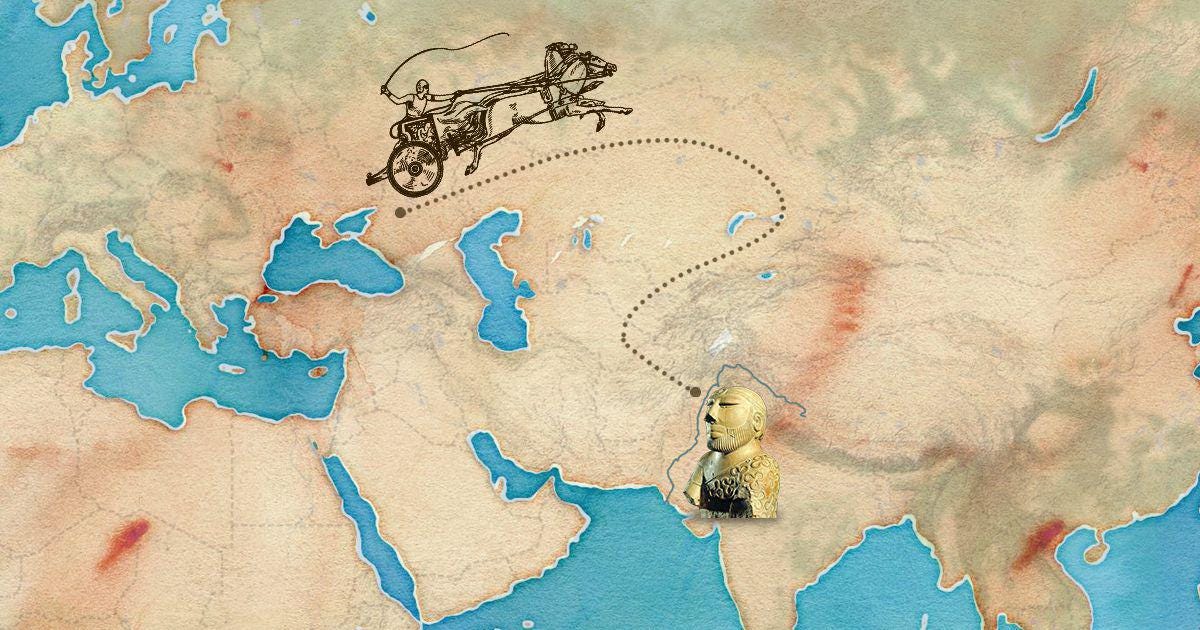
Around 1,500 BC, according to a story still repeated in serious publications, migrants from Central Asia walked into northern India and composed the Rig Veda. Among the hymns they wrote were those to the Sarasvati, the mightiest of rivers, the best of mothers, the best of goddesses. The Sarasvati dried up around 2,000 to 1,900 BC. Migrants arriving a century or two later composed hymns of praise to a river they had never seen.
That is the Aryan Migration Theory, as its defenders now prefer to call it since “invasion” has become embarrassing. The theory claims more than just a change of language. It holds that the Indus-Sarasvati civilisation was a separate, non-Vedic culture with no continuity into what followed, and that the migrants who replaced it brought Sanskrit and Vedic religion with them wholesale. Language and civilisational rupture both rest on the same migration.
The two most recent papers cited in the theory’s defence are Narasimhan et al. in Science (2019) on ancient DNA, and Heggarty et al. in Science (2023) on language phylogenetics. Neither paper makes the wider claims above directly. What they establish is narrower: a demographic signal and a set of language relationships. The rest is built on top of that narrower evidence by popularisers, not stated in the papers themselves. This essay looks at what the papers actually show, what has been built on top of them, and what the rest of the evidence, from the text of the Rig Veda itself to the archaeological record, shows alongside them.
I made the broader case for India rather than Mesopotamia as the cradle of civilisation in an earlier essay. This one narrows in on these claims specifically, still repeated in textbooks and in popular books like Tony Joseph’s Early Indians (2018): that Sanskrit and Vedic culture arrived from outside, and that the civilisation it replaced had nothing to do with it.
The Sarasvati timeline is one of the more stable dates in a region full of unstable ones. Palaeochannel studies of the Ghaggar-Hakra place the drying at roughly 2,000 to 1,900 BC, and while some recent work, notably Giosan et al. (2012), argues the river was already a smaller, monsoon-fed system by the mature period rather than the Himalayan giant of earlier millennia, even that reading doesn’t rescue the migration story, since the hymns still describe a river that no longer existed as described by the time anyone could have arrived to write about it.
Joseph places the Steppe migrants’ arrival in India at roughly 2,000 to 1,500 BC, a three-hundred-year window that itself overlaps the drying rather than following cleanly after it. Even granting the earliest end of that range, the Rig Veda’s composition is not conventionally dated to the moment of arrival. Most scholars in this tradition, including Joseph, put the hymns at 1,500 to 1,200 BC, which means the poets who supposedly composed hymns to the Sarasvati as the mightiest of rivers were working four to eight centuries after it had gone. A three-hundred-year arrival window stacked on top of a three-hundred-year composition lag is the difference between a plausible eyewitness account and a folk memory of a river nobody had seen.
The dry-river paradox is only the beginning of what the Rig Veda tells us about itself.
The text is suffused with references to the sea, maritime travel, gods with oceanic origins. Three-masted ships and ones with a hundred oars appear in its verses. For a people who had, on Joseph’s account, just walked in from the Central Asian grasslands, this is more than strange. The Rig Veda describes the Sapta Sindhu, the land of the seven rivers, and contains no hint of a homeland outside India. Nothing about cold climates, steppe topography, or a journey from anywhere else. If invaders had imposed their language, we would expect older non-Indo-European river and mountain names beneath the Sanskrit layer, in the way the Americas are covered with Native American names sitting under English overlay: Miami, Mississippi, Massachusetts. India shows no such pattern. The Sanskrit names go all the way down.
The word “arya” itself is not a racial category. As David Anthony explained, it was a ritual term. “If you sacrificed in the right way to the right gods, which required performing the great traditional prayers in the traditional language, you were an Aryan, otherwise you were not.” Ancient India’s inter-tribal wars were over water and cattle, between clans within the subcontinent.
The Rig Veda describes a settled agrarian society sustained by a great river system, with cities on its banks, priesthoods, kingships, and a mature body of poetry. The archaeological record confirms this. At its height in the third millennium BC, the Indus-Sarasvati civilisation covered around 1.5 million square miles, roughly what is today Afghanistan, Pakistan, and most of north-western India. Around 3,800 settlements have been identified, the larger cities carrying populations over fifty thousand. The region may have supported as much as ten per cent of the world’s population at the time.
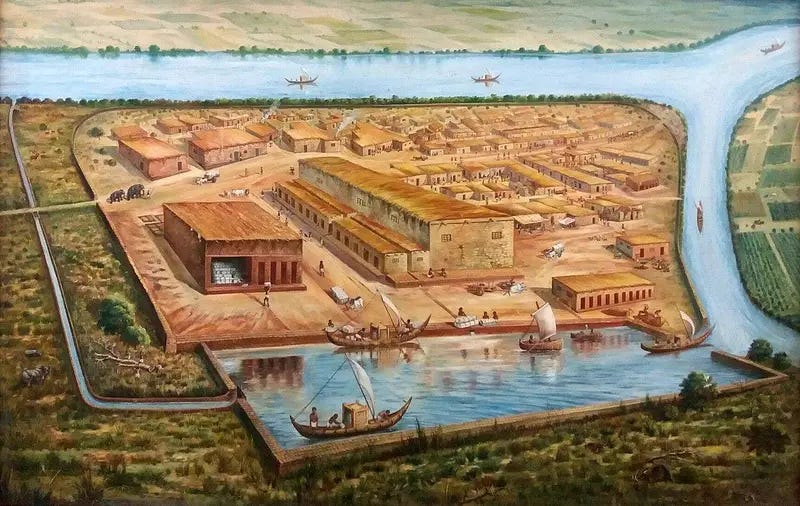
I have laid out the fuller picture, including the Lothal dockyard, the Meluhhan trade quarter in Akkad, and the goods worn by Queen Puabi in her tomb at Ur around 2,450 BC, in the earlier essay linked above. What matters here is the ratio.
The Aryan Migration Theory asks us to believe that a small band of pastoralists walked in from a windswept steppe with a small fraction of India’s demographic base, replaced the language of the world’s most densely populated agrarian civilisation, and composed the greatest corpus of ancient literature anywhere in the world in the process. The same small population is also said to have poured into Europe to create the Corded Ware culture, and moved east into Siberia. All at more or less the same time.
This is more than improbable.
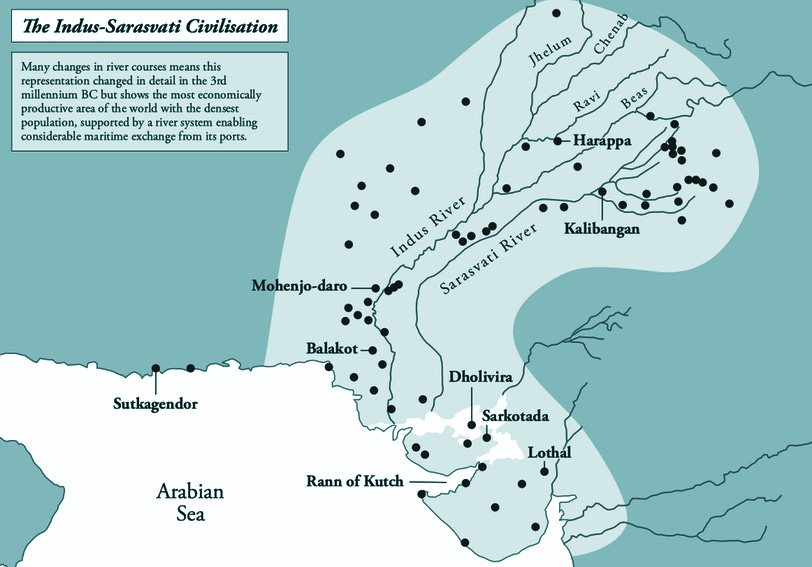
Joseph identifies Mehrgarh, in the Baluchistan foothills, as “the most consequential development, a definite turning point, in the prehistory of India.” Mehrgarh was certainly important. By 7,000 BC it was a cluster of villages covering sixty-five hectares, supporting perhaps twenty thousand people, growing wheat, barley and cotton, and producing the earliest cotton thread yet found anywhere in the world.
Mehrgarh is also well inland. Anyone who works on ancient maritime trade knows that human progress concentrated on coasts. If Mehrgarh looks impressive at 7,000 BC, the obvious question is what was happening at the coast. The answer is that we don’t yet know because most is under water.
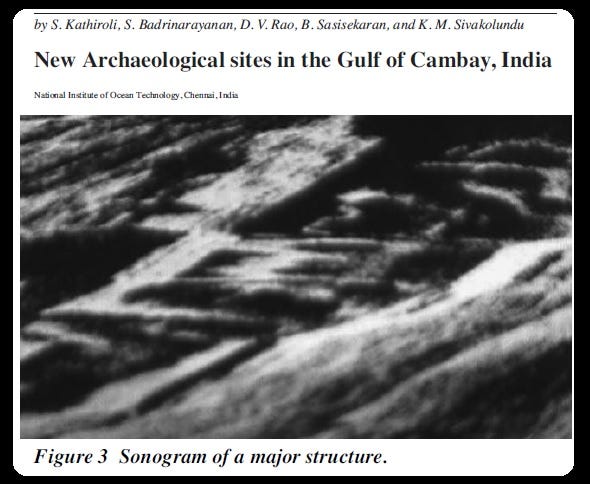
Sea levels have risen roughly 120 metres since the last glacial maximum. Three great meltwater pulses, at 12,000 BC, 9,500 BC, and 5,600 BC, drowned coastal settlements from the Pacific to the Mediterranean and North Europe. The Gulf of Cambay evidence, sonar imaged by the National Institute of Ocean Technology in 2000, shows large rectangular walled structures three metres tall running nine kilometres along the banks of an ancient river, forty metres under water. Sun-dried pottery from around 24,000 BC and fired pottery from 18,000 BC were dredged up.
So Mehrgarh is not the “most consequential development.” It is what is visible. In 2025 and 2026 the Archaeological Survey of India dived on ruins off the modern town of Dwarka. The results have yet to be published, but this is clearly an on-going undersea quest for the answer to that important question: what was happening on the coast?
Tony Joseph's Early Indians, first published in 2018 but subsequently amended as it references papers published in 2021, is now the most widely read popular account of the migration argument in India. Its scientific claims rest almost entirely on the ancient DNA work of the Reich Laboratory, which culminated in Narasimhan et al. Joseph’s early chapters, drawn from that paper, are largely uncontroversial. Humans came out of Africa. A very large percentage of them settled in the Indian subcontinent. That base population is the deepest layer of our species outside its African cradle.
The trouble starts when the popular account overreaches what the paper says.
Narasimhan et al. is worth reading directly rather than through a summary, because it is considerably more cautious than the book built on top of it. The paper posits a population movement out of India in the third millennium BC, evidenced by what it calls the “Indus Periphery Cline,” individuals found well outside the Indus Valley core, at sites in Iran and Turkmenistan, whose ancestry is used to reconstruct the genetic profile of the Indus-Sarasvati population itself, since no ancient DNA has survived from sites within the core. Joseph did not follow this up. He should have.
This evidence doesn’t map onto the separate body of Mesopotamian and Levantine trade evidence I’ve detailed in an earlier essay, the Meluhhan quarters in Akkad, the Indus-Sarasvati seals in Sumer, Puabi’s grave goods at Ur, but together they’re consistent with a wider picture of a maritime-influenced civilisation with 3,800 cities, towns and villages, including great ports, whose population moved and traded well beyond its borders. Joseph doesn’t discuss any of this. None of it appears in his account.
The paper’s data also indicates that a small number of incoming Central Asian males married into a much larger local population. Joseph takes this and names it a Steppe migration that shaped India. Read the underlying finding again. A small number of incoming males married locally. Where the paper reports a demographic trickle, the popular account reports a civilisational rupture. That gap between the data and this dramatic story is the problem.
The claim that this trickle wrote the Rig Veda rests, in Joseph’s telling, on the single observation that Brahmins have somewhat more Steppe ancestry than the average Indian. That is correlation, and it is not one the underlying genetic data settles.
Joseph also rehearses arguments that have been in circulation for decades. Chief among them is the horse debate. The Rig Veda is full of horses and horse-drawn chariots. Indus-Sarasvati seals rarely show them. Migrationists have long read that gap as decisive: horses must have arrived with the incoming Aryans, so the Vedic culture that celebrated them must post-date the migration.
I deal with the counter-argument at length in my How Maritime Trade and the Indian Subcontinent Shaped the World. To summarise: drawings of horses appear in Palaeolithic Indian caves. Horse remains have been found at Indus-Sarasvati sites and their predecessors going back to about 6,500 BC. A terracotta horse head was found at Lothal as part of an early chess set. Seals do not depict cows either, while bulls appear constantly. No one concludes from that that the Indus-Sarasvati civilisation had no cows. Absence of evidence is not evidence of absence.
Joseph leans on David Anthony’s The Horse, the Wheel and Language and picks up the Kurgan hypothesis, which was discredited long ago. The Kurgan people buried their dead in mounds in the foetal position. Vedic India cremated. Burial practice is one of the deepest cultural signatures a population carries. Two peoples who dispose of their dead in entirely different ways are not the same population. The changes in European pottery design that Joseph reads as evidence of total population replacement follow reasoning historians largely abandoned a generation ago.
Joseph writes that “genetic data can rule out scenarios that are plausible based on archaeological and historical evidence alone.” That is his own claim, not the paper’s, and it is worth reading twice. Archaeologists, hang up your trowels. Historians, put away your questions. DNA (or at least his interpretation of it) now trumps everything, including the physical evidence of what people built, wrote and buried, and it trumps common sense. It is not how any other historical science works, and it is not a claim Narasimhan et al. themselves make.
There is a related weakness. People are shown wandering across continents leaving genetic signatures, and no cause is offered. Why did the Steppe pastoralists leave? Why did they head south into a civilisation with roughly ten per cent of the world’s population and a mature written culture, rather than into empty land? Why did the same population also pour west into Europe and east into Siberia? Migrations at that scale usually have obvious drivers. In this account there are none. Only signatures.
Some readers will point to Heggarty et al., “Language Trees with Sampled Ancestors Support a Hybrid Model for the Origin of Indo-European Languages,” Science (2023), published after Early Indians and now widely cited as evidence that the debate has moved on. It has not. It has been repackaged.
Heggarty and thirty-two co-authors used Bayesian phylogenetic analysis on a new cognate database of 161 Indo-European languages to argue for a “hybrid” hypothesis. They “modelled” a scenario based on certain assumptions. The main one is that there is a common ancestral language. There is absolutely no evidence for this. In the ancient world languages changed every thirty miles or so, which is not the pattern of unified descent the tree method assumes.
Their headline claims are that Proto-Indo-European is around 8,100 years old, originated south of the Caucasus in the northern Fertile Crescent, and reached its various daughter branches through a mix of later movements, some from the Steppe. For Indo-Iranic specifically, they consider two possible routes into India and Iran and report the question unresolved.
Notice what has not changed. Sanskrit still arrives in India from somewhere else. The Rig Veda is still, on this model, written by people whose ancestral homeland lies outside the subcontinent. The Indus-Sarasvati civilisation is still assumed not to have spoken Indo-Iranic. India is a destination. It is never a source.
The method is worth a closer look. Bayesian phylogenetics on cognate lists is a form of statistical modelling. It requires calibration assumptions, informed guesses about how old each ancient language was when it was written down. Heggarty is candid on his own support page that Vedic and Avestan dating is “hotly disputed,” and then reports his team set the assumptions on those languages “centred on the majority view.” The result confirms the majority view.
As Subash Kak critiqued, the assumptions “have no substantial evidential basis” and the argument is “circular reasoning.” Furthermore, “the people in the homeland supposedly knew butter but not milk, and snow and feet but not rain and hands.” He writes, “Academics with minds marinaded in 19th-century racism continue to spin the most fanciful derivatives for PIE [Proto-Indo-European] words.”
The paper concedes, in its supplementary material, that the claim Proto-Indo-European speakers had domesticated horses and wheels rests on “linguistic palaeontology” a number of Indo-Europeanists have long challenged. It concedes the aDNA record for a Steppe-through-Balkans route into Anatolia is missing. It concedes the Anatolian branch shows no Yamnaya ancestry. None of these concessions opens the door to the possibility that Sanskrit was already used on the subcontinent when the Rig Veda was composed. The Out of India model is not tested. It is simply not on the menu. A hybrid theory that keeps the destination the same and only debates the route is still working within the frame of the original theory.
An Aryan Invasion or Migration Theory that had been buried is being reinterred through selective interpretation of primary data, either because it is politically useful or because some academics cannot extract themselves from 19th-century theories. As John Maynard Keynes said, “The real difficulty lies not in developing new ideas, but escaping from old ones.”
Back to politics, I have been called far-right Hindutva for my views on the importance of the Indus-Sarasvati civilisation in the history of maritime trade. That is funny. I am a middle class Brit and an ex shipping executive who wanted to write a book on maritime trade’s history. Others have said that I should not, as a non-Indian, write on Indian history at all. Setting aside that I write about maritime trade, which involves a little history from every maritime country, a serious historical discipline that accepts that only insiders may write its history ceases to be credible.
Narasimhan et al. describe a small inflow of Central Asian males around 2,000 to 1,500 BC who married into a much larger local population. Heggarty et al. describe an unresolved question about routes and timing. Neither suggests a migration in the racial sense the Victorian invasion theorists meant. What both describe is the sort of quiet demographic and linguistic contact that has always happened at the edges of great civilisations. To build a story in which Eurasians imposed their language on the world’s most populous ancient civilisation, and simultaneously repopulated Europe and Siberia, is not credible, and it is not what either paper actually claims.
The old evidence has not gone away. The Sarasvati was still mighty when the Rig Veda praised it. The sea and its gods run through those hymns like a monsoon. Three thousand eight hundred settlements including sizeable cities and ports across 1.5 million square miles do not get overwhelmed by a trickle of steppe herders who then proceed to write the greatest corpus of ancient literature anywhere in the world. A flawed nineteenth century racial theory dressed in twenty first century genetics or linguistics is still a flawed nineteenth century racial theory.
Narasimhan, V.M. et al., "The Formation of Human Populations in South and Central Asia," Science 365, 6457 (2019). Heggarty, P. et al., "Language Trees with Sampled Ancestors Support a Hybrid Model for the Origin of Indo-European Languages," Science 381, 6656 (2023). Tony Joseph, Early Indians (2018). David Reich, Who We Are and How We Got Here (2018). David Anthony, The Horse, the Wheel, and Language (2007). Michel Danino, The Lost River: On the Trail of the Sarasvati (2010), p. 140 for the figure of roughly 3,800 Indus-Sarasvati settlements, together with his review of nine major genetic studies from 1999 to 2006. Jim Shaffer on Painted Grey Ware continuity. Peter James et al., Centuries of Darkness (1991), on the misdated Bronze Age Mediterranean. Diodorus Siculus, Book V. Strabo, Geography. Aristotle on Persian religion. The National Institute of Ocean Technology's Gulf of Cambay reports (2000 onwards). Subhash Kak, The Sindhu-Sarasvati Script (2026). And my own How Maritime Trade and the Indian Subcontinent Shaped the World: Ice Age to the 8th Century, especially pages 43 to 45 on horses, seals, and the horse debate.
This essay draws on a three-volume history of maritime trade. The books are available on Amazon, Garuda Prakashan in India, Pen & Sword in the UK.
Thanks for reading Maritime Trade History! This post is public so feel free to share it.
Comments
Nothing yet. Say the first thing.
Sign in to join the conversation.