
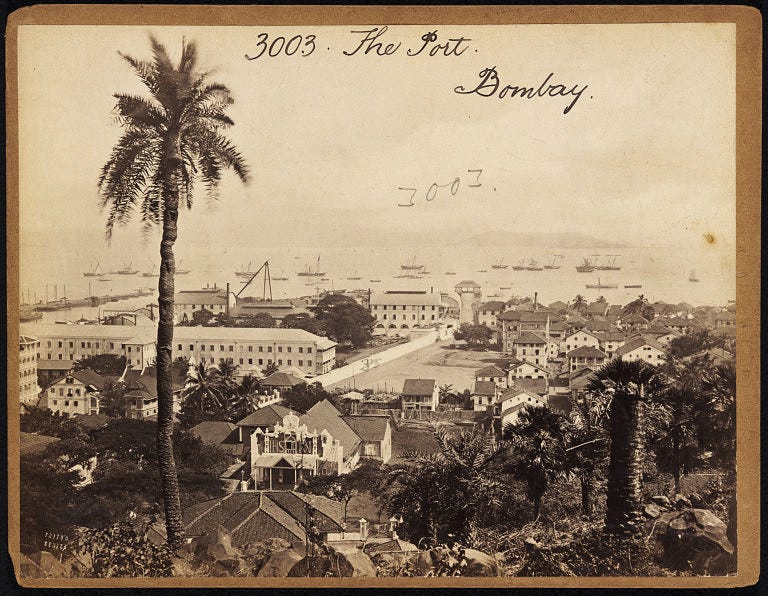
In 1661, Portugal gave England an island off the west coast of India as part of the dowry of Catherine of Braganza when marrying Charles II. He was not particularly grateful. The island had poor soil, a malarial climate, no significant hinterland and negligible commerce and he sold it to the East India Company (EIC). Sixty years later it was the most dynamic commercial city in Asia. The people who built it were refugees.
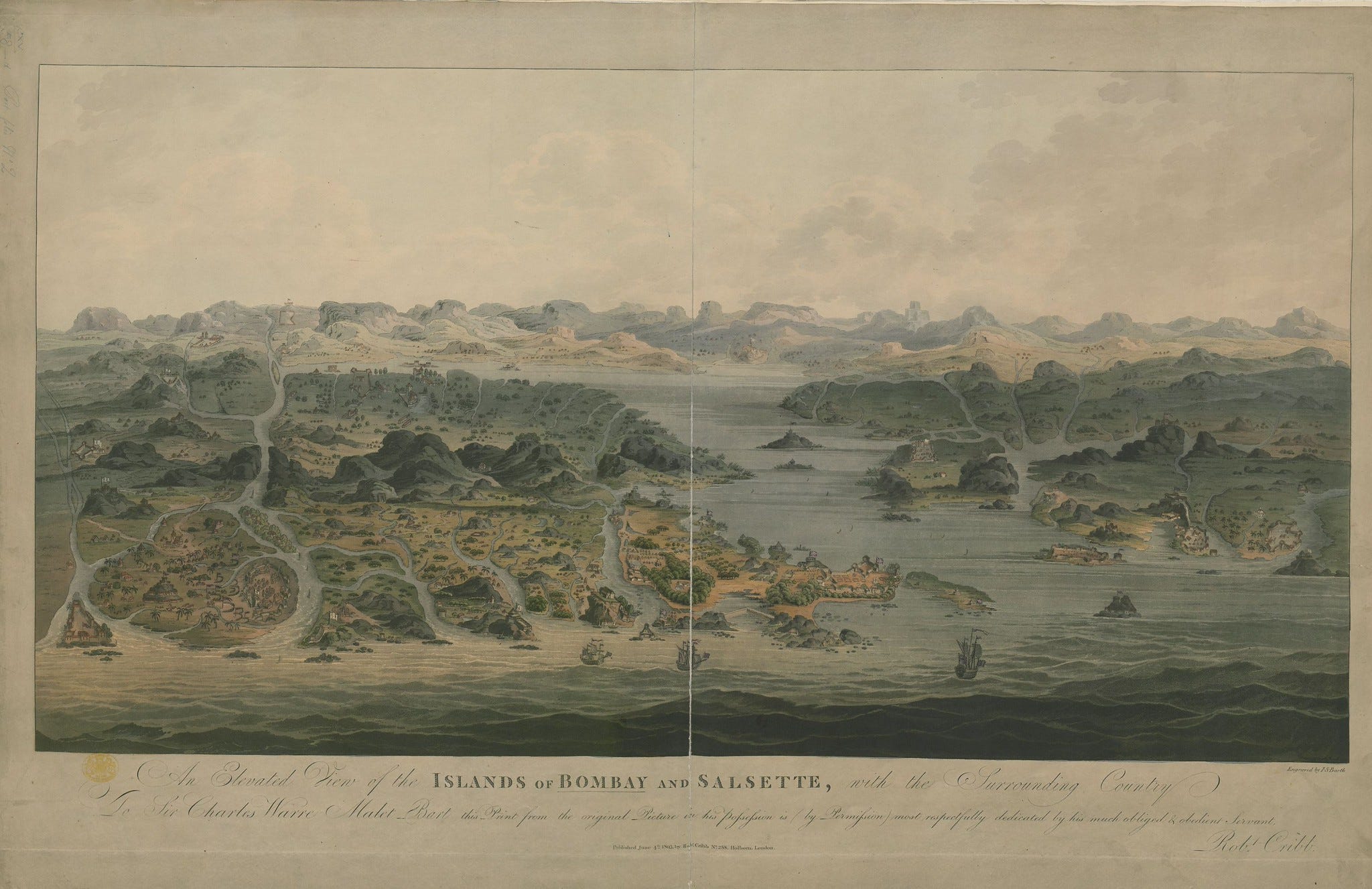
Surat, fifty miles up the coast, had been the greatest port in India, and by many measures the greatest port in the world. Traveller-writer John Henry Grose, who visited in the mid-eighteenth century, described its late sixteenth-century rise as “one of the greatest instances of the power of trade to quickly encourage wealth, arts and population.” By 1600, its harbour held over a hundred ships, mainly two and three hundred tonners. Indian shipowners dominated a sixteen-million-rupee trade. European companies, Dutch and English alike, came to Surat to participate in a system that was already there. The EIC and VOC (Dutch East India Co) did not build the Indian Ocean trade. They wanted to plug themselves into it.
At its centre stood men of extraordinary wealth. Mulla Abdul Ghafur owned seventeen ships in the early eighteenth century. His will left property worth eight and a half million rupees, ships and land around Surat. Before him, the Jain financier Virji Vora, reputedly the world’s richest man, had his base in Surat, with a network spanning India, the Gulf and Southeast Asia. He lent money to Mughal nobles and the EIC alike. The Portuguese had earlier found Indian traders the world’s best in mental arithmetic. The system worked because it had been refined over centuries.
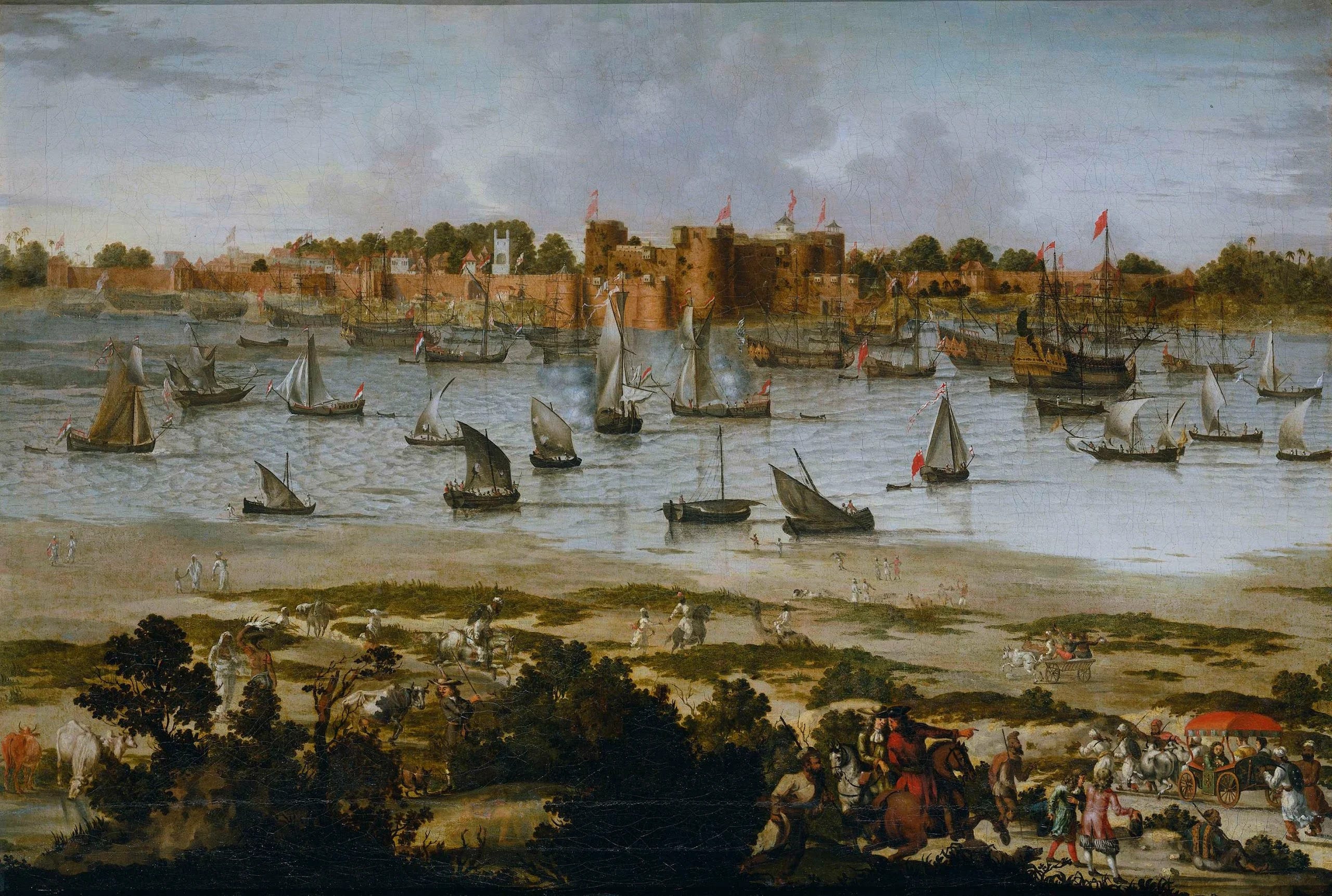
Then the Mughal navy raided its own merchants. Ships supposed to be under imperial protection were captured on the Red Sea because the emperor had not paid his sailors. Sivaji sacked Surat itself in 1664 and again in 1670. Aurangzeb’s last decades cost roughly a hundred thousand lives a year, wasting the empire’s gold reserves, taxing peasants to ruin, conducting endless wars in the Deccan and Afghanistan. Two million died in famine and plague following the 1702 to 1713 Deccan War. Large shipments could not be guaranteed. Credit payments collapsed. Foreign agents withdrew. The stability that commerce requires was gone. The full story of how that stability collapsed - and why India's domination of Indian Ocean trade slipped away in a single generation - is covered in an earlier essay in this series: Why India Lost the Ocean. What matters here is where the survivors went, and what they built.
Some merchants moved to Mandvi in Kutch. Some went to Muscat, some to Zanzibar. And some, despite a port that ships could barely enter and a hinterland that produced almost nothing, went to Bombay.
Bombay’s commercial attraction was the thing Surat had lost: security, predictable law and religious toleration.
English Common Law’s fairness empowered Indian merchants and capital in a way that Mughal administration had never done. Merchants in Bombay, Calcutta and Madras could trade without negotiating their status with a Mughal official, without facing punitive taxes on their faith, without fearing that ships they had commissioned might be seized by the very navy that was supposed to protect them. This was not a moral argument. It was a commercial one. The merchants who came to Bombay were not admirers of English culture. They were professionals choosing the city that gave their capital the best chance of survival.
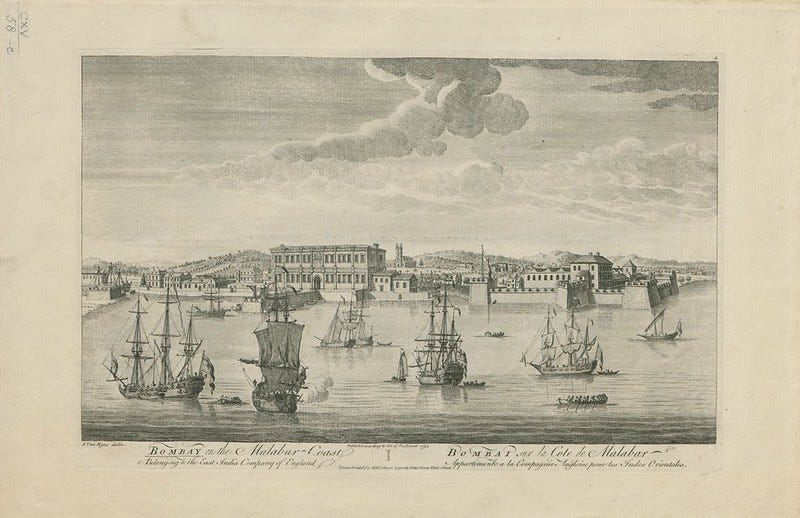
They were, above all, Parsis. Originally Zoroastrian refugees from Persia, who had arrived in India more than a thousand years before, the Parsi community had established itself in Gujarat as merchants, shipbuilders and financiers. As Surat-based Parsis moved to Bombay, they brought Gujarati cotton and Bengali and central Indian opium contacts. Their work ethic, entrepreneurial talents and shipbuilding skills were widely noted. They were, in the words of the period, natural British allies: not out of sentiment, but because the British gave them something the Mughals had withdrawn.
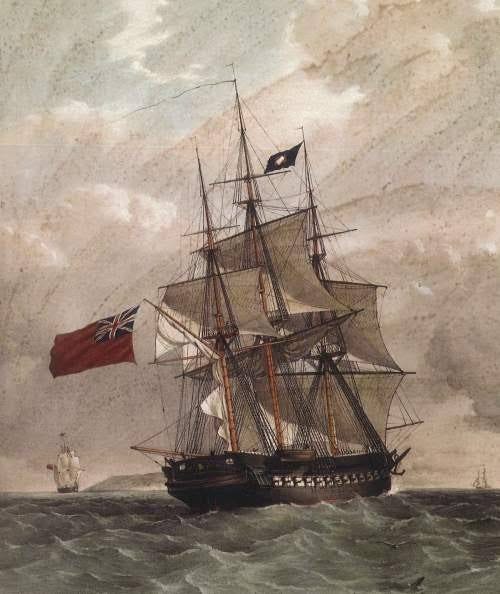
In 1736, the EIC established a shipyard in Bombay. The master builder they chose was Lovji Nusserwanjee Wadia, originally from Surat.
Teak ships lasted forty years and had lower building and repair costs than European oak vessels, giving measurably higher investment returns. The Wadias built dozens of ships over the following century, including East Indiamen and Royal Navy warships. Their yard came to be considered one of the world’s best. In the same period that British oak shipbuilding in England was struggling with timber shortages and high costs, Bombay teak ships were giving the Royal Navy vessels that lasted twice as long at significantly lower cost.
In 1813, the Wadia yard built HMS Cornwallis. In 1842, that ship sailed up the Pearl River and anchored off Nanjing. On her decks, Britain and China signed the treaty ending the First Opium War, ceding Hong Kong to the British Crown. The instrument of British trade expansion in Asia was built by a Parsi family from Surat, on an island received as a royal dowry, by people who had been driven from their original port by Mughal misrule.
The merchants who rebuilt in Bombay did not simply preserve what they had. They expanded it.
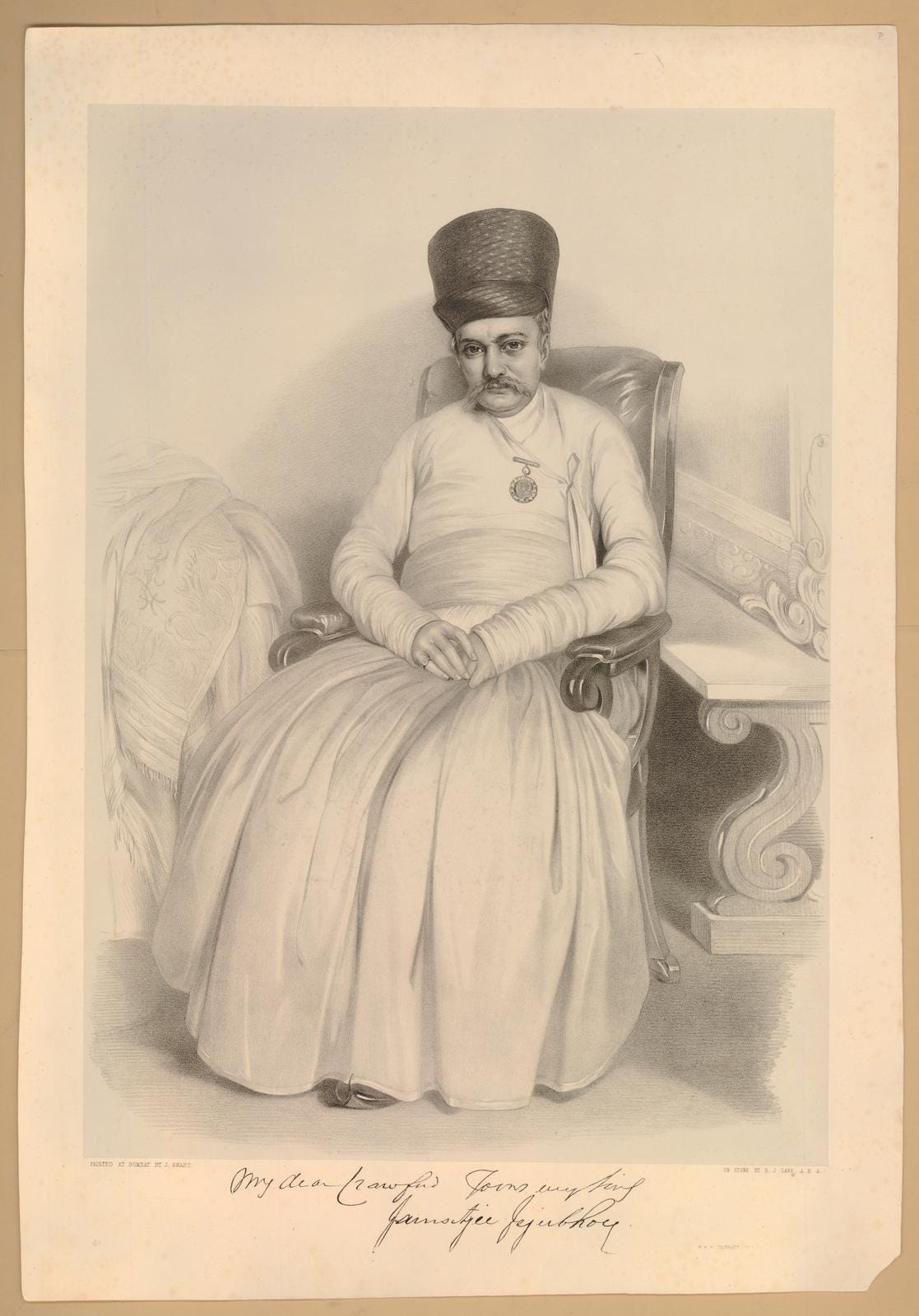
Jamsetjee Jeejeebhoy was born in Bombay in 1783, the son of a Parsi family. He dealt in pearls, rice, cotton, cotton cloth, cochineal and dates. In 1804 he met William Jardine, and between 1805 and 1817 he bought Indian-built 500-1200-tonners, shipping opium and cotton to agencies in Canton, Macao and Hong Kong. He built a commercial network that spanned Colombo, Penang, Sumatra, Calcutta and Madras. He also gave away a quarter of a million pounds sterling to hospitals, schools and public buildings. Knighted in 1842 at the EIC’s recommendation, he became a baronet in 1857: the first Indian to receive a hereditary British title. His contemporary Lord Elphinstone rhetorically asked where else one could find a citizen who had “devoted a quarter of a million sterling to purposes of public charity and benevolence” for the poor and suffering of all creeds.
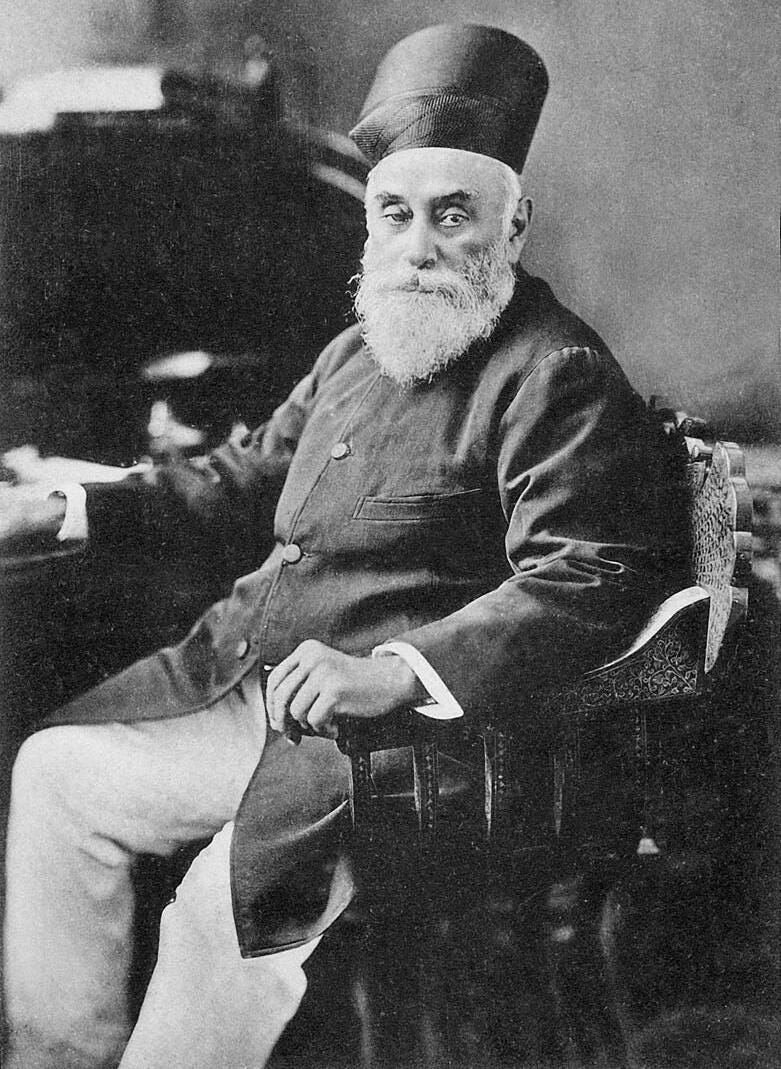
Jamsetji Tata was a different generation, different in methods, identical in instinct. A Parsi, born in 1839 in Navsari in Gujarat, he moved to Bombay and worked in his father’s trading house. When the American Civil War cut off Lancashire’s cotton supply from 1861 and drove cotton prices to extraordinary heights, Tata travelled to Britain with Indian cotton and watched what the price spike did to industrial opportunity. In 1868 he bought a bankrupt Bombay oil mill, converted it to cotton cloth production using what he had learned in Britain, hired Indian and English employees, then bought a larger mill in Nagpur. Diversification from there initiated a business empire that is still growing. The Tata Group today employs over 935,000 people across more than a hundred countries.
India’s first cotton mill started in 1854. By 1865 there were ten mills in Bombay. By 1914, there were 271 mills across India, employing 260,000 workers, most Parsi-owned. The newspaper boast was accurate: Bombay had become the Liverpool and the Manchester of the East simultaneously, within a century and a half of receiving a handful of refugees from Surat.
The standard account of Britain and India emphasises the taking, revenue extracted, industries damaged, textiles undercut by Lancashire’s steam mills. All of this is part of the record. The full record also includes Jeejeebhoy’s hospitals and Tata’s steel works and Wadia’s Royal Navy ships, built by people who came to Bombay carrying the commercial DNA of a civilisation that had been running long-haul maritime trade for four thousand years.
The Parsi story is the most precise possible illustration of what commercial culture actually is. It is not fixed to a location. It moves with its people. The Parsis left Persia carrying their religion and their skills. They settled in Gujarat and became merchants. Their commercial networks were destroyed in Surat by Mughal instability. They moved to Bombay and rebuilt. Their shipyard built the vessel that signed away Hong Kong. Their merchants shipped cotton to a world in crisis and built hospitals with the proceeds. Their industrialists watched Lancashire, learned from it, and built a manufacturing empire that outlasted the British Raj by generations.
Bombay was built by commerce and built on toleration. Remove either and the city does not exist. The merchants did not come because the island was beautiful or because Britain was a particularly admirable imperial power. They came because the alternative was a port where the navy stole the merchants it was supposed to protect and where the emperor had not paid his sailors.
The lesson is not especially complicated. Commerce flows towards security. Capital moves to where contracts are enforced. Talent relocates when the environment becomes hostile. What is worrying as a Briton, is that the majority of British politicians have lost all commercial sense. In 2015, George Osborne, Chancellor of the Exchequer, representing a party that was supposed to support business, and had a reputation for economic common sense, despite warnings, introduced tax on Greek shipowners’ worldwide income, a policy floated by the Treasury for 45 years. The Treasury and the whole of the Civil Service had already lost commercial sense since the 1850s when the policy of recruiting classicists from Oxford was introduced.
All but a handful of the hundreds of Greeks left within weeks; Greek owners that had made London their home since the 1820s due to its security and maritime skills. Some did keep their London office open. Many did not. Their employees’ skills were lost to the City. The beneficiaries were Switzerland, Monaco but mainly Athens which, like most forward thinking, commercially astute countries, offered tax incentives to attract them. Other commercially acute countries that do that include Singapore, Japan and South Korea, not coincidentally, successful ones.
The city that was an afterthought in a royal dowry became the commercial capital of a subcontinent. Its founders were refugees. Its history is in the third and final volume of this series as are reflections on the recipes for national commercial success.
This essay draws principally on my book The Ascent of Maritime Trade 1700–2025 (2026), Chapters 4, 21 and 29, for the Bombay shipyard, the Parsi merchant dynasties, the Jeejeebhoy and Tata stories, and the Civil War cotton boom. The earlier context of Surat’s decline is covered in The Millennium Maritime Trade Revolution 700–1700 (2023), Chapter 28, and How Maritime Trade and the Indian Subcontinent Shaped the World (2021) for the deep background of Indian maritime culture. Key secondary sources: Ashin Das Gupta, Indian Merchants and the Decline of Surat (1979); Jesse S. Palsetia, The Parsis of India: Preservation of Identity in Bombay City (2001); Ruttonjee Ardeshir Wadia, The Bombay Dockyard and the Wadia Master Builders (1955); Gillian Tindall, City of Gold: The Biography of Bombay (1982); and R.M. Lala, The Creation of Wealth: The Tata Story (1981). Full citations in the volume bibliographies. The missteps of Britain’s recent governments are found in later chapters of The Ascent of Maritime Trade 1700-2025, especially Chapter 46.
This essay is part of a three-volume history of maritime trade. The books are available on Amazon, via Garuda in India, Pen & Sword in the UK.
Thanks for reading Maritime Trade History! This post is public so feel free to share it.
Comments
Nothing yet. Say the first thing.
Sign in to join the conversation.