
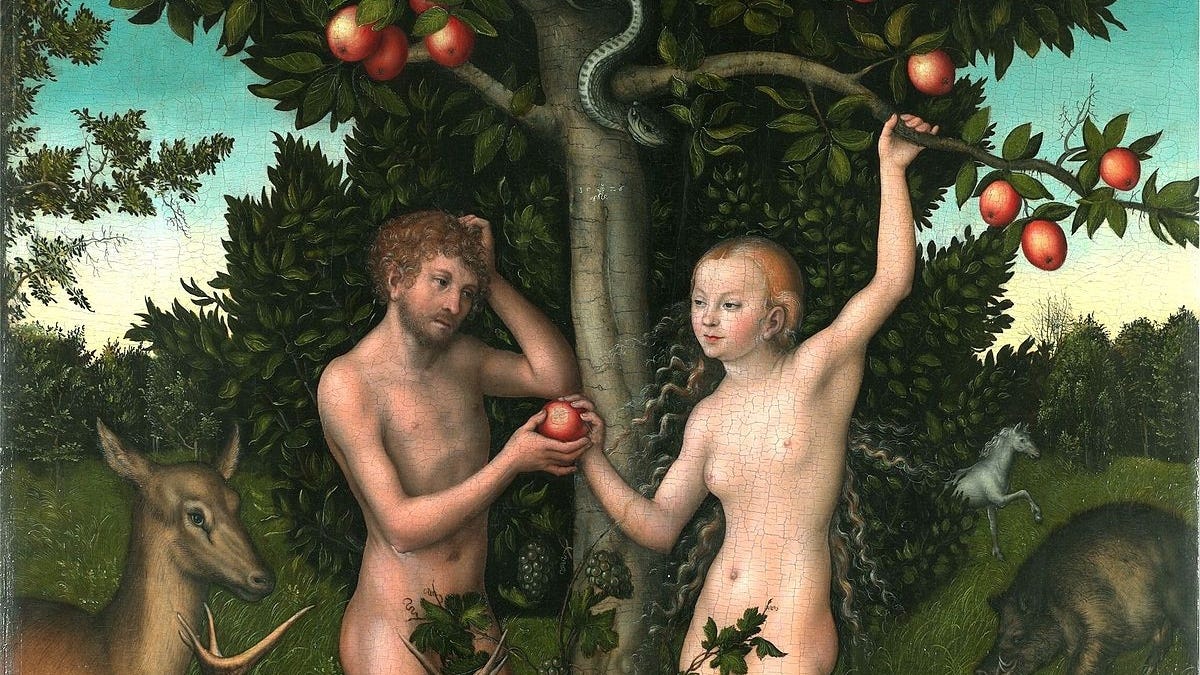
In 1526, William Tyndale completed his translation of the New Testament, the first in early modern English. By the time of his untimely death ten years later, having fallen out with Henry VIII (easily done, no doubt), he had finished the whole Bible. Such was the quality of his translation that about three quarters of it ended up being included in the Authorised Version, popularly known as the King James Bible, of 1611.
One word that didn’t make it was ‘tush’, as in, “tush, ye shall not die” said the serpent to Eve, whilst proffering the proverbial apple. The reason modern bibles don’t include the word ’tush’ – an old fashioned way of saying ‘don’t be silly’ – isn’t because later translators came up with a more suitable alternative, but because there is no word in the original Hebrew that has been translated as ‘tush’. Tyndale simply added it for effect. He made it up.
Though, to be fair, it does sound like a very serpenty thing to say.
There they are, Mr and Mrs Adam and Eve, living happily ever after in the Garden of Eden, and then along comes you-know-who, and it all goes horribly wrong. “Tush, ye shall not die…” says the serpent, convincing Eve to taste the forbidden fruit of the tree of the knowledge of good and evil.
Adam and Eve, you will no doubt recall, were commanded, on pain of death, not to eat the fruit of the tree of knowledge. But the serpent insinuates that they’ve only been told that to frighten them. They won’t really die. In fact, they will gain God-like super-powers and it is this that God wishes to prevent, purely out of jealousy. “Tush, ye shall not die”, whispers the serpent. In one sense, it’s true. The fruit isn’t poisonous and they don’t instantly drop dead. But they have nonetheless been deceived because as a consequence of their disobedience sin and death enter the world.
Regardless of what we may think about the provenance of this story, it undoubtedly tells us something importantly true about the human condition: namely, that we exist in a state that can best be described as ‘fallen’. Contrary to those with more idealistic tendencies, I believe it is hard to gainsay the fact that human beings are fallible creatures, with a seemingly infinite capacity to miss the mark and fall short in one way or another. Some may baulk at the idea of ‘original sin’, but this is just a way of saying that life as we experience it is indelibly marked by the frustration of not getting what we want and having to put up with what we don’t want. Specific manifestations of sin, such as greed, pride, anger, vanity, and the rest, follow downstream from this primordial glitch in the fabric of reality, which we might ascribe to a fundamental ignorance concerning the way things are.
As a result of eating the fruit of the tree of knowledge, Adam and Eve suddenly acquire self consciousness. The scales fall from their eyes; they perceive their nakedness and are ashamed of it. Up until that point they existed in a state of unified consciousness, at one with God and all creation, and did not see themselves as separate entities in relation to other separate entities. In this prelapsarian vision, things are neither good nor bad; everything is just what it is. But the fruit, or outcome, of the ‘knowledge of good and evil’ is that the primordial unified consciousness in which they initially share is replaced by what we know as the relativistic consciousness of the atomised individual in a world of subjects and objects.
In becoming self-conscious about their nakedness they realise for the first time that every object is a subject from its own point of view, and every subject is likewise an object from another subject’s point of view. As a consequence of this newly acquired dualistic consciousness they start to evaluate everything in terms of positive or negative attributes. This feels good, that feels bad. Yet contrary to the serpent’s false promise, this does not make Adam and Eve wise, or in any other way ‘like God’, because they remain subject to the limitations of their finite mortal nature. They are thus unable to resolve the inherent contradictions of dualistic perception, namely that every positive may be a negative from some other vantage point. The knowledge of God, by contrast, is predicated on the perspective of eternity in which judgements of positive and negative are rendered ultimately meaningless.
They may not have dropped dead, but nor did they attain divine consciousness because the fruit of the knowledge of good and evil isn’t enough on it’s own without the fruit of the tree of life, which would have conferred God-like immortality. Our curse is that whilst we know there is a difference between this and that, we lack the God’s-eye perspective that would enable us to know for certain which is which.
It is a commonplace to describe our contemporary era as paralysed by relativism. Every teenager comes at some point to see that what might be considered good or right in one time or place may be thought bad and wrong in another. But at the same time, we instinctively know that reducing morality to a matter of subjective taste, or truth to a matter of personal opinion, doesn’t really add up. In practice, people tend to be very clear about matters of right and wrong. Basic moral precepts largely transcend history and culture. Stealing is objectively wrong. This doesn’t depend on your point of view; it’s a moral fact.
Relativism thus tends to be applied rather selectively, even by its most committed advocates. After all, it doesn’t take long to spot the inherent contradictions. For example, the world’s different religions all claim to be true, but how can this be the case without rendering the very notion of truth itself meaningless? I may think my religion is the only one that’s really true, but everyone else says exactly the same thing. Must we then conclude that if they can’t all be true they must all be false? An atheist would presumably concur, but this only postpones the reckoning because it still assumes a worldview that is somehow objectively true, in comparison with which all other stories are judged to be false.
There is, however, a more palatable alternative, which avoids the otherwise inevitable collapse into self-defeating nihilism. Whilst it may indeed be impossible to decide which story is true without the perspective of eternity, perhaps we have just enough knowledge of good and evil to judge between rival truth claims on the basis of which is better.
I realise, of course, that this suggestion flies in the face of the dogma that all viewpoints are equally valid. After all, to suggest that values might not be relative is one of the great heresies of our age. Surely it is just self evident that notions of right and wrong, good and bad, are entirely subjective? Though we have certainly grown accustomed to thinking this way, that doesn’t mean it is true. It is entirely possible that some religions, ideologies, worldviews or value systems, are better than others. If so, how might we decide between them?
By their fruits you shall know them.
In other words, if we cannot evaluate truth claims themselves due to the fact that we cannot judge them from the perspective of eternity, then perhaps we can at least measure outcomes. When it comes to deciding between different worldviews, we can ask if such-and-such a story is conducive to human flourishing, or encourages our subjugation; whether it describes the universe as a place in which humanity is intended to prosper, or a machine that has no regard for our wellbeing.
Practical impacts are generally easier to assess than theoretical propositions, so for a second bite of the apple, as it were, let’s fast-forward to the story of the temptation of Jesus in the wilderness. In what could be described as a recapitulation of the temptation in Eden, Jesus, the new Adam, is sitting there alone in the silence, when all of a sudden, with tiresome predictability, along comes you-know-who again.
“Mate, Maaate… if you’re hungry, just turn these stones into bread. It would be a mere trifle for someone of your calibre, what with you being the son of God and all!”
Now, note the response. Jesus doesn’t attempt to contradict the devil, but rather he changes the terms of the debate entirely. Notice too that, once again, the devil’s insinuation is not completely untrue. That’s the thing about lies: they seem credible. If Jesus is the son of God, then presumably he could indeed turn stones into bread, and a whole lot more besides.
But Jesus doesn’t get drawn into playing the devil’s game by arguing over the details. He doesn’t, for example, say: “Well, actually Satan, it’s not that straightforward. I mean, obviously I could, but you must realise this sort of thing is harder than it looks. Apart from anything else, the molecular structure of stone is nothing like wheat…”
He doesn’t respond on the devil’s terms at all. Instead, he completely reframes the discussion, in relation to a bigger picture. It’s not that what the devil says is factually untrue; it’s just morally wrong. The point is not primarily about food, but rather the fact that in order to be complete and fulfilled, we need spiritual nourishment as well.
The same thing plays out in response to the other two temptations. “Throw yourself off this high peak and the angels will save you.” Yes, that might be true, but it would not be right. “All of this will be yours, if you will only worship me.” Yes, that might be true, but it would not be right.
In each case, it’s not a matter of what is true or false but what is right or wrong. And this dichotomy, far from being relative is, practically speaking, clearly absolute. If we basically accept the givenness of moral facts, then we instinctively know right from wrong, whereas weighing up the difference between debatable questions of truth and falsehood can be much more difficult.
This is important. Individual wellbeing is a product of a healthy society. Society depends on laws, and laws derive from politics, and politics is informed by the ethical norms of a given worldview. In other words, there is no such thing as a human culture without religion, because what we call ‘religion’ is the foundation of what we call ‘culture’. This also means we have no choice about whether or not we are religious; the only thing we get to choose is which religion? In spite of the fact that some people clearly believe we’ve moved on from all these primitive ways of thinking, we do not live in a secular society if by that we mean a society that is non-religious. On the contrary, our supposedly ‘secular’ society is riddled with a chaotic multitude of incoherent ideologies that owe more to magical thinking than enlightenment rationality. Post-Christian it may be, but irreligious it is certainly not. In many ways, we have arguably reverted to a crude form of paganism, whose cruel and loveless gods don’t just permit human suffering, they actively promote it.
There is a reason we now live in a world that considers progress to be marked by costly sacrifices to the gods of wind and sun, not to mention the legalisation of euthanasia and the decriminalisation of infanticide. And there is a reason why some people might not think that’s a good thing. In both cases, it comes down to our ‘religion’, whatever it may be, understood not so much as a personal viewpoint, but the foundational story that defines a people as ’a people’ in the first place. This makes religion inherently political because without some understanding of the cult at the heart of a culture we cannot possibly hope to understand why the laws, institutions and social norms that constitute our common life are the way they are.
Tyndale was motivated by the high-minded aim of making the scriptures accessible to all, even the proverbial ‘plough-boy’, without the intermediary of a priestly caste. It would never have occurred to him that this might lead to the moral vacuum of post-modern relativism because he would, at the same time, have unequivocally accepted the givenness of moral facts, with God as the ultimate source and guarantor of the good. Nevertheless, the reformers’ well-intentioned insistence on the right of the individual to interpret the scriptures for themselves – and therefore to determine truth – has led with depressing inevitability to the nihilistic conclusion that “it’s right because I say so”.
We’ve been falling for the lies of the serpent in the garden ever since.
A few weeks ago I joined an old friend, mindfulness teacher Michael Atkinson, on his podcast to talk about life, faith, contemplative prayer, and more. Click to listen.
No posts
Comments
Nothing yet. Say the first thing.
Sign in to join the conversation.