
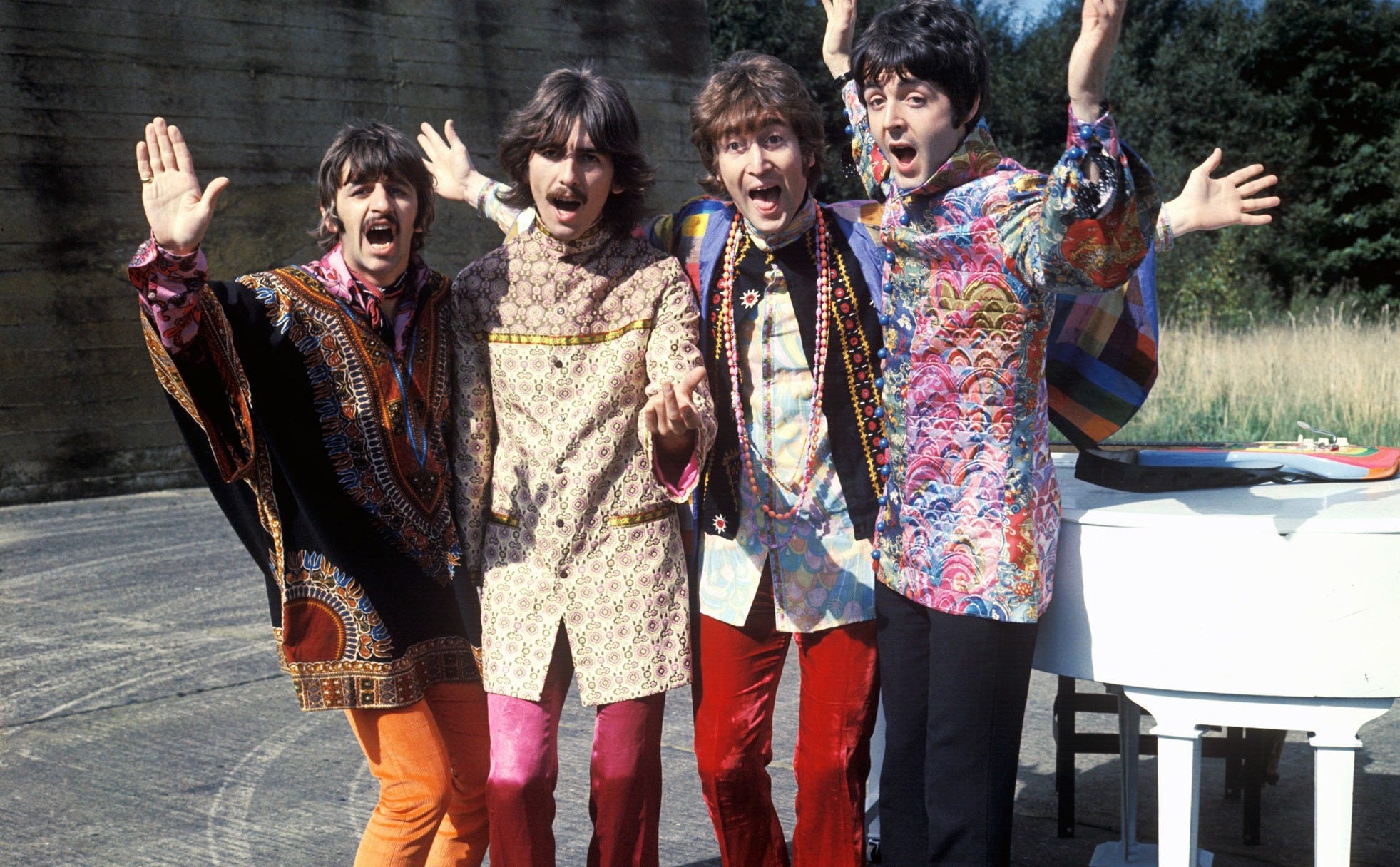
When John Lennon heard that the English teacher at his old school was getting the kids to write essays about the lyrics of Beatles songs, he deliberately set out to compose one that would totally flummox them. The song in question was the 1967 hit I am the Walrus, with its trippy opening line, “I am he and you are he and you are me and we are all together.” Needless to say, Lennon was doing a lot of LSD at the time, which might help explain otherwise nonsensical lyrics about sitting on a cornflake and a semolina pilchard climbing up the Eiffel tower – enough to make even ChatGPT blush.
I don’t listen to the Beatles as much as I used to these days, and my own youthful experiments with LSD are over four decades behind me, but whenever I read those passages from John’s gospel where Jesus talks about being one with the Father, such as: “I am in my father, and you in me and I in you” (John 14.20), I can’t help myself recalling the lyrics of I am the Walrus.
Now, I don’t suppose for one minute that Lennon had John’s Gospel in mind when he penned those words; yet I challenge anyone not to be struck by the similarity. See John 10.30, 10.38; 14.10-11; 15.4; 17.21-23 for further examples.
Is this just a random coincidence? Or might it be plausible to suggest that the feeling of universal oneness experienced on an acid trip could have something in common with the mystical consciousness that may arise as the result of sustained engagement with disciplines of prayer and meditation? Ever since Aldous Huxley’s accounts of taking mescaline recorded in The Doors of Perception (1954), and the famous Marsh Chapel experiment conducted by Walter Pahnke in 1962, LSD and other psychoactive substances have been promoted as a shortcut to mystical consciousness. A small but enthusiastic group of researchers continue to explore the clinical uses of psychedelic drugs today.
Whether the route involves the sustained practice of spiritual disciplines, such as fasting, prayer and meditation, or the rather more instant fix of chemically induced mysticism, the experiences that may result do nevertheless seem remarkably similar. In the depth of contemplation, where we are aware simply of being aware, we may come to see that the deepest reality of what we are is the fundamental intuition of being that is what is, the ground of being we share not only with each other but with that which is ultimately real and true as well. Similarly, even purely recreational users of psychedelics, with no prior religious inclinations, will commonly experience their sense of separate selfhood dissolving in blissful oceanic oneness.
All of that said, I think the similarities are often overstated. For one thing, the use of entheogens – the preferred term for mind-altering substances used in ritual rather than recreational circumstances – can be rather unpredictable. Whilst profound experiences of mystical consciousness may frequently be reported, episodes of drug-induced psychosis are also not unheard of.
The difference between a mystical experience and an experience of the mystical, if we can put it like that, must surely have something to do with the person concerned, their existing beliefs and previous life-experience. Someone dropping acid at a party for a bit of a laugh presents a very different set of conditions to someone whose whole being has been formed, and possibly transformed, by a dedicated commitment to years of spiritual discipline.
Thus, it should presumably go without saying that in spite of what may be interesting convergences between the effect of entheogens and mystical experiences, psychedelic consciousness circa 1967 is not the only lens through which to read John’s gospel. The passages in which Jesus talks about his identity with God and with his followers are, of course, usually taken to be an allusion to the idea of God as a trinity of persons, sharing a common unity that is at the same time described in terms of a dynamic inter-relationship.
The Christian notion of God as “Unity in Trinity, and the Trinity in Unity”, to quote the Athanasian Creed, reflects a number of other tripartite schemas by means of which our various worldviews are constructed. Matter, which is to say everything that has tangible form, exists as solid, liquid and gas; water being the paradigmatic everyday example. Newtonian physics unpacks the relationship between distance, velocity and time. Vedic cosmology portrays God in the forms of Brahma, Vishnu and Shiva. Buddhism, spiritual home of the numbered list, has the three refuges of Buddha, Dharma and Sangha, the three marks of being – namely impermanence, suffering and not-self – and the three fires of greed, hatred and delusion that keep the wheel of life turning in perpetuity. And in terms of our contemporary milieu, we may as well mention the popular and rather cult-like ideologies of climate, race and gender, and the unholy trinity of non-human intelligence: alien, demonic and artificial.
Buses, too, it is said, always come in threes, but there are plenty of things that come in two and fours as well. We could cite any number of binary polarities, including Yin and Yang, male and female, hot and cold, matter and spirit, positive and negative, light and dark; whilst fours include the points of the compass, the seasons of the year, the quarters of the day, and so on.
But somehow, relationships between sets of three seem the most potent. Perhaps it’s something to do with the way in which each can be understood in terms of the other two, just as each point of a triangle can be calculated from the other two angles. Similarly, the classical transcendental properties of goodness, beauty and truth – so named because these are three universal attributes of reality that can therefore be used to describe the nature of God – each contain or imply the other two. Thus, that which is good is also beautiful and true, that which is true is good and beautiful, and that which is beautiful is both true and good.
The transcendental qualities also relate to the three human attributes, of thought, feeling and will. Through thinking we can engage with God as that which is ultimately true, through feeling we can connect with God as that which is beautiful, and through the will we can relate to God as the source of that which is good. By the exercise of these faculties, we manifest the three fields of human endeavour, namely science as the quest for truth, the arts as the quest for beauty and religion the quest for goodness.
It may be suggested that Jesus refers to goodness, beauty and truth when he says, “You shall love the Lord your God with all your heart, and with all your soul, and with all your mind” (Matthew 22.37). Perhaps we can also see an inverse trinity in the story of the temptation in the wilderness, where Jesus, confronted by demons of gluttony, avarice, and vanity, rejects the hedonism of physical satisfaction, the materialism of wealth and the egoism of worldly status. Those who would be his followers are called to seek the virtues of faith, hope and love that relate directly to the God who is truth, beauty and goodness.
Finally, in saying: “I am in my father, and you in me and I in you”, Jesus points to the unity of consciousness in the three fields of being, comprising the self, others, and God. Underlying all particular instances of consciousness, pure consciousness – not of any particular thing, but consciousness itself – is the fundamental substrate of reality. Consciousness does not arise from matter, it is an all-pervasive and irreducible property of life itself. What we call consciousness is the ground of being; not only our being, but all being. It is what is, and it cannot not be. And it has various attributes or capacities, such as intelligence or emotion, which vary in different conscious forms. Not all living entities are intelligent, as we would understand it, or capable of experiencing emotion, but they are nevertheless conscious, with some capacity for awareness, however rudimentary.
Above all, the fact that we can even think these thoughts in the first place is highly significant. That said, just talking about it is nothing like the visceral experience of cosmic consciousness reported in mystical or – possibly – psychedelic experiences. Unfortunately, there is no certainty that we will ever have an experience of pure consciousness, even after years of disciplined spiritual practice. And LSD offers no guarantees either. So, is there anything in our ordinary everyday experience that can at least provide us with a little glimpse of what we might be looking for?
I believe the answer is yes, because we can see the reality of consciousness every time we look into the eyes of another human being. They say the eye is the window to the soul, a notion that may be derived from a saying of Jesus recorded in Matthew’s gospel: ‘The eye is the lamp of the body. So, if your eye is healthy, your whole body will be full of light; but if your eye is unhealthy, your whole body will be full of darkness.’ (Matthew 6.22-23).
Our facial expressions, and particularly our eyes, can reveal certain emotional states, such as fear or happiness. Subtle movements of the muscles around the eyes, and the contraction or dilation of the pupils, can change our expressions in almost imperceptible ways that another person can nevertheless intuitively read. But what is it that we are actually seeing when we look into the eyes of another person?
We literally see consciousness.
Looking into the eyes of another human being, we see consciousness. We cannot hear hearing or taste tasting, but we can see seeing. Moreover, what we see when we see seeing feels instinctively familiar. We have a deep affinity for what we see in another person’s eyes that we do not have when we look into the eyes of, let’s say, a crocodile. It’s still consciousness, but of a very different sort. And we know it.
It is noteworthy too that we can clearly see when consciousness is clouded or obscured. We talk about the eyes glazing over when someone is tired, drunk or in the grip of a psychotic episode. Our eyes don’t literally glaze over, of course, but we can nevertheless see when someone is somehow not fully present, when their consciousness is obscured, diminished or otherwise altered. We describe eyes as being sparkly or dull; blazing, glinting or cold, lifeless and blank. When we say these things we are not talking about the physical organ, or any material change in appearance, but a quality we can nevertheless quite clearly perceive, that is both intangible and yet unquestionably real.
Which is quite interesting.
The consciousness we discern in the eyes of another is apprehended by our own consciousness, and in that there is a profound recognition of the fundamental unity of all that is, for the deepest reality of what we are is the ground of being we all share. The unity of consciousness that we may intuit in the consciousness of another can be even more deeply known as a result of the sustained practice of spiritual discipline or, as some might claim, via the more immediate if unpredictable route of ingesting psychotropic substances. The feeling the individual wave has when it realises that it is in truth the unlimited fullness of the ocean may be one of freedom and joy but, the fact of the matter is, this is not our everyday reality. For the most part we do not experience ourselves in terms of cosmic consciousness, but as limited and self-contained entities. And in many ways, it’s very useful that we do. I am clearly not you, and vice versa. We are autonomous subjects, each with our own experience of reality and our own boundaries of perception. Nevertheless, this experience of separateness is, at some level, illusory. We are also deeply connected – fundamentally united, even – though we don’t see or feel it most of the time.
John Lennon freely admitted that the lyrics of I am the Walrus were not meant to be taken seriously. In fact, he deliberately made the lyrics as absurd as possible in order to wind up those intent on finding deep hidden meanings in Beatles songs. Yet, he also said that although it was a joke it was partly true at the same time.
“I am he and you are he and you are me and we are all together…” Uniting the three persons of I, you and he in one may not have been consciously intended as a reflection on the Christian doctrine of the Holy Trinity, but it does nonetheless point towards something deeply true about the integral nature of reality.
No posts
Comments
Nothing yet. Say the first thing.
Sign in to join the conversation.