
I find it curious that so many people seem to be interested in astrology, tarot cards, crystals, channelling, varieties of Neo-paganism, and all manner of confected New Age ephemera, because they think it’s ‘mystical’. Christianity, by contrast, is seen as some sort of corrupt and worldly institution, lacking in ‘true spirituality’. This may be partly understandable, but it is deeply mistaken. Christianity is, essentially, a mystery religion. It has at its core two profound enigmas – the Incarnation and the Resurrection – the first, a story about God becoming human in the person of Jesus; the second, a story of Jesus transcending human limitation in fulfilment of his divine nature. Note that this is mainstream Christianity, not some esoteric fringe, making it a much more explicitly mystical tradition than most others, including mainstream Judaism, Islam, Hinduism, and Buddhism.
Many people will happily commit themselves to disciplines derived from Indic traditions, such as Yoga-Vedanta and Buddhism, or sign up for personal development programmes based on new age spirituality or popular psychology, because they present a coherent diagnosis of the problem to which they claim to offer a solution, together with a prescription for how to attain it. Yet hardly anyone – many Christians included – seems to think of Christianity in these terms, in spite of the fact that it is very clearly an ascetic discipline; indeed, one so extremely ascetic that it is all but impossible to follow the path laid out in the teachings of Jesus.
Instead, people of Western societies, including those who still consider themselves Christian, have been conditioned since at least the 1960s, to believe the narrative of secularisation, which claims that modernity inevitably renders religion obsolete. Nothing could be further from the truth. Religion, whatever else it is, meets a universal need for narratives of meaning and collective identity. On this view, we have no choice about being religious – it’s just a fact of being human – the only thing we get to choose is our object of worship. A dominant minority have been seduced by the cult of progress, despite it being repeatedly exposed as an empty lie. Whether we are talking about technological progress or ‘progressive’ ideology, the religion of progress is rapidly collapsing under the weight of its own incoherence, not to mention diminishing returns. And some people, at least, are looking for something more satisfying.
For as long as I have been an adult churchgoer, however, Christianity in Britain has been in seemingly inexorable decline. In spite of believing in a resurrection faith, in spite of proclaiming that God brings new life out of death, it has been very hard to see how this decline could possibly be halted, never mind reversed. Indeed, the Church itself has often been complicit in accelerating its own demise by wrongly believing that the best way to attract newcomers is by trying to be more like the world around it. On the contrary, what very often attracts people to churches is as likely to be something to do with how they are a ‘sign of contradiction’ that differs from the world (Luke 2.34). It is surely no accident that it is precisely those churches that are confident about what they believe, and unashamed to stand against the tide of prevailing cultural norms and ideological assumptions, which are the ones that are actually growing. Furthermore, some of this growth appears, unexpectedly, to be most apparent among younger generations fleeing the crisis of meaning, turning their backs on materialism, and – whether consciously or not – abandoning the false religion of progress. This should come as no surprise. So, instead of bending over backwards in order to conform to the expectations of people who don’t even go to church in the first place, perhaps churches should celebrate what makes them different.
The salvation story, of the incarnation, life, death and resurrection of this person Jesus, is routinely derided by the clever people as a mere fairytale, which – according to elite Roman society of the time – was fit only for women and children. Yet it is a story that has changed the world. And it will change us too, if only we let it.
Had it not been for the apostle Paul, however, Christianity would have likely remained – if it had even survived at all – little more than a small and eccentric cult, within an obscure Middle Eastern religion whose adherents, then as now, comprised but a tiny minority of the world’s population. Instead, the powerful combination of Paul’s visionary mysticism and his energetic evangelism, propelled this arcane sect to become the world’s largest and most widespread religion, shaping not only Western but, by extension, global civilisation. This makes Paul arguably the most significant person in human history.
At the heart of Paul’s mission was an extraordinary claim concerning the death and resurrection of the God-man, Jesus Christ. In life, a wandering Galilean miracle-worker and apocalyptic preacher – in itself, not unique – but in death the one who overcame death and showed us all the path to new life through reconciliation with God. This claim was dismissed then, and has been ever since, up to and including the present, as a preposterous lie. And yet, that claim still grips the human imagination to this day, and continues to define how we order our world. Even those discourses that set themselves in opposition to it, such as secular humanism, remain tied to assumptions that are fundamentally Christian. Our basic notions of right and wrong, decency, justice, equality, the rule of law and human rights are based not on universal natural principles but specifically Christian doctrines. Even the more outlandish reaches of contemporary progressive thought, from trans-humanism to critical social justice theory are, at heart, based on concepts derived from Christian theology, albeit taken to nonsensical extremes.
Whatever one may think of any particular Christian dogma, this is a remarkable fact. And it all goes back to this unbelievable, impossible claim about the death and resurrection of this man Jesus, which from the outset was recognised by Paul as ‘a stumbling-block to Jews and foolishness to Gentiles’ (1 Corinthians 1.23).
How on earth can that be the case? What is it about this story that was and continues to be so powerful that it determines the very structure of how we see the world and experience life within it? Surely it hinges on more than what may or may not have been recorded had there been a CCTV camera in the empty tomb? Paul was a mystic, a scholar, an initiate of the mysteries. Historical facts are important, but the story contains multiple layers of meaning. We shouldn’t be satisfied with easy answers, whether credulous acceptance or cynical rejection. We will need to work harder than that if we want to understand anything about who we are, why we’re here, and what we’re meant to do about it.
Christianity is difficult. It is morally demanding and it doesn’t make sense. It’s full of paradox and seemingly requires its adherents to believe at least six impossible things before breakfast – to borrow from Lewis Carroll – if not more. Throughout history, public intellectuals, from the educated Greco-Roman elites of the second century to the not so new atheists of more recent times, have dismissed Christianity as childish and simplistic. It doesn’t fit with everything else we know to be true about the world, and therefore, so the reasoning goes, it must be false.
The logic of this typical viewpoint is straightforward, but lazy. Disparaging Christianity on the basis that it doesn’t conform to existing beliefs is just too easy. Any teenager can do that, and most do. To say that its claims are contradicted by everything else we think we know isn’t really saying much at all. The fact is that human beings basically know very little; indeed, almost nothing really. Yes, we know quite a lot about a few things, but nothing very substantial about a whole lot more. The much more interesting stance would be to consider the possibility that it is precisely those claims that are so contemptuously dismissed as mere foolishness that make Christianity more engaging, more demanding and ultimately more worthwhile.
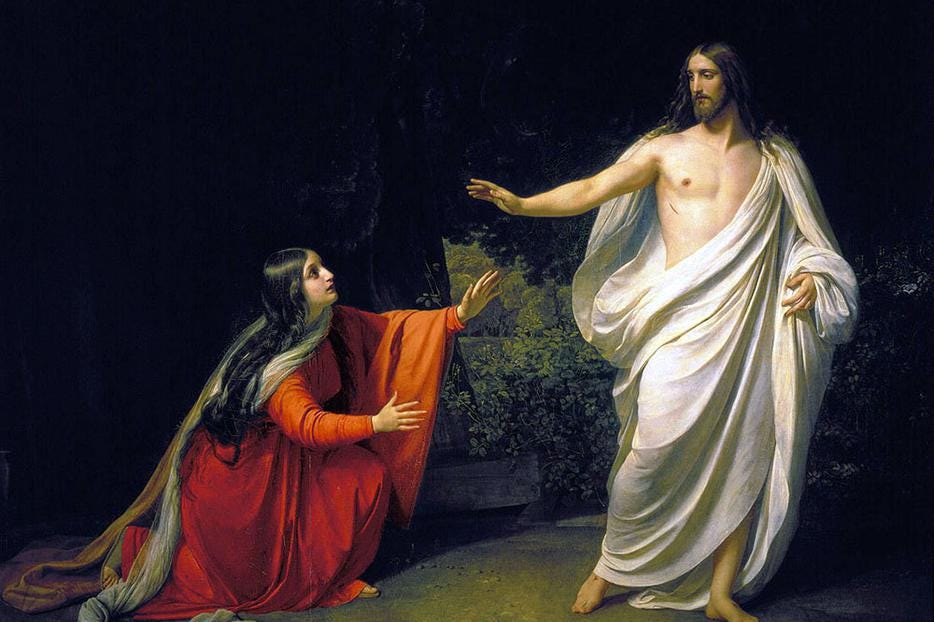
The story of Easter is about nothing if it is not about transformation. This is made even more obvious by the fact that, at first, the disciples – even those closest to him – fail to recognise Jesus. On the first Easter Sunday, Mary Magdalene finds the tomb empty. Remaining behind after the other disciples return to their homes, she encounters the risen Lord but doesn’t recognise him at first, mistaking him for a gardener. Similarly, when Jesus joins two companions walking from Jerusalem to Emmaus, they don’t realise it’s him even though they clearly know all about the dramatic events that have just taken place in Jerusalem. And Thomas, doubting Thomas, will not accept that it really is Jesus standing before him until he can touch the wounds of the crucifixion with his own hands.
This might strike us as rather odd. How could all these people fail to recognise someone they knew so well? In fact, it’s quite common for this sort of thing to happen. We’ve all had that experience of seeing someone, and thinking to ourselves, “I’m sure we’ve met before, but I just can’t remember where”. I frequently can’t place people I bump into, especially if I’ve only previously met them very briefly. It can even happen with people we actually know quite well, but haven’t seen for a while, or if we see them out of context, or if something about their appearance has changed. We might be a bit confused. We think we know who it is, but we’re not certain. Maybe they’ve changed their hair or lost a bit of weight. At first, we’re not sure, but then they speak and at once everything falls into place. We remember. We just needed to hear their voice in order to complete the picture.
Failing to recognise a casual acquaintance might be a common enough experience but, in this case, the disciples not only know Jesus well, but they’ve also seen him recently. This suggests that his appearance must be somehow changed. And that, of course, is the point. The resurrected Christ is both recognisably the person he was and, at the same time, unrecognisably different. In the same way, our faith must be transformative; otherwise what’s the point of it? It changes us, and it changes the way we see the world. But how, exactly? Does it change us to the point of making us unrecognisable? That would really be something if it did! The problem, however, is that real and meaningful change often requires us to take the harder path. It’s relatively easy to just go along with the normal everyday obligations of the faith, like showing up on a Sunday. That’s not nothing, of course, but for many people it’s probably not very demanding either. In fact, it can even be self-serving if it’s what we want to do anyway, or if we get something out of it that somehow or other bolsters our sense of self-worth.
The kind of change I’m talking about is rather more fundamental. Has the faith we profess made us any more selfless? Has it genuinely made us less judgmental? Do we really love our enemies? Are we truly ready to give up life itself? Has it actually changed us, deeply – if not beyond all recognition – to the extent that in some significant sense we are no longer recognisable as the person we used to be?
If not, why not?
I don’t pretend to know what ‘really’ happened on the first Easter morning. And I’m not that interested in arguing about it. The much harder, more demanding, task is to wrestle with the question of what it means. Any other approach to the mystery will inevitably just adapt the facts to fit our preconceived notions of what is deemed reasonable in any given context. We can only really grapple with this question if we take it seriously, if we accept that it is difficult and demanding, and if we take the story literally – I mean literally literally, as a story – whose every part means something significant in relation to the whole. Because either it’s all true or none of it is. Either everything changes or nothing changes. This is why decaf Christianity will never satisfy. A reasonable faith, conformed to our pre-existing understanding of the world, is too easy. It’s undemanding. And it won’t change anything, least of all us.
No posts
Comments
Nothing yet. Say the first thing.
Sign in to join the conversation.