
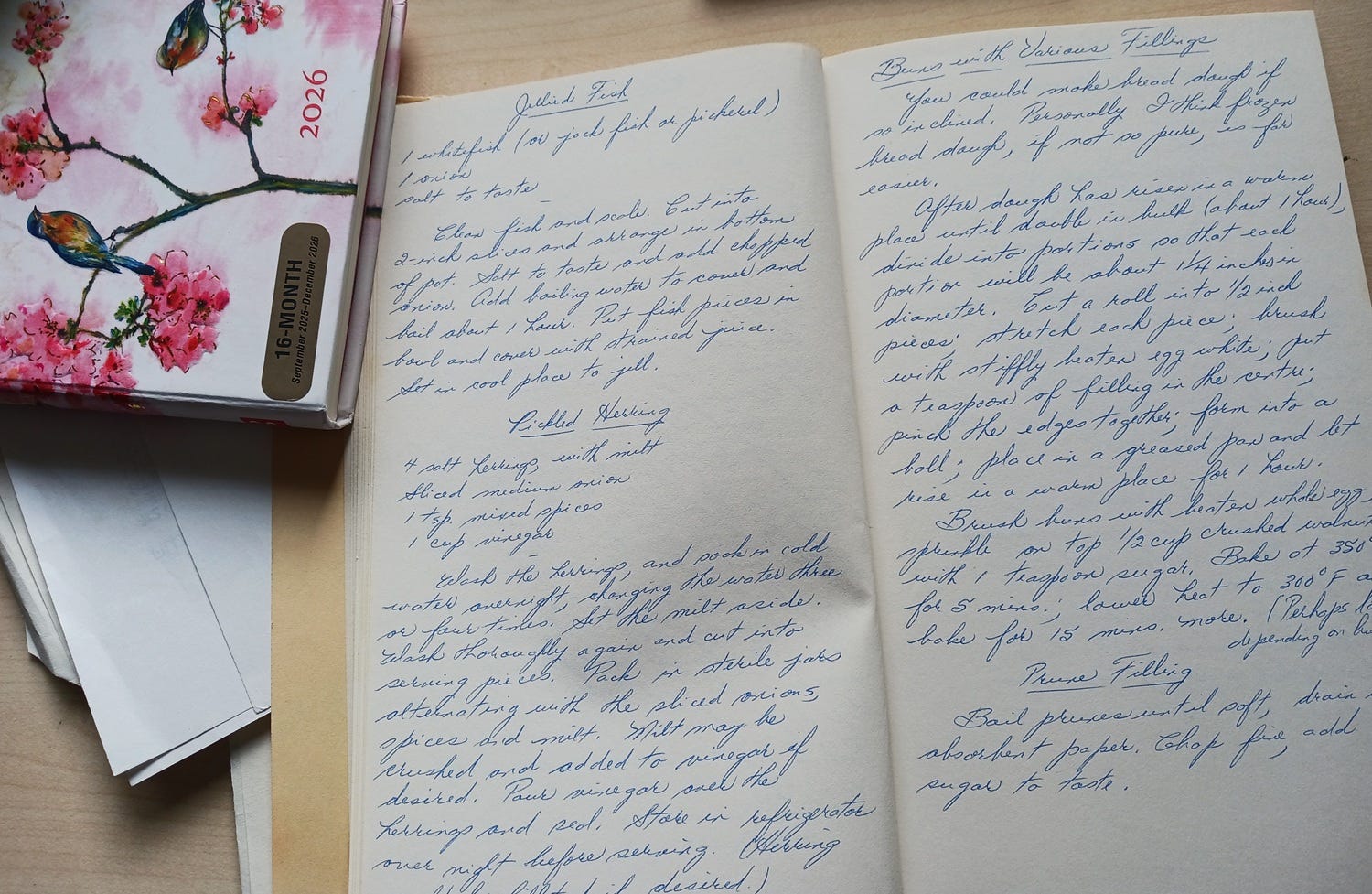
Before Christmas, I was searching for an old notepad that my mother had given me long ago, a scattered collection of her favorite recipes. My grandchild and I were planning to make Nanaimo bars, and I wanted to use mom’s recipe. Nowhere in my crowded shelves of cookbooks could I find that spiral-bound notepad. But I did find something else. Tucked away in a cupboard was a hardback journal with a jaunty Parisian image on the cover. Inside the book were shoved some recipe clippings but, better yet, every page of the actual journal was crammed with my mother’s handwriting: another collection of recipes, including, thankfully, for Nanaimo bars.
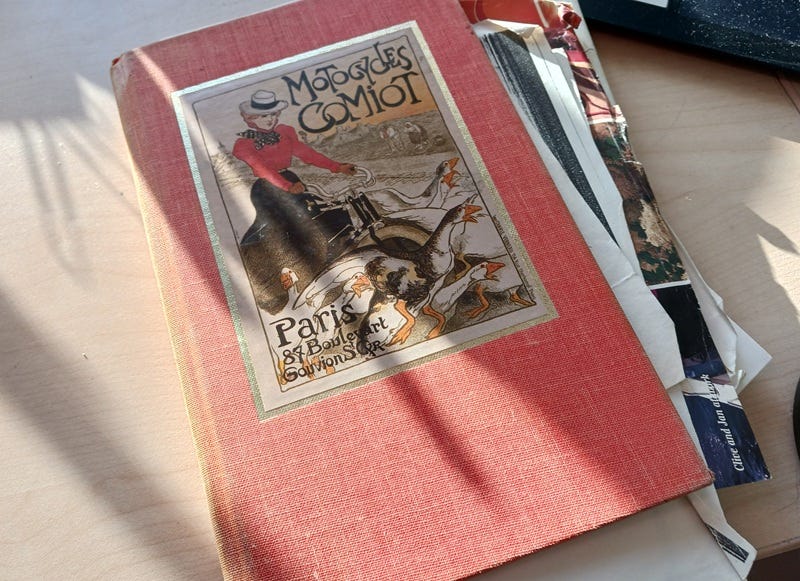
I vaguely remember her giving me this journal years ago when she was newly retired, but at the time I was a busy mother, teacher, wife, person in the world and while I am sure I thanked her in a heartfelt way, did I ever really look at it? No, not in any attentive way.
But now I’m retired so busyness was no excuse. As I browsed through it, I found that this volume was much more than a collection of recipes. It starts off, in her lovely legible, flowing handwriting, with a memory of Christmas when she was a child in the early 1930s.
“There were certain traditions I recall with great pleasure. Straw was put under the table, commemorating the nativity scene. Within the straw we children searched for oranges, candies and nuts. A rare treat for the depression-era youngsters we were.”
I immediately recognized the formal voice she used when she self-consciously wrote what she considered a public document rather than a more chatty, casual letter. This book, then, was more than a slapdash, hodge-podge of recipes. In her slightly old-fashioned prose, she was giving me a version of her life as recorded through the food she made, ate, loved, and associated with special occasions.
Like a 1950s salad hideously made with green Jell-o, iceberg lettuce and cottage cheese. Or the absolutely inauthentic “Chinese” menu she made throughout my childhood. To my delight, she penned an ode to The Under-Appreciated Pudding (rice and custard, especially.) She refers to her own mother many times. She mentions people who came over for various dinners. She writes down recipes that she’d never made but always wanted to, like one called “Sex-in-a-Pie”: “I have included this recipe though I have not yet tried it myself. What could be more decadent?” Indeed, mom!
This treasure of a book has made me think about how a life—especially a woman’s life—might be traced through the lens of recipes and cookbooks. Recently, I read a blog post by a West coast writer, Helen, who writes on women and aging. While her post is more generally about her life-long relationship to books, one of the books she mentions is The Harrowsmith Cookbook. That was a blast from the past. I never owned it, but I can visualize those squashes floating on its cover. How so? Maybe because cookbooks are talismans of their time, they are teachers when we are young, and they talk to us in the language of food, that most visceral of all languages. Surely when I was growing up was the beginning of the Golden Age of Cookbooks, and the Harrowsmith was a classic of its time, busy shifting diets and transforming food habits.
When I was 19 and moved out on my own, I acquired three cookbooks. The first was a spiral-bound book my aunt gave me that was called Cookbook for College Kids and in it I learned basic recipes I still use today, like Western omelets and fried rice. A couple of years later, a high school friend gave me The Joy of Cooking (this JoC is the old version that contains instructions on how to cook a squirrel) which I continue to use for various reasons: not only the Apple Cake Cockaigne recipe but also how to truss a turkey.
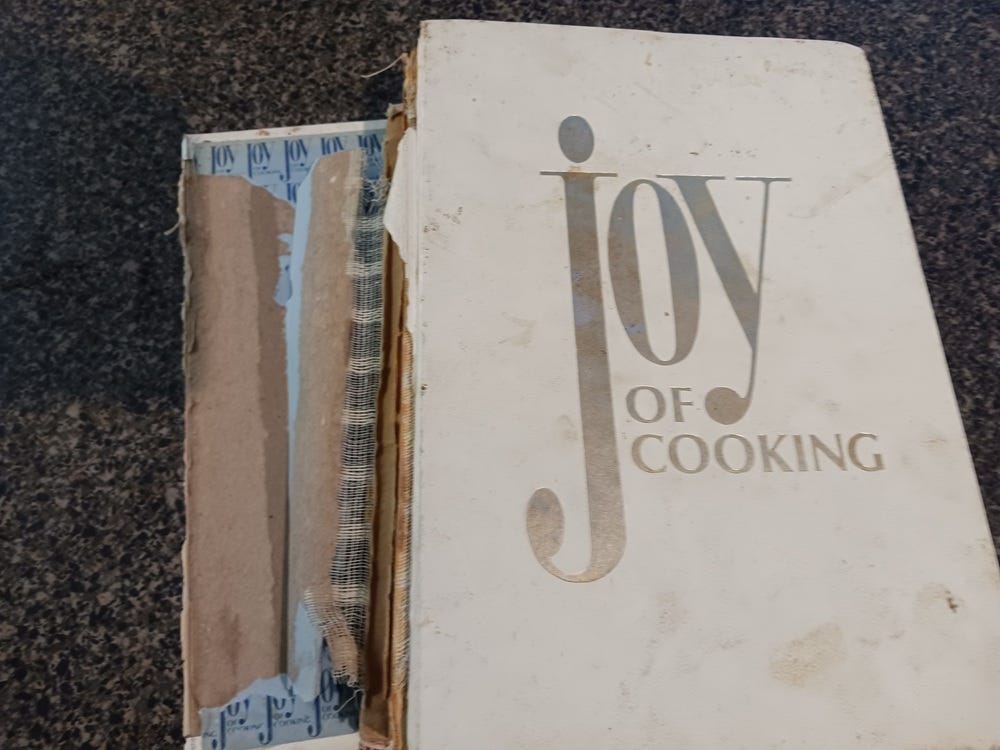
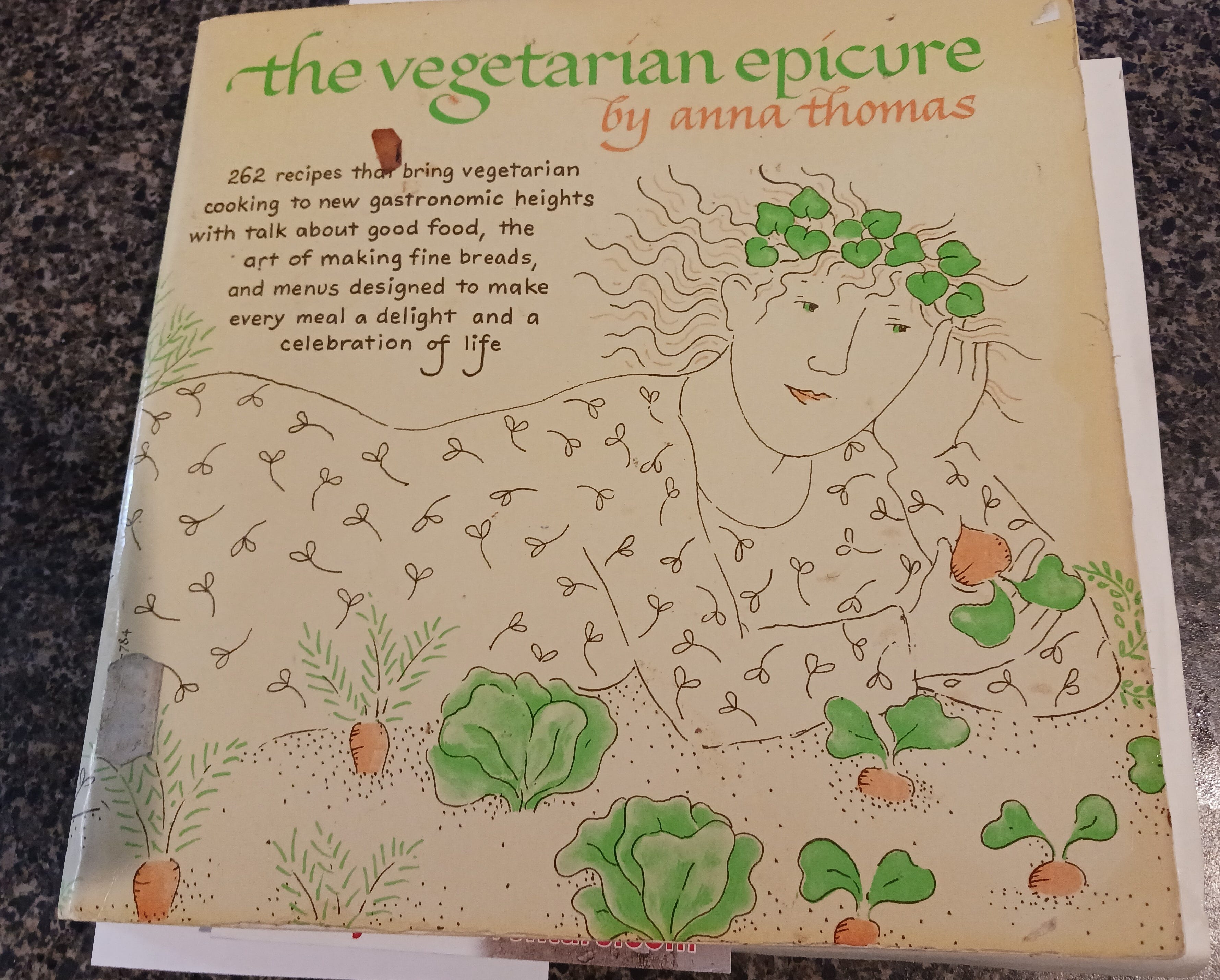
The third book was a small paperback that had a huge impact on me, Recipes for a Small Planet where I learned all I know about pairing legumes with brown rice, a book that probably led to my becoming a vegetarian many decades later. Of these three books only The Joy of Cooking remains on my shelf (broken-spined, stained and sagging) but I have many more vegetarian and vegan ones— several Moosewood ones and my second copy (because the first one fell apart) of The Vegetarian Epicure.
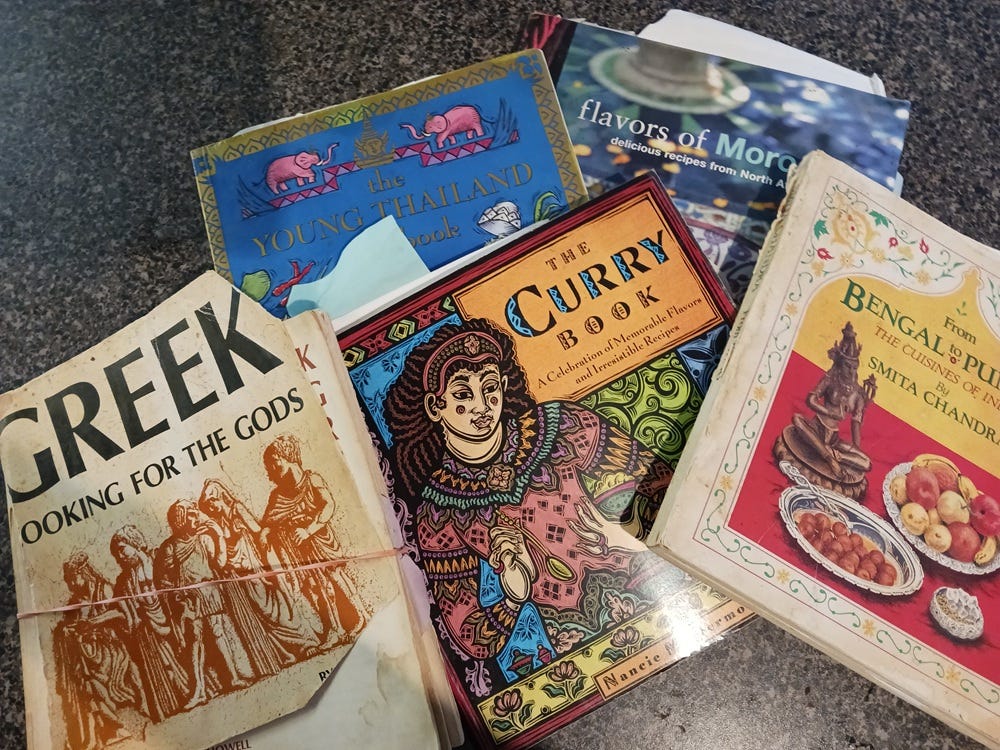
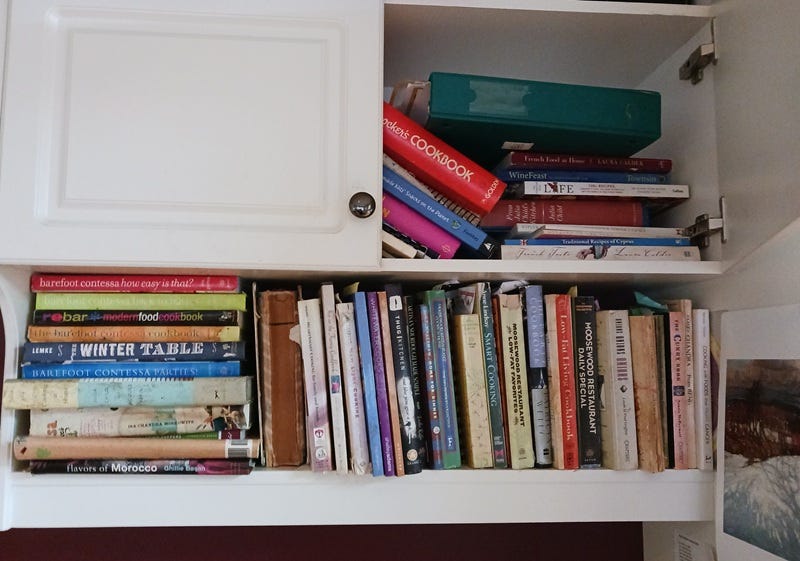
I’ve collected plenty of other cookbooks over the decades: lots of great French cooking ones—Julia, of course, and Patricia Wells— and series like the Barefoot Contessa and the Whitewater cookbooks. As I got older and more health-conscious I added HeartSmart and low-fat ones. I have favorite well- worn “ethnic” ones—Moroccan, Greek, Thai, Indian.
In one cupboard, I keep some cookbooks solely because they have a single special recipe (a Veracruz side dish with red peppers, asparagus and new potatoes; a stew of lamb shanks and white beans). Looking at my collection of tattered and splattered cookbooks, I can track who I cooked for, when I went on various trips, discovered various foods, or aspired to foodiness. I have a filing cabinet in my mind of which book has which recipe and sometimes I can even turn unerringly to the exact page to find the recipe I want. And, unlike my mom, I have a slew of recipes “bookmarked” on my phone.
Maybe now that I’m retired, I too can write a food memoir for my kids. This might be a good project as my three adult kids are all food lovers and great cooks. Maybe they’re too busy now to read my musings on why I became a vegetarian, or what recipes I salvaged from broken marriages and former in-laws, or food in relation to my mother and growing up, or my love for the Mediterranean, or that meal I still remember from a tiny restaurant in Montparnasse where I vowed to learn to make raspberry coulis, or my first taste of Indian food (revelation!), but one day my kids might appreciate it.
However, my memoir would not be as interesting a cultural and historical document as my mom’s. Her book is shadowed by a story that she often told about her life as the child of immigrants in Canada in the early 20th century: the story of how the world she was born into changed so dramatically. Her recipe book begins with her memory of diving into a pile of straw under her grandparents’ northern Alberta farm kitchen table, where, though she doesn’t mention it, everyone would have spoken Ukrainian and the book goes all the way to Sex-in-a-Pie from the swinging Seventies. The recipes from her early childhood are Ukrainian dishes— Kutia, Borscht, Knishes, Nolysnyky, Holubchi, Sauerkraut, Pyrohy—and by the end of the cookbook she’s got Sole Bonne Femme, Shrimp Deluxe and Jambalaya, not to mention Sex-in-a-Pie and a bourbon drink called Knockout. What a transformation of a woman’s life and a revolution of a country into a multicultural, middle-class, upwardly mobile, urban society.
When we lived in Toronto in the 1970s, the popular Caravan festival celebrated immigrant food, dance and culture with numerous “Pavilions”. My mom loved to attend the events and be introduced to cuisines from all cultures, but she was particularly thrilled see Ukrainian pavilions pop up. She was beyond happy to see her own heritage suddenly considered something to celebrate. She had grown up experiencing slurs and discrimination, so much so that she latched onto English as soon as she started grade school and never spoke a word of Ukrainian in my hearing except for the names of food.
My mom would never have understood the critiques of some academics who say that celebrating minority or racialized people’s food and dance and costume detracts from confronting serious issues of discrimination. Through food and dance and costume, through Canada’s official policy of multiculturalism, my mom overcame shame and reclaimed her heritage. We see similar renaissances of pride with Indigenous peoples today and many other marginalized groups. In this dark time, when immigrants are weaponized to poison politics and women’s rights are under attack, it is worth remembering how amazing this world became over the past few decades often because of them.
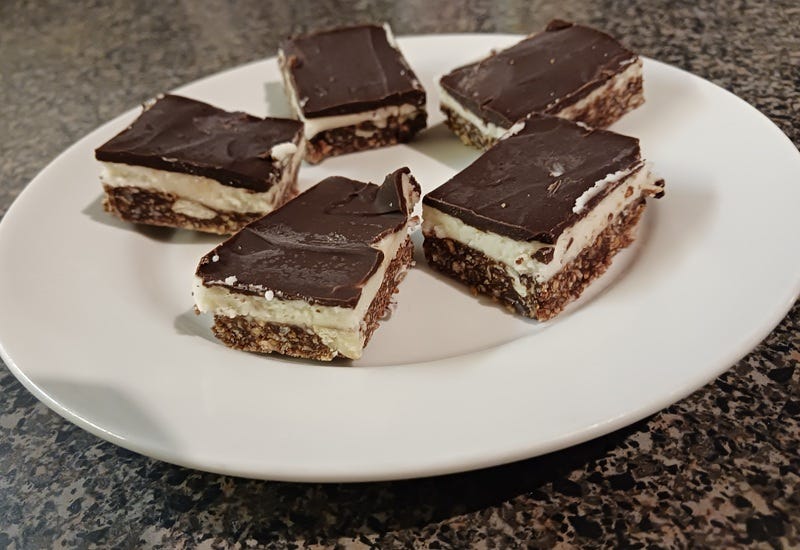
My mom never totally abandoned her mother’s recipes, even before the heyday of multiculturalism. Growing up, we had plenty of holubchi (cabbage rolls) and pyrohy (perogies). To this day they are among my comfort foods. But her recipe memoir moves from Ukrainian Christmas to the Anglo-Scots traditions of my father’s family, which was the meat, potatoes, gravy, and soggy vegetables variety and she became adept at producing this. In her journal, as she describes Christmas dinners of my childhood, she doesn’t mention that we always had holubchi as well as turkey and bread stuffing. She does include a recipe for fruitcake, that beastly Yule food in the Anglo tradition. Because my dad liked it, I remember her making it dutifully every fall, sticky tar-like things, dotted with jewel-like candied cherries, soaked in booze and wrapped in wax paper for weeks-long storage. Her memoir’s Christmas section also includes those decadent 1950s Nanaimo bars and yet more gelatin salads, including the red, white and green one affectionately derided in our family: it was made of both red and lime Jell-o, as well as crushed pineapple and cream cheese. I remember that even into her seventies and eighties, she introduced trendy new Christmas dishes such as salsa and corn chips and Mango-Cucumber Salad (included in her book).
My mom’s book is a small, sweet record of a 20th century woman’s story as well as a record of an immigrant journey in Canada. What a lifetime of change and transformation, of the opening-up of a society to diverse and rich cultures, of women massively modifying — revolutionizing— the kitchen. Her life through recipes shows how she personally created and accepted change and yet cherished traditions. My mother’s book is reminder that she did her best to fulfill the hope of a new life that her grandparents wished for, like all immigrants do, as they watched the family children scramble in the straw beneath the kitchen table. Those elders couldn’t have imagined how new, how different, and how fortunate that life would be.
This week, I turn to my mom’s “New Year’s” section. Reading it, I remember that when I was a teenager our family often celebrated with a fondue. My mom invited friends over, and the fondue pots sizzled away on the big dining room table, and we kids got to “cook our own dinner.” I was always a bit hungry afterwards for it seemed like a lot of effort for some pretty small morsels.
However, I had forgotten this one treat: “After the fondue and before dessert, you children shared in the potatoes which had been placed raw in the fondue pot to inhibit the splattering of oil. Nicely browned, delicious.”
Mmmmm. Yes, now I remember. Another transformation— what cooking is all about.
I feel a bit hopeful that although the current social fabric is fragile, imperfect, and many good things are under assault, it’s unlikely we’re going back to a country of meat, potatoes and soggy vegetables. So Happy New Year and happy feasting! In the Comments section, please share some “life through recipes” thoughts and favorite cookbooks! I would love to read about them.
No posts
Comments
Nothing yet. Say the first thing.
Sign in to join the conversation.