
Last night was the first full moon of the new lunar year, and here in Western Canada it was also a total eclipse of the moon, a “blood moon” as it is called since the eclipsed moon turns a reddish colour. I got up at 3 am to see it, but our sky was blotted with cloud cover. Normally, a full moon would haze a bit of light through the cloud but last night as the moon was eclipsed by earth’s dark shadow, the sky was uniformly black.
It is hard to not feel that this blackness is portentous. These past few days I’ve been reminded why I started writing this blog: anxiety about a bleak future. As I write , the American president is attacking Iran and Iran is retaliating. As awful as the regime in Iran is, is it possible to believe this attack will end up making everything better? I hope my pessimism is unfounded, but I fear unintended consequences. Like many people my age, I remember how twenty years ago the Americans began an unprovoked war on Iraq, based on a series of lies the Americans told themselves, which led to countless deaths, to horrific US military scandals, and to years of civil war in Iraq. Then there was Vietnam, yet another American military quagmire. I am just old enough to remember the tail end of that war, protests and protest songs, the fall of Saigon, the boat people.
I have just returned from a holiday in Vietnam. It was a great trip. Vietnam has a fascinating history both ancient and modern, the people are friendly and resilient. I drank way too much excellent coffee. I learned a lot by talking to people and going to historical sites and museums and travelling by bike and boat through rural villages. Art and flowers were everywhere as the entire country was decorating for Tet, or Lunar New Year. 2026 is the Year of the Fire Horse, an intense, challenging Zodiac sign predicting a time of political and social upheaval.
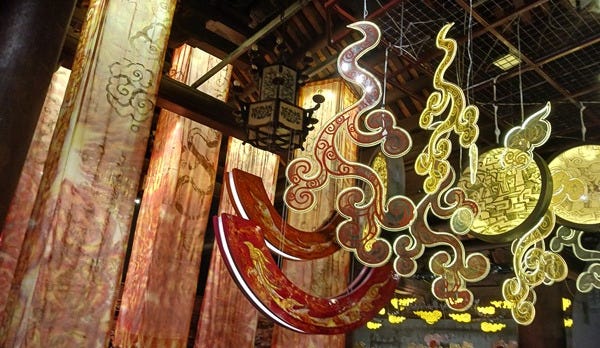
The last Year of the Fire Horse was 1966 when the American War, as the Vietnamese call it, was in full fury. That war is still present in many ways: a bombed-out building preserved on a main street in Hoi An; veterans with amputated limbs begging on streets or sitting in boats in the Mekong Delta while their families worked; charity donation boxes supporting people suffering from the effects of the chemical weapons the U.S. used. The War Remnants Museum in Saigon, or Ho Chi Minh City, is a heart-breaking record of American folly, violence, and mostly Vietnamese death.
At the archaeological site My Son in central Vietnam, our guide said his family was from My Lai, the infamous village where in 1968 American soldiers massacred “over 300 apparently unarmed civilians including women, children, and the elderly.” The guide showed us a photo of his home with a row of deactivated bombs and missiles all lined up against a wall. He said his uncles and other villagers would seek out un-exploded ordnance and very carefully remove the explosives which they would sell on the black market for food in the starving 1970s and 80s. I didn’t ask how many fingers, limbs or lives were lost. In 1973, the Americans left Vietnam—and left badly— and the Vietnamese began the long, rocky road back to some kind of stability and autonomy, and it now seems to be a normally troubled country, dealing with environmental and economic concerns, with the scars of history and volatile global politics.
So on this morning after the ominous blood moon and fresh from a trip to Vietnam, I am wondering why the Americans are doing this invasion thing again, especially when they are so bad at it. Maybe they believe Artificial Intelligence will help them get it right this time (whatever “it” is). However, a recent study published in The New Scientist has this headline: “AIs can’t stop recommending nuclear strikes in war game simulations: Leading AIs from OpenAI, Anthropic and Google opted to use nuclear weapons in simulated war games in 95 per cent of cases.” No wonder I feel the future is bleak.
The historian Timothy Snyder in an short Substack essay “Why Attack Iran?”
points out many reasons the Trump administration wants this war—wag the dog, for one—but Snyder also reminds us that Trump is “using military force to take the side of precisely the countries who have enriched Trump and his family... Along with the subversion of democracy, personal corruption provides a second interpretive framework.”
The consensus is growing that the Trump regime is deeply corrupt. Alexander Cooley and Daniel Nexon in Foreign Affairs just published a piece called “The Age of Kleptocracy: Geopolitical Power, Private Gain.” The authors say that “Trump’s pursuit of personal, family and cronies’ financial interests [is] not a sideline but … the very core of his foreign affairs activity.” So airstrikes on Iran are likely yet another corrupt foreign policy venture, as was Venezuela, as is his covetous brooding on Greenland and Canada, as are his relations with Saudi Arabia and Qatar, as is his very silly and utterly corrupt Peace Board, and so on.
I too have been brooding, brooding about corruption. It started with Vietnamese traffic.
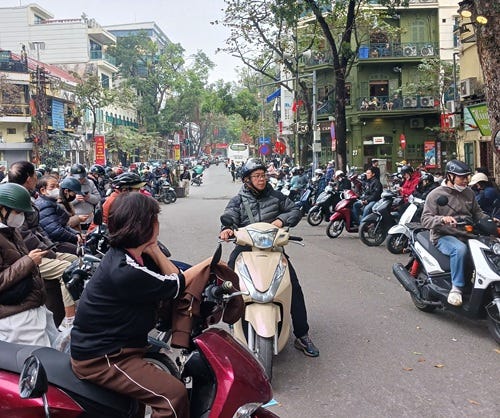
Like all tourists, I was impressed by the number of motor-bikes on the city streets. Scooters dominate the traffic, they park on the sidewalks, they mass at every intersection. The city streets from Hanoi to Ho Chi Minh City are like rivers. Buses, cars, vans, taxis and trucks sail down the road plowing through the scooters as if they are water flowing and streaming around them.
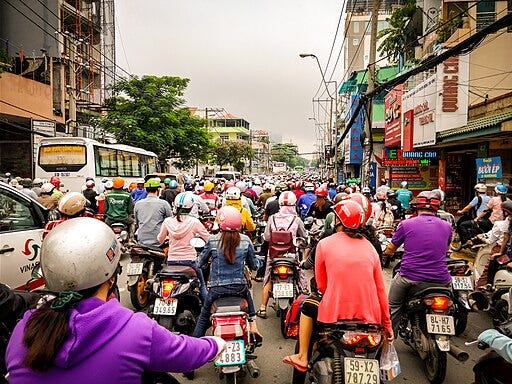
I saw little evidence of traffic rules being followed—road lines were ignored, scooters drove on sidewalks and the wrong way down roads, red lights meant little. In our short time there we saw two scooter accidents. One an aftermath -- a bus had crushed a scooter and this tragic mess was backing up traffic for miles. The other we actually witnessed: a taxi sideswiped a weaving scooter and one of the two people on the scooter limped to the sidewalk injured and crying.
However, overall the anarchy works. The drivers follow a set of unspoken rules. For instance, I was in a bus caught in a huge Tet-induced traffic jam on the outskirts of Ho Chi Minh City. An ambulance siren began to wail. Everyone in the traffic jam squeezed to one side to allow the ambulance through the snarl. It was good to see that in spite of the free- for- all, rules are rules, and everyone assisted the emergency vehicle’s passage.
This was reassuring but reminded me of a conversation I had a couple of years ago with an international student. She was from a West African country. We were talking about graft and oppression in her home. We happened to be driving and an ambulance zoomed up behind us. I and everyone else on the highway pulled over to let the ambulance by. I didn’t think anything of this until she said, “In my country you are supposed to do that too, but traffic in our cities is very bad, traffic jams everywhere. Not long ago, politicians and rich people who wanted to quickly drive through the city began to put sirens on their cars so they could pass through traffic. And now, no one lets an emergency vehicle through since everyone thinks it is just some bigwig who feels he’s important.”
Wow, I thought. Is there a better illustration of the mechanics of corruption? People in power decide to game the system, to exploit and abuse the rules for their benefit. Then that corruption begins to seriously harm a society through resentment and distrust. The rules fall apart. And some people die.
Vietnam itself has been tainted by Trump’s corruption. In order to avoid a massive tariff hit, the Vietnamese government fast-tracked a Trump-family mega golf resort project in north Vietnam despite objections from the local people whose land is being “acquired” and despite several mandatory development steps being skipped over. Trump used his political power to threaten economic woe in order to enrich himself and his family. Vietnam caved and undermined its own regulatory systems that are meant to protect its land and its people. Classic corruption.
Fifty years ago, way back in my first year of university I took an advanced English course in which we studied the whole of Paradise Lost. The epic was way over my head as a fresh-out- of -high -school student, and I disliked it in that sullen fashion that an eighteen year old student does so well. However, one lecture has always stuck in my head. The professor was talking about Milton’s Satan and he said that in the hierarchy of deadly sins, pride is at the top of the list. I was skeptical. Why is pride the worst? What about greed, eh? What about envy and wrath?
Then the professor defined pride: the old Christian moralists said it was the worst sin because pride is the belief that you are more important than anyone else in the world. All other sins come from that: murder? yes. Greed? yes. Envy? yes. Just read that Archive of the Corrupt, the Epstein Files, and hear how rich and powerful men clearly believe “girls” are less than human, less important in every way than them.
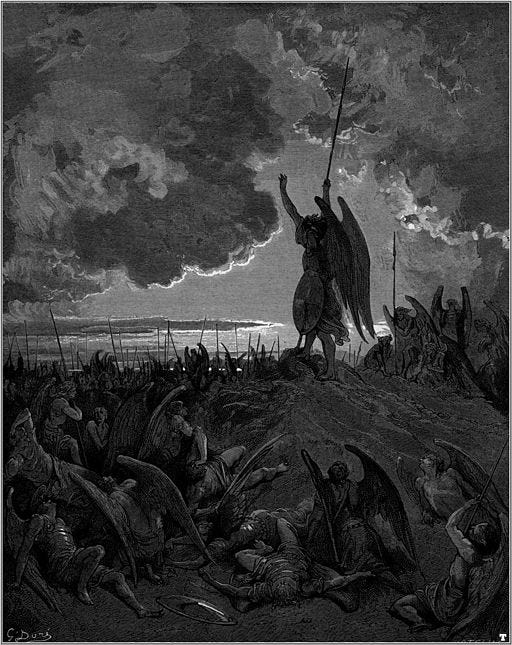
At some level, we all feel we are the centre of the universe. But after years of parents, siblings, school, marriage, work, and children, this delusion is usually reality-checked. But wealth and power seem to erase all that socialization. The current American president seems to be about the most deficient. A few weeks ago, when the New York Times asked Trump if he accepted any limits on his international power, he said: “Yeah, there is one thing. My own morality. My own mind. It’s the only thing that can stop me.” This sounds exactly like something Milton’s Satan would say. Overweening, chilling, vicious self-esteem. Pride and Corruption seem to be fuelling our new year of the Fire Horse. It feels as if we are galloping into the dark, shadowed by a blood moon.

But I also want to think about hope and Vietnam is a good place to start. The Vietnamese survived a recent devastating war, colonialism, and invasion after invasion in their long history. They carry on. They work hard. They treat their many visitors kindly. They make astonishingly good coffee. They allow the ambulances through. They love their kids just as we do.
One day in Hanoi, I was confused by a huge pack of scooters parked on a road, each one with a waiting driver on it, checking cell phones, twiddling thumbs. Why were over one hundred motorbikes just idling on a street? It was weird, yet the scene looked vaguely familiar. And then I saw a kid walking down the street in a school uniform. Of course! This was the daily afternoon school pick-up. And sure enough within 20 minutes those hundreds of scooters were careening down the streets, each bike with a beloved child bouncing on its back.
No posts
Comments
Nothing yet. Say the first thing.
Sign in to join the conversation.