
One of the perks of retirement is having more time to hang out with friends. I go for coffees and lunches, to yoga classes and on dog walks. While my former work friends are still burdensomely busy, I’m at the age where many other friends are retired too. Thus, opportunities are rife. Probably too rife, as I’d rather hang out than clean house, write a book or a blog post, or do other productive things.
However, some of my oldest and dearest friends are far-flung and many I’ve not seen for years, some since well before Covid. So, this fall I decided to embark on a solo road trip to visit all my West Coast friends as I have half a dozen pals scattered across Vancouver Island, some on the gorgeous Gulf islands, some in small towns and others in the city of Vancouver.
I’ve been home a few weeks now, but I am still basking in the glow of my many visits. Of course, Vancouver Island is lovely in the fall. Surrounded by natural beauty, I travelled the Island north to south and back, across the sea and through mountain forests. Long wooded stretches of road knitted together my ferry routes. In fact, I took eight ferry trips in total and each time I boarded one of these beautiful ships, it was like stepping onto a mythical vehicle that conveys a seeker to a land of wonders—a magic carpet or fairy tale coach.
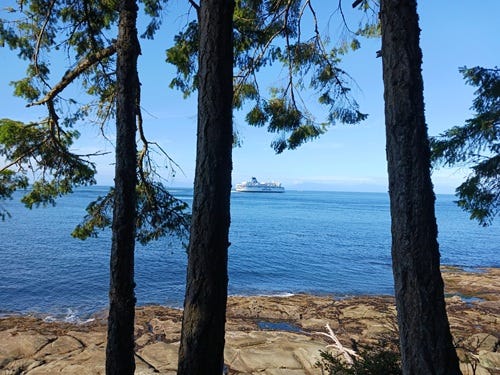
As I travelled, I felt I was following threads and trails, watery and earthy, sunlit and misty, weaving a web of past and present, now and then. When I stopped, there they were: dear old friends. We talked about life, family, literature and the shocking state of the world. We talked, walked, kayaked, laughed, shared meals, saw art, visited gardens, read poems, and got caught up on years of news. I spent the trip in a warm glow of reconnection, recognition, presence, and memory. And the glow just won’t go away!
It’s not as if I hadn’t kept in touch with most of these friends. Over the years, I phoned or emailed or wrote letters. But it was a joy to be back again with my friends in real time: in their homes, in person, side-by-side, exchanging hugs and sharing food, enjoying their families and pets.
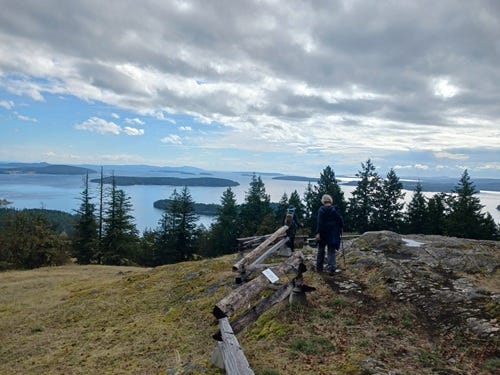
The pleasure, the beauty, the fun—all these were terrific. But still, the two-week expedition felt like something more than just a good time. Something important seemed to be happening inside me as I made this journey. Something that made my Friendship Expedition meaningful, refreshing, healing, and even profound.
My sense of refreshment could have had something to do with the simple fact of making an actual journey. Not an electronic or long distance reaching out, but a trip with boats and walks, crossing thresholds and sitting at kitchen tables. These visits were rooted in place. Also, I saw so many dear friends, and unlike at a party, for example, I got to spend one-on-one time, focussed and fun. The trip was a diverse smorgasbord of friendship and an embodied experience of homes and lovely places. And because I care for all of the people I visited, it was warm, fuzzy and emotional.
Weirdly, I have been thinking about this experience through a book about grief: The Grieving Brain by Mary Frances O’Connor —a non-fiction account of the neuroscience of attachment in the context of loss.
The book was recommended to me by a dear friend whose spouse had recently died. What struck me about this accessible and interesting book was its clear explanations about how much the brain is involved in our relationships. I don’t know about you, but when I think of embodied love and strong emotions, I don’t often think of the brain. But O’Connor explains what many scientists, therapists and psychologists know: our brain cells and neural networks are intricately involved in how we forge and keep relationships.
I was particularly struck by O’Connor’s image of the “mental map”. She says that the brain is constantly creating a mental map of where all the people you care about are located in the world. For people we live with or we see a lot, we have a very clear idea of where they are most of the time. This map is super important for us: think of our panic when we don’t know where our child is. With people more distant, our faith is that they too are on the planet somewhere going about their lives even if we only talk to them a few times a year and rarely see them in their habitat. It’s a faith, a kind of abstract belief, because we don’t really know what they’re up to.
Naturally we have many mental maps—of our house, objects in rooms and cupboards, our home town. But humans are more mobile and unpredictable than things (except perhaps for my reading glasses). So while all my distant friends exist in my brain in a map of the world, maybe a little doubt creeps in. The faith can waver. Sometimes when a friend I don’t often see tells me they spent the whole spring and summer in Greece, I get a tiny jolt of anxiety that they had been so far away and I hadn’t known. Foolish, but it’s evidence to me that the map is there, in my brain, created contingently out of best information and a lot of hope and uncertainty.
O’Connor’s book focusses on when someone dies and your loved one is inexplicably gone from this earth even though your brain still has them pinned on the mental map. Her research explains beautifully that the excruciating process of grief is partly the hard work of the brain having to be re-wired for a suddenly heart-breakingly useless map. When I get a sudden jolt of pain or disbelief, I realize my brain is still teaching itself that my mother is gone and unfindable. But what O’Connor says strikes me as relevant to friendships too.
My brain’s mental friendship map is a neural web that had become a bit frayed and thin: I was pretty sure these west coast people I care about were in their specific places, but I’d not recently seen them. So, my physical journey to visit these friends breathed vibrancy into that mental map. As I drove and sailed around the coast, I was doing internal work, confirming hope, faith and certainty. My mental map clarified and transformed faith into fact. The locator pin for each person sharpened and became more accurately embedded.
This just felt good. My neural networks buzzed and sparked as my connections to these dear people strengthened and deepened with many long and intimate talks but also with hugs and eye contact. Because O’Connor also summarizes the tsunami of current research about how relationships are forged through physical contact, research of great importance in this age of digital everything.
We’ve long known the brain’s hormones, particularly oxytocin, create feelings of bonding in romantic and parental relations but also, it seems, with friends as well. I was meeting my friends in bodily space and time. I planted my feet in their backyards and living rooms. I held their hands and made meals with them. My brain was getting an oxytocin injection. So no wonder, weeks later, I still bask in warm feelings.
And those warm fuzzies lap into the pool of rife opportunities I have to hang out with my local friends. Now I am more conscious of how these regular short visits keep my local mental map vivid and sparkly, assuring me that the good people in my life exist and thrive. I don’t have to live in a state of hope and contingency with them. I just need to text, “Want to walk the dogs?” and, being retired, they usually say yes. So satisfying, isn’t it, Brain? Who says this isn’t productive?
As for my distant friends, I’ll continue to write letters, email, phone and generally keep in touch and I feel very lucky to have so many tools to do this. My west coast friends are all updated and I have heard enough about their current lives so my brain can feel pretty confident it knows where they’ll be for the next few months. Clearly, though, I need to pay attention to these updates. That journey just hit one small corner of the country. What about all those friends in Alberta and Ontario and the East Coast? Those mental friend maps are getting a bit threadbare and hazy. Obviously, I need to plan another Friend Expedition in 2026.
No posts
Comments
Nothing yet. Say the first thing.
Sign in to join the conversation.