

I am no attachment expert. I dabble a little in attachment science, is all. And neuroscience of attachment, a little bit more.
But I can say this one thing that is true about me: I love attachment theory. And I love working with it.
People often ask me what I’d recommend, for starting with attachment theory. So, here is my guide to where I would start, if I were an absolute beginner.
In this post:
I walk you through the key attachment theory concepts
Then I share curated references, each accompanied with a summary of why its importance and relevance, on:
Attachment theory intros - very accessible resources, for a wide audience
Attachment research essentials
Zooming into attachment and mental health
Zooming into Attachment Neuroscience And Neurobiology
I hope you find it useful.
Attachment theory posits that children are born with a biologically predisposed set of instincts to seek the care of reliable adults (attachment figures). This hypothesised system is called the attachment system.
Here are some core concepts from attachment theory - as per Society for Emotion and Attachment Studies (2021) Explanations of attachment theoretical concepts
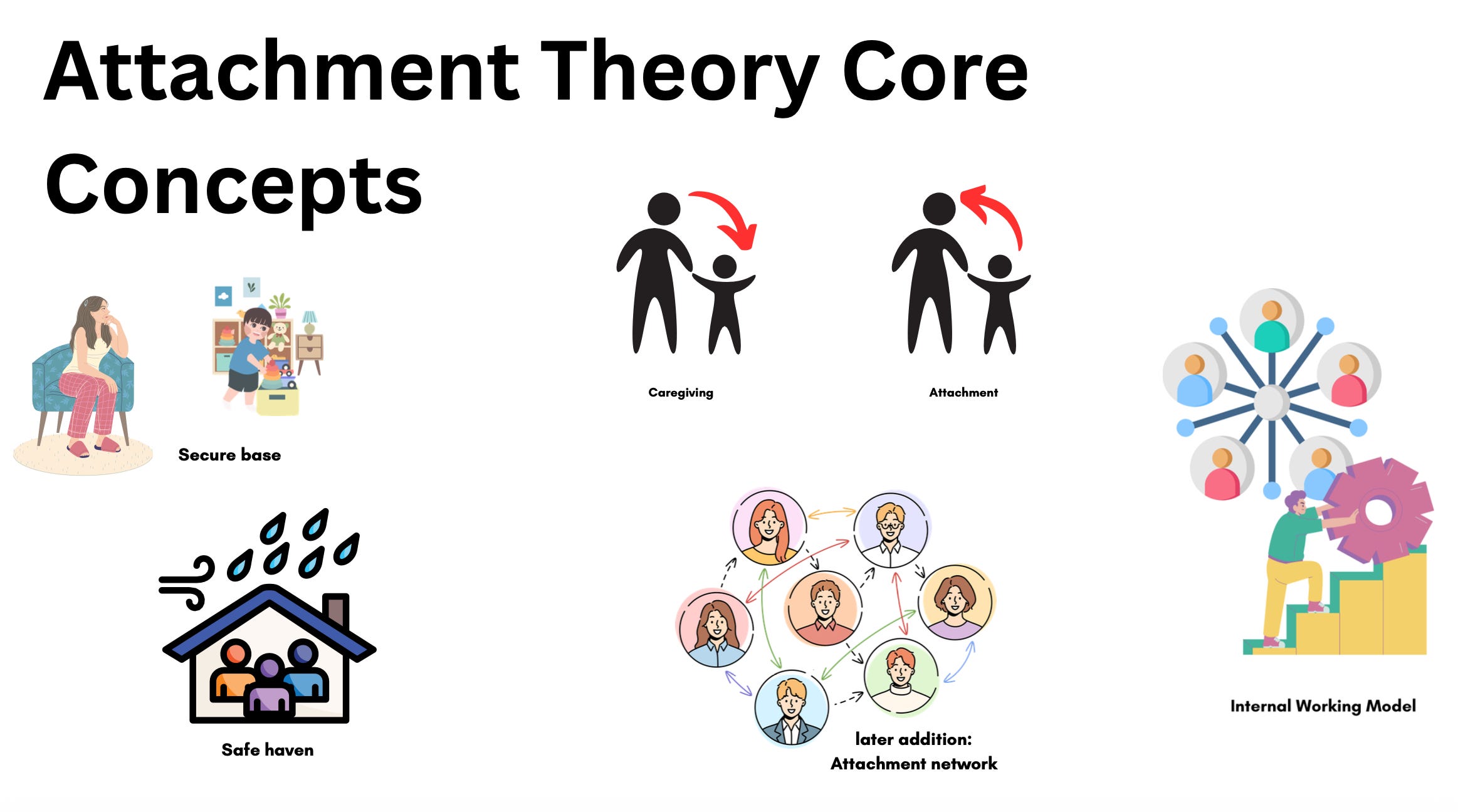
Secure base: Someone who supports exploration when the attachment system is not activated, i.e. the child can explore the environment when s/he is confident that their attachment figure is available to provide support when needed.
Safe haven: someone who (or something that) provides comfort and protection in times of potential alarm or distress (i.e. when the attachment system is activated).
Attachment is not equal to caregiving
Internal Working Models of attachment: A synonym for internal working model is “expectations”. It is thought that based on their experiences in an early attachment relationship, children develop expectations (or internal working models) about the future behaviour of their attachment figure.
In Neuroscience & Psychotherapy I publish weekly dispatches from the frontier of neuroscience and psychotherapy, conversations with N&P friends and more, with plenty of practical material to help you work in a neuroscience-informed way.
If you like this piece please hit the ❤️ and consider subscribing.
Attachment Theoretical Concepts (Society for Emotion and Attachment Studies)
This is a great resource from Society for Emotion and Attachment Studies providing precise and accessible definitions of attachment concepts. An essential resource.
The Psychology of Attachment This short but versatile volume by distinguished attachment researchers has become my go-to when I need reliable and well summarised ideas, concepts and findings from attachment research. It is short and sweet.
Attached by Amir Levine and Rachel Heller. This book has slowly become a global bestseller since it’s been published but unlike many pop-psychology books holds a real value while popularly written. It is particularly interesting for adult attachment - which is almo my area of interest - and while some of it if oversimplified and flattens the complexity of attachment theory I still think it is a very good intro book and can be a good starting point. With the caveat that this book is more helpful for addressing anxious attachment, while avoidant attachment, as per usual, gets a bad rap.
Hold Me Tight by Sue Johnson. This is a popularly written book following the principles of Emotionally Focused Therapy - an attachment-based approach for working with couples. I don’t use this book much but it is a classic.
Here books by John Bowlby are conspicuously missing. This is because I haven’t read them - but the classics are Attachment and Loss trilogy and A Secure Base.
Because I haven’t read them, I don’t know if I can recommend them. My view is that attachment theory is largely accepted and it is flying with its own wings where the new insight is taking it to new directions. It is my view that we don’t need to read Isaac Newton to understand and use the theory of gravity. The same applies here.
Comments
Nothing yet. Say the first thing.
Sign in to join the conversation.