

No man is an island, entire of itself; every man is a piece of the continent, a part of the main.
John Donne
Did you ever ask yourself why we hold hands? It is kind of weird, after all.
OK, for small children, I can see why we do it, to help them or keep them safe. But adults? It’s not obvious.
As a seasoned people watcher that I am , I have a privately devised feelestimate “test” to assess the length and quality of the relationships of couples I see around me, whether they are people I am acquainted with or people on the street, in bars or wherever else.
My rule of thumb goes like this:
If people are holding hands quite intensely, if they seem really into their hand-holding (one can tell if one pays attention), they are a new couple, likely still to be savouring the delights of the first flush of the relationship.
If people are holding hands, but it feels that it is sort of “light” hand-holding, a product of habit rather than intentionally leaning into it, I put the couple in the older-couple-but-getting-along-well category (by older, I mean the length of their relationship).
Finally, if the couple conspicuously never gets into any sort of hand-holding - in fact, sometimes it feels as though that would be the most unnatural thing to be doing - then I class them as a couple operating as a functional unit, long removed from the throes of intimacy (at least with each other). When I spot a couple in this category, it makes me a little bit sad, but such is life.
But there is one exception to this last rule. In fact, I saw one the other day, and I got worried. When I see couples who once were very blasé towards each other, and there was no hand-holding involved whatsoever, suddenly holding hands, I tend immediately to think: “Oh gosh, something bad must have happened. Someone is ill or they have been stricken by another misfortune.” I know that my thinking there is largely an unsubstantiated hunch, but I still stand by it. You know what I mean?
There. That is my 3 ½ point hand-holding relationship scale.
Now, you see, there are people who have made much more progress than I have when it comes to understanding why we, in fact, hold hands. And this is what I am going to tell you about today. It has broader and unexpected consequences for how we conceptualise human connection itself.
It is in keeping with the spirit of previous posts in which I have tried to make explicit the ways in which we might, in some respects, underestimate the importance of our sociality, treating as an important addition to life but not as a basic sustenance need. Social Baseline Theory , which I am going to tell you about here, has really changed how I think of all these things, both in my life and in my work as a therapist. I hope you enjoy it.
In this essay I will:
Present the story of “hand holding” experiments
Tell you about the Social Baseline Theory
Touch on the idea of social allostasis
Make some tentative links with attachment theory and how it throws a spanner into the works of a straightforward narrative
Share key references
In this TED Talk video, James Coan, recounts how - serendipitously - he came to realise that holding hands is much more than that and how that observation led to a whole new way of conceptualising what others are for us and what we are for them.
He was working as a clinical psychologist, treating people with PTSD, and there was this one war veteran who requested that his wife be present during the sessions. What transpired was that the man engaged much better with the treatment when his wife was there, holding his hand. It seemed as though her holding his hand was more than just a symbolic act of emotional and moral support. It felt as though, by lending him her hand, she was augmenting his own capacity for emotional regulation.
This serendipitous observation let to a follow up study that reproduced the similar scenario but in experimental conditions that made it possible to draw more general conclusions. The participants of the study underwent a stressful procedure (some mild electroshock were administered, I am afraid!) while their brain was scanned using fMRI.
The results confirmed the intuition from the initial hand-holding observation when working with PTSD: there was more to holding hands than just holding hands. And this effect was not purely psychological nor symbolic.
The effect was visible in neural correlates of threat, pain and stress processing - such as the dorsolateral prefrontal cortex, anterior insula and hypothalamus, with hand-holding being conducive to an overall attenuated response, including better emotion and stress response regulation.
(For an intro into brain correlates for emotion regulation, please see Top-Down and Bottom-Up: Brain, Body And Emotion Regulation).
I won’t go into more details here - you can check the original study here, but you get the idea. The act of hand-holding was much more than just that - it acted as though it provided the brain the necessary condition for evaluating the situation as less threatening and safer, impacting not only the subjective experience but also the biology that underpins our response to stress and anticipation of things to come.
So let’s look at the bigger picture now.
Do you understand what I mean when I say by the baseline of an experimental setting? It is the null condition that every hypothesis is compared to. It is the ‘normal, or the ‘natural’ state - they are all imperfect descriptions, I admit, but I hope it gives you an idea.
Now, in neuroscience or even psychology - by and large - the baseline is taken to be the person on their own. Left to their own devices.
If someone wants to measure, say the neural correlates of a reaction to a threatening stimuli, the assumption is that the neural activity will somehow be increased as compared to the baseline state (some parts of the brain will be activated on the top of the baseline, to use the vernacular). Generally speaking, whatever is measured - whether it is the neural activity when doing such and such task or when being exposed to such and such stimuli - is measured against the baseline of a person on their own.
But what if that assumption was fundamentally flawed? What if our ‘baseline’, ‘natural’ state was being with others? The state social connection.
Well this kind of is the idea of Social Baseline Theory, but not applied only to science experiments but how we think of what is our ‘natural’, baseline state - in the wild, as it were.
The theory, devised by James Coan - from the hand holding experiments above, and David Sbarra, sits on the crossroads between neuroscience and behavioural ecology - which is a discipline that studies how each species adapts to its own particular habitat.
In a nutshell, the Social Baseline Theory (SBT) theory puts forward the proposition that the brain is operating on an default (baseline) assumption that others are part of our natural environment and that the social support is available.
If you have read my piece on Maslow hierarchy, you will have seen that I detail the elements of what might be referred to as the social brain. It is within the mechanisms of the social brain that we are able to hold the mental representations - the models - of others, as though they were a sort of extension of ourselves (hence, among other things, such a big brain).
This idea that the human brain is fundamentally wired for connection aligns with the premise of SBT: the brain operates on an assumption that others are present and that we can “offload”, as it were, some of the stress load linked to existing onto others.
Does this make sense at all?
The Social Baseline theory substantiates its central proposition with a number of ecological observations about humans, one of the linchpin arguments being precisely the hand-holding study from above.
Now, I should probably won’t even go there but I will do it real quick: do you remember the idea of allostasis? The principle of the organisms maintaining stability through change - through anticipatory regulation, or predictively. I wrote about it in detail - from biological design meets psychotherapy perspective - in A River Runs Through Me: Allostasis.
I start the piece by asking what is the brain really for and conclude, that if we accept the view of anticipatory regulation as a guiding principle of neural design, the brain can be is seen as THE organ for allostasis.
Now, with the idea of the social brain, we have large portions of the brain that are fundamentally involved in social cognition and processing i.e. managing others and their intentions. That, in effects, comes down to trying to predict and regulate through anticipation others and their actions. And do you see how all the pieces of the puzzle are falling into place? Predicting and anticipatory regulation of others sounds awful lot like allostasis, only allostasis when others are included. Enter social allostasis.
The Social Baseline Theory underscores the fact that others ARE fundamentally part of our environment (and maybe the only constant presence in human habitat, given that humans can pretty much live and adapt to any environment). And thus, if others are our environment, in the same way the air, the water, the food and the shelter are, then it ensues that the brain is also taking others into account in the allostatic equation.
Where before we had the brain predictively maintaining stability of homeostatic parameters and regulating the internal milieu and behaviour in order to keep within the vital parameters conducive to life we now have the brain predictively also managing OTHERS and THEIR BEHAVIOUR, through predictions, in order to maintain as part of allostasis.
This might seem like a small, almost semantic step to include social life into the allostasis conceptual realm, but I think it is a big step for humanity (or at least my corner of humanity). I think it can have and already might be starting to have wider implications on how we understand sociality and consequently how we treat problems that are ultimately the problems of social connection (those are many, as I discuss at length Maslow Was, In Fact, Wrong and in On Social Pain: Everybody Hurts Sometimes).
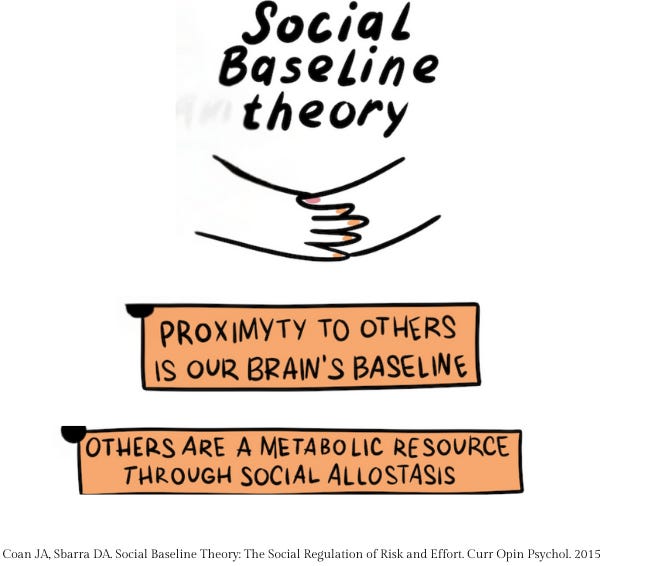
The bottomline proposition of it all, if you were to remember only one key message, is that social support is perceived, biologically, by the brain as a metabolic resource interchangeable with other metabolic resources such as oxygen, glucose, physical safety or levels of restfulness. And adjust its reactions, decisions, perceptions and behaviour accordingly. That’s an idea worth thinking about.
In Neuroscience & Psychotherapy I publish weekly dispatches from the frontier of neuroscience and psychotherapy, conversations with N&P friends and more. Also plenty hands-on material to help you work in a neuroscience-informed way.
If you like this piece please hit the ❤️ and share it with your network.
Now, the plot always inevitably thickens, doesn’t it?
I recently wrote about how it is impossible to fit the idea of the human sociality into the little neat box with a silk ribbon and the label that says: Pretty Social Engagement. Human sociality is all but simple, and there certainly is the Good, the Bad and the Ugly of it. The same complexity extends to how one benefits from social connection and when.
As a therapist, I know, and you might have noticed this too, if you are one, that there is one specific group of clients who typically have a very ambivalent, if not negative, reaction to any offers of social proximity and connection in times of stress and need. In fact, the pattern in these clients seems to be reversed: when things are tough, they tend to withdraw further and avoid help from others, relying on themselves only.
Can you guess which group of clients I am talking about? I will give you a hint: it has to do with attachment.
In my experience, I find this to be one of the defining characteristics of the avoidant attachment. Other people are not experienced as a source of co-regulation but rather as an additional source of stress. So, in times of already heightened stress, they are, others are to be kept at bay. They can’t help, and they’ll only make things more complicated.
This observation is completely in line with how social neuroscience of attachment conceptualises different attachment styles.
So, in case of avoidant attachment style, we might expect that hand-holding increases the stress rather than attenuate it, somewhat paradoxically. Which would go against the general narrative of Social Baseline Theory as outlined above. As I said, things are not that simple.
Actually, independently from the attachment framing, the initial study on hand-holding sheds some light as to how the quality of the relationship affects our reactions to receiving social support. There is more granularity to the study than I initially described.
First, one ‘control’ condition of the experiment was that the participants held the hand of an unknown person while in the brain scanner (this person was part of the experimental setup). Another parameter tracked the quality the relationship satisfaction of the couple that engaged in the study.
Hand-holding by a stranger was beneficial but not as beneficial as the spouse. Additionally, the quality of the relationship was reflected in how strong the effects of hand-holding were: better the relationship of the couple, stronger the ‘protective’ effects of hand-holding.
There is more detail to it but ultimately, I am introducing the nuance here to draw attention once more to the complexity and to the fact that the message here is not the simple simple: “If you are afraid, just hold somebody’s hand”, or “If you have a problem in life, you should just reach out to others”. Things can be more complex and context is important.
Ultimately, all depends on what and who the people we are to reach out to represent for us. And it might even be that, for some of us, we need to learn, from the ground up, that it is possible and OK to rely on others, in the first place.
You know, I could write a whole essay about the implications of all this. Clinical or just for regular living But I won’t. Or maybe some other time.
This time I’ll close with some philosophical thoughts, leaving your mind to percolate about the various implications.
They say that we born alone and die alone. Maybe. Or we are all in this together. I don’t know.
We are certainly born out of the darkness of time. You know, not knowing what we are, who we are, what we are doing, what’s the next day bringing. I don’t even refer here only to us, humans, but, you know, to the brotherhood and sisterhood of all living beings.
Connection, love, attachment and all their evolutionary precursors can be seen as ‘inventions’ of the evolution to help us better hedge our bets against the unknown. Through the helping hands of others, literally, symbolically and, now we know, even metabolically.
Kurt Vonnegut once said:
We’re here to help each other get through this thing, whatever it is.
I think I will go with that.
As always, thank you for reading 🙏.
I would like to thank Dr. Pascal Vrticka for numerous exchanges around these topics including sharing literature with me, especially the links with attachment theory.
Why we hold hands: Dr. James Coan at TEDxCharlottesville 2013
Coan JA, Schaefer HS, Davidson RJ. Lending a hand: social regulation of the neural response to threat. Psychol Sci. 2006
Schnall S, Harber KD, Stefanucci JK, Proffitt DR. Social Support and the Perception of Geographical Slant. J Exp Soc Psychol. 2008
Coan JA, Sbarra DA. Social baseline theory: The social regulation of risk and effort. Curr Opin Psychol. 2015
A River Runs Through Me: Allostasis
·
Mar 29

I have an advantage when it comes to understanding that emotions are in fact intimately linked to energy allocation in the body. I have a condition called reactive hypoglycemia. That means that my blood sugar goes down very quickly into hypoglycemia. Even writing about this, I can almost sense the familiar symptoms - my palms getting sweaty, vision a little blurred, general sense of unease and loss of control.
Attachment
Maslow Was, In Fact, Wrong
·
Jul 14
Why humans have such big brains? Is it because we are so intelligent and clever? We certainly have bigger brains than any other of the large mammals. A large brain requires a large skull, and a large skull means a large head, including for the baby while it is still in mother’s belly. This big baby-head is, together with us being bipeds, the main reaso…
Comments
Nothing yet. Say the first thing.
Sign in to join the conversation.