

Heart rate variability (HRV) is everywhere. This is because it is nowadays so easy to measure in non-invasive ways via the personal self-optimisation devices (aka wearables). But just because something is available does not make it useful, does it?
So what is HRV good for? More particularly, when it comes to emotional wellbeing, how much of it is real deal and how much is hype?
Ultimately, the question I want to be able to answer is the following: is HRV a valuable index or measure of emotional wellbeing, including the levels of psychological and social stress.
The evidence is mounting to show that we are more resilient – physically and emotionally – when HRV amplitudes are higher and more complex.
HRV is a reflection of complex processes and all manners of biological systems influence HRV in complex ways. For example, the immune system changes affect HRV and when we have a flu or have another inflammatory condition the HRV is suppressed by the cytokines.
But to answer the question of the relationship between HRV and emotional and psychological resilience and stress, I’ve got to cover the basics first so that we know what we are talking about.
Because answering my initial question in one go would make this piece intractable, I am making it a two-parter:
Part 1: HRV and RSA ( ResHRV) definitions and basic mechanisms of ANS control and impact of breathing patterns
Part 2: HRV and psychosocial stress, emotion and resilience
In this piece I will:
Define HRV
Recap of the basic concepts and principles of the ANS
Explain how the ResHRV (RSA) is the main component of HRV
Look at the mechanism of ANS cardiac control
Why and how changing breathing pace and pattern influences HRV
Is HRV a measure of the total vagal tone?
Is HRV a reflection of the sympathetic and parasympathetic balance?
All of this is extremely pertinent not only for those of you interested in understanding HRV but also those who are interested in use of ANS in psychotherapy and gaining a better insight into what we know and what we don’t know about the complex web of influence of the inter-dynamics of the sympathetic and parasympathetic systems on our emotional wellbeing.
In this piece, I do not discuss the difficulty and the many levels of approximation and heuristics that come with using HRV measures obtained through the commercially available wearables and the short term measurements that those usually provide. It is a minefield and I would love to see it discussed by another author expertly.
Right off the bat, let’s start with a healthy dose of epistemic humility:
Ok, so now we established that, let’s see what, at my level of understanding, we actually can know.
“A healthy heart is not a metronome”. Heart rate is variable, from one heartbeat to another. In other words, the time interval between two heart beats is not equal and depends on many things - breathing, physical effort, emotional state, health status, circadian rhythm, to name just a few. In a nutshell, heart rate variability (HRV) is the measure of the variability of the interval between two heartbeats.
Terms and definitions to know before we continue:
Heart rate: the average number of heartbeats in a minute ( optimal range between 60 to 80)
R-R interval: the between two consecutive R-waves in an electrocardiogram (ECG) signal (peaks in the graph below)
HRV: beat-to-beat variations of heart rate or the heart period (R-R interval)
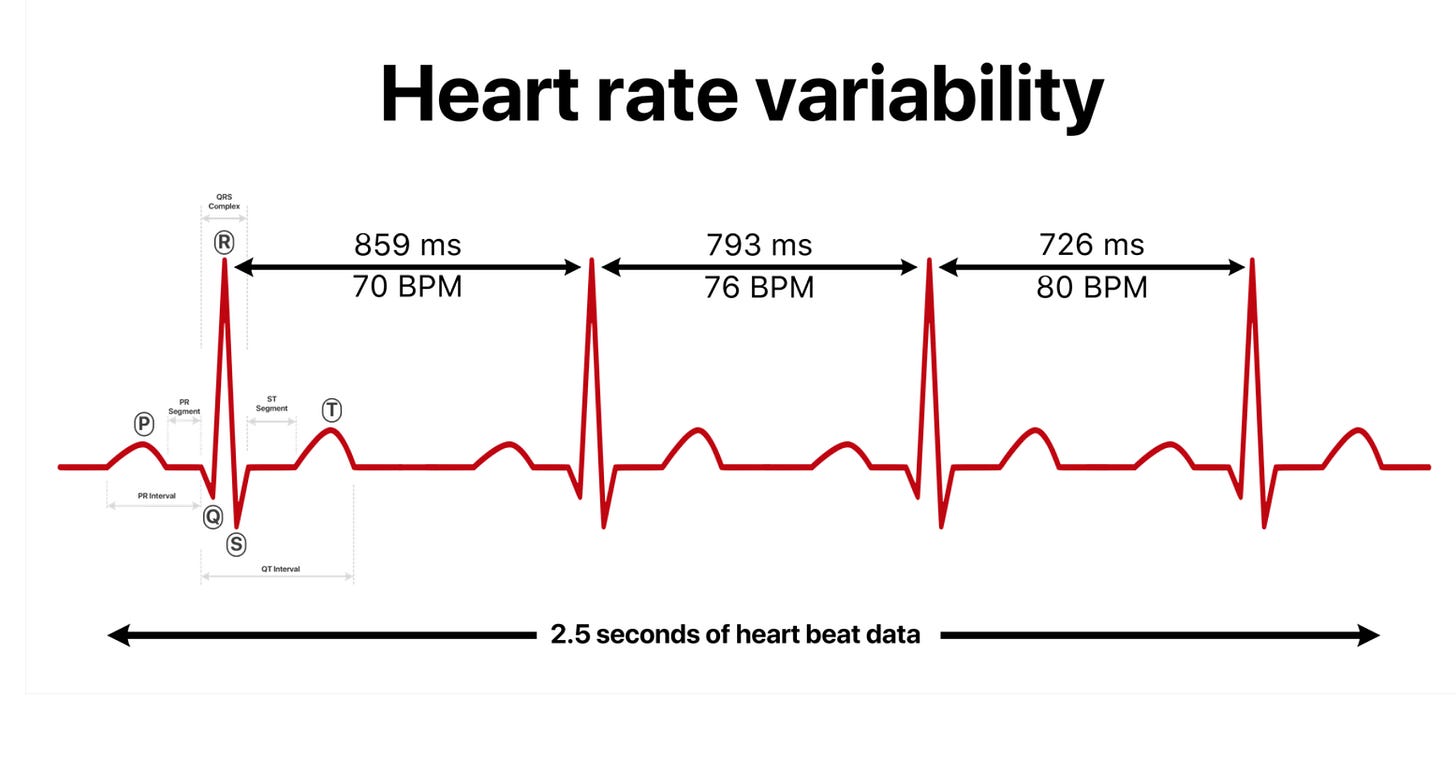
Wikipedia. CC License.
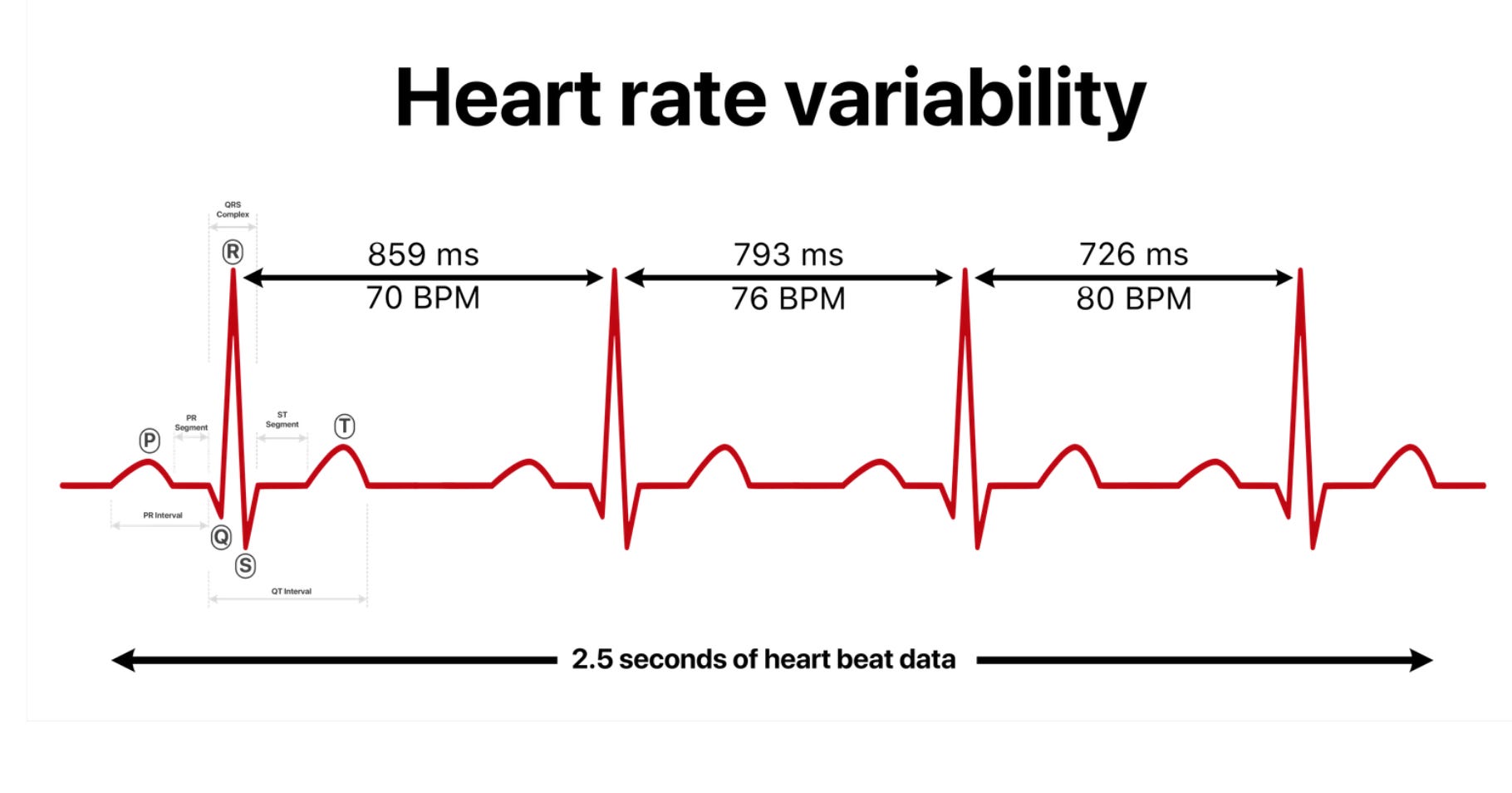
If we use the graph above as illustration, first beat-to-beat interval is 859ms, second is 793ms and the third is 726ms, the HRV between the second and the first interval is 66ms and between the third and the second is 33ms.
More about this later, but HRV is calculated as an average over a certain amount of time - it can be over a 24h, or 5 min or shorter (ultra-short term). 24 h HRV recordings represent the “gold standard” because they can account for all the fluctuations in metabolism and activity that happen over 24h cycle.
But what causes these fluctuations in heart rate and why should you care?
You might have heard about RSA? We have seen it a lot in relation to Polyvagal theory, as some crucial claims of the theory pertain to the purported properties of the RSA.
It stands for respiratory sinus arrhythmia (RSA). RSA has been recently been renamed ResHRV (respiratory heart rate variability) - see below.
HRV and RSA are not the same but the terms are often used interchangeably.
In Neuroscience & Psychotherapy I publish weekly dispatches from the frontier of neuroscience and psychotherapy, conversations with N&P friends and more, with plenty of practical material to help you work in a neuroscience-informed way.
If you like this piece please hit the ❤️.
Comments
Nothing yet. Say the first thing.
Sign in to join the conversation.