

Have you ever noticed your critical sense somehow melting away and softening when you are applying it to people who you consider to be in your ‘circle’ or who you trust as thought leader? All of the sudden you start making allowances and the same argument that you would find incendiary with someone you are not allied with in some ways suddenly becomes much more palatable.
If you haven’t noticed it in yourself, then maybe in others? I have, sadly, noticed both.
And it’s not like we do it on purpose. We all think we are perfectly rational and basing our judgement on available evidence. And yet, all of us perfectly rational people come to wildly different conclusions about almost anything (and boy are we prepared to defend them).
This is possible because our cognition suffers from self-favouritism. It cuts across so many domains - personal, professional, political, ideological and it is called motivated cognition.
Motivated cognition is defined as the process by which “the goals and needs of individuals steer their thinking towards desired conclusions”. It is, at least in part, the mechanisms underpinning the groupthink. It’s the “holier than thou” attitude.
And it has real world and far reaching consequences, especially when it comes to group behaviour. It can fuel polarization, hostility and ultimately conflict.
I’ll give you a fairly easy-going example from my life. I am sure you can think of some other examples, and some them pretty dark. Motivated cognition, for me, certainly highlights some darker sides of human nature.
Some years back I was attending my supervision therapy training. I am a TA therapist (transactional analysis) and fairly solution-focused at that, if the client wants me to be. This therapeutic mindset was at odds with the overwhelming majority of other attendees of the training who were mainly person centred therapists. For those who are not versed in the therapeutic schools taxonomy, the person centred approach typically meets the client with active listening and empathy but refrains from providing any answers, suggestions or advice. It trusts the process and it is non-directive.
As we were doing the training we roleplayed different therapy and supervision situations - supervisor, therapist, client - and provided feedback to each other, one thing became clear: people were perplexed and some quite frankly scandalised that I would engage in proposing an interpretation, a reframe or suggest a different way to think or act to the client, beyond sitting with the person and providing empathy and validation of their experience. I remember, in my group people not being able to fathom why I would work directively with specific attachment styles or advise and work towards certain cognitive and emotional shifts. In their therapy world, this went against the grain what therapy was all about - we are sitting with the person and we provide unconditional positive regard and validation - the therapeutic process and the person themselves are sufficient for the therapeutic change, if one is happen. Being a directive therapist was simply wrong.
Now why am I telling you all this? Because, in that group, reinforced by each other shared values of what therapy is and isn’t, my co-trainees all felt that they were right and that I was wrong. It seemed very obvious to them, and if were not true then why would all these people around them agree? I must admit that for some short moments me too I started feeling the pangs of self-doubt.
My co-trainees were in grips of a process of motivated cognition, and in the reinforcing context of a group, it seemed even more potent.
In I Dodo Bird You Not, I talk about how latest research findings in psychotherapy actually find that directive therapies can be more effective, even when it comes to establishing the therapeutic relationship itself. But that did not matter in my supervision training group - it was the strength in numbers that ruled, epistemically speaking of course. But the group wisdom is not always wisdom at all.
This example illustrates, in a nutshell, motivated cognition. Now transpose it into virtually ANY human activity, especially one that involves in-group dynamics and you can probably see how it applies to all sorts of situations that I am sure all of you notice at times, especially if you are not an invested party.
Think of ubiquity of confirmation bias and disconfirmation bias - just recently Shane Littrell, PhD was on N&P telling us about these guys and how they go hand in hand. As he explained, confirmation bias is the the cognitive phenomenon by which we preferentially accept information that confirms existing beliefs while disconfirmation bias is rejecting information that conflicts with existing beliefs. A perfect combo. Also think of their good friend, the allegiance bias.
I find this fascinating. You can see how it fosters creation of echo chambers and in-group defensiveness, fraction wars and all the other bad things that we see on steroids in the polarized world and of course, on social media. Everyone thinking that THEY are the holier than thou of the story. And, if everyone thinks they are holier than the other and double down instead of stop to think, drifting further apart seems like the sole possible outcome.
As the social media opinion increasingly drive fashions, what appear in the books and what’s talked about in legacy media it is such a timely thing to reflect on, I find.
But this is actually not entirely unrelated to therapy neither. Consider the example of therapy culture from the beginning. Furthermore, lots of therapy is really about our relationship to others, isn’t it? So learning to be more discerning about what in-group power plays and groupthink really comes down to, for example, could be an amazing tool for life. Same goes when it comes to the issues of conflict resolution, which are, one way or another, ubiquitous to therapy. In this case, as many others, my belief is that knowledge is power and making the client aware of the inner workings of the group is a powerful one at that, I think.
In this piece I will explore some of the underlying principles of motivated cognition but what I am also really interested is what are the biological mechanisms that make it possible? And so I want to also explore what is known today about the neural underpinnings of motivated cognition. Fascinating, right?
While I will not be able to refrain to add a layer of my own personal interpretation and questioning, in this piece I will mostly draw on the paper Neuroscience of Motivated Cognition.
In Neuroscience & Psychotherapy I publish weekly dispatches from the frontier of neuroscience and psychotherapy, conversations with N&P friends and more, with plenty of practical material to help you work in a neuroscience-informed way.
If you like this piece please hit the ❤️.
In therapy, we tend to see the corrections of biases, ones about the self and about others, as one of the goals of therapy - I can say that confidently speaking about transactional analysis, my core modality but it also applies across boards, the same fundamental premise appearing in different shapes and forms.
But what if these positive and maybe narcissistic illusions on the top of being ubiquitous are in fact protective of mental health? Maybe that is the only way to survive in an objectively hostile world?
I don’t know.
These trains of thought quite clearly contradict the therapy accepted truth that most of people ultimately suffer from a low self-esteem, have a too loud of a critical parent and experience a profound self-loathing and even at times a fundamental unlovability.
This also contradicts the by now well ingrained neuro-narrative in therapy and mindfulness worlds that claims that what sticks is the negative and threatening information (courtesy of the amygdala). In fact, in this narrative, I think it is Rick Hanson who said that the mind is velcro for negative experiences and Teflon for positive ones.
Now, which one is it? I know as much as you, and reluctant to side with either fully, as both make sense and maybe both are not as true of blanket statements as oversimplification would want it. It is complicated.
Research on motivated cognition tells us that we have a motive to perceive certain situations in certain ways which in turn that creates and maintains a certain degree of delusion about the ‘goodness’, ‘righteousness’, how right, clever, capable or discerning we are. Psychologist call it self-enhancement.
What is important to understand is that these motives affect both our perception and judgement.
Perception and judgement are both affected by what the brain deems to be a preservation of a certain sense of self. That means that even the perception of the incoming data is not the pure, objective data but rather it has been ‘meddled with’ prior to us even gaining awareness of it.
This is because, what we perceive is inferred rather than the objective reading of the reality, as I explain here and here.
Now, what about groups of people? How the principle of motivated cognition applies there? It appears that when a group feels under threat the in-group bias increases. This does not exactly come as a surprise and I am sure we all have examples to pull out from memory where from outside it was obvious that a group, when feeling under threat, doubled down and reinforced their common beliefs and the fact that they are in some ways better than the out-group.
So the motivated cognition operates also on a group level, or rather the interests of group cohesion affect the cognition of the individual leading to motivated cognition.
So what are the neural underpinnings of this process?
In the paper giving an overview of neuroscience of motivated cognition the authors distinguish three processes that underlying the end result that is motivated cognition.
These are attention, perception and decision-making.
When a certain information is in line with what we want or we want to believe, we pay more attention to it.
One area of the brain involved is lateral prefrontal cortex (LPFC) - see the picture below (A) green square. This area is part of the Central Executive Network of the brain and is involved in goal-directed behaviour and the control of attention.
In one experiment , where participants were presented with pessimistic life events and asked how likely they think those events will happen to them. People displayed an optimism bias for themselves and when presented with the information average likelihood for those events people still failed to update their own estimates to a more pessimistic baseline. This seems to have been mediated by a reduced activity in LPFC. It almost like they were paying less attention when the information was not supporting their belief about self and therefore the new information did not completely register.
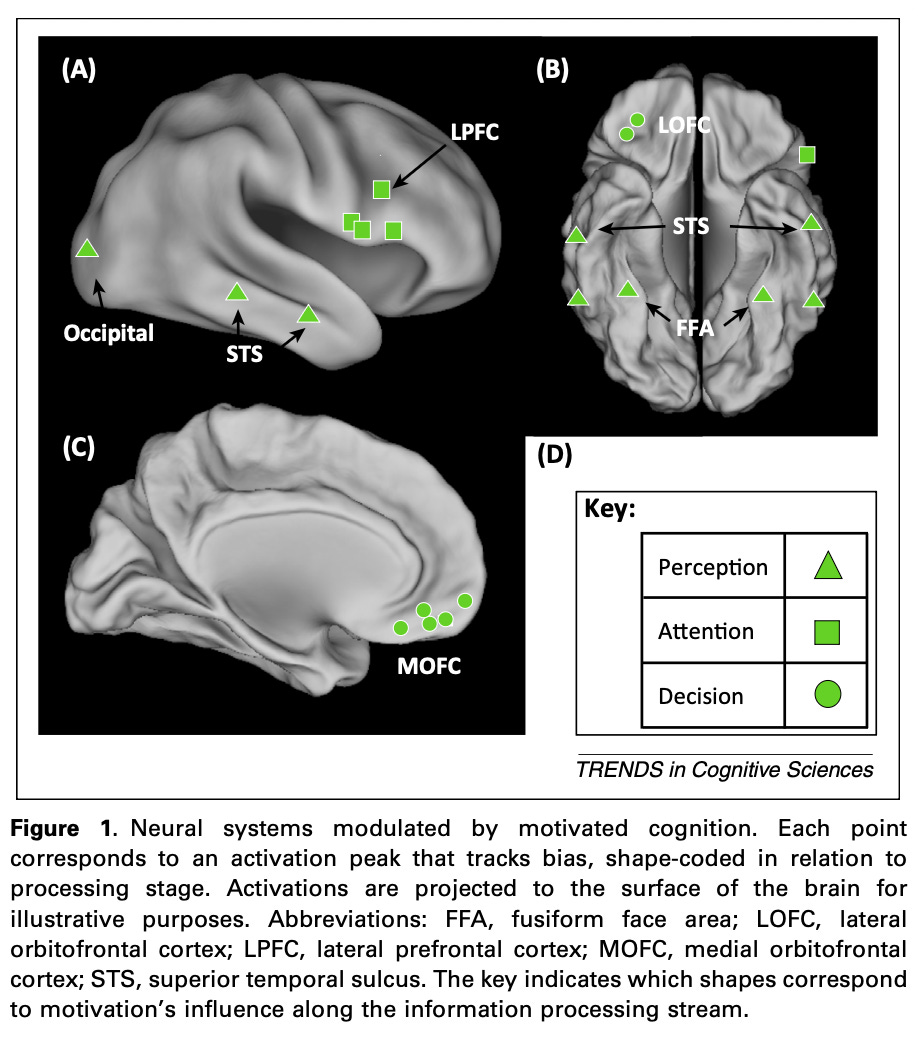
Perception distortion is also part of the motivated cognition reality distortion. It sounds like the neuroscience confirms that we see what we want to see. Motivation to see something can modulate the lower-level perception, through top-down processes.
The areas involved in this process are illustrated with green triangles on the image above.
Finally, the decision making itself falls under influence of our motives. We evaluate things based on out motives by selective taking into account certain memories and not others, for example. We also engage in mechanisms by which the cognitive dissonance of inconsistency of some of our beliefs is resolved somewhat by shifting our beliefs towards the declared belief or choice. In all cases, the cortical midline area called the orbitofrontal cortex (OFC) is involved. This area is involved, amongst other things, in calculating the self-value and value-based decision making. On the graph above the areas associated with decision making and motivated cognition are marked by green circles.
I think the gist of it is that we don’t do it on purpose, it is an in-built flaw of our cognition. In built flaw that serves a purpose, as we have seen. So, it is a flaw of cognition but not a flaw of design.
Furthermore, it seems that we do it effortlessly - automatically and even when the cognitive load is high.
Having said that, I do think that sometimes we do it with (uncomfortable) awareness that we are doing it because of feelings of in-group pressure to conform - and different processes might be in play to ease the feelings of moral discomfort that arise as a result of cognitive dissonance (see the end of the previous paragraph).
I mean , I think we should always try, but it might just be me. After all, I always found it difficult to conform to the laws and rules of the groupthink. However, while this always ultimately served me in my life I cannot recommend it to everyone. As we have seen, motivated cognition is not a design flaw, at least not completely, and plays a role in group cohesion even if sacrificing individuality and objectivity. So, my dear friend, it is ultimately for you to choose.
Now, should you choose to try to work it and get your motivated cognition in check, one thing you can do is make a point of intentionally turning your attention towards the information that goes against what you - or your group - are invested in. This is reminiscent of Shane’s recommendation “Why We Fall For Bullshit?” to avoid falling for BS that he called lateral reading and means that thing you want to believe is the thing that you should question the hardest.
One takeaway from this is that - after everything said and done - we seem to be unrealistic optimists when it comes to evaluating our own qualities and those of our in-group and we have brain mechanisms to allow us to do so. We are self-enhancers.
But on the other hand, this clearly contradicts the narrative of negativity being ‘sticky’ in the mind, the velcro and the teflon mataphor.
Which one is it? The unrealistic optimist or the velcro for negativity. I don’t know, you tell me.
As I therapist, I cannot fully see it that people systematically and consistently self-enhance. Lots of people have massive dysmorphia, both literal and symbolic, and this is really not limited to clinical population. So not sure what to make of this seeming contradiction in observations. Food for thought. And I think, again, things are complicated.
Finally, I want to say that none of us is really holier than thou. Of that, I am sure.
As always, thank you for reading 🙏.
In Neuroscience & Psychotherapy I publish weekly dispatches from the frontier of neuroscience and psychotherapy, conversations with N&P friends and more, with plenty of practical material to help you work in a neuroscience-informed way.
If you like this piece please hit the ❤️.
I would like to thank Brent Hughes for kindly sharing with me the current literature from his lab on the topic of motivated cognition.
The Case for Motivated Reasoning (thanks Shane Littrell for sharing this one with me)
How unrealistic optimism is maintained in the face of reality
Brent Hughes Social Neuroscience Lab studying motivated cognition
Comments
Nothing yet. Say the first thing.
Sign in to join the conversation.