
“The difficulty lies, not in the new ideas, but in escaping from the old ones.”
— John Maynard Keynes
This is the third report in the Settlement Infrastructure Series at netzmoney.substack.com. Report 1 — Settlement Finality — found the dominant settlement architecture stable at its core but structurally excluding distributed ledger systems through a legal recognition gap that technical maturation cannot close: technical systems must adapt to legal doctrine; legal doctrine does not adapt to technical architectures. Report 2 — Collateral Velocity — found the collateral architecture fragmented by a visibility gap between the timescales at which collateral is reused and the timescales at which the reporting frameworks designed to govern it operate, closing with an open question: whether central bank standing facilities are becoming the permanent structural ceiling on private repo markets rather than their emergency supplement.
This report takes up that question directly.
Liquidity is commonly treated as a single function — the ability to convert assets into cash. This report asks whether that’s true, and what follows if it isn’t.
The modern liquidity architecture contains mechanisms aimed at two different problems: keeping an individual institution solvent under idiosyncratic stress, and keeping markets functioning under systemic stress.
Whether those are the same problem, addressed by the same infrastructure, is the question this cartography maps — along with the institutional transitions now reshaping that infrastructure regardless of the answer.
On March 9, 2023, Silicon Valley Bank’s customers withdrew $42 billion in a single day.
The bank was eligible to borrow from the Federal Reserve’s discount window, the lender-of-last-resort facility designed precisely for situations like this. It failed before the facility could help.
Three days later, the Federal Reserve introduced the Bank Term Funding Program. Borrowing reached $152 billion within days.
The institution had not changed. The collateral had not changed. The underlying function had not changed.
The terms had changed.
That distinction matters because liquidity crises are often described as shortages of cash. More often they are failures of convertibility: failures of assets to become cash quickly enough, through the channels available when stress arrives.
The same pattern appears repeatedly. In September 2019, overnight repo rates spiked 400 basis points despite ample aggregate reserves. In March 2020, the Federal Reserve purchased nearly two trillion dollars in sovereign debt in a single quarter because primary dealers had exhausted the balance sheet capacity needed to absorb institutional selling. In March 2023, a bank failed despite having access to the facility designed to prevent precisely that outcome.
Each episode appeared sudden. None was structurally surprising.
Who can convert assets to cash, through which channel, at what cost, and under what conditions — and why does the answer differ so sharply between an institution in distress and a market in dysfunction?
The question is active in three institutional registers simultaneously.
In Washington, Treasury Secretary Scott Bessent and Federal Reserve Chair Kevin Warsh have proposed recognizing pre-positioned discount window collateral as a valid component of regulatory liquidity buffers — a reform that would restructure the legal architecture governing how banks hold and access liquidity without changing the facility itself.
In Frankfurt and Brussels, the European Central Bank completed the most significant redesign of its monetary operations in a decade in March 2024, transitioning from passive abundant-reserve distribution to active demand-driven lending as the long-term financing programs of the pandemic era reach their natural maturities.
In London, the Bank of England has already completed that transition. Its weekly and six-month repo operations now supply approximately one quarter of outstanding sterling reserves through active facility engagement rather than balance-sheet abundance.
At the same time, the SEC’s Treasury clearing mandate is restructuring the private mechanism through which repo liquidity ordinarily flows.
Across all three jurisdictions, the same underlying question is emerging from different directions: whether liquidity infrastructure functions as its formal design suggests when the conditions it was built for actually arrive.
This report is written for tech/fin/legal readers who want to understand how governance architecture conditions market behavior, and why mechanisms designed for stress perform differently under it than their designers intended.
The Silicon Valley Bank episode illustrates the distinction.
Moving loan portfolios to Federal Reserve custody requires days of operational processing, not hours, and requesting discount window access signals to market counterparties that the borrowing institution is in distress — a signal capable of accelerating the run it was meant to arrest.
Forty-eight hours after the bank failed, the Federal Reserve announced the Bank Term Funding Program, offering the same underlying function — central bank emergency lending against securities collateral — on terms that removed both the operational barrier and the reputational signal.
Borrowing reached $152 billion within days.
The facility had existed throughout.
The terms changed.
So did the outcome.
That gap — between a facility’s formal existence and its functional availability under the conditions it was designed to address — is what this cartography maps.
The Repo Engine is what most practitioners mean when they describe market liquidity: the private mechanism through which institutions convert securities positions into cash through short-term collateralized lending. Its analytical label is Repo-Clearing Migration Architecture — a name that captures both the mechanism’s function and its current structural condition, as the SEC’s clearing mandate migrates dominant U.S. Treasury repo volume from bilateral uncleared arrangements toward central clearing through the Fixed Income Clearing Corporation, restructuring a market whose daily cleared volume reached $2.43 trillion by 2026.
The Operational Floor is the institutional layer beneath the private market: the central bank facilities through which monetary authorities supply reserves under normal conditions. The ECB’s Main Refinancing Operations, the Bank of England’s Short-Term and Indexed Long-Term Repo facilities, and the Federal Reserve’s Standing Repo Facility together constitute Demand-Driven Reserve Architecture — a framework in active transition across all three major central banks as quantitative tightening (QT) drains the abundant reserves created by a decade of asset purchases.
The Window is the bilateral backstop: the Federal Reserve’s discount window and its Eurosystem equivalents, designed to provide emergency funding directly to individual institutions facing idiosyncratic stress. Its analytical label is Bilateral Facility Architecture — a name that captures its function as a one-to-one institutional lending mechanism, structurally distinct from the market-wide operations that constitute The Operational Floor.
The Scaffold is the governance architecture conditioning all three: the Basel III Liquidity Coverage Ratio, the leverage ratio constraints, the intraday liquidity requirements, and the regulatory classification system that determines which assets qualify as high-quality liquid assets. Its analytical label is Regulatory Liquidity Architecture — the framework that simultaneously mandates pre-positioned liquidity buffers, defines which assets qualify for those buffers, and, as this analysis demonstrates, generates structural barriers to deploying them at the moment of stress.
The four mechanisms above are conventionally described as components of a single liquidity architecture. The evidence requires a more careful formulation.
Consider what the system is actually asked to perform. When Silicon Valley Bank faced $42 billion in deposit outflows in a day, the relevant functional requirement was individual institution convertibility: the ability of a specific bank facing idiosyncratic funding stress to convert its assets into cash at sufficient speed to meet its obligations. When the Treasury market seized in March 2020 and bid-ask spreads reached historical widths, the relevant functional requirement was market-wide convertibility: the ability of markets as a whole to function as a liquidity distribution mechanism during systemic stress. These are different problems. They require different institutional responses. And, critically, they fail through different mechanisms under different conditions.
Calling both requirements “liquidity” is accurate in the way that calling both surgery and antibiotics “medicine” is accurate. The label is not wrong. But it obscures the question of which instrument is designed for which condition — and what happens when the wrong instrument is the only one available.
The September 2019 repo market disruption produced market-wide convertibility failure — overnight rates spiked 400 basis points — without triggering any individual institution’s bilateral backstop. The March 2023 banking stress produced individual institution convertibility failure — SVB failed without viable access to bilateral backstop facilities — while broader markets functioned without disruption. The March 2020 episode concentrated systemic stress in market liquidity dynamics — dealer balance sheet exhaustion, repo haircut repricing, CCP (Central Counterparty) margin call cascade — rather than bilateral institution access. Three episodes, two distinct failure modes, no overlap in which mode activated when.
The test for commensurability asks whether two functional requirements arise from the same infrastructure layer and degrade together under stress. The individual institution convertibility requirement (F1) operates through bilateral lending facilities governed by counterparty eligibility criteria, collateral pre-positioning arrangements, and the social convention of institutional stigma. The market-wide convertibility requirement (F2) operates through open market mechanisms — reserve supply operations, overnight repo facilities, sovereign bond purchases — governed by aggregate reserve dynamics and market-wide pricing signals. Different layers. Different governance frameworks. Three documented stress episodes in which they degrade independently.
The mechanisms that sustain individual institution convertibility (F1) and the mechanisms that sustain market-wide liquidity (F2) operate through different infrastructure layers, respond to different governance frameworks, and fail under different conditions — liquidity is architecturally bifurcated at all times, but unified in appearance under normal conditions.
The performance map follows directly from this structure.
Repo-Clearing Migration Architecture performs F1 at Absent and F2 at Partial: the private repo market provides no individual institution backstop — bilateral haircuts reprice against the distressed institution, withdrawing funding at the moment of maximum exposure — while performing market-wide convertibility under normal conditions and failing under correlated stress.
Demand-Driven Reserve Architecture performs F1 at Partial and F2 at Partial: central bank reserve supply facilities reach most eligible institutions under normal conditions, but performance on F1 degrades under collateral eligibility constraints, and performance on F2 degrades as the reserve drain progresses toward an uncertain scarcity threshold.
Bilateral Facility Architecture performs both at Absent: F2 because bilateral lending to individual institutions is categorically incapable of addressing market-wide liquidity failure, and F1 because the facility designed specifically for individual institution stress is, under the conditions that produce that stress, structurally inaccessible to the institutions that need it most.
Regulatory Liquidity Architecture performs both at Partial: the governance framework ensures pre-positioned liquidity buffers exist but simultaneously creates the structural barriers to deploying them, producing partial performance everywhere and coherent performance nowhere under stress.
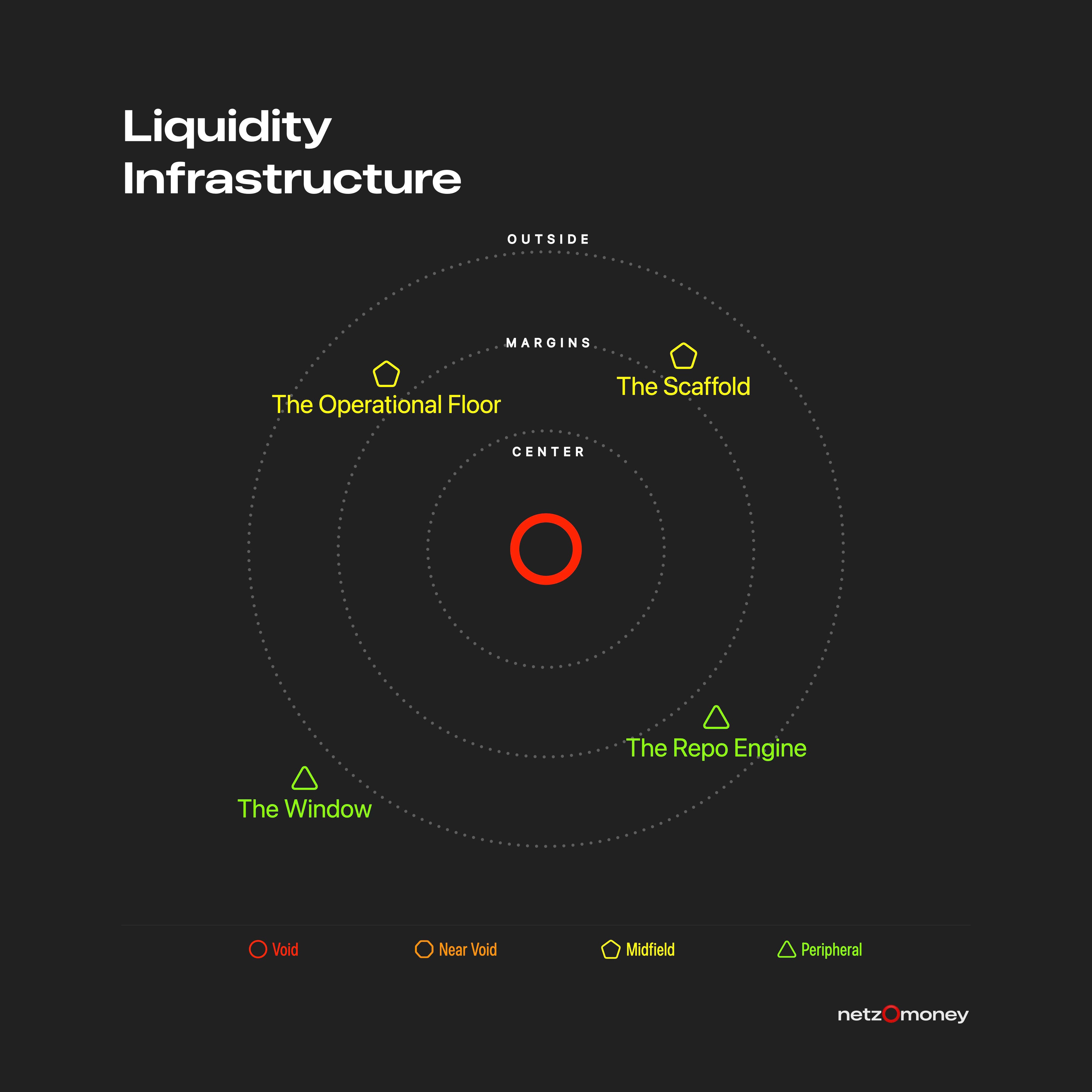
No phenomenon in the constellation currently performs both functional requirements at scale under stress. The void center is unoccupied.
Center is the functional ideal: the configuration in which assets can be converted to settlement media at predictable cost and speed for both individual institutions under idiosyncratic stress and markets under systemic stress. No mechanism currently fills that space.
Margins contains phenomena that perform both F1 and F2 at Partial — present, partially functional, operationally significant, but not reaching the functional ideal under the stress conditions that define the requirement.
For legal readers: phenomena in Margins have formal governance standing and operational presence; their structural gaps are performance limitations under stress, not legitimacy deficits.
For technical readers: phenomena in Margins are the mechanisms that work until they don’t — functioning within normal operating parameters but degrading in ways that require either formal backstop activation or market-wide intervention to contain.
Outside contains phenomena that are structurally excluded from at least one functional requirement — performing it at Absent.
For legal readers: Absent does not mean illegal or unauthorized; it means the gap is structural, not a temporary implementation problem, and cannot be closed without a change in either the legal architecture or the social conventions governing utilization.
For technical readers: phenomena at Outside are mechanisms whose design parameters do not cover the failure mode their designers intended them to address.
This cartography reveals Reconfiguration. The dominant architecture — reserve-based settlement, sovereign collateral, central bank backstops — is reorganizing internally across three concurrent transitions: the bilateral-to-cleared migration in U.S. Treasury repo markets, the abundant-to-demand-driven shift in ECB and BoE reserve supply frameworks, and a contested reform proposal targeting the discount window’s structural impairment through LCR recalibration. No phenomenon is approaching the void center. No phenomenon is being displaced. The constellation is reorganizing around the same unoccupied void center, not converging toward it.
Zone assignments:
Repo-Clearing Migration Architecture — Outside, Distance Peripheral
Demand-Driven Reserve Architecture — Margins, Distance MidField
Bilateral Facility Architecture — Outside, Distance Peripheral
Regulatory Liquidity Architecture — Margins, Distance MidField
Three analytical threads run through the deep dives that follow.
The first is the structural asymmetry between F1 and F2 performance across all four phenomena — the bifurcation that the Structural Heart Sentence names.
The second is the role of accumulated historical traces in producing the current configuration: the mechanisms introduced to address the vulnerabilities revealed in 2008 now shape, and in some cases constrain, the pathways through which liquidity normalization can occur.
The third is the structural relationship between The Scaffold and all three other phenomena — the governance architecture that simultaneously constitutes the liquidity buffers the system requires and constrains the conditions under which those buffers can be deployed.
Repo-Clearing Migration Architecture occupies the Outside zone because the bilateral repo market performs F1 at Absent regardless of its F2 performance profile — the private market mechanism provides no individual institution backstop under stress, and the cleared architecture it is migrating toward addresses F2 rather than F1. Net effect: an architecture performing the market distribution function under normal conditions while remaining structurally absent from the individual institution function at all times.
Demand-Driven Reserve Architecture occupies the Margins zone because both F1 and F2 performance land at Partial — the ECB and BoE frameworks are functionally effective under normal conditions and have not been tested under severe reserve scarcity; the SRF caps overnight rates but does not reach non-dealer institutions. Net effect: an architecture performing the reserve supply function at operational scale during the transition period, with the stress test still ahead.
Bilateral Facility Architecture occupies the Outside zone because both F1 and F2 performance land at Absent — the discount window cannot address market-wide failure by design, and the behavioral evidence establishes that it does not reliably perform individual institution backstop under the acute stress conditions it was designed to address. Net effect: a formal backstop architecture whose effective function is structurally impaired through a combination of social convention and operational design.
Regulatory Liquidity Architecture occupies the Margins zone because both F1 and F2 performance land at Partial — the governance framework produces the pre-positioned buffers the system requires while simultaneously generating the structural barriers to their deployment, yielding partial performance everywhere and absent coherence under stress. Net effect: the governing architecture of the system, whose calibration from the 2008 crisis now shapes the pathways available for liquidity normalization.
What You’re Looking At: The U.S. Treasury repo market is in the middle of a regulatory-mandated structural transition, migrating from a predominantly bilateral uncleared architecture toward central clearing through the FICC, while simultaneously serving as the primary private-sector liquidity distribution mechanism for the financial system. The analytical question is not whether the transition is happening — the evidence is unambiguous — but whether the transition addresses the structural vulnerabilities the map reveals or redistributes them.
For legal readers: The SEC’s December 2023 clearing mandate establishes compliance deadlines of December 31, 2026, for eligible cash transactions and June 30, 2027, for eligible repo transactions; the mandate requires routing covered transactions through designated covered clearing agencies, with FICC, CME Securities Clearing, and ICE Clear Credit now designated. The balance sheet netting benefit — up to $1.3 trillion in primary dealer gross exposure reduction — is the primary structural rationale for mandatory clearing, directly addressing the dealer intermediation failure documented in March 2020.
For technical readers: The FICC Sponsored Repo service, through which direct netting members sponsor non-dealer counterparties onto FICC’s cleared platform, has grown from $1.1 trillion at end-2023 to $2.86 trillion at end-2025 in daily cleared volume. The December 2025 “done-away” model approval, decoupling execution venue from clearing sponsor, accelerates this migration by enabling buy-side participants to execute with any approved counterparty while submitting for clearing through their sponsoring member.
Repo-Clearing Migration Architecture performs F2 at Partial in its bilateral segment and at Partial-conditional in its cleared segment. Under normal conditions, the bilateral market provides reliable short-term funding access across commercial banks, money market funds, and leveraged funds. Under correlated institutional stress, the bilateral segment fails precisely because its collective conventions about haircut pricing are socially determined rather than contractually fixed — bilateral repo haircuts increased 1.5 percentage points in March 2020 without any formal mechanism trigger, spontaneously repricing against institutions whose positions were most exposed to the selling pressure those positions were generating. Convention Stability names this structural property: the collective agreements that make bilateral repo function under normal conditions — about counterparty norms, haircut pricing, and repo execution — reach their non-participant boundary when they are asked to extend to conditions of acute stress. The convention does not fail under normal conditions. It fails when the population of participants most needing it cannot access it on the terms under which it ordinarily functions.
The cleared segment’s F2 performance is partially improved by central clearing — CCP novation eliminates bilateral counterparty credit risk and provides contractual rather than convention-dependent haircut governance — but the improvement is offset by a structural transformation of risk type. By novating between counterparties and concentrating bilateral credit risk, the FICC creates a mechanism that performs F2 by converting counterparty credit risk into systemic liquidity demand. When the March 2020 episode produced simultaneous institutional selling, CCP margin calls surged by $115 billion in aggregate daily variation margin and $300 billion in initial margin requirements simultaneously — the cleared architecture’s risk management process generating a system-wide cash demand at the same moment that repo market participants were attempting to source cash through the same mechanism. Settlement Sequencing captures this property directly: repo settlement requires synchronized cash and securities movement through payment infrastructure, and when margin calls and repo settlement volume both spike during the same stress window, the synchronization requirement converts a risk management event into a payment system peak-demand event that amplifies rather than contains the underlying stress.
The trace from March 2020 runs directly through this architecture. The SEC clearing mandate — enacted December 2023, extended February 2025, compliance deadlines December 2026 and June 2027 — is a regulatory artifact of the 2020 dealer capacity failure. The March 2020 episode deposited in the regulatory record the specific mechanism through which bilateral uncleared repo concentration produced systemic vulnerability: gross balance sheet demands on primary dealers, without netting relief, prevented dealer intermediation when institutional selling pressure most required it. The clearing mandate directly addresses this mechanism through the balance sheet netting benefit. What it does not address is F1: the cleared repo architecture, like its bilateral predecessor, provides no individual institution convertibility backstop. Cleared or uncleared, the repo market withdraws from distressed counterparties rather than toward them.
Repo-Clearing Migration Architecture — Distance Peripheral. F1 Absent. F2 Partial — improving in structure, unchanged in stress robustness.
Evidential Basis:
Convention Stability
[1] Kashyap, Stein, Wallen, Younger — BPEA (2025)
[2] ESRB — Mitigating Procyclicality of Margins and Haircuts (2020)
[3] TBAC — Central Clearing Implementation, Q2 2026
Settlement Sequencing (shared with The Window)
[4] Ghamami, Glasserman, Young — IJCB, Central Clearing and Systemic Liquidity Risk (2019)
[5] EWFS — Intraday Liquidity and Money Market Dislocations (2022)
[6] Brookings — What is the Repo Market? (2026)
What You’re Looking At: Three major central banks are simultaneously transitioning their reserve supply frameworks from the abundant-reserve regime created by a decade of asset purchases to demand-driven architectures in which commercial banks actively borrow reserves against collateral through central bank facilities. The Bank of England has completed this transition. The ECB completed its framework redesign in March 2024 and is managing the implementation. The Federal Reserve has not begun. That asymmetry is analytically significant.
For legal readers: The ECB’s 2024 operational framework review established the Deposit Facility Rate as the primary policy steering rate, narrowed the Main Refinancing Operations rate corridor to 15 basis points above the DFR (effective September 18, 2024), and mandated the development of structural longer-term refinancing operations once excess Eurosystem reserves decline to the €1.0–1.5 trillion target range. The BoE’s Sterling Monetary Framework governs the STR — a full-allocation weekly facility at Bank Rate against Level A collateral — and the ILTR, a competitive six-month facility against a broader collateral pool, expanded from £25 billion to £35 billion per auction in 2025.
For technical readers: By 2026, BoE STR drawings consistently exceeded £60 billion weekly; ILTR usage stabilized near £70 billion per auction. Together these facilities supply approximately one quarter of outstanding sterling reserves — the demand-driven framework operating at operational scale, with weekly reserve supply determined by bank demand at the policy rate rather than by the legacy balance sheet composition.
Demand-Driven Reserve Architecture performs F2 at Partial and F1 at Partial, but the Partial ratings carry importantly different content. On F2, the framework performs reserve supply to the financial system effectively under normal conditions — ECB MRO allotment growing as excess liquidity drains from TLTRO III maturities, BoE facility usage demonstrating that demand-driven reserve supply functions without market disruption — while performance degrades as reserve balances approach the lowest comfortable level of reserves threshold, an institution-specific and nonlinear boundary whose activation pattern the September 2019 episode documented. On F1, performance is limited by collateral eligibility constraints and counterparty structure: ECB MRO access requires eligible Eurosystem collateral, and the Federal Reserve SRF is accessible only to primary dealers and eligible depository institutions, leaving non-dealer banks and buy-side participants without direct access to the market-rate backstop even when it is the operationally appropriate instrument.
Timescale Stratification names the structural property that keeps this phenomenon at MidField rather than approaching Center. The technical framework transitions — ECB operational framework redesign, BoE SMF calibration, SRF parameter adjustments — operate at the months-to-years timescale of central bank operational planning. The trust substrate that makes these frameworks legitimate and effective — the institutional recognition of central bank authority, the convention that direct facility borrowing is routine rather than stigmatized, the shared understanding of what constitutes adequate reserve supply — operates at the decade-to-generation timescale of institutional norm formation. The ECB MRO and BoE STR and ILTR carry this trust substrate fully: active borrowing at scale, no documented stigma, growing uptake. The SRF carries it partially: designed to avoid the stigma attaching to discount window use, but described in its own documentation as “not for daily use,” suggesting an institutionalized avoidance convention extending even to the stigma-free alternative. The technical framework is ready for the transition. Whether the social substrate of routine facility engagement is present across the full range of institutions that will need it when reserves approach scarcity is the open question the framework’s designers have not yet answered, because the answer requires observing the system under conditions that have not yet arrived.
The stigmergic trace from September 2019 is embedded in the SRF’s architecture. The September 2019 repo disruption deposited in Federal Reserve operational planning the recognition that intraday distribution constraints — not aggregate reserve shortages — were the binding failure mechanism. Banks held end-of-day reserve surpluses above estimated regulatory thresholds and refused to lend them intraday, because doing so would have violated their intraday liquidity buffer requirements. The SRF’s twice-daily auction format, its rate ceiling function, and its multiple-price auction design directly encode that intraday failure mode into permanent operational architecture. The SRF is a trace artifact of the 2019 disruption as much as it is a designed policy instrument. The ECB’s 2024 framework revision carries a parallel trace: the TLTRO III maturity schedule deposited a predetermined reserve drain into ECB planning that required framework redesign before scarcity became disruptive rather than after.
Liquidity Provision addresses the structural transition directly. The mechanisms through which reserves are supplied to the financial system are shifting from passive distribution — the abundant-reserve regime in which banks held large excess reserve balances as a byproduct of QE asset purchases — to active facility engagement — the demand-driven architecture in which reserve balances are acquired through weekly and term borrowing against collateral at the policy rate. That transition changes the nature of the provision architecture: from a stock of reserves that banks hold as a buffer to a flow of reserves that banks borrow as a resource. Whether that transition from stock to flow maintains adequate supply under severe reserve scarcity is the structural test the demand-driven framework has not yet faced. The Legitimacy Gap between what the framework formally provides and what institutions actually access under stress — visible in the SRF’s “not for daily use” designation — is the analytical thread this phenomenon shares with The Window.
Scoped Jurisdiction Note — The United Kingdom as Speed Comparator
The Bank of England’s Sterling Monetary Framework has completed the transition that the ECB is managing and the Federal Reserve has not started. BoE STR drawings consistently exceeding £60 billion and ILTR usage near £70 billion demonstrate that a demand-driven reserve supply architecture can operate at scale during active quantitative tightening without reserve market dysfunction. This is what the destination looks like. The BoE case cannot establish whether the framework will hold under severe reserve scarcity — that threshold has not been reached — but it demonstrates operational achievability. The BoE’s experience functions here as a proof of concept, not a performance guarantee.
Demand-Driven Reserve Architecture — Distance MidField. F1 Partial. F2 Partial. The transition is functionally underway. The stress test is structurally ahead.
Evidential Basis:
Liquidity Provision
[10] BoE — Resilience and Readiness Across the Sterling Monetary Framework (2026)
[11] BoE — How is the Transition to a Repo-Led Framework Progressing? (2025)
[12] IMF — Euro Area FSAP Technical Note on Systemic Liquidity (2025)
Timescale Stratification
[13] ECB — Annual Report 2024
[14] EconReporter — Why the Fed’s Standing Repo Facility Isn’t for Daily Use (2026)
Legitimacy Gap (shared with The Window)
[7] Yale YPFS — Central Bank Lending Lessons from the 2023 Bank Crisis (2024)
[8] Richmond Fed — EconFocus, Central Bank Lending Lessons (2024)
[9] Armantier, Ghysels, Sarkar, Shrader — FRBNY Staff Report No. 483, Stigma in Financial Markets (2015)
What You’re Looking At: The Federal Reserve’s discount window is the oldest continuously operating lender-of-last-resort facility in the United States. Its legal mandate, its capital backing, and its operational infrastructure are beyond question. The analytical question is narrower: whether Bilateral Facility Architecture performs the specific functional requirement it was designed to address — F1, individual institution convertibility under idiosyncratic stress — under the conditions that produce that stress. The evidence is precise on this point.
For legal readers: The discount window extends primary credit to eligible depository institutions at the primary credit rate, against eligible collateral, for overnight or short-term maturities. The Federal Reserve has full legal authority to lend; eligible institutions have full legal access; the terms are publicly documented and the facility is continuously available. The legal architecture is complete and uncontested. The functional gap that this analysis identifies is not a legal gap.
For technical readers: Discount window borrowing — primary credit — runs at or near zero under non-crisis conditions for extended periods, consistently underutilizing a facility designed to be immediately accessible. The operational collateral transfer requirement — pre-positioning loan collateral at the Federal Reserve takes days of processing, not hours — means that institutions without pre-positioned collateral cannot access the facility on the timescale that acute deposit flight requires.
Bilateral Facility Architecture performs F1 at Absent and F2 at Absent. The F2 assessment is definitional: a facility that lends bilaterally to individual institutions cannot address market-wide convertibility failure; the functions are categorically distinct. The F1 assessment rests on three evidence lines.
Persistent near-zero utilization despite continuous availability indicates that Bilateral Facility Architecture is not functioning as a routinely accessible F1 convertibility mechanism. A facility designed for idiosyncratic stress need not be used frequently — lender-of-last-resort facilities are structurally distinct from market-making mechanisms and should not be assessed by utilization rate alone. But a facility that institutions systematically avoid even when funding incentives favor its use cannot be classified as a stable Partial performer. Partial requires some baseline performance to degrade from. The near-zero baseline is not a baseline that degrades under stress; it is the operational condition of the facility before stress arrives.
Armantier, Ghysels, Sarkar, and Shrader’s 2015 Federal Reserve Bank of New York Staff Report documents that during the 2007–2008 financial crisis, banks paid an average premium of at least 37 basis points — and 150 basis points after Lehman’s bankruptcy — to borrow through the Term Auction Facility rather than access the discount window. This is not a sociological characterization of stigma. It is a behavioral measurement: institutions accepted quantifiable additional cost to avoid the window’s reputational signal. At the funding costs prevailing during acute stress, 37 basis points is not a marginal preference; it is a structural behavioral norm that persists even when the financial stakes of avoidance are direct and measurable.
The March 2023 episode establishes the mechanism’s operational failure under the exact conditions F1 is designed to address. Silicon Valley Bank’s deposit flight began March 9. The bank failed March 10. The Federal Reserve announced the Bank Term Funding Program March 12. Discount window borrowing spiked to $152.9 billion on March 15. The chronological sequence matters: the institution F1 was designed to serve failed before the facility it was eligible to use became operationally accessible. The borrowing peak reflects institutions drawing after the stigma-free alternative was established, not the discount window performing its designed function under acute stress. The BTFP offered the same bilateral central bank emergency lending against securities collateral on terms that removed both the operational barrier (par valuation against pre-existing securities holdings, not loan portfolio transfer) and the reputational signal (universal availability during a named crisis event, not bilateral stigmatized access). Utilization was immediate and substantial. The difference was not the underlying function. The difference was the terms.
Legitimacy Gap names the structural property precisely. The discount window holds formal authority — legal mandate, full capital backing, uncontested regulatory standing. It does not hold recognized authority in the social register in which institutional liquidity decisions are made. That gap between formal and recognized authority has persisted through fifteen years of Federal Reserve awareness, through explicit post-2008 messaging designed to normalize window use, through the 2011 Federal Reserve transparency initiative naming discount window borrowers after a two-year delay, and through the March 2023 crisis that provided the most vivid recent demonstration of the gap’s consequences. Recognized authority is not conferred by legal designation. It is produced through the social substrate of repeated, normalized, non-stigmatized use — the substrate that ECB MRO and BoE STR borrowing carry and that discount window use has not produced. Settlement Sequencing adds the operational dimension: the bilateral collateral transfer requirement — loan portfolio pre-positioning — means that the facility’s effective availability depends on a logistical preparation that institutions structurally avoid making because the preparation itself signals distress.
The trace from the BTFP runs through this landscape. When the Bank Term Funding Program offered par-valuation against existing securities holdings, it deposited in policy discourse a proof of concept: pre-positioned central bank facility collateral can function as a liquidity buffer equivalent to or better than market-value HQLA under the stress conditions the LCR is designed to address. The Bessent-Warsh LCR reform proposal — currently at advocacy stage, no formal rulemaking as of June 2026 — directly inherits this trace. The proposal’s core mechanism is recognizing pre-positioned discount window collateral as HQLA-equivalent in LCR calculations, reducing precautionary reserve demand and enabling Federal Reserve balance sheet normalization. Whether regulatory recognition alone can close the Legitimacy Gap — whether changing the classification architecture changes the behavioral norm — is the structural question the proposal leaves open.
The Absent rating describes the system-wide behavioral norm, not a claim that no institution’s calculus would change. For institutions whose primary obstacle to discount window use is the balance-sheet cost of holding non-HQLA-recognized collateral — rather than the reputational signal — removing that cost could shift behavior at the margin even while the broader stigma convention persists for the institutions whose obstacle is reputational. That distinction is itself diagnostic: if the LCR reform produces measurable utilization change concentrated among institutions for whom balance-sheet cost was binding, while utilization remains near-zero among institutions for whom reputational signal was binding, the reform will have demonstrated that the Legitimacy Gap separates into at least two components — one addressable by classification change alone, one not. Phase Transition Indicator 3 is designed to detect exactly this distinction if the reform advances.
Bilateral Facility Architecture — Distance Peripheral. F1 Absent. F2 Absent. The formal backstop exists. The functional backstop does not reliably operate under the conditions that require it.
Evidential Basis:
Legitimacy Gap (shared with The Operational Floor)
[7] Yale YPFS — Central Bank Lending Lessons from the 2023 Bank Crisis (2024)
[8] Richmond Fed — EconFocus, Central Bank Lending Lessons (2024)
[9] Armantier, Ghysels, Sarkar, Shrader — FRBNY Staff Report No. 483, Stigma in Financial Markets (2015)
Settlement Sequencing (shared with The Repo Engine) [4] Ghamami, Glasserman, Young — IJCB, Central Clearing and Systemic Liquidity Risk (2019) [5] EWFS — Intraday Liquidity and Money Market Dislocations (2022) [6] Brookings — What is the Repo Market? (2026)
What You’re Looking At: The Basel III Liquidity Coverage Ratio, the leverage ratio requirements, and the intraday liquidity standards together constitute the governance architecture within which every other liquidity mechanism in this cartography operates. The Scaffold is architecturally primary because every other phenomenon’s zone assignment is conditioned by it: the Repo Engine’s bilateral-to-cleared transition is driven by the leverage ratio’s balance sheet netting rationale; The Window’s Legitimacy Gap is shaped by the regulatory classification architecture the Scaffold controls; The Operational Floor’s framework transitions are structured around the reserve demand the Scaffold’s HQLA requirements produce. Understanding The Scaffold is a prerequisite for understanding why the constellation is configured as it is.
For legal readers: The Basel III LCR requires covered institutions to hold a stock of high-quality liquid assets sufficient to cover expected net cash outflows over a 30-day stress horizon, at a minimum ratio of 100 percent. Level 1 HQLA — central bank reserves and qualifying sovereign bonds — carries no haircut. Level 2A and 2B assets carry specified haircuts. The Classification Authority that determines which assets qualify as HQLA at which haircut level is the structural lever through which the governance architecture shapes institutional liquidity behavior. The LCR reform proposal would extend HQLA-equivalent recognition to pre-positioned discount window collateral, restructuring that classification at its source.
For technical readers: The leverage ratio — Supplementary Leverage Ratio in the U.S., Total Leverage Exposure under Basel III — constrains gross primary dealer balance sheet size regardless of asset risk weight. Under standard accounting rules, repo and reverse repo transactions expand Total Leverage Exposure on a gross basis. Central clearing enables balance sheet netting of offsetting positions, reducing TLE by up to $1.3 trillion for primary dealers under full mandate compliance. This netting benefit is the direct structural connection between the leverage ratio constraint and the SEC clearing mandate — the mandate addresses a governance constraint by changing the accounting treatment of the mechanism through which that constraint binds.
Regulatory Liquidity Architecture performs F1 at Partial and F2 at Partial through a structural mechanism that Stigmergic Dynamics names precisely. The 2008–09 global financial crisis deposited in the shared regulatory environment the absence of formal mandatory liquidity buffers as a recognized systemic vulnerability. The Basel Committee responded with the LCR framework, embedding crisis-period political consensus about the importance of pre-positioned liquidity into international standard-setting that member jurisdictions implemented domestically. That trace is now producing a constraint that the framework’s designers did not anticipate: the hoarding ratchet. By designating central bank reserves and sovereign bonds as primary HQLA — the assets that count most toward the 100 percent floor — the LCR creates structural demand for those assets that sustains regardless of whether the monetary policy objective requires it. As quantitative tightening drains the reserve balances that QE created, commercial banks’ precautionary HQLA demand creates resistance to the drain that forces central banks to maintain larger balance sheets than their monetary policy objectives require. The mechanism introduced to address the 2008 liquidity problem now shapes the pathways through which liquidity normalization can occur.
Path Dependence names the governance-level expression of the same constraint. The LCR’s calibration — the 100 percent floor, the 30-day stress horizon, the HQLA asset definitions — is the product of G20 political consensus formed in the specific post-crisis environment of 2009–2010. Reforming that calibration requires reconvening something like that consensus across jurisdictions that have built regulatory, supervisory, and institutional infrastructure around the existing standard. The U.S. Basel III endgame dispute — in which domestic implementation of the internationally agreed standard became a site of political contestation — demonstrates that the path dependency operates not only at the level of the international standard but at the level of each jurisdiction’s accumulated regulatory investment. Options that are technically straightforward — recognizing pre-positioned collateral as HQLA-equivalent, adjusting the 100 percent floor for institutions with demonstrated access to central bank facilities — are constrained by the institutional architecture built around the existing calibration.
The regulatory architecture’s F1 and F2 Partial performance reflects a structural incoherence that the September 2019 and March 2020 episodes documented directly. In September 2019, large dealer banks held end-of-day reserve surpluses above estimated regulatory thresholds while simultaneously being prevented by intraday liquidity requirements from lending those reserves into the repo market during the business day. The regulatory architecture required holding liquidity and structurally prevented its deployment into the market that needed it — producing the overnight rate spike that required Federal Reserve intervention. In March 2020, the leverage ratio’s gross balance sheet ceiling produced the dealer intermediation capacity failure that required $2 trillion in Federal Reserve purchases to address — the constraint that the clearing mandate now targets by changing the netting treatment of covered transactions. The Scaffold creates the pre-positioned buffers the system requires. The same Scaffold creates the structural barriers to their deployment.
Classification Authority and Compliance Architecture are the two lenses that jointly explain this paradox and neither alone can explain it without the other. The HQLA classification designation — the regulatory power to specify which assets qualify as liquid for LCR purposes — is the constitutive mechanism through which the compliance floor produces the hoarding ratchet. Without the HQLA designation specifying reserves and sovereign bonds as Level 1 assets, compliance with a minimum liquidity ratio would not produce structural demand for those specific assets. The Bessent-Warsh LCR reform proposal targets Classification Authority directly: extending HQLA-equivalent status to pre-positioned discount window collateral would change the classification mechanism without changing the compliance architecture, potentially reducing precautionary reserve demand without restructuring the regulatory floor itself. Whether the classification change alone is sufficient — without concurrent reduction in the Legitimacy Gap that makes the discount window a credible liquidity source in institutional planning — is the structural question the proposal must answer.
Regulatory Liquidity Architecture — Distance MidField. F1 Partial. F2 Partial. The Scaffold governs the constellation. Its calibration was set in 2008. The system it is governing has changed.
Evidential Basis:
Stigmergic Dynamics
[15] BPI — Liquidity Regulations, Prepositioned Discount Window Collateral, and the Central Bank Balance Sheet (2026)
[16] Acharya, Chauhan, Rajan, Steffen — Liquidity Dependence and the Waxing and Waning of Central Bank Balance Sheets, NYU Stern (2026)
Path Dependence
[17] Brookings — Clearing the Path for Treasury Market Resilience (February 2026)
Classification Authority ⟷ Compliance Architecture (Enabling)
[18] ECB — Towards a New Eurosystem Balance Sheet (November 2025)
[19] PwC — Our Take: Liquidity Reform and Tokenized Securities (March 2026)
[20] Northern Trust — SEC US Treasury Central Clearing Final Rule (2026)
Liquidity infrastructure is not one function — it is two. The individual institution convertibility requirement and the market-wide convertibility requirement share a name, a regulator’s attention, and a crisis response history, but they operate through different infrastructure layers, fail through different mechanisms, and have been observed to degrade independently across every major stress episode in the record. This cartography reveals Reconfiguration: the dominant architecture — reserve-based settlement, sovereign collateral, central bank operational backstops — is reorganizing internally across three concurrent transitions while the void center remains unoccupied, both functional requirements remain unperformed at Full level by any phenomenon in the constellation, and the structural conditions that produced the three documented stress episodes remain present in the map.
The Federal Reserve, the ECB, and the Bank of England are each managing a version of the same underlying challenge: how to supply reserves to a system whose regulatory architecture creates structural demand for those reserves in excess of what the monetary policy objective requires. Primary dealer banks, commercial banks, money market funds, and leveraged funds are each navigating a version of the same operational constraint: how to maintain access to the liquidity they need under conditions in which the mechanisms designed to provide it degrade through different pathways depending on whether the stress is idiosyncratic or systemic. The infrastructure — sovereign collateral as the primary eligible asset, central bank reserves as the ultimate settlement medium, the repo market as the private distribution mechanism — is the constant. The governance objective varies across jurisdictions. The structural constraint it generates is the same.
The second half of 2026 brings three sequential decision points that will shape which migrations become structurally possible. The December 31 deadline for U.S. Treasury cash clearing compliance tests whether the bilateral-to-cleared migration achieves critical mass before the next market stress episode — if the transition stalls, the primary dealer balance sheet constraint identified in March 2020 persists at current scale. Any Federal Reserve rulemaking on LCR reform tests whether changing the classification architecture governing HQLA eligibility can reduce precautionary reserve demand without directly reducing the Legitimacy Gap that makes the discount window ineffective as an F1 backstop — the classification change and the behavioral norm change are different mechanisms, and the proposal targets only the first. And the ECB’s anticipated activation of structural longer-term refinancing operations, expected once excess Eurosystem reserves decline to the €1.0–1.5 trillion target range, tests whether the demand-driven reserve supply framework scales to its designed endpoint without reserve market disruption analogous to September 2019.
The dominant architecture is absorbing pressure. Whether it transforms or merely defers remains the open question.
This report applies the nemo framework to the structural conditions governing liquidity infrastructure across the U.S., EU, and UK financial systems, as of June 2026. A pre-analysis cartography was conducted independently of the nemo framework and delivered as the evidential foundation for Phase 1 Initialization.
The NonarySet is used here not to classify systems, but to identify which constraints are mutable — technical or regulatory — and which are binding — social convention, accumulated institutional architecture, or legal classification.
Convention Stability demonstrates that the bilateral repo market’s reliance on socially determined haircut conventions is a binding constraint, not a design choice that clearing alone can replace. Classification Authority demonstrates that the HQLA designation is the constitutive mechanism through which the LCR produces the hoarding ratchet — and therefore that the reform most likely to reduce precautionary reserve demand is a change in classification, not a change in the compliance floor.
This report is a structural cartography, not a policy recommendation or a prediction of regulatory outcomes.
Contested status is warranted by three independently load-bearing empirical fragilities:
The magnitude and behavioral persistence of discount window stigma as a binding structural constraint on F1 performance, which is documented across multiple stress episodes but lacks a continuous quantitative measurement of behavioral norm change trajectory
The adequacy of CCP default fund resources under simultaneous multi-member stress, which the OFR working paper (2025) identifies as contested and which has not been tested at scale
The empirical uncertainty around the reserve level at which hoarding behavior activates, which is both nonlinear and institution-specific, producing genuine uncertainty in the transition probability estimates for P2 and P4.
The framework evaluates observable structural signals — institutional, capital, regulatory, and operational indicators — to assess zone assignments and migration conditions. It does not infer institutional desirability, optimality, or normative superiority of any configuration. Classification reflects signal convergence under current conditions and remains contingent on regulatory, capital, and technological evolution. Lens signals were assigned ex post following structured evidence extraction; each lens was evaluated independently against observable indicators before aggregation. The framework also recognizes that technical architecture cannot substitute for the social coordination infrastructure that sociotechnical systems require. Where a phenomenon’s technical layer is operational but its trust and coordination substrate is absent or contested, the protocol records this as a structural gap in the Functional Performance Map, not a temporary implementation problem. The analytical vantage point declared at Phase 1 conditions what is visible in this cartography; perspective-invariant findings — those that persist across multiple valid lens selections — carry stronger epistemic weight than findings that depend on a specific NonarySet.
Zone assignments
Repo-Clearing Migration Architecture — Distance Peripheral (Outside).
Demand-Driven Reserve Architecture — Distance MidField (Margins).
Bilateral Facility Architecture — Distance Peripheral (Outside).
Regulatory Liquidity Architecture — Distance MidField (Margins).
Center remains unoccupied for both functional requirements; no phenomenon achieves Distance NearVoid or AtVoid on the full requirement set.
Transitions
T1 — Repo-Clearing Migration Architecture from Outside, no zone crossing predicted; probability Low
Cleared volume momentum is present
F1 remains Absent regardless of cleared-segment F2 improvement
zone migration requires F1 to move above Absent, which the clearing mandate does not address
T2 — Demand-Driven Reserve Architecture from Margins toward Outside; probability Low
Demand-driven frameworks designed to prevent LCLR breach
BoE operational precedent demonstrates achievability
Obstacle: LCLR threshold is nonlinear, institution-specific, and uncertain
T3 — Bilateral Facility Architecture from Outside toward Margins; probability Low
Political will evidenced by Bessent/Warsh advocacy
BTFP proof of concept establishes mechanism
Obstacle: stigma is a social convention that regulatory classification change alone cannot eliminate; zone migration requires both regulatory change and behavioral norm shift
T4 — Regulatory Liquidity Architecture from Margins toward Outside under hoarding ratchet activation; probability Moderate
This probability refers specifically to a full migration to Outside — Absent performance on F1 or F2 — not to incremental degradation within Margins, which is more likely given that QT is actively progressing across all three central banks
The LCR reform — the only identified mechanism that could relieve the hoarding ratchet — remains Proposed with no NPRM as of June 2026
The demand-driven framework’s adequacy under severe reserve scarcity is structurally untested
Obstacle: LCLR threshold uncertain
T5 — Regulatory Liquidity Architecture from Margins toward Center under enacted LCR reform; probability VeryLow
BCBS international standard requires jurisdictional coordination
classification change insufficient without Legitimacy Gap reduction
dual mechanism requirement constrains convergence
NonarySet disclosure
Convention Stability (MUTUAL AUTONOMY) → P1
Legitimacy Gap (MUTUAL AUTONOMY) → P3 primary, P2 shared
Stigmergic Dynamics (MUTUAL AUTONOMY) → P4
Path Dependence (TEMPORAL DYNAMICS) → P4
Timescale Stratification (TEMPORAL DYNAMICS) → P2
Compliance Architecture (COMPETING POWERS) → P4
Liquidity Provision (FINANCIAL CYCLES) → P2
Settlement Sequencing (FINANCIAL CYCLES) → P1 primary, P3 shared
Classification Authority (LEDGERED VALUES) → P4
Three perspectives represented:
MUTUAL AUTONOMY (3)
COMPETING POWERS (1)
FINANCIAL CYCLES (2)
LEDGERED VALUES (1)
Trust Dependency Cluster
Two lenses at ceiling: Convention Stability + Legitimacy Gap. Non-redundancy confirmed — Convention Stability covers stability conditions of collective agreements at the non-participant boundary; Legitimacy Gap covers formal vs. recognized authority.
Coupled Lenses
Classification Authority + Compliance Architecture / Enabling / The HQLA classification designation is the structural precondition for the LCR compliance floor to produce the hoarding ratchet; neither lens alone generates the causal explanation.
FindingType Reconfiguration Dominant architecture stable, no zone crossing, three concurrent internal transitions, void center unoccupied. Lens signal basis:
Path Dependence (2008 calibration forecloses reform trajectories)
Compliance Architecture (governance architecture reorganizing under reform pressure)
Stigmergic Dynamics (accumulated traces producing internal reorganization without displacing dominant configuration)
Timescale Stratification (technical transitions within stable institutional substrate)
FunctionalPerformanceMap
F1 and F2 both at highest Partial across Margins phenomena; Absent on both for Outside phenomena; void center unoccupied for both requirements. Ambiguous signal: Partial-on-both is the consistent profile for Margins phenomena, providing limited signal differentiation between P2 and P4.
Zone migration definition
Outside-to-Margins migration requires a phenomenon to become formally addressable:
for F1, the bilateral backstop becoming routinely accessible with measured utilization under non-crisis conditions
for F2, market-wide convertibility performing at Partial or above under documented stress conditions
Margins-to-Center migration requires the phenomenon to become structurally dominant across the full functional requirement set — performing both F1 and F2 at Full, including under stress.
What does not constitute migration
Growth within a zone is not migration.
Increased cleared repo volume within the Outside zone is not migration.
Operational scale on an undesignated facility does not constitute migration.
Coexisting Trajectories Rule
P1 and P3 may both be at Peripheral while on divergent trajectories — P1’s cleared segment strengthening while P3 remains static — without either trajectory constituting a zone change for the phenomenon as a whole.
Method identification
Polycentric Zone Cartography with Symbolic Co-Evolution theoretical constraint, applying the nemo Process Protocol v3.8. Pre-analysis structural mapping conducted using Structural Cartography Pass v1.2, independently.
Distance is an ordinal measure of how far a phenomenon is from the functional ideal. Peripheral means the phenomenon is structurally excluded from at least one functional requirement. MidField means the phenomenon performs both requirements at Partial. NearVoid means the phenomenon performs nearly all requirements at scale, with one or two structural gaps. AtVoid means full performance. Center is unoccupied in this cartography.
F1 refers throughout to the individual institution convertibility requirement: the ability of a specific institution facing idiosyncratic funding stress to convert assets to cash at sufficient speed and cost to meet obligations.
F2 refers throughout to the market-wide convertibility requirement: the ability of financial markets as a whole to function as a liquidity distribution mechanism during systemic stress.
Probability is expressed as an ordinal: VeryLow, Low, Moderate, High, VeryHigh. These are structural priors based on the conditions required for a zone change, not probabilistic forecasts.
LCLR (Lowest Comfortable Level of Reserves) is the institution-specific, nonlinear reserve level below which banks begin hoarding rather than lending reserves, producing the distribution failure documented in September 2019.
HQLA (High-Quality Liquid Assets) are the assets that qualify toward LCR compliance under Basel III. Level 1 HQLA — central bank reserves and qualifying sovereign bonds — carries no haircut in LCR calculations.
References are grouped by analytical lens to show evidential logic. Lens names match the NonarySet exactly as declared at Phase 1.
Kashyap, Stein, Wallen, Younger — Treasury Market Dysfunction and the Role of the Central Bank, Brookings Papers on Economic Activity (2025)
kashyap-stein-bpea-treasury-market-2025
European Systemic Risk Board — Mitigating the Procyclicality of Margins and Haircuts in Derivatives Markets and Securities Financing Transactions (January 2020)
esrb-procyclicality-margins-haircuts
U.S. Treasury — TBAC Charge 1, Q2 2026: Central Clearing Implementation (2026)
tbac-q2-2026-central-clearing
Ghamami, Glasserman, Young — Central Clearing and Systemic Liquidity Risk, International Journal of Central Banking (2019)
ijcb-central-clearing-systemic-liquidity
Intraday Liquidity and Money Market Dislocations — EWFS Working Paper (2022)
ewfs-intraday-liquidity-2022
Brookings Institution — What is the Repo Market, and Why Does It Matter? (2026)
brookings-repo-market-explainer
Yale Program on Financial Stability — Central Bank Lending Lessons from the 2023 Bank Crisis, EliScholar (2024)
yale-ypfs-2023-bank-crisis-lending
Federal Reserve Bank of Richmond — Central Bank Lending Lessons from the 2023 Bank Crisis, EconFocus (Q3 2024)
richmond-fed-econfocus-2023
Armantier, Ghysels, Sarkar, Shrader — Stigma in Financial Markets: Evidence from Liquidity Auctions and Discount Window Borrowing during the Crisis, FRBNY Staff Report No. 483 (January 2011; revised August 2015)
frbny-sr483-discount-window-stigma
Bank of England — Resilience and Readiness Across the Sterling Monetary Framework, Bank Insights (2026)
boe-smf-resilience-2026
Bank of England — How is the Transition to a Repo-Led Framework Progressing?, Bank Overground (2025)
boe-repo-led-framework-2025
International Monetary Fund — Euro Area: FSAP Technical Note on Systemic Liquidity (2025) imf-euro-area-fsap-2025
European Central Bank — Annual Report 2024 (2024)
ecb-annual-report-2024
EconReporter — Why the Fed’s Standing Repo Facility Isn’t for Daily Use: An Explainer (2026) econreporter-srf-explainer-2026
Bank Policy Institute — Liquidity Regulations, Prepositioned Discount Window Collateral, and the Central Bank Balance Sheet (2026) bpi-liquidity-regulations-discount-window
🕯️ Regulatory Liquidity Architecture — documents the structural link between LCR HQLA designation, precautionary reserve demand, and central bank balance sheet normalization constraints, establishing the hoarding ratchet as the primary mechanism through which the 2008 crisis trace now shapes monetary normalization pathways.
Acharya, Chauhan, Rajan, Steffen — Liquidity Dependence and the Waxing and Waning of Central Bank Balance Sheets, NYU Stern Working Paper (2026)
acharya-nyu-liquidity-dependence-2026
Brookings Institution — Clearing the Path for Treasury Market Resilience (February 2026)
brookings-treasury-clearing-resilience-feb2026
🕯️ Regulatory Liquidity Architecture — establishes the path-dependent connection between the March 2020 dealer capacity failure and the clearing mandate’s $1.3tn netting benefit rationale, demonstrating how the leverage ratio constraint shapes the policy instruments available for addressing the intermediation capacity problem it creates.
Classification Authority ⟷ Compliance Architecture (Enabling)
European Central Bank — Towards a New Eurosystem Balance Sheet, ECB Speech (November 2025)
ecb-balance-sheet-speech-nov2025
PwC — Our Take: Liquidity Reform and Tokenized Securities (March 2026)
pwc-liquidity-reform-march2026 🕯️ Regulatory Liquidity Architecture — establishes the BTFP-to-LCR-reform trace: the par-valuation proof of concept deposited by BTFP operations directly informs the proposal to extend HQLA-equivalent classification to pre-positioned discount window collateral, targeting the Classification Authority mechanism at its constitutive source.
Northern Trust — SEC US Treasury Central Clearing Final Rule (2026)
northern-trust-sec-treasury-clearing
Comments
Nothing yet. Say the first thing.
Sign in to join the conversation.