
Infrastructure is invisible until it fails.
— Susan Leigh Star
Series note: This is the second report in the Settlement Infrastructure series, which maps the architectures competing to deliver final, legally protected, cross-border value transfer and the structural conditions that make that delivery possible or impossible. The opening report — Settlement Finality — found the void center of settlement unoccupied and its FindingType Reconfiguration: the dominant core is stable while the periphery is excluded by a legal recognition gap that technical maturation cannot close. Its governing principle carries directly into this analysis: technical systems must adapt to legal doctrine; legal doctrine does not adapt to technical architectures. The open question it left — by what architecture does any settlement mechanism claim recognised protection across jurisdictions that share no common legal order — is the structural backdrop against which collateral velocity’s own governance gaps become legible.
Financial markets run on collateral — assets like government bonds that back up trades and loans. But these assets don’t just sit still. They get reused over and over through a process called rehypothecation, allowing one bond to secure multiple obligations simultaneously across different banks, countries, and financial products. This collateral velocity is what keeps global markets liquid. But it is also fragile.
The core problem: the operational systems that move collateral can now settle trades in minutes or hours using real-time digital settlement platforms. But the regulators responsible for monitoring risk still look at balance sheets only at the end of each day, quarter, or year. This visibility gap — faster settlement, slower oversight — means systemic risk can accumulate invisibly. The report calls this the digital curtain.
What the report found: the system is fragmented — no single institution or architecture does everything needed. Pension funds supply collateral but don’t track what happens to it. Banks recirculate it at high speed but can’t regulate themselves. Central banks provide emergency liquidity only after private markets fail. Tokenized platforms settle intraday but leave no trace in end-of-day reports. And the actual regulatory framework (Basel III) is so slow that banks engage in window dressing: temporarily shrinking their balance sheets before reporting dates to appear safer than they are.
Recent 2025–2026 developments: the SEC now requires daily reserve calculations (up from weekly). The Federal Reserve removed its cap on standing repo operations, making emergency funding structurally unlimited. Neither closes the core gap. The UK and US still have different laws on rehypothecation, and no one is harmonising them.
The bottom line: the infrastructure that moves collateral is accelerating. The governance system that oversees it is not. Every technical improvement in settlement speed widens the gap. The report doesn’t offer a solution — it maps the problem so that people designing the next generation of market infrastructure can see what they’re walking into.
In September 2008, Lehman Brothers International Europe entered administration holding client assets that clients believed they owned. They did not. Under English law title transfer, legal ownership had moved to Lehman at the moment of rehypothecation. The assets were frozen in insolvency proceedings for years. The clients — institutional, sophisticated, advised — had not understood that the convention protecting their assets could not survive the scenario in which they most needed it.
That event deposited a structural trace that still governs how collateral is negotiated, custodied, and intermediated today. It did not close the underlying vulnerability. It raised the cost of proximity to it.
The problem was not merely leverage. It was that the same collateral chain could simultaneously appear legally valid, operationally liquid, and systemically unobservable.
What makes the same underlying asset simultaneously secure multiple obligations — and what happens to the system when the architecture that enables this can no longer be seen by the regulators responsible for governing it?
In 2025 and 2026, three regulatory actions are testing the boundaries of collateral governance in real time. The SEC’s amendment to Rule 15c3-3, effective December 31, 2025, requires daily reserve computations from large broker-dealers rather than weekly calculations. The change partially closes the temporal gap between operational activity and regulatory visibility, while introducing new timing mismatches around daily sweep cutoffs. The Federal Reserve removed the aggregate operational limit on its standing repo operations on December 11, 2025, redesignating them in full allotment format — a structural expansion of the public backstop whose long-run implications for the boundary between private intermediation and public liquidity provision remain analytically open. The FSB’s non-binding guidance on rehypothecation harmonisation sits unimplemented, the US/UK legal divergence intact, and no legislative process in either jurisdiction aimed at closing it.
None of these actions has closed the core structural gap. The system that maximises collateral reuse velocity remains invisible to the framework designed to govern it at the moments when visibility matters most.
This analysis is written for readers with operational familiarity with repo markets, prime brokerage, macroprudential frameworks, or payment system design.
The Pool is SovereignCollateralPool.
The stock of high-quality liquid assets, principally sovereign debt and central bank reserves, that functions as the foundational security layer for derivative transactions, repurchase agreements, and short-term funding markets globally.
The Engine is DealerIntermediationComplex.
The network of global systemically important banks and prime brokerage desks that simultaneously sources collateral from institutional asset owners and redistributes it across the system through rehypothecation, transformation chains, and securities lending.
The Backstop is CentralBankBackstopApparatus.
The standing facilities through which central banks provide overnight cash against eligible collateral when private market channels freeze, anchored by the Federal Reserve’s standing repo operations and the ECB’s collateral framework.
The Curtain is TokenizedCollateralInfrastructure.
The emerging layer of DLT-based intraday settlement platforms enabling collateral settlement at minute-specified precision, whose architectural property of opening and closing within a single business day renders it structurally invisible to end-of-day regulatory reporting.
The Framework is MacroprudentialRegulatoryFramework.
The Basel III leverage ratio, G-SIB surcharge methodology, and associated reporting architecture that governs systemic risk through quarterly and annual balance sheet snapshots.
Consider a US Treasury bond held by a pension fund in Tokyo. It is lent overnight to a London prime broker, which uses it to secure a repo borrowing in New York, whose proceeds fund a derivatives margin call in Frankfurt, whose collateral is simultaneously posted against a clearing obligation in Chicago.
The same bond is, at that moment, performing four distinct financial functions across five jurisdictions — each legally valid, each operationally necessary, each invisible as a chain to any single regulator. This is not an edge case. It is the normal operating condition of global collateral plumbing at scale.
The phrase “collateral velocity” conceals a structural fracture between functions that do not travel together.
The capacity to originate, hold, and make available high-quality liquid assets as the foundational security layer. This function operates at the timescale of asset ownership — days to years — and is performed by institutional asset owners and sovereign debt issuers.
The capacity to recirculate the same underlying asset across multiple simultaneous obligations through rehypothecation, transformation chains, and securities lending. This function operates at the timescale of balance sheet turnover — overnight to intraday.
The capacity to execute, confirm, and settle collateral movements through tri-party platforms, central counterparties, and tokenization infrastructure. This function operates at the timescale of settlement windows — hours to minutes.
The capacity to monitor, assess, and intervene in collateral velocity dynamics in real time. This function nominally operates at the timescale of regulatory reporting — quarterly to annual.
The capacity to replace private collateral intermediation with public liquidity when private channels freeze. This function operates at crisis timescale — activated after private failure.
These five requirements sit on different infrastructure layers. They fail independently. The non-commensurability between F3 and F4 is not a calibration problem. It is the structural condition this analysis maps:
Global collateral plumbing is organised around a structural trade-off in which the settlement architecture that maximises collateral reuse velocity operates at timescales that are invisible to the reporting architecture designed to govern it — a visibility gap that widens with each technical acceleration and narrows with no current regulatory instrument.
Performance profiles:
SovereignCollateralPool (The Pool):
F1: Full
F2: Absent
F3: Partial
F4: Absent
F5: Absent
DealerIntermediationComplex (The Engine):
F1: Partial
F2: Full
F3: Full
F4: Absent
F5: Absent
CentralBankBackstopApparatus (The Backstop):
F1: Absent
F2: Absent
F3: Partial
F4: Partial
F5: Full
TokenizedCollateralInfrastructure (The Curtain):
F1: Absent
F2: Partial
F3: Partial
F4: Absent
F5: Absent
MacroprudentialRegulatoryFramework (The Framework):
F1: Absent
F2: Absent
F3: Absent
F4: Partial
F5: Absent
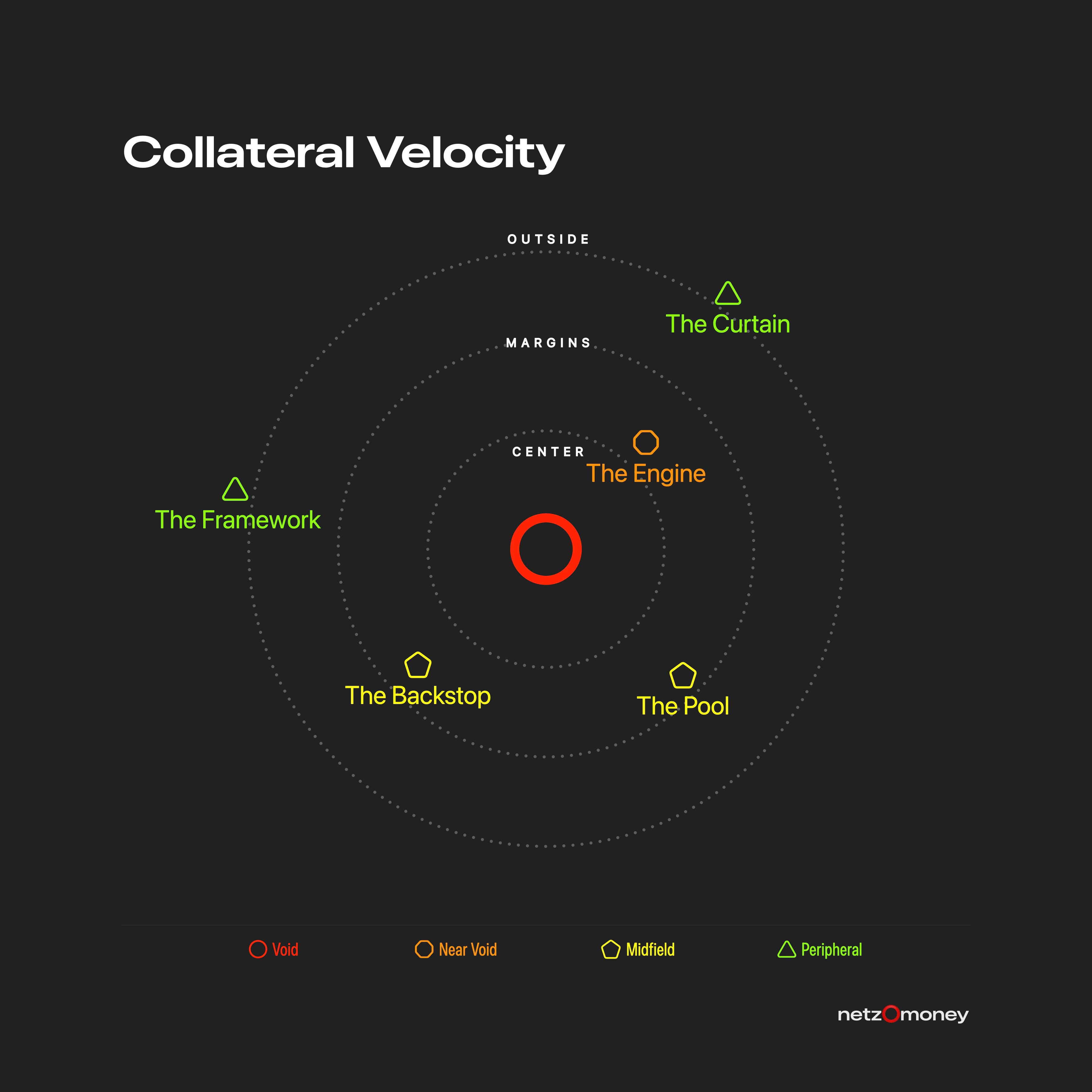
Center is the configuration in which all five functional requirements are met simultaneously at systemic scale. No phenomenon currently occupies it. The void circle is real and its gap is widest on F4 — no phenomenon performs systemic risk governance at Full under stress conditions.
For legal readers: Center is the architecture in which every collateral movement is simultaneously legally enforceable across jurisdictions, operationally cleared, and visible to governance actors responsible for systemic risk. The binding constraint is not legal enforceability — the GMRA and ISDA master agreements achieve that within jurisdictions. The binding constraint is temporal: the governance layer cannot see what the operational layer is doing at the timescale at which systemic risk accumulates.
For technical readers: Center is the settlement architecture whose collateral velocity is continuously observable by macroprudential actors with authority to intervene. The constraint is not computational — the data exists at the transaction layer. The constraint is institutional: no reporting obligation currently captures intraday collateral flows, and the technical acceleration of settlement has outpaced the regulatory architecture designed around it.
Margins is where SovereignCollateralPool, DealerIntermediationComplex, and CentralBankBackstopApparatus operate — each performing essential functions, each blocked from Center by gaps on the requirements they do not perform.
Outside is where TokenizedCollateralInfrastructure and MacroprudentialRegulatoryFramework operate — the first by absence of regulatory address, the second by absence of operational reach into the system it governs.
The FindingType is Fragmentation. The functions of collateral supply, velocity intermediation, settlement clearing, systemic governance, and backstop provision are performed by different phenomena at different timescales with no integrating architecture. The governance layer is not merely lagging the operational layer — it is excluded from observing it at the timescale that matters. Four analytical threads run through the Deep Dives:
How SovereignCollateralPool performs collateral supply at Full under normal conditions and how QE-driven scarcity reveals that Full as conditional — a pool that can be locked away from the system it supplies
How DealerIntermediationComplex is the closest approach to Center — the sole performer of both velocity and clearing at Full — and how the Lehman trace, legal divergence, and risk convexity asymmetry permanently contest its trust substrate
How CentralBankBackstopApparatus performs F5 at Full but activates only after private failure — and what the December 2025 removal of aggregate limits signals about the trajectory of that sequence
How TokenizedCollateralInfrastructure and MacroprudentialRegulatoryFramework are excluded from each other’s operational register — one invisible to governance, the other unable to reach the operational layer — producing the digital curtain that is this report’s central finding
Zone assignments:
SovereignCollateralPool: MidField.
DealerIntermediationComplex: NearVoid.
CentralBankBackstopApparatus: MidField.
TokenizedCollateralInfrastructure: Peripheral.
MacroprudentialRegulatoryFramework: Peripheral.
The two Peripheral phenomena are excluded for distinct reasons:
TokenizedCollateralInfrastructure is excluded because it operates faster than governance can see.
MacroprudentialRegulatoryFramework is excluded because it operates slower than the system it governs.
The Fragmentation finding names the condition in which both are simultaneously true and no integrating mechanism exists.
What You’re Looking At: The stock of sovereign debt and central bank reserves that functions as the foundational security layer of global financial markets — the assets whose legal quality, liquidity, and institutional recognition make them acceptable collateral across every transaction type, jurisdiction, and counterparty relationship.
For legal readers: SovereignCollateralPool performs F1 at Full under the GMRA and ISDA master agreement frameworks — the legal infrastructure that converts sovereign debt into cash-equivalent instruments through standardised title transfer and close-out netting.
For technical readers: The pool is the upstream node in every collateral chain — reverse repos, securities lending, prime brokerage margin accounts — whose quality determines the maximum leverage the system can sustain before haircuts force deleveraging.
SovereignCollateralPool performs collateral supply at Full under normal conditions. Institutional asset owners — sovereign wealth funds, pension funds, insurers — purchase sovereign debt to fulfil asset-liability matching mandates and lease unencumbered holdings to dealer desks through securities lending programs, generating minor incremental yield while maintaining beneficial ownership.
The structural relationship is asymmetric: the pool is the system’s raw material, but the pool’s owners are largely indifferent to what the system does with it downstream. That indifference is a governance property, not a preference.
The stress behavior of F1 reveals the conditional nature of Full. When the ECB conducted large-scale asset purchases between 2015 and 2022, it absorbed German Bunds onto its balance sheet at a rate that created acute scarcity in private repo markets. Repo rates for German collateral fell significantly below risk-free rates, the specialness premium rose, and bond market functioning was impaired — not because the Bunds ceased to exist, but because they were locked where private markets could not reach them. The German Debt Management Office intervened directly, tapping its own holdings to lend bonds back into the private market — €132 billion in April 2020, €54 billion in October 2022. The pool was Full; the system could not access it. Full on F1 and Absent on F3 under stress are not contradictory — they are the condition QE made observable.
The ECB collateral substitution channel, documented by Greppmair, Paludkiewicz, and Steffen (2025), demonstrates the active instrument this creates. During the pandemic, the ECB temporarily accepted lower-quality Additional Credit Claims as eligible collateral for TLTRO funding. Banks pledged these illiquid assets to the central bank rather than locking up sovereign bonds — releasing an estimated €30 billion of high-quality government bonds back into the private repo market, a meaningful supply injection relative to the structural scarcity that had developed in German Bund markets. The facility actively managed the composition of collateral circulating in private markets by determining which assets banks needed to hold versus which they could release into circulation. That design choice is a macroprudential instrument, not a technical specification. This trace conditions every subsequent analysis of central bank collateral policy: the ECB demonstrated that collateral framework design can actively manage private market scarcity, and that instrument now exists as an institutional precedent.
The Compounding Dynamics of QE absorption are worth naming precisely. The scarcity effects of asset purchases did not reverse immediately when purchases ended. The market infrastructure adapted around the scarcity — repo rates repriced, collateral transformation chains adjusted, substitution conventions formed — and those adaptations persist as features of the post-QE environment. The pool’s Full performance on F1 under normal conditions conceals an accumulated fragility: the conditions under which F1 degrades to Absent are not hypothetical. They have been observed, documented, and responded to by the institutions responsible for managing the system.
Net effect: Full collateral supply under normal conditions; F1 degrades to Absent under QE-driven scarcity; F3 Partial and stress-sensitive; Absent on velocity, governance, and backstop functions. MidField.
Evidential Basis
Collateral Custody
[1] Singh — Collateral and Monetary Policy, Cambridge University Press
[2] IMF — Collateral Reuse and Balance Sheet Space, WP/17/113
Settlement Sequencing (shared with The Engine)
[3] OFR — Repo Market Intermediation, OFR Brief 24-07
What You’re Looking At: The network of global systemically important banks and prime brokerage desks that intermediates between institutional asset owners and leveraged users — sourcing collateral from pension funds and sovereign wealth funds, redistributing it through rehypothecation and transformation chains, and operating the balance sheet infrastructure that makes collateral velocity possible at systemic scale.
For legal readers: The Engine operates at the intersection of two legal regimes: US Regulation T and SEC Rule 15c3-3 cap rehypothecation at 140% of client net debit balances; English law and the EU Financial Collateral Directive permit unlimited title transfer, granting the prime broker full legal ownership of client assets at the moment of transfer. That divergence is not a regulatory gap awaiting harmonisation — it is a feature of the architecture that both jurisdictions have maintained since 2008.
For technical readers: Dealer balance sheets are the mediation layer through which collateral transformation chains run — the upgrade pipeline converting lower-grade assets into HQLA through nested repo transactions. The pipeline’s integrity is a function of dealer credit ratings; a rating downgrade severs the transformation chain immediately.
DealerIntermediationComplex is the closest approach to Center in this constellation. It is the sole performer of both collateral velocity intermediation and operational clearing at Full — no other phenomenon comes close. Its NearVoid distance is not a measure of proximity to adequacy. It is a measure of proximity to the functional ideal while remaining blocked from it by the Absent on F4: the Engine has no self-governance capacity, and the governance instruments designed to observe it cannot see it at the timescale at which its risk accumulates.
The rehypothecation engine is the system’s primary velocity mechanism. A single unit of sovereign collateral received by a dealer can be repledged to secure the dealer’s own funding, which generates cash that finances a reverse repo, which receives further collateral that can itself be repledged. The collateral multiplier — the rate at which a single underlying asset simultaneously secures multiple obligations — reached 2.5 to 3.0 before 2008. Post-crisis regulatory tightening and counterparty risk aversion reduced it to approximately 2.0, where it has remained static for a decade despite the expansion of the pledged collateral market to approximately $13 trillion. The plateau is structural: market concentration and regulatory balance sheet constraints jointly cap the reuse rate. JP Morgan and Barclays each hold approximately $2 trillion in pledged collateral available for reuse. US banks account for over half the global market. The concentration is not incidental — it is the architecture.
Risk Convexity names the payoff asymmetry that makes this concentration load-bearing for zone assignment. Dealer balance sheets in collateral intermediation carry a concave risk position: the upside from intermediation fees and spread income is bounded and predictable; the downside from counterparty trust collapse is unbounded and non-linear. When rehypothecation capacity contracts — whether from rating downgrade, regulatory action, or generalised counterparty risk aversion — the contraction is not gradual. It is discontinuous. The March 2020 episode demonstrated this: collateral velocity contracted sharply over hours, not days, before central bank facilities stabilised conditions. The system’s normal operating state conceals its stress behavior; the stress behavior is the analytically load-bearing condition.
Convention Stability frames the Lehman trace precisely. The convention that client assets are protected in a prime brokerage relationship holds reliably within the institutional network that generated it — among dealers, central counterparties, and sophisticated buy-side actors who share the regulatory framework, legal infrastructure, and repeated interaction that produced the convention. It cannot extend to actors outside that network. Buy-side clients who had not negotiated ring-fenced custody accounts discovered in September 2008 that the convention they relied upon — implicit asset protection in rehypothecation — did not survive the insolvency scenario in which they needed it most. The convention had not failed for participants inside the network. It had failed at the non-participant boundary: the clients who were subject to the architecture but not party to the norms that governed it.
The consequence is permanent and observable. Modern asset managers actively negotiate segregated custody accounts and tri-party collateral structures as a condition of prime brokerage relationships. That negotiation cost is a direct measure of the convention gap — the price of extending protection to actors the convention did not originally cover. The gap has not closed. The cost of managing proximity to it has risen.
Collateral Custody ⟷ Convention Stability (Cascading): The custodial concentration of rehypothecated assets at dealer nodes amplifies the convention collapse risk at the non-participant boundary. When dealer insolvency occurs, clients without individually negotiated ring-fenced accounts discover simultaneously that the custodial concentration means their assets are commingled in the insolvency estate — the convention that protected them assumed a segregation that the custodial architecture did not provide. Removing either lens breaks the causal explanation of how the Lehman trace produced its specific consequence.
The legal divergence between US and English law is the second property that grounds the NearVoid distance. Under Regulation T and SEC Rule 15c3-3, a broker-dealer may rehypothecate up to 140% of a client’s net debit balance; the remainder must be segregated in a customer protection account. Under English law and the EU Financial Collateral Directive, unlimited title transfer is permitted — the prime broker obtains full legal ownership upon transfer, and the client holds an unsecured contractual claim for return of equivalent securities. The same economic transaction produces structurally different legal positions depending on the jurisdiction of the prime broker entity. The FSB has published non-binding harmonisation guidance. No jurisdiction has implemented it. The divergence is now institutionally entrenched.
Net effect: F2 and F3 at Full — sole performer of both velocity and clearing at systemic scale; F1 stress-degraded; F4 and F5 Absent; trust substrate Contested by Lehman trace and legal divergence; Risk Convexity asymmetry grounds the discontinuous stress behavior. NearVoid.
Evidential Basis
Collateral Custody ⟷ Convention Stability (Cascading)
[6] IMF — The Sizable Role of Rehypothecation, WP/10/172
[7] ICMA — FAQ: What is rehypothecation of collateral
Risk Convexity
[6] IMF — The Sizable Role of Rehypothecation, WP/10/172
[18] OFR — Are Zero-Haircut Repos as Common as Advertised (2025)
Settlement Sequencing (shared with The Pool, The Curtain)
[3] OFR — Repo Market Intermediation, OFR Brief 24-07
[4] SEC — Rule 15c3-3 Daily Reserve Computation Amendment
What You’re Looking At: The standing facilities through which central banks provide overnight liquidity against eligible collateral when private repo market channels freeze — anchored by the Federal Reserve’s standing repo operations in the US and the ECB’s collateral framework and targeted lending operations in the Eurozone.
For legal readers: The Federal Reserve’s standing repo operations, restructured on December 11, 2025, operate in full allotment format with no aggregate operational limit — any eligible counterparty holding unencumbered qualifying collateral can access overnight funding at the facility rate. The constraint is not capacity but eligibility: the backstop is unlimited in aggregate and conditioned on asset quality.
For technical readers: The facility operates twice daily — morning (8:15–8:30 ET) and afternoon (1:30–1:45 ET) windows — settled via BNY Mellon tri-party platform. Per-proposition limits of $40 billion per security type per operation apply within the unlimited aggregate.
CentralBankBackstopApparatus performs the emergency liquidity function at Full following the December 2025 redesign. The removal of the $500 billion aggregate limit converts the facility from a capped backstop into a ceiling on overnight repo rates. The facility rate, set at the top of the Federal Funds target range, acts as an interest rate ceiling: private repo rates cannot sustainably exceed it because any counterparty with eligible unencumbered collateral can access the facility instead.
The conditionality embedded in F5 Full is analytically load-bearing. The Backstop performs F5 at Full for counterparties holding unencumbered, high-quality collateral. For counterparties whose balance sheets are encumbered — whose eligible assets are already pledged against prior obligations — the facility is inaccessible regardless of its unlimited aggregate capacity. The institutions most likely to need emergency liquidity under systemic stress are precisely those most likely to have encumbered balance sheets. The unlimited ceiling is effective for the system as a whole; it is potentially unavailable to specific institutions at the moments of peak stress.
Sequencing Effects names the governance consequence of this conditionality. The Backstop activates after private market failure — sequence dependency is architecturally embedded. The March 2020 episode is the canonical trace: private intraday credit limits were withdrawn across correspondent banking and repo corridors before the Federal Reserve expanded liquidity facilities. The system was stabilised not by internal resilience but by public announcement of backstop expansion. The sequence — private freeze first, public response second — is not an implementation choice. It is the structure of a facility designed to supplement rather than replace private intermediation. The December 2025 redesign does not invert the sequence. It lowers the cost of the public response when the sequence runs.
The ECB collateral substitution channel, documented by Greppmair, Paludkiewicz, and Steffen (2025), demonstrates a more active governance instrument. By temporarily accepting lower-quality Additional Credit Claims as eligible collateral for TLTRO funding, the ECB enabled banks to pledge illiquid assets to the central bank rather than locking up sovereign bonds — releasing an estimated €30 billion of high-quality government bonds back into the private repo market. The facility actively managed the composition of collateral circulating in private markets by determining which assets banks needed to hold versus which they could release into circulation. That design choice is a macroprudential instrument, not a technical specification — and its existence as an established precedent conditions every subsequent analysis of central bank collateral policy.
The trajectory question this report cannot fully answer — and that hands forward to Report 3 (Liquidity Infrastructure) — is whether the progressive expansion of standing repo operations represents a permanent shift in the boundary between public and private liquidity provision, or a series of crisis-driven expansions that will be partially reversed as conditions normalise.
Net effect: F5 at Full under December 2025 redesign — unlimited aggregate, full allotment; conditioned on unencumbered collateral eligibility; F3 and F4 Partial; Absent on supply and velocity functions; Sequencing Effects ground the post-failure activation structure. MidField.
Evidential Basis
Sequencing Effects
[12] Richmond Fed — The Fed’s Evolving Involvement in Repo Markets, EB 21-31
[13] FRBNY — Operating Policy: Standing Overnight Repo Operations, December 10, 2025
Collateral Custody (shared with The Engine)
[19] Greppmair, Paludkiewicz, Steffen — Collateral easing and safe asset scarcity, Bundesbank DKP 20/2025
[20] Ampudia, Formoso da Silva, Hesse, Pütz, Schobert, Von Landesberger, Wohlert — Supply Effects and Repo Rates in the Bund Market, ECB Money Markets Conference (2025)
Scoped Jurisdiction Note — The Eurozone Substitution Channel
The ECB collateral framework and the German Bund specialness episodes function in this analysis as a proof-of-concept: evidence that central bank collateral eligibility design operates as an active macroprudential instrument, not merely a technical specification. The ECB’s temporary acceptance of lower-quality credit claims during 2020–2022, and the documented release of approximately €30 billion in high-quality government bonds back into private markets, demonstrates that the substitution channel exists, has been activated under live stress conditions, and produces measurable effects on private repo market functioning. The Eurozone case cannot be directly extrapolated to US or UK markets — the ECB’s institutional architecture, the Bund’s unique scarcity profile, and the DMO’s direct intervention capacity are all jurisdiction-specific. What the Eurozone case demonstrates is the principle: collateral framework design is a policy instrument whose macroprudential consequences are real and tractable. That principle is jurisdiction-invariant even when its specific parameters are not.
What You’re Looking At: The emerging layer of DLT-based intraday settlement platforms — of which JP Morgan’s Kinexys is the most operationally advanced current example, alongside Broadridge’s DLT repo and HQLAˣ — that enables collateral settlement at intraday precision, allowing repo transactions to open and close within a single business day.
For legal readers: Intraday repos that open and close within the same business day produce net-zero end-of-day balances. Current regulatory reporting frameworks capture exposures using EOD snapshots. The legal consequence is that these transactions are not visible in any regulatory filing — they exist, generate real intraday exposures, and disappear before the reporting clock runs. No jurisdiction has addressed this.
For technical readers: The digital curtain is an emergent property of combining instantaneous DLT settlement with EOD snapshot reporting. It is not a design choice by any single platform operator — it is a consequence of the mismatch between settlement timescale and reporting timescale that applies across all platforms operating on this architecture. The faster settlement becomes, the wider the curtain.
TokenizedCollateralInfrastructure sits at Peripheral distance not because it performs poorly but because it exists before the governance architecture that would address it. The technology is operational across multiple platforms. The regulatory framework for observing it is absent on all of them. The digital curtain is not a transitional gap awaiting regulatory adaptation. It is a property of an architecture deployed before its classification.
Regulatory Inscription names the structural act that is missing. Intraday tokenized transactions generate real exposures — counterparty risk, collateral movements, leverage accumulation — at the operational layer. They produce net-zero entries at the regulatory layer. The gap between these two registers is the digital curtain. What cannot be inscribed in the regulatory record cannot be governed by the regulatory framework. The inscription gap is not a data availability problem — the transaction data exists on the DLT platforms. It is a reporting obligation problem: no rule requires that data to be reported to any supervisory authority at any timescale.
Settlement Sequencing ⟷ Regulatory Inscription (Enabling): The intraday-open/EOD-close settlement architecture is the precondition that makes net-zero EOD ledger entries possible. Without same-day settlement capability, the digital curtain cannot operate — an overnight repo that remains open at EOD appears in the snapshot. Settlement Sequencing must exist for Regulatory Inscription’s gap to be possible.
Large global banks benefit from immense intraday netting floats whose scale, while not captured in any current supervisory reporting framework, is directly proportional to the velocity of their intraday collateral activity — and whose governance consequence is identical regardless of precise magnitude: supervisors are blind to the leverage that accumulates and unwinds within the business day.
The first-mover deployment of platforms like Kinexys established the architecture of opacity — intraday settlement producing EOD invisibility — before any regulatory framework existed to address it. That sequence mirrors the pattern the predecessor report identified in DLT settlement: the architecture is deployed, the convention forms around it, and the regulatory framework must subsequently adapt to an established market practice rather than shaping it in advance. The adaptation, when it comes, will run from technology toward legal doctrine, not the reverse.
The T1 transition (Outside toward Margins) requires a formal regulatory address — a reporting obligation mandating intraday or transaction-level SFT disclosure. No G10 jurisdiction has published a consultation paper toward this requirement as of the analytical date. The transition probability is Low not because the technical barrier is high but because the regulatory process has not started.
Net effect: F2 and F3 Partial within current deployments; Absent on supply, governance, and backstop functions; trust substrate Absent — no regulatory recognition, no systemic-scale institutional trust; the digital curtain is a property of the architecture, not of any single platform. Peripheral.
Evidential Basis
Settlement Sequencing ⟷ Regulatory Inscription (Enabling)
[3] OFR — Repo Market Intermediation, OFR Brief 24-07
[5] Risk.net — Collateral velocity is disappearing behind a digital curtain
Regulatory Inscription
[4] SEC — Rule 15c3-3 Daily Reserve Computation Amendment
[5] Risk.net — Collateral velocity is disappearing behind a digital curtain
What You’re Looking At: The Basel III leverage ratio, G-SIB surcharge methodology, and associated reporting architecture that governs systemic collateral risk through quarterly and annual balance sheet snapshots — the primary macroprudential instrument for monitoring whether the system’s collateral velocity has accumulated risks that require intervention.
For legal readers: The Basel III framework produces legally binding capital requirements for globally active banks. Its leverage ratio is calculated using quarter-end balance sheet snapshots; its G-SIB scoring methodology uses year-end data. The legal consequence is that the framework’s requirements are binding at the moments of minimum informational content — the snapshots that banks can manage in advance — rather than at the moments of maximum systemic risk, which occur intraday and intra-quarter.
For technical readers: The G-SIB surcharge creates a discrete step function in capital requirements. Banks whose scores fall above a threshold face materially higher capital charges. The scoring methodology uses year-end data, creating a strong incentive to reduce measurable balance sheet exposures in the weeks before the year-end snapshot.
MacroprudentialRegulatoryFramework (F4: Partial, degrades to Contested under stress; all others Absent) is the governance instrument that cannot close the visibility gap it is designed to address. Its Peripheral distance reflects a condition more precise than mere inadequacy: the framework’s own architecture generates the arbitrage incentives that undermine its governance function. The Basel III leverage ratio does not merely fail to capture intraday risk — it actively incentivises banks to manage their quarter-end balance sheets in ways that make the snapshot less informative than an unmanaged balance sheet would be.
Timescale Stratification names the property precisely. The system operates simultaneously across at least three non-overlapping timescales: intraday settlement (minutes to hours), overnight funding (the repo timescale), and quarterly regulatory reporting. These timescales do not communicate. An intraday stress event that triggers margin calls, forces collateral liquidation, and compresses dealer balance sheets within a six-hour window will not appear in any quarterly report filed in the weeks following — the snapshot will show the post-stabilisation balance sheet, not the stress behavior. The governance framework produces a temporally lagged picture of a system whose systemic risk accumulates on timescales the framework cannot observe.
Timescale Stratification ⟷ Compliance Architecture (Cascading): The gap between intraday execution timescale and quarterly reporting timescale is the precondition that enables Basel III compliance requirements to generate window dressing incentives. The cascade runs from temporal architecture to behavioural distortion: because the governance framework observes only snapshots, banks can satisfy the framework’s requirements while maximising their balance sheets at all other moments. The compliance requirement becomes the mechanism of its own circumvention precisely because the temporal architecture makes circumvention available.
The window dressing evidence is empirical and documented at scale. ECB supervisory data shows that euro area banks reduce reported balance sheet repo volumes by approximately 10–15% before quarter-ends and up to 25–30% before year-ends. Banks with below-median leverage ratios reduce their period-end repo exposures significantly more than better-capitalised peers. By temporarily purging repo transactions from their balance sheets, window-dressing banks report leverage ratios artificially inflated by 0.4 to 0.9 percentage points — in extreme cases by up to 2 percentage points. The practice has historically enabled up to 13 major institutions to reduce their capital requirements, and three to avoid G-SIB designation entirely.
The window dressing mechanism is not a compliance failure in the conventional sense. The banks are complying with the framework as written. The distortion is a consequence of the framework’s design: snapshot-based reporting in a system that operates continuously.
The SEC’s amendment to Rule 15c3-3, effective December 31, 2025, partially addresses this for large broker-dealers by requiring daily reserve computations. It does not close the Basel III leverage ratio gap, which is a BIS BCBS standard requiring 28-jurisdiction consensus to reform.
Entrenchment Architecture explains why reform is resistant. The G-SIB scoring methodology is embedded in the Basel III framework through BIS BCBS standards with implementing regulations in every major jurisdiction. Daily averaging — the most commonly proposed reform — requires not merely technical recalibration but political consensus across all 28 BCBS member jurisdictions simultaneously. Reform is available in principle; the supply constraint on what is politically achievable is the entrenchment that makes the Peripheral distance stable rather than transitional.
Net effect: F4 Partial under normal conditions, degrades to Contested at quarter-end; Absent on all operational functions; trust substrate Partial — formal legitimacy high, recognised authority contested at the operational layer; Timescale Stratification and Compliance Architecture in cascading coupling ground the window dressing mechanism. Peripheral.
Evidential Basis
Timescale Stratification ⟷ Compliance Architecture (Cascading)
[8] ECB — Window dressing of regulatory metrics, WP 2771
[9] ECB — Closing the blinds on banks’ window dressing, ECB Blog 2024
[14] BIS BCBS — Revisions to leverage ratio disclosure requirements, d456
Entrenchment Architecture
[14] BIS BCBS — Revisions to leverage ratio disclosure requirements, d456
[16] BIS — Basel III LCR and liquidity risk monitoring, bcbs238
[10] FSB — Re-hypothecation and collateral re-use: financial stability issues
Collateral is not merely stored value. It is a continuously recirculated system of claims whose velocity simultaneously produces systemic liquidity and systemic fragility.
This cartography reveals a system in Fragmentation:
The five functional requirements of collateral supply, velocity intermediation, operational clearing, systemic governance, and backstop provision are performed by structurally separate phenomena at structurally incompatible timescales, with no integrating architecture that simultaneously satisfies all five. The void at Center is not a gap waiting to close. It is a condition of an architecture that has optimised each layer independently.
The architecture that emerges from this mapping is not one system but several, operating in parallel:
Pension funds supply sovereign debt they do not follow into the velocity chain.
Dealer balance sheets intermediate at a speed regulators cannot observe. Central bank facilities absorb the failure of private intermediation after it occurs.
Tokenized platforms settle in minutes what regulation measures in quarters.
The governance framework counts what survives to the snapshot date and calls it the balance sheet.
These are not coordination failures among actors pursuing the same goal. They are distinct functions performed by distinct institutions at distinct timescales, loosely coupled by the convention that the chain holds and catastrophically correlated when it does not. The infrastructure is the constant. The governance objective varies.
The 2025–2026 regulatory window has generated three structural data points:
The SEC’s daily computation amendment demonstrates that temporal reporting gaps can be partially closed when the regulatory will and jurisdictional scope exist.
The Federal Reserve’s removal of the aggregate limit on standing repo operations demonstrates that public backstop capacity can be made structurally unlimited — with the conditionality of collateral eligibility as the binding constraint rather than aggregate size.
The FSB’s unimplemented rehypothecation guidance demonstrates that cross-jurisdictional harmonisation of the velocity architecture remains politically unavailable at the speed the system requires.
The three data points together describe not convergence but differentiation: national instruments improving at the margin while the cross-border architecture that carries systemic risk remains outside any governance instrument’s reach.
The visibility gap is widening, not closing:
Every technical acceleration of settlement — instantaneous DLT clearing, intraday repo, automated margin calls — moves the operational layer further from the timescale at which the governance layer can observe it. The digital curtain is not a temporary condition awaiting regulatory catch-up.
The question this report cannot answer is at what point the requirement to adapt arrives — and what the system looks like in the interval.
The December 2025 removal of the aggregate limit on Federal Reserve standing repo operations, combined with the ECB’s documented collateral substitution channel, marks an observable institutional trajectory: central bank backstop architecture is expanding toward a structural rather than emergency function. The T3 transition — CentralBankBackstopApparatus from MidField toward NearVoid — has a visible prerequisite and a visible obstacle. The prerequisite is confirmed. The obstacle is political.
If standing repo operations become the structural ceiling on overnight funding costs rather than an emergency facility, the private dealer balance sheets that currently perform F2 at Full face a permanently altered competitive environment — the backstop competes with private intermediation rather than supplementing it. If the boundary between public and private liquidity provision shifts structurally rather than cyclically, the functional requirements of the collateral system reorganise around the new boundary — what counts as adequate private intermediation changes when the public alternative is always available at the facility rate. If that reorganisation occurs without a corresponding expansion of the governance architecture’s observability into intraday flows, the visibility gap that is this report’s central finding widens further rather than closes.
If central bank standing facilities become the permanent structural ceiling on private repo markets rather than their emergency supplement, at what point does the boundary between public liquidity provision and private collateral intermediation become the binding constraint on the architecture of the system — and what governance configuration would be required to manage that boundary rather than merely observe it?
This nemo 3 cartography maps collateral velocity using a Functional Performance Map derived from structured pre-analysis and confirmatory research across five phenomena. Readers new to this series will find the full framework description at the nemo 3 series page. The NonarySet is used here not to classify systems, but to identify which constraints are mutable (technical, operational) and which are binding (legal designation, institutional recognition). For example: TokenizedCollateralInfrastructure is blocked at Regulatory Inscription — the formal reporting obligation that no G10 jurisdiction has created for intraday SFT flows. MacroprudentialRegulatoryFramework is blocked at Timescale Stratification — the incompatibility between intraday systemic risk accumulation and quarterly governance observation that no instrument currently bridges.
Genre: Structural cartography — not policy advice, market forecast, or legal opinion.
Contested status: Twenty references are used. Contested status is warranted by three independently load-bearing empirical fragilities:
Collateral velocity figures post-2020 rely on Singh/IMF methodology whose denominator construction is disputed;
The intraday netting float scale, while structurally significant, is not captured in any current supervisory reporting framework and cannot be precisely quantified from available public sources;
The zero-haircut repo concentration figures from OFR (2025) represent a new data series whose methodology has not yet been subject to independent replication.
Epistemic Boundary: The framework evaluates observable structural signals — institutional, capital, regulatory, and operational — to assign zones and migration conditions. It does not infer desirability or normative superiority of any configuration. Each lens was evaluated independently against observable indicators before aggregation. The framework recognises that technical architecture cannot substitute for social coordination infrastructure; where trust substrate is absent or contested, the protocol records a structural gap, not a temporary implementation problem. The macroprudential surveillance vantage — which makes systemic concentration, temporal mismatch, and regulatory arbitrage visible — may underweight the operational efficiency gains of high-velocity collateral circulation and the resilience properties dealer intermediation provides during normal market functioning. Perspective-invariant findings — the temporal mismatch finding and the rehypothecation legal divergence — carry stronger epistemic weight than findings dependent on this specific NonarySet.
Zone assignments:
SovereignCollateralPool — MidField.
DealerIntermediationComplex — NearVoid.
CentralBankBackstopApparatus — MidField.
TokenizedCollateralInfrastructure — Peripheral.
MacroprudentialRegulatoryFramework — Peripheral.
Transitions:
T1: TokenizedCollateralInfrastructure, Outside → Margins. Probability: Low (prerequisite met — technical capability exists across multiple platforms; obstacle remaining — no G10 jurisdiction has published a consultation paper toward intraday SFT disclosure).
T2: MacroprudentialRegulatoryFramework, Outside → Margins. Probability: Low (prerequisite met — SEC Rule 15c3-3 daily computation demonstrates regulatory willingness; obstacle remaining — 28-jurisdiction BCBS consensus with no current negotiating mandate).
T3: CentralBankBackstopApparatus, MidField → NearVoid. Probability: Moderate (prerequisite met — aggregate limit removed December 2025, ECB substitution channel documented; obstacle remaining — no G10 central bank has endorsed permanent displacement of private intermediation as structural policy). Full analytical development in Report 3 (Liquidity Infrastructure).
T4: DealerIntermediationComplex, NearVoid → MidField (diverging). Probability: Low (prerequisite met — FSB non-binding guidance published; obstacle remaining — binding harmonisation requires simultaneous SEC and FCA/PRA implementation with no current legislative mandate).
NonarySet:
Collateral Custody (FINANCIAL CYCLES — The Engine);
Settlement Sequencing (FINANCIAL CYCLES — The Engine, The Pool, The Curtain);
Risk Convexity (FINANCIAL CYCLES — The Engine);
Timescale Stratification (TEMPORAL DYNAMICS — The Framework);
Sequencing Effects (TEMPORAL DYNAMICS — The Backstop);
Compliance Architecture (COMPETING POWERS — The Framework);
Entrenchment Architecture (COMPETING POWERS — The Framework);
Convention Stability (MUTUAL AUTONOMY — The Engine);
Regulatory Inscription (LEDGERED VALUES — The Curtain).
Coupled lenses:
Timescale Stratification ⟷ Compliance Architecture (Cascading) — the temporal architecture enables the compliance circumvention; removing either breaks the window dressing causal explanation.
Collateral Custody ⟷ Convention Stability (Cascading) — custodial concentration amplifies convention collapse at the non-participant boundary; removing either breaks the Lehman trace causal explanation.
Settlement Sequencing ⟷ Regulatory Inscription (Enabling) — intraday settlement capability is the precondition for the digital curtain; without same-day settlement, net-zero EOD entries are impossible.
FindingType: Fragmentation — functions disaggregating without coherent successor assembly; void center unoccupied; no phenomenon trajectory converging on Center under current conditions; digital curtain widens the F3/F4 gap as technical settlement accelerates.
Zone migration: Migration is a zone-assignment change.
Outside → Margins requires formal regulatory address.
Margins → Center requires Full performance across all five functional requirements simultaneously.
Growth within a zone is not migration.
Operational scale on an undesignated platform does not constitute migration. Coexisting Trajectories Rule applies: T3 and T4 can proceed simultaneously in opposite directions.
Method: Structured pre-analysis plus deep research on collateral velocity mechanics, rehypothecation legal architecture, window dressing evidence, DLT tokenization platforms, and central bank standing facility design. FunctionalPerformanceMap constructed before phenomenon definition. Nine lenses from five perspectives.
Phenomena: five.
Geographic scope: global; US/UK-EU primary; Eurozone proof-of-concept.
Tier 2 reference: nemo 3.
Understanding Key Metrics:
Distance (ordinal):
AtVoid
NearVoid
MidField
Peripheral
Unreachable.
ProbabilityRange (ordinal):
VeryLow
Low
Moderate
High
VeryHigh
Each transition carries a gloss naming at least one prerequisite met and one genuine obstacle remaining.
Collateral multiplier: The rate at which a single underlying asset simultaneously secures multiple obligations. Pre-2008: 2.5–3.0. Post-crisis plateau: approximately 2.0. Source: Singh/IMF methodology; denominator construction disputed — see Contested status.
Digital curtain: The regulatory blind spot produced when intraday DLT settlement generates transactions that open and close within a single business day, producing net-zero end-of-day balances in EOD snapshot reporting frameworks.
Window dressing: The practice of temporarily reducing balance sheet exposures around regulatory reporting dates to appear safer than current conditions warrant. Empirically documented at euro area banking sector level by ECB supervisory data.
F1–F5: Shorthand for the five functional requirements defined in The Two Layers of Collateral Function.
References are grouped by analytical lens to show evidential logic. Lens names match the NonarySet exactly.
Singh, M. — Chapter 9: Collateral and Monetary Policy, Cambridge University Press (2014)
cambridge — collateral monetary policy Public 2014-01-01
🕯️ SovereignCollateralPool — establishes the collateral multiplier framework and the pre/post-2008 velocity contraction, grounding the MidField distance assignment and the single-performer concentration finding for DealerIntermediationComplex on F2.
International Monetary Fund — Collateral Reuse and Balance Sheet Space, IMF WP/17/113 (2017)
imf — collateral reuse Public 2017-05-01
🕯️ DealerIntermediationComplex — documents the balance sheet mechanism through which the same collateral simultaneously secures multiple obligations, directly evidencing the F2 Full performance and the custodial concentration that grounds the Collateral Custody lens assignment.
Office of Financial Research — Repo Market Intermediation, OFR Brief 24-07 (2024)
ofr — repo intermediation Public 2024-01-01
🕯️ DealerIntermediationComplex — confirms that repo dealers rehypothecate the majority of collateral received via reverse repos and that outstanding repo collateral is predominantly sourced from reverse repos, evidencing the systemic reliance on continuous circulation at the settlement layer.
Sidley Austin — SEC Amends Rule 15c3-3 to Require Daily Reserve Computations, Sidley Insights (2025)
sidley — 15c3-3 daily Public 2025-01-01
🕯️ MacroprudentialRegulatoryFramework — documents the SEC’s partial closure of the temporal reporting gap through daily computation, establishing the T2 transition prerequisite and evidencing that regulatory willingness to shift from periodic to daily observation exists within a single jurisdiction.
Risk.net / Singh, M. — Collateral velocity is disappearing behind a digital curtain, Risk.net (2024)
risk — digital curtain Public 2024-01-01
🕯️ TokenizedCollateralInfrastructure — names the digital curtain mechanism and establishes that intraday DLT settlement produces governance invisibility at EOD snapshot reporting frameworks; the ordinal finding — the gap is structurally significant — holds independently of any precise figure.
International Monetary Fund — The (Sizable) Role of Rehypothecation in the Shadow Banking System, IMF WP/10/172 (2010)
imf — rehypothecation shadow banking Public 2010-01-01
🕯️ DealerIntermediationComplex — documents the scale and mechanics of rehypothecation, evidencing the asymmetric payoff structure that grounds the Risk Convexity lens assignment and the discontinuous stress behavior finding.
International Capital Market Association — What is rehypothecation of collateral?, ICMA ERCC FAQ (2023)
icma — rehypothecation faq Public 2023-01-01
🕯️ DealerIntermediationComplex — documents the US/UK legal divergence in rehypothecation architecture and the Lehman insolvency consequence, grounding the Convention Stability non-participant boundary finding and the Contested trust substrate assignment.
European Central Bank — Window dressing of regulatory metrics: evidence from repo markets, ECB Working Paper 2771 (2023)
ecb — window dressing wp Public 2023-01-01
🕯️ MacroprudentialRegulatoryFramework — provides the primary empirical documentation of quarter-end and year-end balance sheet compression, evidencing the window dressing mechanism and the leverage ratio inflation figures that ground the F4 degrades-to-Contested finding.
European Central Bank — Closing the blinds on banks’ window dressing, ECB Blog (2024)
ecb — window dressing blog Public 2024-05-02
🕯️ MacroprudentialRegulatoryFramework — confirms G-SIB scoring distortion from window dressing at systemic scale, including the finding that three institutions avoided G-SIB designation through balance sheet management, grounding the governance-floor-becoming-blind-spot finding.
Financial Stability Board — Re-hypothecation and collateral re-use: Potential financial stability issues, market evolution and regulatory approaches, FSB (2017)
fsb — rehypothecation reuse Public 2017-01-01
🕯️ CentralBankBackstopApparatus — documents the FSB’s assessment of rehypothecation financial stability risks and the non-binding harmonisation guidance, grounding the T4 transition obstacle finding and evidencing that cross-jurisdictional governance of the velocity architecture remains politically unavailable.
Bank for International Settlements — Euro repo market functioning: collateral is king, BIS Quarterly Review (2019)
bis — euro repo collateral Public 2019-12-01
🕯️ CentralBankBackstopApparatus — documents the structural relationship between collateral quality and repo market access, evidencing the conditionality embedded in backstop eligibility and grounding the F5 Full with unencumbered-collateral condition finding.
Federal Reserve Bank of Richmond — The Fed’s Evolving Involvement in the Repo Markets, Economic Brief EB 21-31 (2021)
richmond fed — repo involvement Public 2021-01-01
🕯️ CentralBankBackstopApparatus — documents the September 2019 and March 2020 repo market stress episodes that motivated the SRF’s establishment, grounding the Sequencing Effects finding that backstop facilities activate after private failure and evidencing the Covid-19 stigmergic trace.
Federal Reserve Bank of New York — Statement Regarding Standing Overnight Repo Operations, FRBNY Operating Policy (2025)
frbny — standing repo ops Public 2025-12-10
🕯️ CentralBankBackstopApparatus — primary Federal Reserve source confirming removal of aggregate operational limit effective December 11, 2025, and adoption of full allotment format; grounds F5 Full assignment and T3 Moderate probability assessment.
Basel Committee on Banking Supervision — Revisions to leverage ratio disclosure requirements, BIS Consultative Document d456 (2018)
bis — leverage ratio disclosure Public 2018-01-01
🕯️ MacroprudentialRegulatoryFramework — documents the BIS consultation on leverage ratio disclosure, establishing the reform pathway and the 28-jurisdiction consensus requirement that grounds the Entrenchment Architecture lens assignment and the T2 Low probability assessment.
European Central Bank — Window dressing of regulatory metrics: evidence from repo markets, ECB Working Paper 2771 (2023)
ecb — window dressing wp Public 2023-01-01
🕯️ MacroprudentialRegulatoryFramework — evidences that window dressing is institutionally embedded across the euro area banking sector, demonstrating that the distortion is a consequence of framework design rather than individual misconduct — the Entrenchment Architecture finding that the pathology persists because the framework that produces it resists reform.
Basel Committee on Banking Supervision — Basel III: The Liquidity Coverage Ratio and liquidity risk monitoring tools, BIS bcbs238 (2013)
bis — lcr Public 2013-01-01
🕯️ MacroprudentialRegulatoryFramework — establishes the HQLA definition and LCR framework determining what assets qualify as SovereignCollateralPool members, grounding the F1 Full assignment and the regulatory architecture within which collateral quality is defined.
De Nederlandsche Bank — What does QE mean for repo markets?, DNB Working Paper 745 (2022)
dnb — qe repo markets Public 2022-01-01
🕯️ SovereignCollateralPool — documents the collateral scarcity mechanism produced by ECB QE absorption, evidencing the F1 degrades-to-Absent stress behavior and the Bund specialness episodes that ground the MidField assignment’s conditional Full finding.
Cenicola, A., Mann, R., and Paddrik, M. — Are Zero-Haircut Repos as Common as Advertised?, OFR Blog 25-09 (2025)
ofr — zero haircut repos Public 2025-08-12
🕯️ DealerIntermediationComplex — documents that 56% of outstanding NCCBR repo carried zero haircuts during January–May 2025, with 92% of zero-haircut repo backed by Treasuries and significant concentration among affiliate counterparties — evidencing the Risk Convexity asymmetry and the procyclical deleveraging risk embedded in the zero-haircut leverage architecture.
Greppmair, S. (Deutsche Bundesbank), Paludkiewicz, K. (European Central Bank), and Steffen, S. (Frankfurt School of Finance and Management) — Collateral easing and safe asset scarcity: How money markets benefit from low-quality collateral, Deutsche Bundesbank Discussion Paper No. 20/2025 (2025)
bundesbank — collateral easing Public 2025-07-09
🕯️ CentralBankBackstopApparatus — documents the ECB collateral substitution channel, showing that banks pledged newly eligible credit claims to reduce encumbrance of high-quality marketable assets, releasing approximately €30 billion of sovereign bonds back into private repo markets — evidencing that central bank collateral framework design functions as an active macroprudential instrument.
Ampudia, M., Formoso da Silva, P.M., Hesse, S., Pütz, A., Schobert, F., Von Landesberger, J., and Wohlert, A. — Supply Effects and Repo Rates in the Bund Market, ECB Conference on Money Markets (2025)
ecb — bund supply effects repo rates Public 2025-11-07
🕯️ SovereignCollateralPool — documents the DMO supply-side interventions (€132 billion April 2020; €54 billion October 2022) that evidenced the QE stigmergic trace, grounding the Compounding Dynamics structural effect and the conditional Full on F1.
Comments
Nothing yet. Say the first thing.
Sign in to join the conversation.