
The dollar and euro backstops both deliver liquidity in full — but neither is free of a documented confidence gap about whether they can be relied on without a hedge.
The dollar’s gap comes from an active dispute over a discretionary Treasury swap channel. The euro’s comes from an institutional decision to stop publishing who uses its new facility.
An IMF governance deadlock that has survived three quota-review cycles, a permanent blind spot in official gold-reserve reporting, and genuinely thin public evidence on PBOC-linked settlement infrastructure round out the picture.
None of the five mechanisms is converging on, displacing, or undermining another. The defining pattern is full delivery layered with partial trust.
Credit means that a certain confidence is given, and a certain trust reposed. Is that trust justified? and is that confidence wise? These are the cardinal questions.
— Walter Bagehot, Lombard Street (1873)
This is the fourth report in the nemo 3 series. Reports 1, 2 and 3 each found an unoccupied Center — no phenomenon in those domains achieved a position near the functional ideal. This report’s central finding, Coexistence with two phenomena at the Center’s boundary, is a genuine divergence from that pattern, not a confirmation of it.
In 2026, two currency-backstop channels are doing real work under real stress. One moves dollars; the other moves euros. Both can deliver, in full, whenever a counterparty draws on them. Neither is free of an open question about whether that delivery can be relied on without a hedge. This report is about what that gap means, why it takes two different forms depending on which channel you’re looking at, and what else in the world’s reserve architecture looks similar — or genuinely does not.
This analysis is built from sources concentrated in Federal Reserve, US Treasury, ECB, and IMF material. That is a disclosed choice, not an oversight: it means the mechanics of dollar- and euro-based channels are documented here in detail that PBOC-administered infrastructure is not. Readers should not read the comparative quiet on that infrastructure as evidence that it has no comparable tensions — only that this report did not have an adequate evidentiary basis to characterize them responsibly, and did not attempt to.
Three functional capabilities recur across every mechanism examined here:
Liquidity Delivery (F1) is the capacity to supply usable liquidity to another jurisdiction during stress.
Settlement Access (F2) is the capacity to supply settlement assets or functioning clearing and messaging access.
Confidence Without Hedging (F3) is the capacity to sustain institutional trust sufficient that a counterparty relies on a channel without separately hedging against it.
Five phenomena are mapped against these three capabilities:
The Split Backstop — dual-channel dollar backstop provision
The Open Vault — the euro-area backstop facility with liberalized access
The Veto Loop — the IMF’s quota-governance mechanism
The Blind Ledger — gold-exclusive reserve reporting
The Separate Rail — PBOC-anchored bilateral swap and settlement infrastructure
Across every phenomenon mapped in this domain, the technical and financial capacity to deliver liquidity or settlement assets and the institutional confidence required to rely on that delivery without hedging against it vary independently of one another — a currency-provision channel can perform its delivery function at full capacity while its trust substrate simultaneously degrades, and a governance body can hold no delivery function at all while still carrying an actively contested confidence dimension — meaning no single phenomenon’s standing in this domain can be assessed from its delivery capacity alone.
Liquidity Delivery and Settlement Access travel together in this domain; Confidence Without Hedging does not travel with them. That single fact does most of the explanatory work for everything that follows.
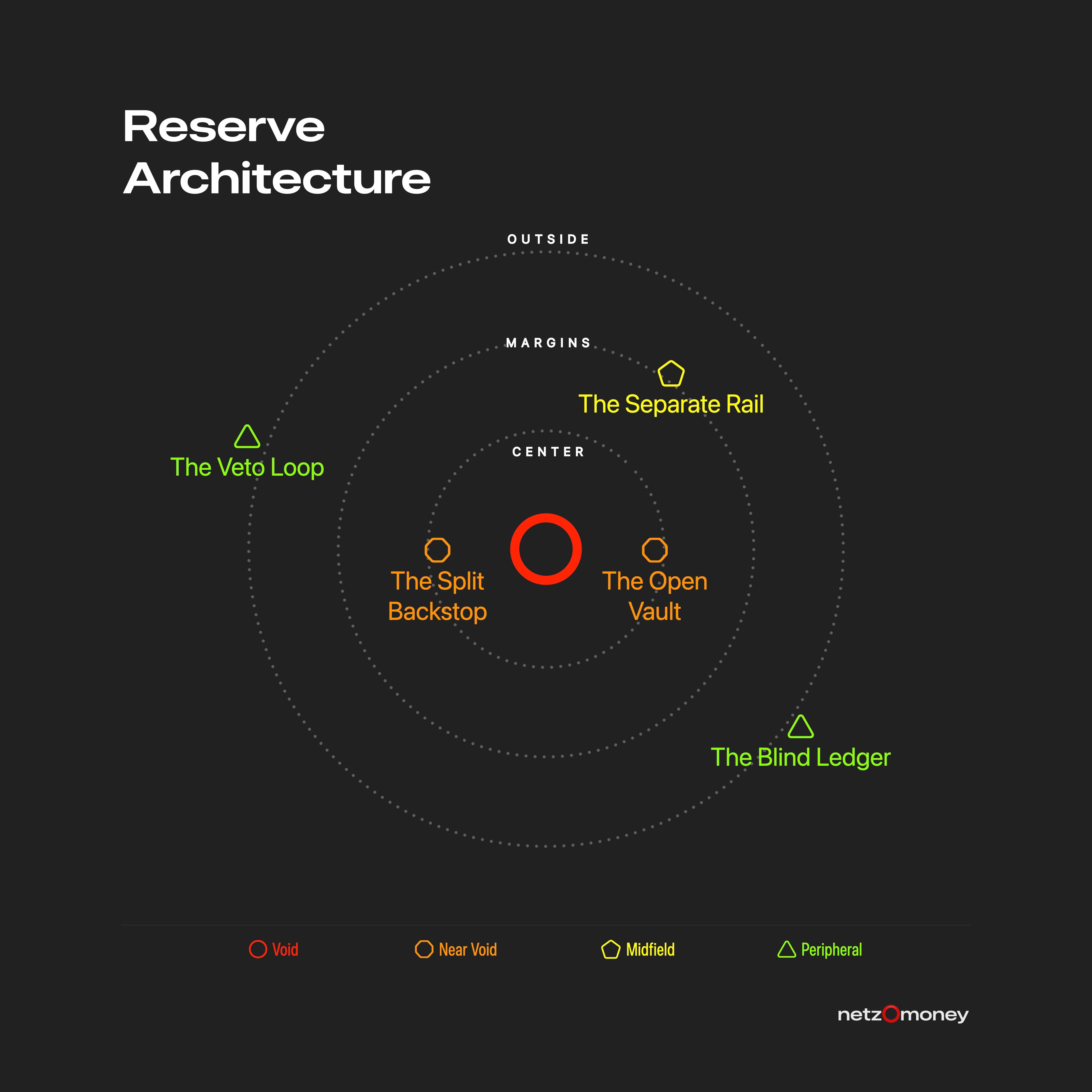
Here is where the five phenomena sit. The Split Backstop and The Open Vault sit at the boundary of the Center: both achieve full performance on Liquidity Delivery and Settlement Access, and both carry a Partial rating on Confidence Without Hedging — the same functional profile, reached independently, in two different currencies. The Veto Loop and The Blind Ledger sit Outside: each carries at least one functional requirement it does not perform at all — The Veto Loop because it is a governance mechanism that does not deliver liquidity or settlement assets by design, The Blind Ledger because it is a measurement instrument with the same non-applicability. Neither Absence is the kind of failure a delivery mechanism would exhibit; both are recorded identically under the framework’s current categories, a limitation this report flags rather than papers over (see Methodology). The Separate Rail sits in the Margins: its performance is uniformly a mix, not because any function has been shown to fail, but because this report’s own evidence about it is genuinely thin.
This is the report’s central and, relative to the three prior reports in this series, unexpected finding: the constellation’s overall shape is Coexistence. Each of the five mechanisms occupies a position that reflects its own specific mix of Liquidity Delivery, Settlement Access, and Confidence Without Hedging performance, with no evidence that any one is converging toward, displacing, or undermining another. Where Report 3 in this series found a different structural bifurcation (between individual-institution and market-wide convertibility), this report does not reproduce that specific finding; it finds a different non-commensurable pair instead — an honest divergence, not a continuation.
The Split Backstop delivers on both Liquidity Delivery and Settlement Access without qualification. Its Confidence Without Hedging rating is split internally: the primary, standing FOMC channel carries no documented dispute, while a second, more discretionary Treasury/ESF channel does. That second channel has been invoked twice within this report’s analytical window, amid an ongoing regional conflict that gives continued reason for further use. On April 22, 2026, Treasury Secretary Scott Bessent told a Senate Appropriations subcommittee that Gulf and Asian allies had requested dollar swap lines — testimony independently reported by four separate news organizations. Senator Van Hollen’s on-the-record objection to using the Exchange Stabilization Fund for this purpose is documented, but no evidenced mechanism currently lets that objection bind how the channel is used going forward. This is a confidence gap that exists because of an active, ongoing dispute: the channel works, and the argument about whether it should be used this way is unresolved.
The Open Vault also delivers in full on Liquidity Delivery and Settlement Access — the ECB’s February 2026 announcement extended standing repo access in principle to nearly all central banks, effective Q3 2026. Its Confidence Without Hedging gap looks the same, on paper, as The Split Backstop’s — Partial, sitting at the same boundary position — but it arises for a different reason. The ECB’s own FAQ on the facility states plainly that it will stop publishing which central banks actually use it. No dispute preceded this; no incident triggered it. It is a design choice made ahead of any documented contest over the facility’s use, and it is a choice that could, in principle, be reversed, though nothing in the evidence gathered here suggests reversal is under consideration. The Split Backstop’s gap is something being argued about. The Open Vault’s gap is something that was decided.
Comparing these two phenomena side by side is itself informative in a way that neither would be alone. A single-jurisdiction look at either case might reasonably conclude its confidence gap was a local political quirk. Seeing both — one dispute-driven, one design-driven, converging on the same functional profile — raises the possibility of something more general about centralized backstop provision itself. This report treats that possibility carefully. With exactly two cases observed, it is a candidate pattern, not an established one, and it would be weakened if a third or fourth centralized facility were found to sustain full confidence performance, if either gap turned out to be a temporary response to 2026-specific conditions rather than a lasting feature, or if both gaps traced back to the same underlying cause — the same regional conflict, for instance — rather than to an independent property of centralized backstop design. None of those three possibilities has been ruled out by the evidence gathered here.
The Veto Loop sits Outside the Center. It does not perform Liquidity Delivery or Settlement Access at all — that is not its function — and its own governing mechanism has not produced a quota realignment across three consecutive review cycles, under an 85% supermajority threshold that lets one above-threshold member’s position hold the outcome in place. The IMF’s own April 2026 press briefing called the Diriyah Principles the “fairest such reforms in over 15 years,” and adoption was unanimous — but independent legal commentary confirms the principles do not address the core supermajority mechanism, and a separate expert commentary frames the 17th General Review’s deferral to 2028 as a choice, not a neutral delay. Reading continued engagement as evidence the structural problem has been resolved would go beyond what this report’s evidence supports — which is exactly why this phenomenon’s Confidence Without Hedging rating is Contested rather than merely Partial: the sources themselves genuinely disagree.
The Blind Ledger also sits Outside. It performs no liquidity or settlement function; it is a reporting instrument, and the gap in what it reports is permanent by design rather than a lag or an oversight — COFER, the IMF’s own reserve-reporting framework, definitionally excludes monetary gold from its methodology. The best available public window into gold-based reserve diversification is the World Gold Council’s survey, which is directionally informative but self-reported and industry-body composed, not equivalent to an audited count of holdings — and its own more granular monthly figures show at least one major reserve-holder (Russia) as a net seller in 2026, cutting against any simple narrative of universal accumulation. This is a third distinct kind of gap: not a dispute, not a design choice about disclosure timing, but a structural blind spot built into what the measurement instrument can see in the first place.
The Separate Rail sits in the Margins. Every functional requirement it carries is rated Partial — but that uniform rating reflects something different from the other four phenomena’s gaps. It is not that this infrastructure has been evidenced as underperforming; it is that this report’s own evidence about its scale is thin, including an unresolved order-of-magnitude discrepancy between PBOC’s own most recent published figure (32 active swap lines, May 2025) and a more recent but uncorroborated trade-press figure (42 lines, Q1 2026). Independent think-tank analysis confirms CIPS, the settlement messaging system most often discussed alongside this network, remains structurally dependent on SWIFT messaging infrastructure rather than operating independently of it. A related, more geopolitically sensitive body of material about adjacent settlement infrastructure was excluded from this report entirely, on the sponsor’s direction, because the evidence available was single-sourced and because handling it responsibly with that evidence base was judged not currently possible. That exclusion is a deliberate boundary, not a gap for the reader to fill in from general knowledge.
The definitive finding is Coexistence: five mechanisms, each occupying a position that reflects its own specific mix of delivery and confidence performance, with no evidence that any is displacing or converging toward another. That configuration rests on a few conditions holding steady — most notably, whether continued use of The Split Backstop’s discretionary channel, amid ongoing conflict, deepens its confidence gap enough to distinguish it more sharply from The Open Vault’s identical-looking but differently-caused gap.
Two implications are worth stating plainly, in descriptive rather than advisory terms. First, an assessment that treats The Split Backstop’s standing channel and its discretionary channel as carrying different confidence profiles — one uncontested, one actively disputed — tracks what this report’s evidence actually shows, even though both channels deliver identically. Second, an assessment of reliance on The Separate Rail’s infrastructure that treats current published figures as uncertain, rather than settled, matches the evidentiary state this report found, rather than the state a single confident number might suggest.
What this report does not claim is also worth stating. It does not claim that centralized backstop provision generally carries a confidence cost — only that two cases, examined carefully, show the same pattern, not yet tested against a case that would prove or disprove it more broadly. It does not claim continuity with this series’ prior finding about individual-institution versus market-wide convertibility; this report found a different, related, but distinct tension instead. And it does not claim that the current four-category way of rating performance (Full, Partial, Absent, Contested) can always tell the difference between a function a mechanism was never meant to perform and one it is genuinely failing at — a limitation in the underlying framework that this report inherited and flags for those maintaining it, rather than one it resolves here.
This report maps five institutional mechanisms in the global reserve-currency architecture against three functional requirements — Liquidity Delivery, Settlement Access, and Confidence Without Hedging — derived directly from this domain’s own evidence, not imported from prior reports in this series.
Bridge: the bridge between evidence and claim runs through a formal structural model and pattern register before any interpretive lens is applied, so that what follows is traceable back to specific, cited sources rather than asserted from general knowledge.
This report is a structural and interpretive analysis, not investment, legal, or policy advice, and does not recommend action by any actor.
Epistemic Boundary Statement: findings are bounded by the evidence gathered as of the analytical date; where evidence was thin, contested, or excluded on the sponsor’s direction, this report says so explicitly rather than filling the gap with general knowledge.
Geographic scope: United States, euro area, and the IMF’s multilateral governance structure are treated in direct comparative and institutional detail; PBOC-administered and adjacent infrastructure is treated with disclosed, comparatively thinner evidence, and one related subject (mBridge/BIS characterization) was excluded from Phenomenon-level treatment entirely.
Zone assignments: The Split Backstop and The Open Vault sit at the Center’s boundary (NearVoid); The Separate Rail sits in the Margins (MidField); The Veto Loop and The Blind Ledger sit Outside (Peripheral).
Zone migration: A phenomenon’s position changing between Center, Margins, and Outside as its functional performance changes; none is predicted here with better than Moderate probability, and two (T4/T5, affecting The Split Backstop and The Open Vault) point in genuinely opposite directions simultaneously.
Method: Phenomena were constituted through a nine-lens analytical framework (the NonarySet) spanning five theoretical perspectives — Competing Powers, Mutual Autonomy, Financial Cycles, Ledgered Values, and Mediated Markets.
NonarySet purpose, with examples: Each lens isolates one structural property; Polycentric Plurality, for instance, identifies multi-center governance authority in both The Split Backstop and The Veto Loop, while Legitimacy Gap distinguishes The Split Backstop’s active dispute from The Open Vault’s not-yet-active visibility gap.
Phenomena and lens coverage: all five phenomena are covered by at least two lenses each; no lens is assigned to more than two phenomena.
The three functional requirements are referenced throughout by shorthand (F1, F2, F3); their full invariant definitions appear in the Vocabulary section above and are preserved unchanged from this report’s underlying analytical model.
Understanding Key Metrics:
Distance (AtVoid/NearVoid/MidField/Peripheral/Unreachable) measures how close a phenomenon is to performing all three functional requirements at Full;
Zone (Center/Margins/Outside) is the broader category Distance maps into; transition probabilities (VeryLow/Low/Moderate/High/VeryHigh) are qualitative ordinals, not numerical estimates, and each carries a stated prerequisite and a stated obstacle.
References are grouped by analytical lens to show evidential logic.
Al Jazeera — US Treasury Secretary Bessent says Gulf, Asian allies request swap lines (April 22, 2026)
https://www.aljazeera.com/economy/2026/4/22/us-treasury-secretary-bessent-says-gulf-asian-allies-request-swap-lines [accessed 2026-07-04] Grounds The Split Backstop’s F3 rating of Partial via independently corroborated reporting of the April 2026 testimony episode establishing the Treasury/ESF channel’s contested standing.EJIL:Talk! — Diriyah Meets Washington: The IMF’s Institutional Reform Dilemma (May 11, 2026)
https://www.ejiltalk.org/diriyah-meets-washington-the-imfs-institutional-reform-dilemma/ [accessed 2026-07-04] Grounds The Veto Loop’s Peripheral distance and Contested F3 rating via confirmation that the 85%-supermajority threshold structurally blocks quota realignment and that the Diriyah Principles do not resolve it.
Entrenchment Architecture
Project Syndicate — The IMF’s Spring Meetings Must Deliver Three Reforms (April 8, 2026)
https://www.project-syndicate.org/commentary/imf-spring-meetings-must-reform-quotas-give-more-votes-to-developing-economies-by-attiya-waris-2026-04 [accessed 2026-07-04] Grounds The Veto Loop’s Contested F3 rating by independently corroborating that the 17th General Review was deferred to 2028, read as a choice rather than a neutral delay — the source of disagreement underlying the Contested classification.IMF — IMFC Press Briefing Transcript, Spring Meetings 2026 (April 17, 2026)
https://www.imf.org/en/news/articles/2026/04/17/tr-04172026-transcript-imfc-press-briefing-spring-meetings-2025 [accessed 2026-07-04] Grounds the opposing side of The Veto Loop’s Contested F3 rating — the IMF’s own on-the-record characterization of the Diriyah Principles as “the fairest such reforms in over 15 years,” the reading that Strong-quality sources 2 and 3 above dispute.
CNBC — Bessent says ‘many’ U.S. allies have asked for currency swaps amid Iran war turbulence (April 22, 2026)
https://www.cnbc.com/2026/04/22/iran-war-treasury-uae-scott-bessent-currency-swaps.html [accessed 2026-07-04] Grounds The Split Backstop’s F3 Partial rating via independent confirmation of the same Senate testimony and Senator Van Hollen’s documented objection.Bloomberg — US Allies in Gulf, Asia Seek Currency Swap Lines, Bessent Says (April 22, 2026)
https://www.bloomberg.com/news/articles/2026-04-22/bessent-says-many-us-allies-in-gulf-asia-requested-swap-lines [accessed 2026-07-04] Third independent corroboration of the same testimony, further supporting The Split Backstop’s Contested Treasury/ESF-channel characterization.CNBC — Bessent defends U.S. dollar swap lines as Iran war harms global finances (April 24, 2026)
https://www.cnbc.com/2026/04/24/bessent-iran-war-uae-swap-lines-gulf-asia.html [accessed 2026-07-04] Grounds the ongoing, rather than one-time, character of The Split Backstop’s confidence gap via follow-up reporting on continued use amid conflict.
Convention Stability
European Central Bank — FAQ on EUREP https://www.ecb.europa.eu/mopo/international-market-operations/liquidity_lines/ecb.faq_EUREP.en.html [accessed 2026-07-04] Grounds The Open Vault’s F3 Partial rating via the ECB’s own primary disclosure of its decision to cease publishing counterparty-utilization data.
European Central Bank — ECB enhances repo facility for central banks (February 14, 2026)
https://www.ecb.europa.eu/press/pr/date/2026/html/ecb.pr260214~076e09a6cc.en.html [accessed 2026-07-04] Grounds The Open Vault’s Full F1/F2 rating via the primary announcement of near-universal standing access.European Central Bank — The international role of the euro, June 2026 https://www.ecb.europa.eu/press/other-publications/ire/html/ecb.ire202606.en.html [accessed 2026-07-04] Further grounds The Open Vault’s F1/F2 Full rating and its institutional framing as a stability-and-competition instrument.
People’s Bank of China — Status of Bilateral Local Currency Swap Agreements (as of May 31, 2025)
http://www.pbc.gov.cn/en/3688241/3688636/3688657/5793816/index.html [accessed 2026-07-04] Grounds The Separate Rail’s F1 Partial rating via PBOC’s own primary, but comparatively stale, count of active swap agreements.Council on Foreign Relations — Central Bank Currency Swaps Tracker (updated April 21, 2026)
https://www.cfr.org/articles/central-bank-currency-swaps-tracker [accessed 2026-07-04] Further grounds The Separate Rail’s F1 Partial rating and clarifies the “signed since 2009” versus “currently active” distinction underlying the network-scale discrepancy.CryptoBriefing — Central banks draw $16.4B from People’s Bank of China swap lines in Q1 (May 13, 2026)
https://cryptobriefing.com/pboc-swap-lines-q1-16-billion/ [accessed 2026-07-04] Grounds The Separate Rail’s F1 Partial rating via the uncorroborated, Thin-quality figure that produces the report’s order-of-magnitude discrepancy — the specific claim this report treats as unresolved, not as fact.
IMF — Currency Composition of Official Foreign Exchange Reserves (COFER) Data Brief (March 27, 2026)
https://data.imf.org/en/news/imf%20data%20brief%20march%2027 [accessed 2026-07-04] Grounds The Blind Ledger’s F1/F2 Absent ratings via the IMF’s own reported reserve-composition figures under COFER’s methodology.IMF — COFER dataset and methodology https://data.imf.org/en/datasets/IMF.STA:COFER [accessed 2026-07-04] Grounds the permanent, definitional character of COFER’s gold exclusion underlying The Blind Ledger’s Peripheral distance derivation.
World Gold Council — Central Bank Gold Reserves Survey 2026 https://www.gold.org/goldhub/research/central-bank-gold-reserves-survey-2026 [accessed 2026-07-04] Grounds The Blind Ledger’s F3 Partial rating via the self-reported, industry-body-composed survey that partially and imperfectly substitutes for COFER’s gold-exclusion gap.
World Gold Council — Central bank gold statistics: Central banks remain committed to gold (July 2026)
https://www.gold.org/goldhub/gold-focus/2026/07/central-bank-gold-statistics-central-banks-remain-committed-gold [accessed 2026-07-04] Further grounds The Blind Ledger’s F3 Partial rating and supplies the Russia net-seller data point that qualifies any simple accumulation narrative.
Center for Strategic and International Studies (CSIS) — Sanctions, SWIFT, and China’s Cross-Border Interbank Payments System (March 4, 2026) https://www.csis.org/analysis/sanctions-swift-and-chinas-cross-border-interbank-payments-system [accessed 2026-07-04] Grounds The Separate Rail’s F2 Partial rating via documented confirmation of CIPS’s continued structural dependency on SWIFT messaging infrastructure.
Comments
Nothing yet. Say the first thing.
Sign in to join the conversation.