
Every banker knows that if he has to prove he is worthy of credit, in fact his credit is gone.
— Walter Bagehot
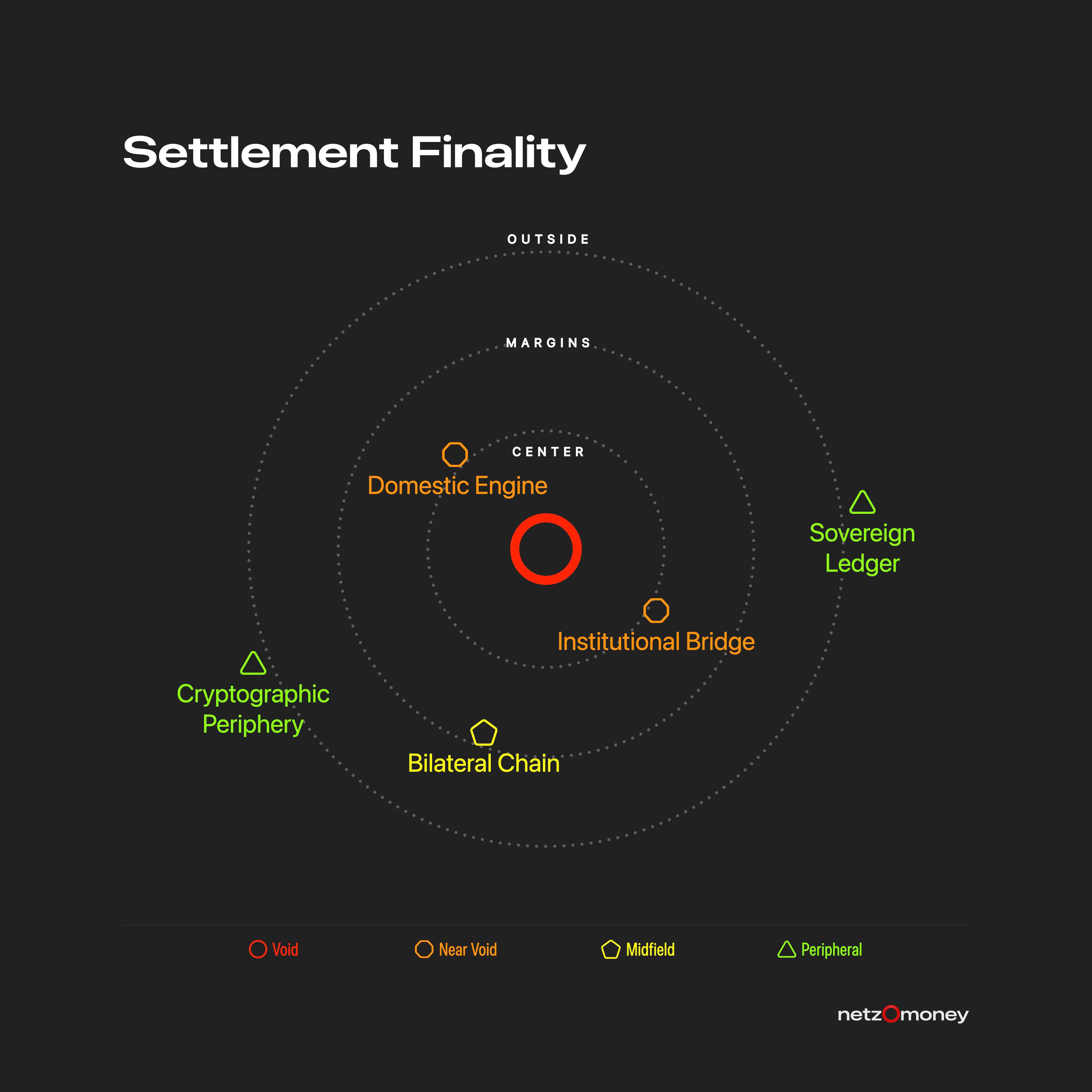
Series note: This report opens the nemo 3 series. The Settlement Infrastructure series — of which Settlement Finality is the opening report — maps the architectures competing to deliver final, legally protected, cross‑border value transfer. Its opening finding is structurally significant: no architecture currently occupies the Center of this domain. The functional ideal remains unfilled. The gap appears structural rather than technical. Insights of this kind are uncommon in technology analysis and often useful to decision‑makers.
In March 2020, cross‑border payments did not fail because systems broke. They stalled because trust was withdrawn faster than settlement could complete — and the architecture was stabilised not by any internal resilience mechanism, but by central bank announcements of expanded liquidity facilities. The trust on which settlement depends turned out to be conditional. The condition was central bank signalling, not bilateral relationship depth. That distinction — between what technical systems produce and what legal frameworks recognise — is the reason five architectures that all claim to produce finality occupy five different positions on the zone map.
What actually makes a settlement final — and which architectures currently qualify?
In 2026 three regulatory experiments are testing that question; none has yet satisfied the structural conditions that would constitute a definitive answer.
The EU DLT Pilot Regime is testing whether distributed‑ledger systems can be designated under existing settlement‑finality law without a centralised checkpoint. Its design shows that DLT projects are being required to engineer a centralised checkpoint, effectively importing the architecture the framework was intended to transcend.
The BIS wholesale CBDC programme has bifurcated. Project Agorá entered user testing in January 2026 with five reserve‑currency issuers. mBridge progressed to a Minimum Viable Product (MVP) in mid‑2024 and, after the BIS announced a handover, now operates under the stewardship of participating central banks rather than as a BIS‑run experiment. mBridge’s participant set includes China, Hong Kong, Thailand, the UAE and Saudi Arabia, and the platform has acquired clear geopolitical sensitivity as it moved from BIS coordination to partner governance.
The correspondent‑banking chain — the non‑institutional scaffolding that handles payment corridors no formal architecture covers — continues concentrating, and its trust substrate is thinning in ways that stress episodes reveal but do not themselves cause.
The domestic RTGS engines and CLS Continuous Linked Settlement are stable. They perform the functions that define the functional ideal without occupying it. The periphery is not converging on the core. The void at Center persists.
This analysis is written for readers with operational familiarity with settlement infrastructure, regulatory frameworks, or payment system design.
Consider a payment from New York to Frankfurt. The sending bank instructs its US correspondent, which passes the obligation along a chain of bilateral relationships until a German correspondent credits the receiving bank — each intermediate balance entry carrying no statutory finality protection until the final leg settles in T2,the Eurosystem’s RTGS and central liquidity management system. The same transaction routed through CLS settles both the USD and EUR legs simultaneously in central bank money, with neither party exposed to principal risk at any point. Same economic outcome. Structurally different finality. The five architectures mapped below are variations on this structural difference, at systemic scale.
The Domestic Engine is RTGS‑anchored domestic settlement — the real‑time gross settlement infrastructure operated by central banks that converts a payment instruction into an unconditional, irrevocable transfer of central bank money within a single jurisdiction.
The Bilateral Chain is Correspondent banking cross‑border settlement — the web of bilateral nostro and vostro relationships through which banks complete cross‑border payments by passing obligations along a chain until the final leg settles in domestic RTGS.
The Institutional Bridge is CLS Continuous Linked Settlement — the payment‑versus‑payment mechanism that simultaneously settles both legs of a foreign exchange transaction in central bank money, eliminating the temporal gap that creates Herstatt risk for eighteen currencies.
The Cryptographic Periphery is DLT‑based settlement — distributed ledger systems offering probabilistic or economic finality through consensus mechanisms, operating on commercial bank tokens or unregulated stablecoins, outside the legal safe‑harbour framework.
The Sovereign Ledger is Wholesale CBDC platforms — shared ledger infrastructure on which multiple central banks issue digital representations of their currencies and settlement occurs in direct central bank money across jurisdictions. mBridge has been operational in a narrow five‑jurisdiction corridor since mid‑2024, outside any settlement finality designation framework; Project Agorá entered user testing in January 2026.
The term “settlement finality” conceals a structural fracture. Finality requires two distinct achievements — and they do not travel together.
F1 — Technical irrevocability: the moment when a transfer entry can no longer be reversed by the system’s own operating rules. An RTGS engine produces this by posting a transaction to a participant’s account on the central bank ledger in real time, gross, per instruction. A DLT consensus mechanism produces it asymptotically, or in BFT‑class systems through a quorum vote. The technical layer can function on its own terms.
F2 — Legal insolvency protection: the moment when a court will refuse to unwind that transfer in bankruptcy proceedings. This requires something the technical layer cannot supply. A statute — the EU Settlement Finality Directive, Article 4A of the US Uniform Commercial Code, or their jurisdictional equivalents — must designate the settlement system and declare that transfers completed through it before a specified moment are immune from zero‑hour rules and clawback. Without this second act, technical finality is a fact on a screen that an insolvency administrator can erase.
F3 — Settlement asset quality: whether the asset in which settlement occurs is central bank money or commercial bank money carrying counterparty risk.
F4 — Cross‑border chain integrity: whether the mechanism closes a cross‑border transaction with legal finality protection across all legs, in all participating jurisdictions, at scale.
These four requirements sit on different infrastructure layers. They fail independently.
The asymmetry between F1 and F2 is not a gap waiting to close. It is structural and directional: technical finality is necessary but not decision‑relevant; legal finality is decision‑relevant but technically indifferent. Technical systems must adapt to legal doctrine to achieve designation. Legal doctrine does not adapt to technical architectures. The EU DLT Pilot Regime is the observable proof: it did not create a new finality category for DLT — it required DLT to produce a centralised checkpoint that satisfies existing doctrine. Regulators are normalising distributed systems into existing legal frameworks, not revising frameworks to accommodate distributed systems. That is the binding direction of travel, and it governs every zone assignment that follows.
Technical finality and legal finality are non‑commensurable: a transfer can be technically irrevocable without surviving insolvency, and legal protection cannot create technical completion where none exists. A phenomenon that performs F1 without F2 is not halfway to finality — it is performing a different function with different structural consequences.
Performance profiles:
RTGS‑anchored domestic settlement (RTGS) — F1: Full / F2: Full / F3: Full / F4: Absent
CLS Continuous Linked Settlement (CLS) — F1: Full / F2: Full / F3: Full / F4: Partial
Correspondent banking cross‑border settlement (Chain) — F1: Partial / F2: Partial / F3: Partial / F4: Partial
DLT‑based settlement (DLT) — F1: Partial / F2: Absent / F3: Partial / F4: Absent
Wholesale CBDC platforms (CBDC) — F1: Partial / F2: Absent / F3: Partial / F4: Absent
Center is where no phenomenon currently operates — no settlement architecture has assembled Full performance on all four requirements simultaneously at global scale. The void circle is real.
For legal readers: Center is the configuration in which every transfer is technically irrevocable, statutorily protected from insolvency unwind, settled in central bank money, and closed across all currency corridors with legal finality. No designated system achieves this. The gap is cross‑border chain integrity: the law that protects finality within a jurisdiction cannot be made to operate across jurisdictions without a multilateral designation structure that does not currently exist.
For technical readers: Center is the architecture whose settlement sequence produces a declarable moment of irrevocability that a court in every participating jurisdiction will enforce. The constraint is not computational — it is institutional. The finality moment must be declared by a designated operator whose authority is recognised by the relevant legal system. No distributed architecture has produced that declaration under live adversarial conditions.
Margins is where Correspondent banking cross‑border settlement operates — performing all four requirements partially, structurally necessary, and concentrating.
Outside is where DLT‑based settlement and Wholesale CBDC platforms operate — F2 Absent in both cases, for structurally distinct reasons.
The FindingType is Reconfiguration. The dominant core — RTGS and CLS — is stable and not being displaced. What is restructuring is the distribution of trust and institutional recognition around it: the correspondent chain is concentrating, the CBDC landscape has bifurcated, and the legal designation boundary is being actively policed through sandboxes and pilots that test rather than relax its constraints. Four analytical threads run through the Deep Dives:
How RTGS‑anchored domestic settlement performs three requirements at Full within its jurisdiction and is structurally incapable of the fourth — and why that incapacity is a design property, not a deficit
How Correspondent banking cross‑border settlement performs all four at Partial and is concentrating in ways that make its trust substrate structurally brittle under stress
How CLS Continuous Linked Settlement is the closest functioning approach to the functional ideal — and why its coverage boundary is structural, not temporary
How DLT‑based settlement and Wholesale CBDC platforms are excluded at Peripheral distance by the F2 gap, and how the specific pathway to that gap differs between them
Zone assignments:
RTGS — NearVoid
CLS — NearVoid, closest approach.
Chain — MidField.
DLT — Peripheral.
CBDC — Peripheral.
What follows is a constellation of five architectures placed by their distance from the unoccupied ideal. The map describes current configuration and direction of movement — not predictions, not rankings, not claims about which architecture ought to prevail.
The Domestic Engine — RTGS (F1–F3: Full; F4: Absent) — occupies the position nearest the functional ideal. Its single structural gap is F4: an RTGS system is jurisdictionally isolated by design. A payment from New York to Frankfurt passes through The Domestic Engine twice — once in each jurisdiction — with a temporal gap between those events that the engine itself cannot close. Net effect: performs domestic finality perfectly; structurally incapable of cross‑border closure. Its NearVoid distance is a property of its institutional design, not a performance deficit.
The Institutional Bridge — CLS (F1–F3: Full; F4: Partial) — is the closest functioning approach to the functional ideal. It eliminates settlement risk for eighteen currencies, covering approximately sixty percent of daily FX settlement obligations. The remaining forty percent falls outside CLS — not a technical limitation, but a coverage boundary fixed by membership criteria. Net effect: the architecture that most fully demonstrates the functional ideal is achievable; also the architecture whose existence makes the incompleteness of the global settlement fabric precisely visible.
The Bilateral Chain — Chain (F1–F4: all Partial) — occupies MidField. It performs all four requirements at Partial level and is structurally necessary — it handles the non‑CLS corridors that no institutional architecture covers. Its trust infrastructure is being restructured: active correspondent relationships have declined by roughly twenty‑five percent since 2011, with surviving relationships carrying higher volume. Switching costs — the loss of trade finance, custody, and FX relationships if a correspondent exits — create an appearance of depth that stress episodes reveal as brittle. It is not collapsing. It is concentrating, and concentrated fragility is a different structural condition than stable equilibrium. Net effect: performs cross‑border closure that no institutional architecture provides; fragility is masked by switching costs and revealed by stress.
The Cryptographic Periphery — DLT (F1: Partial; F2: Absent; F3: Partial; F4: Absent) — is structurally excluded at Peripheral distance. No jurisdiction currently recognises a DLT‑based settlement system as designated under settlement finality law; migration would require either a new legal category for non‑operator‑declared finality — which no jurisdiction is developing — or DLT systems that produce a centralised checkpoint, which removes the architectural rationale for their existence. Net effect: F2 Absent under current legal doctrine; F2 gap is a currently binding constraint, not an unresolved question.
The Sovereign Ledger — CBDC (F1: Partial; F2: Absent; F3: Partial; F4: Absent) — shares Peripheral distance but for structurally distinct reasons. It holds an F3 condition that private DLT cannot replicate — the settlement asset is central bank money — but its F2 gap is structurally larger: a multi‑CBDC platform requires simultaneous designation across all participating jurisdictions, plus resolution of which jurisdiction’s insolvency law governs a transaction settling in multiple CBDCs on a shared ledger distributed across legal orders. Post‑BIS withdrawal, no governance configuration exists that simultaneously includes reserve‑currency issuers whose legal systems would need to grant designation and the operational platform processing transactions. That is the binding constraint on F2. Net effect: superior trust asset condition versus DLT; harder F2 pathway; designation prerequisite currently unmet by construction.
The constellation describes a Reconfiguration. The dominant architectures are not being displaced. The periphery is structurally excluded by the F2 gap — a gap that neither technical maturation nor operational scale can close, because F2 is legally indifferent to both.
The void at Center persists. No architecture achieves Full F4 at global scale. The nearest approach covers eighteen currencies. No current development trajectory is closing the gap under conditions that exist at the analytical date.
What You’re Looking At: Central bank real‑time gross settlement systems — Fedwire, T2, and their equivalents — converting payment instructions into unconditional, irrevocable transfers in central bank money within a single jurisdiction. For legal readers: These are the designated systems whose F2 protection is provided by statute — the Settlement Finality Directive in the EU, UCC Article 4A and Federal Reserve Operating Circular No. 6 in the US. For technical readers: Centralised, continuously operating account ledgers with finality attaching at the moment of posting — a deterministic event declared by the central bank as system operator.
RTGS (F1–F3: Full; F4: Absent). The engine performs F1, F2, and F3 at Full level within its jurisdiction. Technical irrevocability is achieved by real‑time, gross settlement: each transaction is processed individually and immediately, with no netting and no batching, and the moment of posting is unambiguous. F2 protection is provided by statute, and the engine’s designation is a settled institutional fact in every major jurisdiction. F3 is central bank money. No architecture exceeds this performance profile for domestic settlement.
The F4 gap is jurisdictional isolation, not a technical deficiency. An RTGS engine cannot close a cross‑border transaction because it cannot operate accounts in another central bank’s ledger — not a technical constraint but a legal and institutional one. The central bank’s authority to issue money and operate settlement accounts ends at the national boundary. The engine that performs domestic finality perfectly is structurally incapable of performing cross‑border finality at all. The gap this creates is the precise structural condition that every other architecture on the map exists to address.
The settlement sequence captured by Settlement Sequencing is immediate and per‑transaction, producing a deterministic finality moment at a specific, identifiable point. This makes compliance verification tractable (Compliance Architecture) and concentrates operational fragility in the central bank’s own infrastructure (Fragility Concentration): a central bank operational event simultaneously incapacitates all dependent settlement systems. The Domestic Engine, by design, creates the dependency chain to which every other architecture is tethered.
The stigmergic trace to monitor is not about The Domestic Engine directly — the domestic engines are stable — but about whether the legal designation architecture that protects them will be extended or denied to the architectures pressing at its boundaries. That question is being answered in real time through the DLT Pilot Regime and the wholesale CBDC testing programmes.
Net effect: F1–F3 at Full within jurisdiction; F4 structurally absent by design. NearVoid.
Evidential Basis
Settlement Sequencing (shared with The Institutional Bridge, The Bilateral Chain, The Cryptographic Periphery, The Sovereign Ledger) BIS PFMI — Principle 8, settlement finality sequencing as structural requirement. ECB T2 specification — real‑time gross posting moment. Federal Reserve OC6 — Fedwire irrevocability rule.
Compliance Architecture (shared with The Institutional Bridge) EU Settlement Finality Directive — designation and compliance obligations. Federal Reserve Act and OC6 — legal basis for Fedwire F2 protection.
Fragility Concentration (shared with The Institutional Bridge) BIS CPMI — PFMI stress testing, concentration risk in central infrastructure. FSB — Continuity of Access to FMI Services (2023), concentration as systemic vulnerability.
What You’re Looking At: The web of correspondent banking relationships — nostro and vostro accounts, bilateral credit lines, and the trust judgments behind them — through which cross‑border payments are completed when no shared settlement infrastructure exists.
For legal readers: Each leg is a separate settlement event in a different jurisdiction subject to its own finality rules — the chain is only as legally sound as its weakest jurisdictional link.
For technical readers: A mesh network without a central operator; each link is a bilateral agreement with its own risk parameters; finality on any leg is contingent on finality on every subsequent leg.
Chain (F1–F4: all Partial). The Functional Performance Map registers Partial across all four requirements. F1 is achieved only when the final domestic RTGS leg settles — every intermediate balance entry is commercial bank money with no statutory F2 protection. F2 is jurisdictionally patchy: a correspondent in a jurisdiction with weak finality legislation introduces a legal gap that no downstream leg can close. F3 is commercial bank money until the last hop. F4 is Partial: the chain closes, but with a temporal gap between timezone‑separated settlement legs that exposes transactions to principal risk throughout.
The architecture of correspondent trust operates at four layers. The first is continuous counterparty credit assessment — balance sheet scrutiny, regulatory action tracking — updated intraday during stress. The second is uncommitted intraday credit limits: a correspondent bank can withdraw or reduce the credit line it extends to a downstream bank with zero notice and no contractual consequence. This is the critical structural feature — trust is never locked, and in crisis conditions the incentive to withdraw it is immediate and individual while the systemic cost is deferred and collective. The third is operational familiarity. The fourth is institutional anchoring: correspondent relationships bundle settlement with trade finance, custody, and FX pricing — exit is costly beyond the settlement channel, creating switching‑cost stickiness that is observationally similar to deep trust but structurally distinct from it.
The March 2020 episode is the canonical stress case. Intraday credit limits were withdrawn across corridors, settlement chains lengthened, and the architecture was stabilised not by internal resilience but by central bank announcements of expanded liquidity facilities. The trust infrastructure is conditional on central bank signalling. When that signalling is delayed, The Bilateral Chain’s four Partial ratings degrade simultaneously — they collapse together rather than independently.
Relational Substrate illuminates the thinning foundation. Active correspondent relationships have declined by roughly twenty‑five percent since 2011, concentrated in emerging‑market corridors. Surviving relationships carry higher volumes — concentration rather than depletion. Each relationship now carries more systemic weight; the withdrawal of a single major correspondent has larger cascade potential; the capacity to reroute around a failed link diminishes as the network shrinks. The switching‑cost stickiness masks this fragility — relationships persist not because trust is deep but because exit destroys value in adjacent services. That is also a Liquidity Provision problem: the liquidity sustaining the chain is private, uncommitted, and procyclical — least available precisely when most needed.
The stigmergic trace from the 2008 Lehman insolvency shaped this architecture in a specific way: it taught market participants that correspondent banks can fail, and that the legal status of in‑process transfers in a failing correspondent depends on the jurisdiction of the insolvency. That trace — deposited in risk models, credit manuals, and regulatory expectations — hardens the behaviour that makes the chain fragile under stress. Institutions withdraw credit precisely because they learned that the legal framework may not protect them if they do not, in ways consistent with post‑2008 credit manual revisions and regulatory expectations that now treat correspondent credit withdrawal as rational precautionary behaviour under generalised uncertainty.
The Bilateral Chain is bifurcating: in major currency corridors with deep correspondent pools, performance remains Partial but stable. In EM corridors with thin relationships, performance hovers near the contested boundary of exclusion. The Phase Transition Indicator to monitor is correspondent withdrawal from a critical corridor without replacement architecture — the condition whose absence currently keeps MidField assignment defensible.
Net effect: F1–F4 all Partial; structurally necessary for non‑CLS corridors; fragility masked by switching costs and revealed by stress. MidField.
Evidential Basis
Settlement Sequencing (shared with The Domestic Engine) BIS CPMI — correspondent banking survey data, payment chain sequencing.
Liquidity Provision FSB — Holistic Review of March 2020 Market Turmoil, intraday credit withdrawal mechanics. BIS CPMI — Correspondent Banking: Trends and Developments (2023), relationship concentration metrics.
Relational Substrate ⟷ Convention Stability (Enabling — shared with The Cryptographic Periphery, The Sovereign Ledger) BIS CGFS — Structural Changes in Banking After the Crisis (2018), switching‑cost stickiness. BIS — Trust Bridges and Money Flows (2023), fixed costs of correspondent link formation and concentration dynamics.
Convention Stability (shared with The Cryptographic Periphery, The Sovereign Ledger) BIS CPMI — correspondent banking decline data, non‑participant boundary analysis.
What You’re Looking At: CLS Bank International — the only global infrastructure that simultaneously settles both legs of a foreign exchange transaction in central bank money with legal finality protection. For legal readers: CLS is designated as a systemically important payment system in each of the jurisdictions whose currencies it settles — the only cross‑border settlement architecture that achieves multilateral F2 protection at systemic scale. For technical readers: The CLS settlement process links to each member central bank’s RTGS system, executing gross payments in each currency simultaneously so that no leg completes unless all legs complete.
CLS (F1–F3: Full; F4: Partial). CLS settles approximately $6.4 trillion per day across eighteen currencies — roughly sixty percent of daily global FX settlement obligations. The forty percent outside CLS is not a design failure but a boundary fixed by membership criteria: currencies must be freely convertible, supported by an RTGS system meeting CLS’s technical specifications, and backed by a central bank willing to provide settlement accounts and intraday liquidity in CLS‑compatible formats. These criteria are the structural preconditions for the PvP guarantee to hold.
The convergence of Settlement Sequencing, Compliance Architecture, and Liquidity Provision in a single institutional design is what places CLS at the nearest approach to the functional ideal. The settlement sequence is simultaneous PvP: both legs are submitted, netted multilaterally, and settled in central bank money during a scheduled window. If either leg fails, the entire transaction unwinds without either party losing principal. The legal finality architecture is multilayered: CLS is designated under the EU SFD for EUR, under Federal Reserve rules for USD, and under equivalent instruments for each of the other sixteen currencies. A single set of CLS rules satisfies eighteen separate national designation requirements — a governance achievement with no equivalent in any DLT or CBDC settlement architecture currently operating or in testing.
The F4 gap is a coverage boundary, not a performance deficit. The corridors CLS cannot reach are precisely the corridors where settlement risk is most concentrated — and those corridors sit outside CLS not because CLS has failed but because their currencies do not meet the membership criteria that make the PvP guarantee structurally possible.
The concentration of critical functions in a single design produces the structural property captured by Fragility Concentration: a CLS operational event simultaneously disrupts settlement for all eighteen currencies in its system. This is a known and managed risk, subject to PFMI stress testing, but it means The Institutional Bridge carries systemic fragility as the direct consequence of the centralisation that makes its performance possible.
The Phase Transition Indicator tracking EU‑UK equivalence for settlement systems carries latent relevance. CLS settles in both GBP and EUR; a breakdown of post‑Brexit equivalence recognition could create a situation where F2 protection is intact in one jurisdiction but contestable in the other. The indicator remains at Watching, with no near‑term trigger visible.
Net effect: F1–F3 at Full; F4 Partial by coverage boundary, not design deficit. NearVoid, closest approach.
The EU DLT Pilot Regime as Designation Test
The EU DLT Pilot Regime (Regulation 2022/858) functions in this analysis as a live test of whether legal doctrine can be extended to accommodate distributed finality — and as the clearest available evidence that it cannot without centralisation. The Pilot does not create a new legal category for probabilistic or quorum‑based finality. It requires DLT systems to define a moment of finality in their own rules and then seek designation under the existing SFD framework — the same framework that assumes a central operator declaring a deterministic event. A DLT system operating within the Pilot must, at the finality layer, engineer a centralised checkpoint. The Pilot is not accommodating DLT finality; it is accommodating DLT that behaves like a conventional system at the moment F2 is required. This is the observable proof that regulators are normalising distributed systems into existing doctrine, not adapting doctrine to distributed systems. The Pilot’s design is the finding, not its outcome.
Evidential Basis
Settlement Sequencing (shared with The Domestic Engine, The Bilateral Chain, The Cryptographic Periphery, The Sovereign Ledger) BIS CPMI — Settlement Risk in Foreign Exchange Transactions (2013), PvP sequencing and principal risk elimination. CLS Bank — settlement process documentation, member RTGS links.
Compliance Architecture (shared with The Domestic Engine) CLS Rulebook — designation documentation for member jurisdictions. ECB — CLS designation under SFD across eighteen currencies.
Liquidity Provision BIS — CLS liquidity architecture, central bank intraday credit dependence. Federal Reserve — CLS participant liquidity management.
Fragility Concentration (shared with The Domestic Engine) BIS CPMI — PFMI concentration risk in central settlement infrastructure. BIS CPMI — CLS systemic importance, correlated failure under operational stress.
What You’re Looking At: Distributed ledger settlement systems — private consortium platforms and public permissionless networks — that produce settlement finality through consensus mechanisms rather than through a declared operator rule. For legal readers: None of these systems hold settlement finality designation; their transfers are technically irrevocable within the ledger but legally voidable in insolvency. The gap is not regulatory lag — it is a currently binding constraint produced by the mismatch between what legal doctrine requires and what distributed architectures can produce without centralisation. For technical readers: BFT‑class systems do produce deterministic finality events through quorum agreement — this is a genuine technical achievement. The constraint is not technical: no jurisdiction currently recognises that declaration as satisfying the designated‑operator requirement that F2 demands.
DLT (F1: Partial; F2: Absent; F3: Partial; F4: Absent). The F2 gap is a currently binding constraint, not an unresolved question. No jurisdiction currently recognises a DLT‑based settlement system as designated under settlement finality law. Migration would require either a new legal category for non‑operator‑declared finality — which no jurisdiction is developing — or DLT systems that produce a centralised checkpoint, which removes the architectural rationale for their existence. The EU DLT Pilot Regime — the most advanced regulatory attempt to close this gap — confirms the constraint rather than resolving it, as documented in the scoped jurisdiction note above.
The architectural source of the constraint is captured by Verification Architecture. In an RTGS system, F2 is grounded in observing the account balance after the posting moment — a deterministic proof requiring only trust in the central bank’s record‑keeping integrity. In a BFT‑class DLT, finality is declared through quorum agreement — a proof that depends on the assumption that fewer than one‑third of validators are malicious. The constraint is not that this proof is weak. The constraint is that it is not the proof that legal doctrine requires: a declaration by a designated operator at a legally recognised system boundary. No jurisdiction has created a legal category that treats quorum agreement as equivalent to operator declaration. No jurisdiction is developing one.
Convention Stability, in enabling coupling with Relational Substrate, illuminates why this constraint is structural rather than transitional. The norm that “settlement is final” is a collective agreement held by banks, central banks, courts, and market participants. It extends reliably to actors who share the institutional history, regulatory framework, and repeated interaction that produced it. It cannot be constituted at all where relational substrate among participants is absent — anonymous validators and distributed node operators who were not party to the norm’s formation are outside its reach. This is not a maturity problem. It is the non‑participant boundary failure mode: the norm cannot form where the substrate that produces it is structurally absent.
The stigmergic trace from the 2017 BIS CPMI report on DLT has proven self‑reinforcing. It framed DLT as a finality problem, and every subsequent regulatory examination has approached DLT through that lens and found the same constraint. The EU DLT Pilot Regime’s design is the latest confirmation: the trace has created a regulatory expectation that DLT must satisfy existing doctrine before it can migrate, and every attempt to do so without centralisation at the finality layer has confirmed the incompatibility.
Net effect: F2 Absent under current legal doctrine; F1 Partial; F3 and F4 Absent. F2 gap is a currently binding constraint. Peripheral.
Evidential Basis
Settlement Sequencing (shared with The Domestic Engine, The Institutional Bridge, The Bilateral Chain, The Sovereign Ledger) BIS CPMI — DLT in Payment, Clearing and Settlement (2017), probabilistic versus deterministic sequencing. ESMA — DLT Pilot Regime guidance, finality checkpoint requirements.
Verification Architecture (shared with The Sovereign Ledger) BIS BCBS — Novel Risks of Permissionless DLT (2024), probabilistic settlement and legal uncertainty. ECB — DLT for Central Bank Money Settlement (2024), BFT consensus and the designated‑operator gap in European law.
Convention Stability ⟷ Relational Substrate (Enabling — shared with The Bilateral Chain, The Sovereign Ledger)BIS CPMI — DLT finality framing as regulatory expectation, non‑participant boundary. BIS — mBridge and Project Dunbar technical reports, legal gap at the convention boundary.
Regulatory Inscription (shared with The Sovereign Ledger) EU Regulation 2022/858 — DLT Pilot Regime, designation requirements and centralised checkpoint condition. ESMA — SFD framework applicability to DLT systems.
What You’re Looking At: Wholesale central bank digital currency platforms — mBridge, Project Agorá, and their conceptual successors — on which multiple central banks issue digital representations of their currencies on a shared ledger, and cross‑border settlement occurs through direct transfer of CBDC tokens. For legal readers: No platform in this category holds settlement finality designation in any participating jurisdiction; the F2 gap is structurally larger than for single‑jurisdiction DLT because simultaneous multi‑jurisdiction designation is required and the governance configuration that would make it possible does not currently exist. For technical readers: These platforms use consortium DLT architectures with permissioned validator sets and BFT‑class consensus designed to produce deterministic finality within the ledger — but deterministic finality within an undesignated ledger remains legally voidable outside it.
CBDC (F1: Partial; F2: Absent; F3: Partial; F4: Absent). The Sovereign Ledger occupies a structurally distinct position from The Cryptographic Periphery despite sharing Peripheral distance. It holds an F3 condition that private DLT cannot replicate — the settlement asset is central bank money, if the platform’s CBDC tokens are authorised as direct central bank liabilities. This is real and analytically load‑bearing. But it does not resolve the F2 gap, and the F2 pathway has become harder since the initial mapping.
The F2 gap for The Sovereign Ledger is structurally larger than for The Cryptographic Periphery. A single‑jurisdiction DLT settlement system requires designation from one authority. A multi‑CBDC platform requires simultaneous designation across all participating jurisdictions — and must also resolve which jurisdiction’s insolvency law governs a transaction settling in multiple CBDCs on a shared ledger whose nodes are distributed across legal orders. This is the Polycentric Plurality problem in its most concentrated form: multiple centres of legal authority with no hierarchical resolution mechanism. A platform governance document can specify a choice of law, but that choice binds only the operating rules — it does not bind insolvency courts in jurisdictions that have not recognised the platform as a designated system. Regulatory Inscription names the structural act that is missing: the entry of a multi‑CBDC platform into the settlement finality ledger of any participating jurisdiction, let alone all of them simultaneously.
mBridge reached MVP status in June 2024 and has been operational in a narrow five‑jurisdiction corridor since, processing cumulative transaction volume exceeding $55 billion by late 2025, with one currency accounting for approximately ninety‑five percent of settlement volume. Volume on an undesignated platform is evidence of technical function, not legal finality. A transaction settled on mBridge is irrevocable within the ledger and legally voidable outside it. The volume figure is evidence of F1 performance, not F2 performance.
In October 2024, the BIS withdrew from mBridge. The structural consequence — whatever the stated rationale — is the binding constraint: post‑withdrawal, no governance configuration exists that simultaneously includes reserve‑currency issuers whose legal systems would need to grant designation and the operational platform processing transactions. That is the F2 prerequisite that is currently unmet by construction. The BIS simultaneously stated that “mBridge is not the BRICS Bridge” and that BIS systems cannot be used by sanctioned countries. Some observers have interpreted the withdrawal as reflecting concerns about the platform’s geopolitical alignment; the BIS has contested that interpretation. The analytical object here is not the interpretation — it is the governance configuration that resulted, and its consequence for F2.
The BIS has since redirected its wholesale CBDC work toward Project Agorá — seven central banks including five reserve‑currency issuers, over 40 private financial institutions — designed to operate within existing legal frameworks. Agorá entered user testing in January 2026, described by BIS Deputy General Manager Andréa Maechler as “a major milestone”; a six‑month testing window precedes any formal launch decision, with the first‑phase report expected in the first half of 2026. The two projects represent a structural bifurcation: mBridge operational but missing the governance configuration that F2 requires; Agorá institutionally credible but not yet designated. Testing is not designation.
The trust substrate condition for Wholesale CBDC platforms is Contested. No jurisdiction has designated a multi‑CBDC platform. The reserve‑currency issuers whose legal systems would need to grant designation are not participating in the governance of the operational platform. The institutionally credible alternative is in user testing. Neither project has produced a positive result on the legal recognition question. Both are structurally capable of doing so. The conditions are not being met.
The stigmergic trace deposited by the BIS withdrawal has overwritten the earlier trace left by mBridge’s technical completion. Where MVP status had increased pressure on legal frameworks to accommodate multi‑CBDC settlement, the withdrawal shifted the institutional signal. The operational platform continues expanding — but without the governance participation that makes legal accommodation politically available in the jurisdictions that matter most for global settlement.
Net effect: F3 superior to private DLT; F2 Absent with harder pathway than single‑jurisdiction DLT; governance configuration prerequisite for F2 currently unmet by construction. Peripheral.
Evidential Basis
Settlement Sequencing (shared with The Domestic Engine, The Institutional Bridge, The Bilateral Chain, The Cryptographic Periphery) BIS Innovation Hub — mBridge project documentation, shared‑ledger sequencing. BIS — Project Dunbar technical specification, BFT consensus finality approach.
Verification Architecture (shared with The Cryptographic Periphery) BIS — mBridge and Dunbar verification architecture, quorum‑based proof and consensus failure modelling. ECB — wholesale CBDC exploratory work, verification gap in multi‑jurisdiction legal context.
Polycentric Plurality BIS — cross‑border CBDC legal working group reports, multi‑jurisdiction designation and insolvency law conflicts. IMF — Legal Aspects of Central Bank Digital Currency (2022), absence of hierarchical resolution mechanism.
Regulatory Inscription (shared with The Cryptographic Periphery) BIS — Project mBridge legal framework, designation gap documentation. BIS — Project Dunbar legal assessment, insolvency law conflicts across jurisdictions.
Settlement finality is not a technical property that legal frameworks recognise — it is a legal and social achievement that technical systems must be configured to enable.
This cartography reveals a system in Reconfiguration. The dominant architectures — RTGS-anchored domestic settlement and CLS Continuous Linked Settlement — remain structurally central. They perform most of the functions required for the functional ideal without fully reaching it. The correspondent banking chain, which continues to carry the payment corridors no institutional architecture covers, is concentrating into fewer relationships with greater systemic weight.
The periphery is excluded for a different reason. DLT-based settlement systems and wholesale CBDC platforms are not blocked primarily by technical immaturity. They are blocked by the F2 gap: the absence of recognised legal insolvency protection across jurisdictions. Operational scale does not resolve this condition. Technical sophistication does not resolve it. Legal finality is institutionally granted, not computationally discovered.
Across all five architectures, the shared problem is settlement sequencing — the production of a moment after which a transfer is treated as irrevocable. RTGS systems, CLS, and correspondent banking chains all ultimately rely on legally recognised operators declaring that moment within an established jurisdictional framework. DLT and CBDC architectures attempt to produce the same outcome through consensus mechanisms and shared ledgers. But no jurisdiction has yet created a legal category that treats distributed consensus as equivalent to designated institutional declaration.
The infrastructure is the constant. The governance objective varies.
The 2026 decision window is now active. Project Agorá is testing whether a reserve-currency consortium can construct a wholesale settlement platform that remains compatible with existing legal doctrine. The EU DLT Pilot Regime continues testing whether distributed systems can obtain finality designation without reintroducing centralised checkpoints. mBridge continues expanding operationally while remaining outside the governance configuration required for multilateral legal recognition.
None of these experiments has yet resolved the underlying question.
The void at Center therefore persists. No architecture currently achieves legally protected cross-border finality at global scale across all major jurisdictions simultaneously. The nearest functioning approximation remains CLS — an architecture whose coverage boundary reveals, rather than solves, the fragmentation of the global settlement fabric.
The unresolved problem is no longer how to move value across borders.
It is how to produce a form of finality that multiple sovereign legal orders will recognise at the same time.
By what architecture does any settlement mechanism claim recognised F2 protection across jurisdictions that share no common legal order — and what is the governance configuration that makes that claim legally operative rather than merely asserted?
The three phenomena at Peripheral and MidField distance collectively reveal a consistent structural pattern: every architecture that extends settlement capacity beyond a single jurisdiction encounters the same boundary — the point where the legal order that could grant F2 protection ends, and the next one begins. The Bilateral Chain navigates that boundary through bilateral trust. CLS navigates it through multilateral designation. DLT and CBDC have not yet navigated it at all.
The successor analysis must examine what architecture — if any — can assemble the multilateral designation structure that the functional ideal requires, and whether the current bifurcation between institutionally credible and operationally active CBDC development tracks is closing or deepening.
If the legal fragmentation of the global settlement fabric continues to widen, at what point does it become the binding constraint on cross‑border payment system development — and what governance architecture would be required to address it?
Bridge: This nemo 3 cartography maps settlement finality using a Functional Performance Map derived from the SCP pre‑analysis and confirmatory deep research. The analysis applies the NonarySet — nine lenses drawn from five perspectives — not to classify systems but to identify which constraints are mutable (technical, operational) and which are binding (legal designation, institutional recognition). For example: DLT is blocked at Regulatory Inscription — the structural act of designation that no jurisdiction has performed. CBDC is blocked at Polycentric Plurality — the absence of a hierarchical resolution mechanism across the legal orders that would need to designate simultaneously. Genre:Structural cartography — not policy advice, market forecast, or legal opinion.
Contested status: Twenty references are used. Contested status is warranted by two independently load‑bearing empirical fragilities: the mBridge trust substrate characterisation (the BIS describes its exit as a “graduation” signalling maturity; the structural consequence for designation feasibility is contested by platform participants) and the DLT finality legal incompatibility claim (contested by proponents of the EU DLT Pilot Regime who argue a designated checkpoint satisfies the legal requirement without defeating the architectural rationale).
Epistemic Boundary: The framework evaluates observable structural signals — institutional, capital, regulatory, and operational — to assign zones and migration conditions. It does not infer desirability or normative superiority of any configuration. Each lens was evaluated independently against observable indicators before aggregation. The framework recognises that technical architecture cannot substitute for social coordination infrastructure; where trust substrate is absent or contested, the protocol records a structural gap, not a temporary implementation problem. The systemic‑risk‑regulator vantage — which makes institutional designation architecture and the stress behaviour of trust infrastructure visible — may underweight participant‑level exit costs and innovation pathway friction from outside the reserve‑currency consensus. Perspective‑invariant findings carry stronger epistemic weight than findings dependent on this specific NonarySet.
Zone assignments: RTGS‑anchored domestic settlement — NearVoid. CLS Continuous Linked Settlement — NearVoid, closest approach. Correspondent banking cross‑border settlement — MidField. DLT‑based settlement — Peripheral. Wholesale CBDC platforms — Peripheral.
Transitions:
T1: DLT‑based settlement, Outside → Margins. Trigger: legal designation of a DLT system under a finality doctrine that does not require a centralised operator declaration. Probability: VeryLow (no jurisdiction proposes the required legal category; the EU DLT Pilot Regime imports centralised checkpoint requirements that remove the architectural rationale for DLT at the finality layer — this is the observed direction of regulatory travel).
T2: Wholesale CBDC platforms, Outside → Margins. Trigger: simultaneous settlement finality designation across all participating jurisdictions, plus resolution of the multi‑jurisdiction insolvency hierarchy — contingent on a governance configuration that includes reserve‑currency issuers in the operational platform. Probability: VeryLow (that configuration does not currently exist; Project Agorá in user testing since January 2026 — testing is not designation).
T3: Correspondent banking cross‑border settlement, MidField → contested boundary. Trigger: withdrawal of a major correspondent from a critical EM corridor without replacement architecture. Probability: Low (concentration ongoing; no single withdrawal has yet been corridor‑terminal; the structural precondition exists in at least three thin corridors — absence of a trigger is a current condition, not a structural guarantee).
NonarySet:
Settlement Sequencing (FINANCIAL CYCLES — shared across all five phenomena),
Liquidity Provision (FINANCIAL CYCLES — The Domestic Engine, The Bilateral Chain, The Institutional Bridge),
Polycentric Plurality (COMPETING POWERS — The Bilateral Chain, The Cryptographic Periphery, The Sovereign Ledger, The Institutional Bridge),
Compliance Architecture (COMPETING POWERS — The Domestic Engine, The Institutional Bridge),
Convention Stability (MUTUAL AUTONOMY — The Cryptographic Periphery, The Sovereign Ledger, The Bilateral Chain),
Relational Substrate (MUTUAL AUTONOMY — The Bilateral Chain),
Fragility Concentration (TECHNICAL ARCHITECTONICS — The Domestic Engine, The Bilateral Chain, The Institutional Bridge),
Verification Architecture (TECHNICAL ARCHITECTONICS — The Cryptographic Periphery, The Sovereign Ledger),
Regulatory Inscription (LEDGERED VALUES — The Cryptographic Periphery, The Sovereign Ledger, The Domestic Engine, The Institutional Bridge).
Coupled lenses:
Relational Substrate ⟷ Convention Stability (Enabling) — relational substrate is the structural precondition for convention stability; removing either lens breaks the causal explanation of why DLT‑based settlement and wholesale CBDC platforms cannot migrate through technical means or operational scale alone.
No other couplings.
FindingType:
Reconfiguration — dominant core persists while social substrate restructures; genuine void on global cross‑border chain integrity. FunctionalPerformanceMap pattern: four non‑commensurable requirements; no phenomenon achieves Full on F4.
Zone migration: Migration is a zone‑assignment change.
Outside → Margins requires legal designation.
Margins → Center requires Full performance on F1–F3 with global F4.
Growth within a zone is not migration.
Operational scale on an undesignated platform does not constitute migration. Coexisting Trajectories Rule applies.
Method: Structured pre‑analysis (38 objects, 53 relationships) plus deep research on legal recognition gaps, correspondent trust architecture, CLS coverage, CBDC design, and social substrate stress. FunctionalPerformanceMap constructed before phenomenon definition. Nine lenses from five perspectives.
Phenomena: five architectures.
Geographic scope: global, USD/EUR/GBP core.
Tier‑2 reference: nemo 3
Key metrics:
Distance (ordinal)
AtVoid (functional ideal occupied)
NearVoid (near‑full performance, one structural gap remaining)
MidField (partial performance, contested)
Peripheral (structurally excluded; one or more functional requirements Absent)
Unreachable (no plausible migration path under current conditions)
ProbabilityRange (ordinal)
VeryLow
Low
Moderate
High
VeryHigh
Each declared transition carries a parenthetical gloss naming at least one prerequisite met and one genuine obstacle remaining, as above.
References are grouped by analytical lens to show evidential logic. Lens names match the NonarySet exactly.
📝 Committee on Payment and Market Infrastructures — Principles for Financial Market Infrastructures, BIS (2012)
🔗 bis — pfmi Public 2012‑04‑16
🕯️ Principle 8 defines settlement finality sequencing as a structural requirement for systemically important FMIs; establishes the RTGS deterministic sequencing baseline — the declared‑operator model against which DLT and CBDC finality mechanisms are evaluated in the F2 analysis.
📝 Bank for International Settlements — Settlement Risk in Foreign Exchange Transactions, CPMI (2013 update)
🔗 bis — fx settlement risk Public 2013‑02‑15
🕯️ Documents CLS PvP settlement sequencing as the institutional architecture eliminating principal risk for covered currencies, and the temporal gap in bilateral settlement persisting for non‑CLS corridors — grounding CLS’s F4 Partial and the Chain’s F4 Partial assignments.
📝 Federal Reserve — Fedwire Funds Service: Operating Circular No. 6, Federal Reserve Financial Services (2022)
🔗 frbservices — oc6 Public 2022‑01‑01
🕯️ Specifies the precise moment of irrevocability for Fedwire RTGS settlement — the posting moment — establishing the deterministic, operator‑declared sequencing architecture that grounds the F1/F2 asymmetry: F2 attaches at a declared moment, not a converging probability.
📝 Financial Stability Board — Targets for Addressing the Four Challenges of Cross-Border Payments: Progress Report, FSB (2024)
🔗 fsb — cross‑border progress Public 2024‑10‑10
🕯️ Most recent authoritative assessment confirming that no DLT or CBDC architecture has closed the legal recognition gap despite technical maturation — primary external source grounding the void center finding and the F2 Absent assignments for DLT and CBDC.
📝 Financial Stability Board — Holistic Review of the March Market Turmoil, FSB (2020)
🔗 fsb — march 2020 reviewPublic 2020‑11‑17
🕯️ Evidences the correspondent bank liquidity withdrawal mechanism during March 2020 stress — intraday credit limits revoked unconditionally, settlement chains lengthened — grounding the Chain’s F1 degradation under stress and the conditional nature of its trust infrastructure.
📝 Bank for International Settlements — Correspondent Banking: Trends and Developments, BIS CPMI (2023)
🔗 bis — correspondent banking trends Public 2023‑06‑20
🕯️ Quantifies the 25% decline in active correspondent relationships globally since 2011, evidencing the concentration dynamic that increases systemic weight per surviving relationship and supports the Chain’s bifurcating trajectory toward the MidField contested boundary.
📝 European Central Bank — Settlement Finality Directive: Implementation and Practice, ECB (various)
🔗 ecb — sfd Public Accessed 2026‑05‑01
🕯️ Documents the legal designation framework protecting RTGS and CLS F2 within the EU, and reveals the jurisdictional boundary — SFD protection is domestic to the EU legal order — that Polycentric Plurality names as the cross‑border fragmentation mechanism keeping multi‑CBDC platforms at Peripheral distance.
📝 International Monetary Fund — Legal Aspects of Central Bank Digital Currency: Central Bank and Monetary Law Considerations, IMF (2022)
🔗 imf — cbdc legal Public 2022‑02‑11
🕯️ Analyses the multi‑jurisdiction legal coordination problem for CBDC platforms; the absence of a hierarchical resolution mechanism across legal orders is the Polycentric Plurality condition that keeps CBDC at Peripheral distance regardless of operational transaction volume.
📝 European Union — Directive 98/26/EC on Settlement Finality in Payment and Securities Settlement Systems, EUR‑Lex (consolidated 2019)
🔗 eur‑lex — 98/26/ec Public 2019‑06‑27
🕯️ Primary legal instrument designating settlement systems and granting insolvency safe‑harbour; evidences the Compliance Architecture keeping RTGS and CLS at NearVoid on F2, and identifies the designation threshold that DLT and CBDC have not crossed.
📝 CLS Bank International — CLS System Rules, CLS Group (2023) Self‑Reported
🔗 cls — rules Public 2023‑01‑01
🕯️ Documents how a single set of CLS operating rules satisfies eighteen separate national designation requirements — the Compliance Architecture achievement that makes CLS uniquely capable of simultaneous multi‑currency F2 protection with no equivalent in DLT or CBDC architecture.
📝 Bank for International Settlements — Distributed Ledger Technology in Payment, Clearing and Settlement, BIS CPMI (2017)
🔗 bis — dlt finality Public 2017‑02‑27
🕯️ Formalised the probabilistic‑versus‑deterministic finality distinction and deposited the stigmergic trace framing DLT as a legal recognition problem; the trace hardened the convention that F2 requires a designated operator declaration, shaping all subsequent regulatory examinations including the EU DLT Pilot Regime design.
📝 Committee on Payments and Market Infrastructures and IOSCO — Application of the Principles for Financial Market Infrastructures to Stablecoin Arrangements, BIS CPMI Papers No. 198 (2021)
🔗 bis — pfmi stablecoin Public 2021‑10‑06🕯️ Demonstrates that the settlement finality convention embedded in the PFMI cannot be automatically extended to architectures lacking the institutional features of designated FMIs — directly supporting the Convention Stability non‑participant boundary claim for DLT and CBDC.
📝 Bank for International Settlements — Structural Changes in Banking After the Crisis, BIS CGFS Papers (2018)
🔗 bis — structural changes Public 2018‑01‑22
🕯️ Evidences the switching‑cost stickiness masking Relational Substrate thinness in correspondent banking — relationships persist because exit destroys adjacent service value, producing an appearance of depth that stress episodes reveal as brittle concentration.
📝 Bank for International Settlements — Trust Bridges and Money Flows, BIS Working Papers No. 1112 (2023)
🔗 bis — trust bridges money flows Public 2023‑07‑25
🕯️ Demonstrates that fixed costs of building correspondent links foster an expensive and concentrated network — directly supporting the Relational Substrate thinning claim and the systemic weight increase per surviving relationship in The Bilateral Chain.
📝 Committee on Payment and Market Infrastructures — Resilience and Recovery of Financial Market Infrastructures, BIS CPMI (2017)
🔗 bis — fmi resilience Public 2017‑07‑12
🕯️ Specifies the concentration risk framework for central settlement infrastructure; the finding that a central bank operational event simultaneously incapacitates all dependent settlement systems applies to both RTGS and CLS and is derived from these stress testing scenarios.
📝 Financial Stability Board — Continuity of Access to Financial Market Infrastructure Services for Firms in Resolution, FSB (2023) 🔗 fsb — fmi access continuity Public 2023‑07‑27
🕯️ Maps dependency chains between financial institutions and FMIs during resolution; identifies concentration of critical FMI services among a small number of providers as a systemic vulnerability — supporting Fragility Concentration for centralised settlement infrastructure.
📝 Basel Committee on Banking Supervision — Novel Risks, Mitigants and Uncertainties with Permissionless Distributed Ledger Technologies, BIS BCBS Working Paper (2024)
🔗 bis — bcbs dlt risks Public 2024‑08‑28
🕯️ Identifies settlement finality as a key risk for banks using permissionless DLTs; confirms that probabilistic settlement with no guarantee of finality creates legal uncertainty — grounding the Verification Architecture gap between what DLT can demonstrate and what legal designation requires.
📝 European Central Bank — DLT for Central Bank Money Settlement: Findings and Implications, ECB Occasional Paper (2024)
🔗 ecb — dlt cbdc settlement Public 2024‑03‑20
🕯️ Confirms that even BFT‑class DLT consensus mechanisms cannot satisfy SFD designation requirements without a centralised operator checkpoint — the specific legal‑institutional verification gap in European law that applies to both DLT and CBDC platforms.
📝 European Union — Regulation (EU) 2022/858 on a Pilot Regime for Market Infrastructures Based on DLT, EUR‑Lex (2022)
🔗 eur‑lex — dlt pilot Public 2022‑06‑02
🕯️ The EU’s most advanced Regulatory Inscription attempt for DLT settlement; its design is the observable proof that regulators are normalising DLT into existing doctrine rather than adapting doctrine — the Pilot imports centralised checkpoint requirements that remove the architectural rationale for DLT at the finality layer.
📝 Bank for International Settlements — Project mBridge: Legal and Governance Framework Assessment, BIS Innovation Hub (2024)
🔗 bis — mbridge legal Public 2024‑10‑31
🕯️ Documents the multi‑jurisdiction Regulatory Inscription gap for multi‑CBDC platforms; no participating jurisdiction has designated the platform for settlement finality — evidencing the Sovereign Ledger’s F2 Absent performance regardless of cumulative operational transaction volume, and the governance configuration gap that is the binding F2 prerequisite.
Comments
Nothing yet. Say the first thing.
Sign in to join the conversation.