
US equity indices opened lower Thursday giving back all of Wednesday’s gains as Treasury yields rebounded following their losses Wednesday, which came after the US Treasury announced an increase in its buybacks of longer maturity bonds as discussed in yesterday’s update. Traders also apprehensively awaited trade restrictions to be levied at Iranian trading partners presumably including China as discussed this morning.
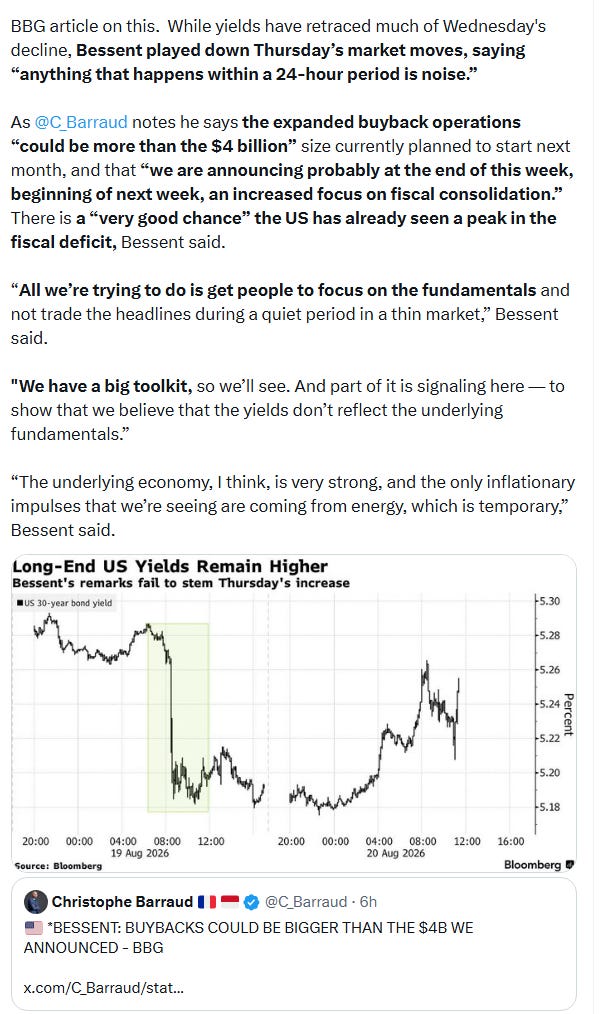
The rebound in yields was cooled only slightly after Treasury Secretary Scott Bessent told CNBC on Thursday that the accelerated buyback of government debt could be higher than the announced $4 billion, and the White House would be “announcing probably at the end of this week, beginning of next week, an increased focus on fiscal consolidation.” There is a “very good chance” the US has already seen “peak deficits,” Bessent said.
Oil added another macro headwind as tensions with Iran remained high. As discussed in the morning update President Trump threatened “Economic Warfare and Isolation on an unprecedented scale” in an overnight social media post, while Bessent said the US would lay out additional sanctions and isolation measures Monday. WTI rose nearly 3%.
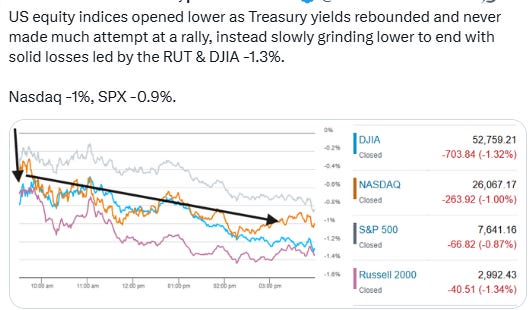
Equity indices never made much of an attempt at a rally, instead grinding steadily lower throughout the session. At day’s end, the Russell 2000 and Dow Jones Industrial Average led declines at -1.3%, while the Nasdaq Composite fell 1.0% and the S&P 500 lost 0.9%.
Breadth deteriorated sharply. Just two S&P 500 sectors finished higher, Energy and Real Estate, and neither gained more than 0.4%. The other nine sectors declined, with five down roughly 1% or more.
Retail was a major drag, with Walmart sinking the most since May 2022 after disappointing sales, while Advance Auto Parts plunged after earnings and weakness spread across other consumer and auto-parts names. Higher rates and oil also weighed on homebuilders, cruise lines, apparel, airlines, and defense stocks (more details in subscriber section).
Technology held up better than the broader market, with the sector down just -0.4%, while the PHLX Semiconductor Index gained +0.5% after two sharp down sessions. That semiconductor resilience, along with strength in crypto-linked stocks as bitcoin topped $72,000, provided a few pockets of support, not enough though to offset broader selling.
Attention turns to Friday’s options expiration which will keep some traders around but otherwise should be a light day with just flash PMIs on the US macro calendar.
US equities:
“People are waiting for either new information or the market signaling something,” Secker said. “When you see the Korean market going up 5% and then down 5% the next day, particularly for the hedge fund community that level of volatility is not encouraging confidence.”
“The announcement from Treasury Secretary Bessent yesterday seems to be creating less confidence in investors’ minds, not more confidence,” said Matt Maley at Miller Tabak. “This is not great given that we’re heading into a seasonal period that is frequently rough for the markets.”
Bonds:
Michael Schumacher, former head of macro at Wells Fargo, doesn’t think bond market respite will last. “I’m still negative. I think long-term rates go up for a few reasons. In the U.S. case in particular, there’s just a huge budget deficit. Not much sign that’s going to improve. On top of that, you’ve got defense spending going up,” he told CNBC in an interview. “I think that was the case really before the conflict in Iran, and that’s intensified.”
“It’s going to be a circuit breaker for this long-end selloff globally,” said Andrew Lilley, chief rates strategist at Barrenjoey Markets Pty in Sydney. But “it’s not enough on its own to stop the yield rise.”
There’s a “synchronicity of forces arguing for higher yields, steeper yield curves” with the largest developed markets all facing fiscal pressures and stubborn inflation, said Andrew Canobi, a director of fixed income at Franklin Templeton. “I can’t see the longer end finding too much of a bid as long as those forces are prevailing.”
“If there’s a structural reason why bond yields are drifting higher, a bit of short-term intervention buys you a little bit of time, but doesn’t necessarily change the longer-term trajectory,” said Graham Secker, equity strategy head at Pictet Wealth Management.
“Fed Chairman Warsh has argued that rising long yields have been doing some of the Fed’s tightening for it. If the Treasury now suppresses those yields and loosens financial conditions, the Fed may have to compensate through higher policy rates. If they don’t, doubts over inflation fighting credibility may push up long-end yields anyway.” — Skylar Montgomery Koning, macro strategist.
The Treasury intervention showed policymakers are uncomfortable with the pace of the rise in yields, but it does not fundamentally alter the outlook for rates, according to Ulrike Hoffmann-Burchardi at UBS Chief Investment Office. “Our base case remains that the Fed is unlikely to raise rates this year if inflation continues to moderate, although policymakers have retained the option to tighten should price pressures prove more persistent than expected,” she added.
The 10-year Treasury yield is “right on the cusp” of breaking out of its trading range, which appears to be worrying investors in the U.S. stock market, said Adam Turnquist, chief technical strategist for LPL Financial, in a phone interview Thursday. There’s a risk that selling pressure in Treasurys could “spill over” into the stock market amid worries over rising borrowing costs for the U.S. government, companies and consumers, according to Turnquist. A higher 10-year Treasury yield also hurts stock valuations, he said.
A deeper look at Thursday’s stock and sector breakdown, including the poor sector breadth and widespread pressures outside of the AI trade.s
A closer look at earnings-related reactions from Walmart, Advance Auto Parts, Deere, and Nordson, and notable midday movers from CNBC and BBG.
Updated technical charts across the SPX, Nasdaq, Russell 2000, and equal-weighted SPX, including MACD sell signals and Frank Cappelleri on their recent track record.
A review of market breadth and participation, including the drop in large SPX winners and the latest heatmap.
A look at the rates and Fed backdrop, including the rebound in Treasury yields, Mary Daly’s comments, ING on the Fed minutes, long-end Treasury positioning, Treasury buyback/fiscal questions, and the broader competition-for-capital theme.
A look at volatility and market structure, including VIX, VVIX, and 1-day VIX.
A review of cross-asset trends, including WTI crude, the dollar, gold and gold miners, copper, natural gas, and bitcoin.
A look at current macro and sentiment posts, including AI spending trends, the Architecture Billings Index, and AAII investor sentiment.
A wrap-up on the faded Treasury-yield relief rally, broad risk-asset weakness, AI-trade resilience, thin volumes, and the setup into options expiration.
A look ahead to Friday’s calendar, including US economic data, Fed speakers, Treasury auctions, SPX earnings, and ex-US highlights.
Comments
Nothing yet. Say the first thing.
Sign in to join the conversation.