
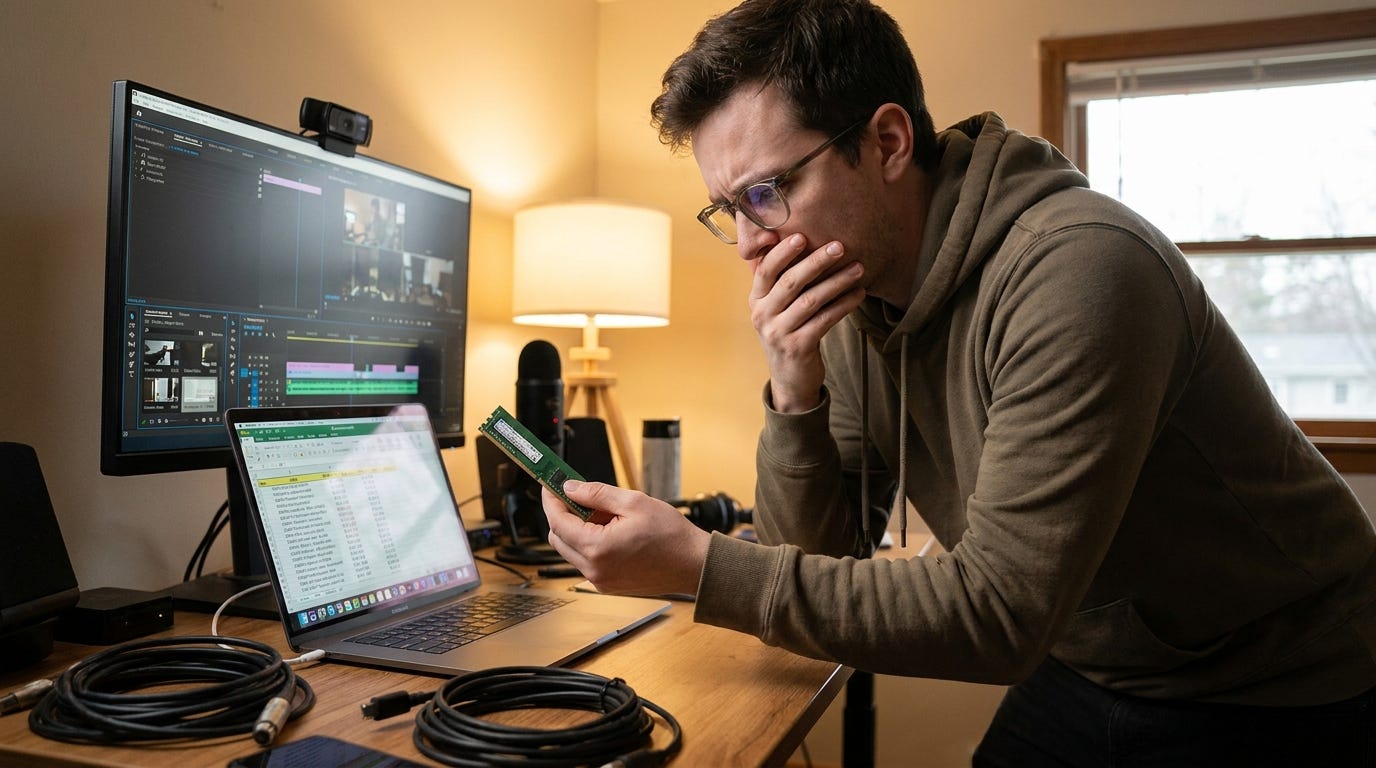
I priced a 4TB NVMe drive last week for a client’s new edit rig. An NVMe drive is just a fast type of storage drive, the modern replacement for the old spinning hard disk, the thing that actually holds your video files and lets your editing software read them quickly. Same drive I bought myself eighteen months ago for about €130.
It’s now €330.
I checked twice because I assumed I’d misread something. I hadn’t. Welcome to the 2026 memory shortage, and if you create video or audio for a living, it’s about to touch your business whether you’ve noticed it yet or not.
A quick note before we go further: I’m going to keep this as plain-English as I can. If you’re not technical, that’s fine, this still applies to you, and you don’t need to understand the engineering to understand the bill.
I’ve lived through plenty of component shortages. They follow a pattern: demand spikes, prices climb for a few months, manufacturers ramp production, prices fall back. You wait it out.
This one doesn’t follow that pattern.
AI data centres are absorbing the world’s supply of two specific components: RAM and SSD storage.
Quick definitions, because these matter for the rest of this article:
RAM is your computer’s short-term memory. It’s what your editing software, your live streaming software, or any AI tool actually uses while it’s running. The more you have, the more your computer can juggle at once without slowing down or crashing.
SSD stands for Solid-State Drive. It’s where your files actually live, your footage, your projects, your exports. An NVMe drive (mentioned above) is just a faster category of SSD.
DRAM and NAND are the technical names for the chips inside RAM and SSDs. You’ll see these terms in industry reporting, so it’s worth knowing DRAM = RAM, NAND = SSD storage.
With that out of the way: every chip factory that used to make the RAM in your laptop is now weighing whether that same factory space is worth more making memory chips for AI servers instead, the same way a bakery might stop making bread to make more profitable cakes if cake suddenly became wildly popular. It almost always is more profitable for them. That kind of AI server memory (sometimes called HBM) earns chipmakers three to five times more money per batch than the memory in your editing computer.
So Samsung, SK Hynix, and Micron, the three companies that make basically all of the world’s memory chips, are quietly redirecting their factory capacity away from consumer and prosumer gear and toward the AI buildout.
Here’s what that’s done to prices since late last year:
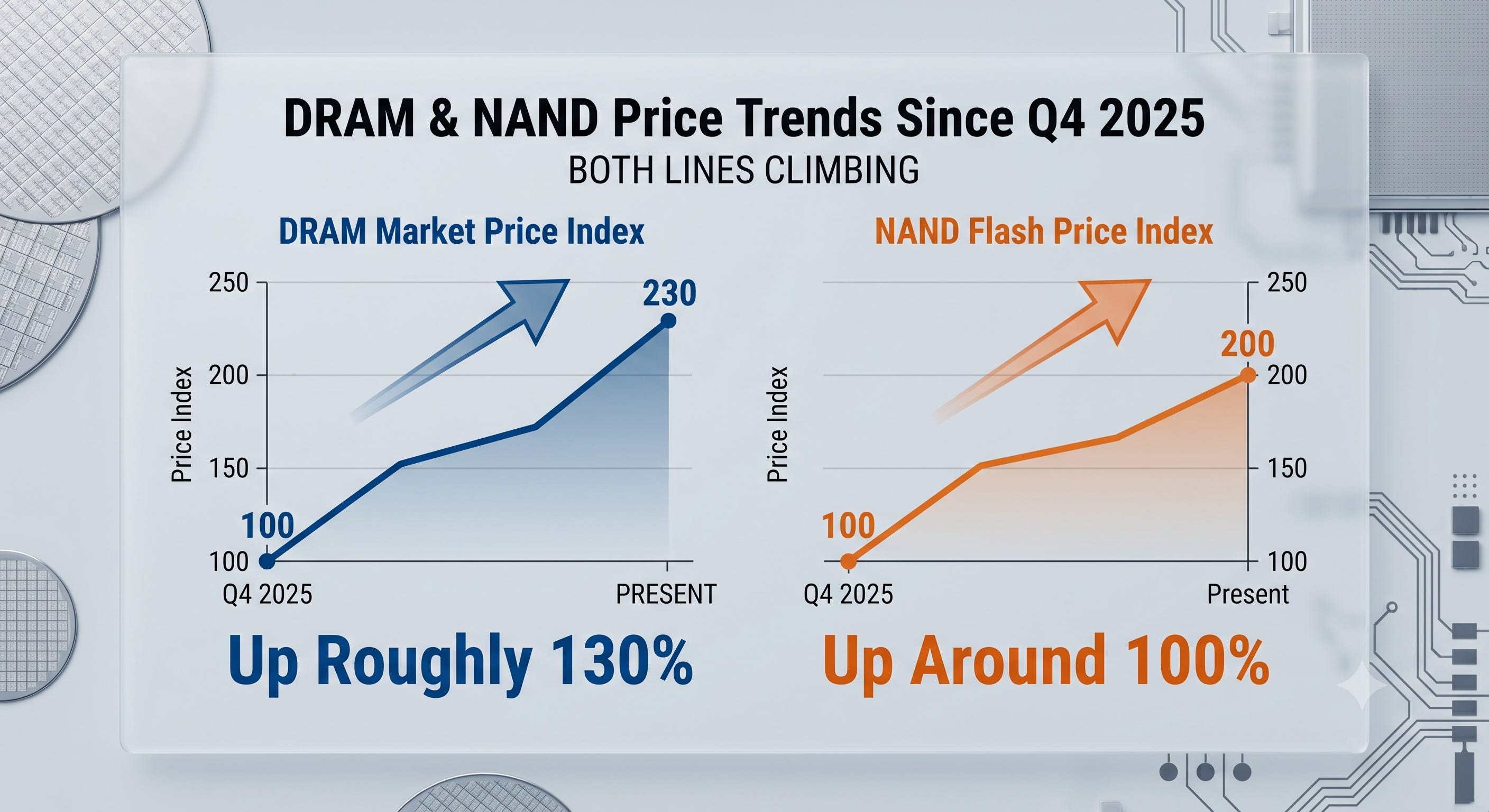
RAM prices are up roughly 130% since Q4 2025. SSD storage prices are up around 100%, and both lines are still climbing. Industry analysts kept revising their forecasts upward as 2026 went on, not down.
This is a structural shift, not a seasonal dip. IDC has gone as far as calling it a potential permanent reallocation of global chip capacity, not the usual boom and bust.
Forget the index numbers for a second. Here’s what it looks like on a receipt.
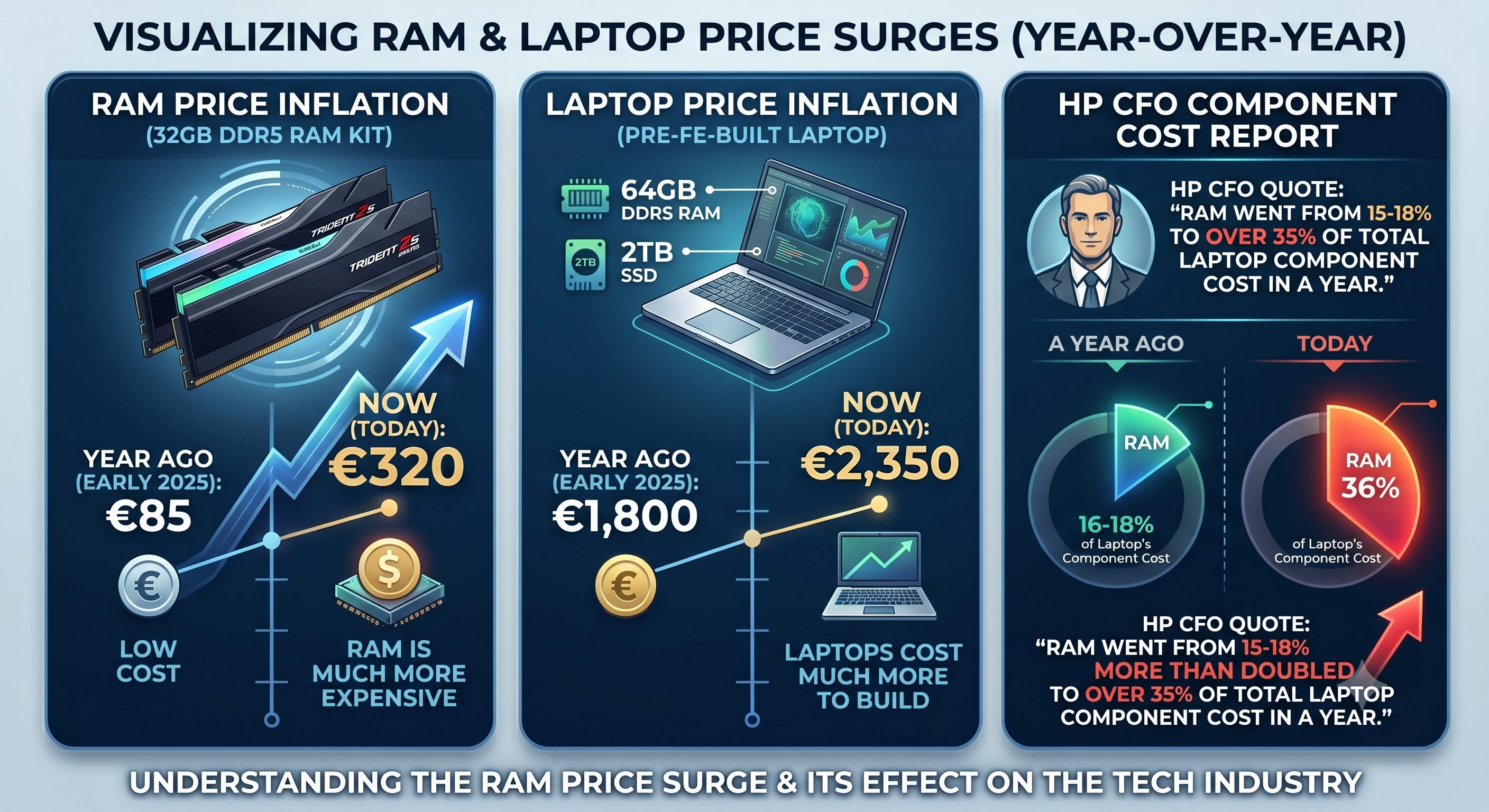
A 32GB RAM kit (DDR5 is just the current generation type, the number after it is how much memory it holds) that cost around €85 in early 2025 is running €320 today. A decent 4TB NVMe storage drive has gone from roughly €130 to €330. And a pre-built editing laptop, the kind with 64GB of RAM and 2TB of storage that a lot of us run our businesses on, has jumped from around €1,800 to something closer to €2,350.
HP’s own CFO said it plainly on a recent earnings call. RAM used to be 15 to 18% of a laptop’s total component cost. It’s now over 35%. That’s not a rounding error. That’s the entire economics of building a computer getting rewritten in about a year.
If you’re someone who occasionally upgrades your gear, this is annoying. If you’re a solo creator or small production team whose workflow lives or dies on render speed and storage headroom, this is a real line item you need to plan around.
I want to be specific here, because vague warnings aren’t useful to anyone.
Editing 4K video with multiple camera angles uses a lot of RAM and needs fast storage to keep up. If you were planning to double your RAM, or add a second storage drive for your footage, that upgrade now costs two to three times what it did a year ago.
AI tools you run on your own computer (things like AI-powered note-taking, audio cleanup, or transcription) also compete for the same memory your editing software needs. More creators are running these tools locally instead of paying for cloud subscriptions, right as the hardware to run them well gets more expensive.
Studios and small teams planning to replace several machines at once are seeing real delays, not just higher prices, because RAM and storage have become genuinely hard to source even for standard computer builds.
Budget and mid-tier laptops are quietly shipping with less RAM and smaller storage drives than they would have a year ago, because manufacturers are protecting their profit margins by giving you less instead of charging more upfront.
I used to think hardware planning was the boring part of running a content business. I was wrong. Right now it’s one of the few parts you actually have leverage over.
The good news? You don’t need a panic-buy. You need a plan.
Here’s what I’m telling clients who ask me about this:
If you know you need a RAM or SSD upgrade in the next 12 to 18 months, buy it now. Every credible forecast I’ve read, from IDC to TrendForce to Gartner, says prices climb further before they ease, and “easing” doesn’t arrive before late 2027 at the earliest.
Protect your main machine first. Whatever computer you actually edit on or stream from every day should be the one you spend your upgrade budget on. Let any backup or admin computers run with less if money is tight.
If your laptop or desktop can be physically opened up and upgraded (most non-Apple machines can), upgrade it rather than replace the whole machine. A three-year-old computer with maxed-out RAM and a fresh storage drive can carry you another three to five years of real work, and it’s still a fraction of the cost of buying new at today’s prices. If you’re not sure whether your machine can be upgraded, a quick search for your exact model name plus “RAM upgrade” will tell you.
For Apple users, buy more memory and storage than feels comfortable at the time of purchase. Most Macs can’t be upgraded later, the memory and storage are sealed in at the factory, and Apple’s pricing reflects this same market even if their supply chain has been a bit more protected so far.
Build lighter, faster-to-handle versions of your footage into your editing habit now, not as a future nice-to-have. Most editing software can create smaller “preview” copies of your footage to edit with (often called proxies), which reduces how much you’re leaning on expensive RAM and storage speed during the edit itself.
If you’re planning to add cameras to a live show, budget the RAM and storage upgrade before you budget the camera. A new camera is the cheap part. The memory and capture headroom to actually run it live, reliably, alongside the others, is where the real cost sits right now. Hardware capture devices will also help with this.
None of this is about fear. It’s about treating memory the way you’d treat any other constrained resource in your business: plan early, protect what matters most, and don’t let the panic-buyers set your pace.
I’d love to know where this is hitting you. Are you holding off on an upgrade, or did you already feel this in your last hardware purchase?
Drop a comment, I read every one, and I’m curious how widely this is actually landing across the creator world right now.
Comments
Nothing yet. Say the first thing.
Sign in to join the conversation.