
Somewhere in 1997, a 416 kilobyte file called badday.mpg started landing in inboxes across the world. Twenty-seven seconds. Grainy, black and white, security camera footage. A guy in a cubicle, losing it completely on his computer.
He slaps the monitor. Pounds the keyboard with his fist. Then he picks the keyboard up, swings it like a baseball bat, and knocks the monitor clean off the desk. A coworker peeks over the partition, twice, too curious to look away. The guy finishes the job with a kick.
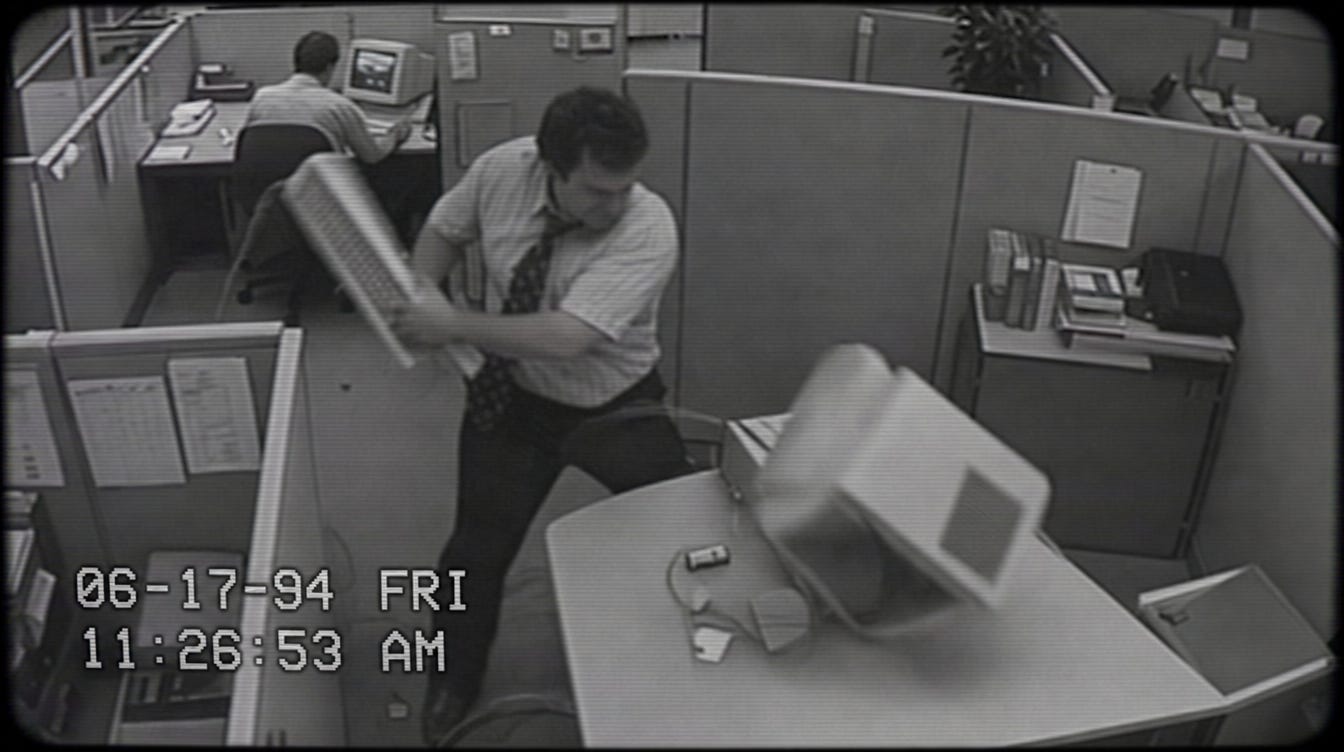
You’ve probably seen it. Even if you don’t remember where.
It became known as “Bad Day,” or “Computer Rage,” or “Office Rage.” Long before “going viral” was a phrase anyone used, this clip was clogging corporate email servers so badly that some companies actually banned it internally.
Here’s the part almost nobody knew for years: the whole thing was staged.
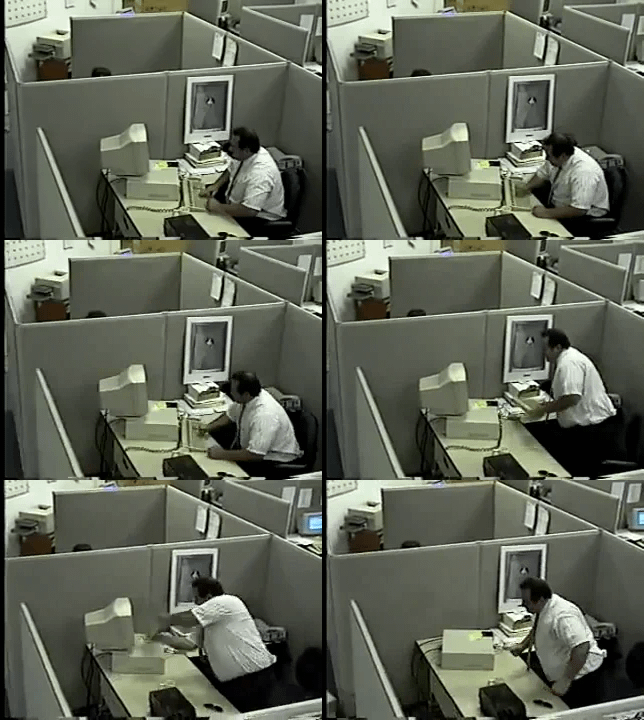
The “angry man” was a real person. His name is Vinny Licciardi, and at the time he worked as a shipping manager at a small Colorado tech company called Loronix Information Systems.
Loronix wasn’t in the business of comedy. They were building digital video recording systems for security cameras, and they needed sample footage to show potential clients what their surveillance tech could capture. Licciardi and Loronix’s CTO, Peter Jankowski, grabbed a video camera and a pile of dead office equipment and started improvising.
“It was pretty ad hoc,” Jankowski said years later. “We had some computers that had died and monitors and keyboards that weren’t working, so we basically set that up in a cubicle on a desk.”
They filmed a few different bits that day, including a fake ATM robbery. But it was Licciardi’s idea to play a “disgruntled employee” that stuck. He picked up the keyboard, went full barbarian on the monitor, and a piece of internet history was born completely by accident.
If you freeze the frame and look closely, the evidence is right there. The computer is unplugged. Licciardi is smiling.
Nobody at Loronix was trying to fool the world. They just wanted a fun demo clip for a trade show CD-ROM.
Here’s where it gets interesting for anyone who thinks about how video actually spreads.
The clip started life as a giveaway, handed out on CD-ROMs at trade shows alongside company brochures. It also made the rounds by email among industry contacts. But its file size, tiny by today’s standards but hefty for 1997, meant it occasionally overloaded email servers as it got forwarded and re-forwarded across companies who had absolutely nothing to do with Loronix.
By mid-1997, it had escaped its intended audience entirely. It wasn’t a “professional demo” anymore. It was just a guy losing his mind at his computer, and everyone with a computer understood that feeling instantly.
A French engineer named Benoit Rigaut hosted an early fan page for the video on a personal site through CERN in 1998, and it started pulling in thousands of visitors a day, mostly tech-savvy early internet users arguing about whether it was real.
Loronix itself didn’t find out how big this had gotten until June 1998, when the popularity of their own promotional clip started causing them internal computer headaches.
The company that made the video didn’t know it had gone viral until their own servers started struggling under the weight of it.
CNN eventually broke the real story, followed by trade press. But by then the myth had a life of its own. It took a proper Wired feature years later to really dig into the origin and interview the people who made it.
I spend my days helping people build video presence that actually reflects their expertise. And this 27-second clip from 1997 quietly holds a lesson I bring up more than you’d think.
Bad Day wasn’t authentic. It was effective. Those are two different things, and people mix them up constantly.
A financial planner filming a market update doesn’t need hidden cameras and unscripted chaos to build trust. A leadership coach doesn’t need to fake a bad day to seem relatable. What made this clip travel wasn’t realism. It was a genuinely well-made piece of short, purposeful video that tapped into something universal: everyone who’s ever used a computer has wanted to throw it across the room.
That’s the actual takeaway. Good video doesn’t need to be a polished lie or a raw diary entry. It needs a clear point, delivered in a format people will actually watch and pass along.
Here’s what I’d pull from this if you’re building your own video presence:
Keep it short. Twenty-seven seconds carried this thing around the entire planet before smartphones existed.
Give people one clear emotional hook, not five ideas competing for attention.
Don’t confuse “raw” with “trustworthy.” Loronix’s staged demo outlasted a thousand genuine, forgettable clips because the idea was sharp, not because it was real.
Design for forwarding. Ask yourself: would a stranger send this to a coworker with zero context, the way people did with badday.mpg?
Bad Day was never meant to be a viral phenomenon. It was a shipping manager and a CTO messing around with broken office equipment on a slow afternoon. Nearly thirty years later, it’s still the clearest example I know of a simple idea, well executed, completely outperforming anything more complicated.
Drop a comment if you remember getting this one forwarded to you back in the day. I’d love to know how many inboxes this thing actually made it through.
Cheers,
Neil.
Comments
Nothing yet. Say the first thing.
Sign in to join the conversation.