
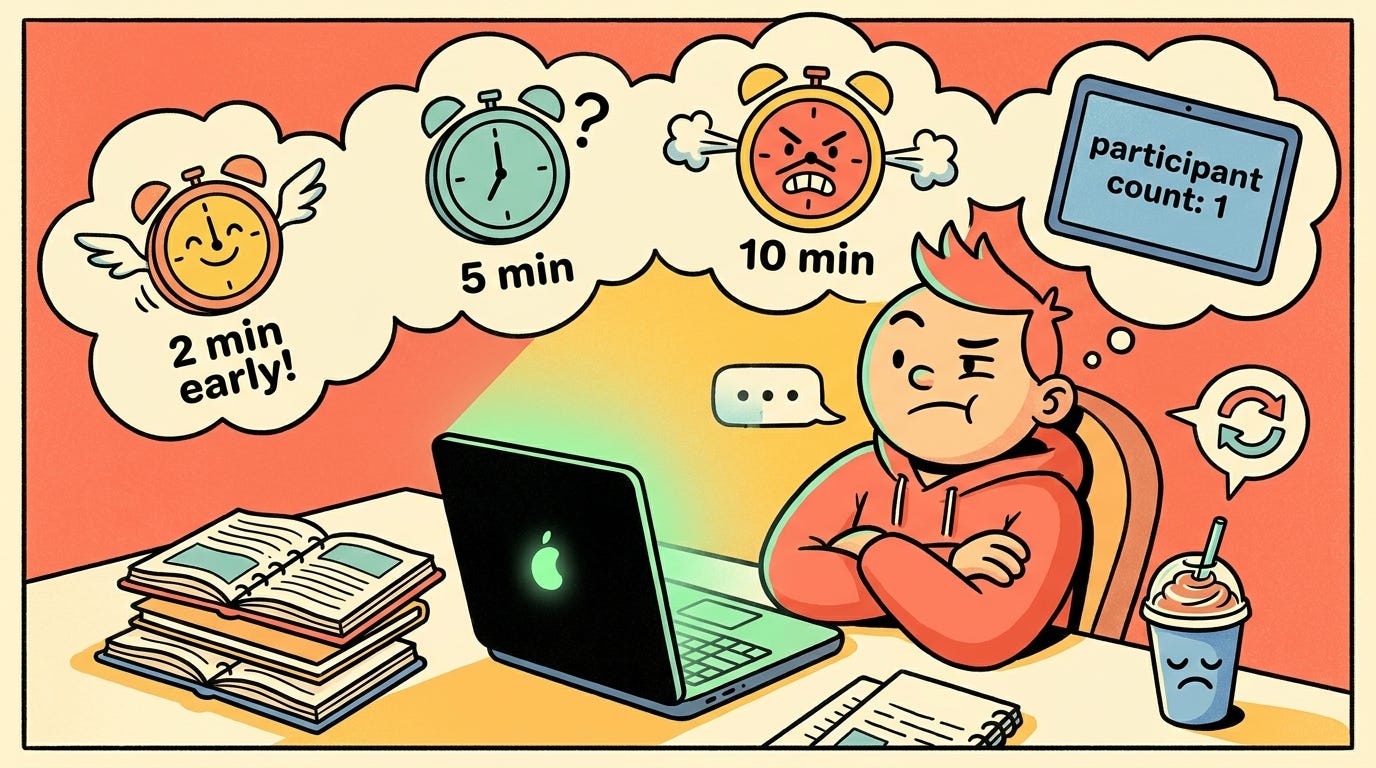
You’re sitting there. Camera on. Background tidy. Notes open. You even logged in two minutes early.
And nobody’s there.
So you wait. Five minutes. You refresh the link. Check your calendar invite. Send a tentative message. Wait a bit more. Ten minutes in, you’re doing that thing where you’re half-working, half-watching the participant count sit at one.
Eventually you close the call and feel a strange mix of annoyed and slightly guilty, as if you did something wrong.
I’ve been there, where missed meetings had real consequences, where time meant SLAs and billable hours and project deadlines.
I’ve thought a lot about why this keeps happening to professionals who should know better.
The no-show isn’t the problem. Your lack of a policy is.
When I talk to consultants, coaches, and specialist practitioners about Zoom no-shows, they always ask the same thing: how long should I wait?
It’s a reasonable question. The general consensus, across multiple professional sources, lands around this:
3-5 minutes for internal calls or peer meetings
5-10 minutes for external meetings, first-time conversations, or senior clients
Up to 15 minutes for high-stakes sessions where the whole outcome depends on that person being there
One rule of thumb I’ve seen is to wait no more than a third of the total scheduled time. A 30-minute call gets 10 minutes. A 60-minute strategy session gets 20. After that, you’re not being patient. You’re just waiting.
The question isn’t really “how long do I wait?” The question is: “what did I agree with this person before they booked the call?”
If the answer is nothing, that’s your answer.
Don’t call them. Not immediately, anyway.
An unscheduled phone call from someone you’ve just stood up feels intrusive. Even if you’re the one who was stood up. Send a short, neutral message instead: something calm, not passive-aggressive, that gives them the benefit of the doubt and includes the direct Zoom link again in case there’s a tech issue.
Something like:
“Hi — I’m on the call when you’re ready. Sending the link here in case there were any issues getting in. No rush.”
That’s it. Keep it short. Keep it warm. You’re not accusing anyone of anything yet.
What you don’t want to do is sit there crafting a message that says “I’ve been waiting” or “you missed our meeting.” That creates defensiveness rather than resolution. It rarely gets the conversation back on track.
Assuming no response and the meeting window has passed, send a brief email the same day. Not the next day. Same day, while context is still there.
Keep it light. Assume good intent. Something went wrong on their end, and they probably know it.
A leadership coach I know uses this structure:
One line acknowledging the missed call, with no accusation
One line checking they’re okay
A direct offer to reschedule with two specific times
That’s the whole email. No lengthy explanation of how much you prepared. No mention of how long you waited. Just a clear path forward.
If someone repeatedly misses calls without notice, then you have a pattern worth addressing. One missed meeting is life. Three is a relationship to rethink.
Here’s what I learned from years in IT consulting, where clients expected fast response times and clear escalation paths: the professionals who got respect for their time were the ones who established what their time was worth before anything went wrong.
That means a cancellation policy. In writing. Seen and acknowledged before anyone books a call with you.
The standard structure looks like this:
Cancellation 24+ hours before: full reschedule, no penalty
Cancellation under 24 hours: no refund, session credit at your discretion
No-show, no contact: session fee charged in full
Some coaches add a grace period: the first no-show gets a pass. After that, the policy applies.
Coaches who implement clear written policies see no-show rates drop from 20-40% down to under 5%. Not because clients suddenly become more responsible. Because the expectation was made real.
One thing worth saying out loud: your time is just as valid on Zoom as it would be in a room you’d both driven to. You prepared. You blocked the slot. You didn’t book anything else in. Whether the meeting is virtual or in person is irrelevant. Time is time.
I actually now have this in my booking form as a short but respectful point:
I block out dedicated time for every call, so I can show up fully prepared and focused on you.
I ask the same in return: please make every effort to be there. Life happens, and I get it, things come up. If something does, just let me know and we’ll find another time. No drama, no awkwardness.
If you’re a no-show without a heads-up, I’ll wait around 10 minutes, send you a quick check-in message, then free up the slot for someone else.
Your time matters. So does mine. Let’s both show up.
If you want something practical to walk away with, here it is.
Before the call:
Have a written cancellation and no-show policy, shared with every client at booking
Send a reminder 24 hours before with the Zoom link and any prep materials
Make it easy for them to reschedule if needed, so they have no excuse not to
Many tools like Calendly, tidycal, and cal.com have these automations built in to make this whole rescheduling and reminders easy.
During the wait:
Give it 5 minutes for internal contacts, 10 for external
Send one calm, non-accusatory message at the 5-minute mark with the meeting link
After your wait limit, close the call and note the time
After the no-show:
Email the same day, short and neutral, offering two reschedule options
Don’t mention how long you waited
If your policy includes a fee, apply it without apology, because you agreed it in advance
If you’ve read this far and realised you don’t have a cancellation policy, you’re not alone.
Many people I work with are brilliant at what they do and quietly terrible at protecting their own time. They have years of expertise, strong reputations, and no system for what happens when a client just doesn’t show up.
The good news? This is one of the easiest things to fix. A single paragraph, added to your booking confirmation, changes the dynamic completely.
When people know there are real expectations, they meet them. When there are no expectations, they fill in the gap themselves.
And that gap is where the no-shows live.
I’d love to know how you handle this. Do you have a policy in place? Do you wait the full 15 minutes, or are you out at five?
Drop a comment.
We’re all building this playbook together.
Neil.
Comments
Nothing yet. Say the first thing.
Sign in to join the conversation.