
Dear friend,
Too many people fail to realise that large-scale migration does not simply move people across borders. It also carries habits, tastes, and practices that can clash with the standards and safety of the host society.
In Britain today, this reality is becoming harder to ignore. Politicians of both major parties have too often placed ideology ahead of the long-term well-being of the country’s indigenous population, leaving ordinary families to live with the consequences.
We already see the strain in rising knife crime, groups of “troubled youth” making the streets unsafe, higher rates of cousin marriage in certain communities, and growing reports of sexual assaults against women.
Now, a new and particularly unsettling problem is drawing attention: the illegal trade in bushmeat, wild animal flesh from tropical regions. Tons of it are being smuggled into the UK and finding their way onto the black market.
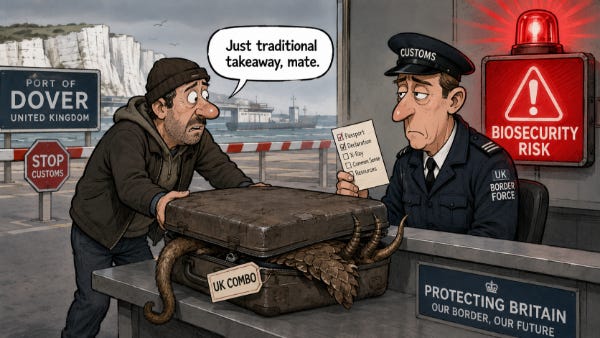


Nearly 100 tonnes of illegal meat were seized at Dover during 2024 alone.
Smugglers are importing monkeys, antelopes, pangolins and other wild animals into Britain.
Bushmeat sellers openly advertise online and offer home delivery to British customers.
Unregulated wild meat risks spreading Ebola, anthrax, tuberculosis and other serious diseases.
Cultural tolerance must never override public health, border security or wildlife conservation.

According to official reports, nearly 100 tonnes of illegal meat were confiscated at the Port of Dover in 2024 alone. This represents an increase of more than 75 per cent on the previous year. However, authorities warn that the amounts intercepted are likely just a fraction of what is getting through.
The bushmeat typically includes monkeys, sharks, antelopes, goats, and other wild species. There have also been confirmed cases involving critically endangered animals such as pangolins.
Once inside the country, some of this meat is sold through informal networks and markets, sometimes mislabelled as ordinary lamb, chicken, or beef to avoid detection.
Despite enforcement efforts, the trade continues openly on social media. Sellers advertise on platforms such as TikTok and Instagram, even offering home delivery. One account based in Lagos, Nigeria, under the name “LocalFoodsDiary”, openly mocked the authorities and posted images of packages addressed to London addresses with captions celebrating successful deliveries of bushmeat.
Other profiles promote “UK combo deals” that include antelope, rats, goat, and dried snails, with claims that the goods arrive within days.
Reform UK’s home affairs spokesman Zia Yusuf put it bluntly:
“I’m not sure when monkey became a delicacy in this country… This is the Britain the Tories and Labour have created.”
There is a bitter irony here. Some on the progressive side have long joked that Britain would be a dull place without migrants introducing their traditional dishes. Well, they are now, and they present a real biosecurity risk. Bushmeat carries well-documented risks of transmitting pathogens. It has been linked to diseases such as Ebola, tuberculosis, anthrax, and other zoonotic infections that can jump from animals to humans. Because the meat is often hunted, slaughtered, and transported without proper hygiene controls or veterinary checks, the danger is real not only for those who eat it, but also for the wider population and for British livestock farming.
The problem is not limited to the United Kingdom. Belgium, France, and Italy have all recorded significant seizures of illegal bushmeat, much of it arriving from West and Central Africa. The demand is largely driven by diaspora communities and enabled by weak border controls.
The issue goes beyond food preferences. Stewardship of creation includes protecting endangered species and preventing unnecessary risks to human life. A society that prioritises the gluttony of some groups over the safety of the majority has lost its sense of ordered priorities.
The West today needs leaders willing to say that cultural practices that threaten health and conservation have no automatic right of entry.
Tolerance is not the same as surrender.
Until next time, God bless you, your family and nation.
Take care,
A Nation First Staff Writer

George Christensen is a former Australian politician, a Christian, freedom lover, conservative, blogger, podcaster, journalist and theologian. He has been feted by the Epoch Times as a “champion of human rights” and his writings have been praised by Infowars’ Alex Jones as “excellent and informative”.
George believes Nation First will be an essential part of the ongoing fight for freedom:
“The time is now for every proud patriot to step to the fore and fight for our freedom, sovereignty and way of life. Information is a key tool in any battle and the Nation First newsletter will be a valuable tool in the battle for the future of the West.”
— George Christensen.
Find more about George at his www.georgechristensen.com.au website.
NOTE: Due to the large volume of emails I receive, it is not possible to email me and ask to be unsubscribed from this newsletter. You must do it yourself by following the simple processes listed below:
Comments
Nothing yet. Say the first thing.
Sign in to join the conversation.