
Dear friend,
Every so often, the World Economic Forum publishes something that makes you stop and read it twice. A piece it ran on 20 July did exactly that. The title was “State infrastructure in a box”, which sounds bland enough until you see what is actually inside the box.
The article describes an AI-powered state that can draw on satellite imagery, phone records, and payment data. It talks about taxation, welfare, digital identity, government contracts, and public services. In plain English, these are the systems that decide who you are, what you owe, what you are entitled to receive, and whether the government believes you.
A fortnight later, the WEF was writing about AI agents negotiating across ports, banks, suppliers, and government agencies. Between those two articles came another about artificial intelligence spending money on our behalf. Read separately, each sounds like a specialist discussion for bureaucrats and technology executives. Read together, they start to look like the working parts of a rather ugly machine.
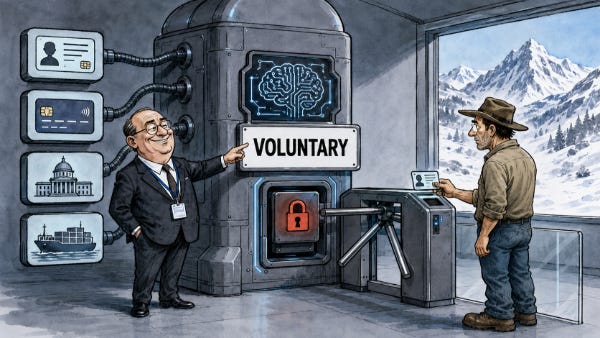


The WEF has promoted AI government drawing upon phone records, payments and satellite data.
Automated tax and welfare decisions could leave citizens fighting machines they cannot question.
Banks are testing AI agents that spend money while monitoring the intentions behind each transaction.
Autonomous software could soon influence finance, shipping, purchasing and access to essential supplies.
Australia’s expanding Digital ID system brings a crucial part of this machinery closer to home.

There is no single WEF document announcing an “AI control grid”. Their articles are not orders to governments, and some carry the usual disclaimer that the views belong to the author. Fair enough. But the Forum chooses which ideas to put before the political and corporate leaders who read its website and attend its gatherings. What it chooses to promote matters.
The pitch behind “state infrastructure in a box” is easy to understand. Poorer countries often lack the staff and systems needed to collect taxes, distribute welfare, and deliver basic services. Building those institutions properly can take decades, so the proposed answer is to leap ahead using artificial intelligence and ready-made digital systems.
There could be genuine benefits. Fraud might be detected more quickly, and emergency payments could reach people sooner. Nobody wants public servants wasting weeks shifting paper between desks when a computer can do the routine work in seconds.
But the proposal goes far beyond replacing forms. The data would not necessarily come from information a person had knowingly handed to a government department. The WEF article points to Togo, where algorithms used satellite and mobile phone data to estimate poverty at the level of individual subscribers before assistance was paid via mobile money.
That should make anyone who values privacy uncomfortable. A phone record or payment does not tell the whole story of a person’s life, yet AI is very good at turning scraps of information into a confident-looking score. Once that score lands in a tax office or welfare department, it can take on the appearance of official truth.
Australia has been down part of this road before. Robodebt turned doubtful calculations into government accusations and left ordinary Australians to prove that the computer was wrong. People received debt notices for money they did not owe, only to find themselves trying to explain their lives to a system built to assume the debt was real. Speed and automation did nothing to make the process fair.
AI would allow this sort of administrative decision-making to spread much further. A payment to a particular group, repeated contact with someone under investigation, a mismatch between databases, or an address appearing in satellite data could all feed a risk score. None of it proves wrongdoing, although the person affected may never be told what triggered the decision.
That is where the relationship between citizen and state begins to change. The department no longer has to lay out its evidence in a form that a normal person can understand. The citizen gets a letter, a frozen payment, or a tax demand and then has to fight his way back through the machine.
Even the WEF article admits there are dangers. Digital identity systems can exclude people who are perfectly entitled to assistance. It also concedes that allowing a foreign vendor to operate taxation or welfare infrastructure raises serious questions about sovereignty and accountability.
That is quite an admission. If a private overseas company supplies the model, maintains the software, and controls the technical knowledge required to understand it, the minister may be legally responsible yet have little practical control. The public servant can blame the program, the vendor can hide behind commercial confidentiality, and the citizen is left on hold.
On 29 July, the WEF turned its attention to payments made by AI agents. This is already beyond the laboratory. Santander and Mastercard have demonstrated a live payment carried out by an AI agent in a regulated European setting, with the article also referring to work involving BBVA, Visa, Nordea, and Mastercard.
The attraction is obvious. An AI agent might renew subscriptions, book travel, order household supplies, or make routine purchases for a business. Plenty of people would happily hand over those chores, particularly if the agent saves money and remembers the bills they forget.
To make that system safe, banks and payment companies would need to know who stands behind the agent, what authority it was given, the circumstances of the purchase, and the human intention behind it. That last word, intention, is the one that should bothers you.
Banks currently ask whether a transaction is lawful, whether the funds are available, and whether fraud is suspected. An AI payment system would push them towards interpreting why a person wanted something purchased and whether the transaction fit the authority supposedly granted to the machine. That creates a detailed record of behaviour and gives the financial gatekeepers another reason to intervene.
Some intervention will be justified. Stolen identities and fraudulent payments are hardly imaginary problems. Yet anyone who has had a perfectly ordinary card purchase blocked while travelling knows how blunt these systems can be. It is irritating when a human can fix the problem after a telephone call. It becomes far more serious when the same logic is tied to an AI agent that pays bills, orders supplies, or runs part of a business.
The infrastructure built to verify a person’s intentions could easily become a system that records, questions, or restricts them. A bank or payment processor may decide a purchase falls outside the agent’s authority, conflicts with company policy, or simply looks unusual. The customer then has to persuade another automated system that the purchase was none of its business.
The next piece appeared on 4 August. The WEF described “agentic supply chains” in which autonomous programs perceive conditions, reason, negotiate, and carry out decisions across manufacturers, suppliers, ports, logistics companies, banks, and governments.
These programs would do more than advise a manager. The article says an increasing share of the decisions that determine global commerce will no longer be made exclusively by people. Software will negotiate with software, often across different companies and countries.
Anyone who has run a small business knows the frustration of being told that “the system” has rejected something and nobody at the other end can explain why. Now extend that experience across finance, shipping, procurement, and regulatory compliance. One program assesses the business for credit, another selects suppliers, another changes a shipping route, and another determines that the product carries too much risk.
Each decision may look defensible on its own. Taken together, they could shut a lawful business out of the market without a minister signing an order or Parliament passing a ban. Once climate ratings, sanctions, reputational warnings, and corporate political policies are fed into these systems, the software begins enforcing rules that voters never approved.
The WEF article does mention human accountability, as it should. But attaching those words to a system does not solve the problem. If thousands of programs are making linked decisions across organisations and borders, finding the person responsible for one disastrous result may be close to impossible.
On 8 July, WEF president and chief executive Alois Zwinggi argued that public-private partnerships will define innovation in artificial intelligence, quantum computing, and biotechnology.
Governments do need outside technical knowledge. No sensible person expects a minister or a departmental committee to understand every line of code inside an advanced AI system. The trouble starts when the companies selling the technology are also invited to shape the rules, standards, and public contracts that determine how it will be used.
Technology companies supply the systems, and banks control the transactions. Governments provide legal authority, while bodies such as the WEF bring decision-makers together and lend the overall arrangement an air of respectable international consensus. The people who will live under these systems usually enter the discussion much later, if at all.
There does not have to be a secret meeting in a smoke-filled room. Many of those involved probably believe they are making government faster and commerce more efficient. Power still becomes concentrated when the same group of officials, executives, and approved advisers keep writing the plans together.
This is why the WEF matters, even though it cannot pass laws in Australia. It introduces people, spreads policy language, and helps make radical changes sound like unavoidable technical upgrades. By the time the public hears about a proposal, much of it may already sit inside contracts, standards, and software specifications that few elected representatives have read.
This discussion is not confined to Davos. In June, the Albanese Government announced that private Digital ID providers will be able to enter the Australian Government Digital ID System from 1 December 2026. Selected government services will be allowed to use accredited private providers, and businesses will also be able to take part in the wider system.
The government says Digital ID will remain voluntary. It points to accreditation, privacy regulation, and alternative ways of accessing services. Those protections are important, but Australians have learned to be wary of the word “voluntary” when the alternative means hours on the phone, a long drive to an office, or waiting weeks for someone to process a paper form.
Convenience has a habit of becoming a necessity. If one method works instantly and every other method is allowed to wither, most people have little practical choice. They sign up because the rent is due, a government payment is late, or they need to get the business moving again.
Allowing private providers into the Australian system does not prove that Canberra intends to adopt every idea appearing on the WEF website. But it does mean that an important piece of the machinery is about to reach further into the private economy. That makes the overseas discussion immediately relevant to us.
There is still time to set firm limits. There’s no way we can soften Digital ID; it is a gateway to all sorts of invasion of privacy and curtailment of liberty that it just needs to go. But AI can help public servants find information without being allowed to decide a person’s legal rights. And automated payments can save time without turning a bank into an interpreter of lawful private intentions.
People selling automated government tend to talk about friction as though it is always wasteful. Forms, separate databases, human review, and a slower decision all look inefficient on a presentation slide. Sometimes they are. Anyone who has dealt with a government department knows how maddening that pointless bureaucracy can be.
Some of that friction protects us. It forces the state to produce evidence in a form that can be challenged. It gives a citizen the chance to speak to another person and prevents a single bad entry in a database from instantly infecting every part of his life. Keeping the tax office, welfare system, bank, and identity provider at arm’s length from one another is sensible, even if joining them together would be faster.
Australians should retain a permanent right to use essential public services without a Digital ID. No tax assessment, welfare cancellation, financial restriction, or similar decision should be made entirely by an algorithm. When AI materially affects a government decision, the person involved should be told and given the evidence used against him, along with a real right of appeal to a human being.
Foreign vendors should never have unreviewable authority over essential government functions. An autonomous commercial agent must remain tied to a person or company that bears legal responsibility for its actions. Information collected for one purpose should not be passed around as convenient raw material for another.
The technology will keep moving, and much of it will be useful. But that is no reason to join identity, money, government records, and commercial decisions into one system simply because the software can do it. The limits need to be settled before soon, while refusing or changing course is still a practical option.
Until next time, God bless you, your family and nation.
Take care,
George Christensen, with a Nation First Staff Writer
Thanks for reading Nation First, by George Christensen! This post is public so feel free to share it.

George Christensen is a former Australian politician, a Christian, freedom lover, conservative, blogger, podcaster, journalist and theologian. He has been feted by the Epoch Times as a “champion of human rights” and his writings have been praised by Infowars’ Alex Jones as “excellent and informative”.
George believes Nation First will be an essential part of the ongoing fight for freedom:
“The time is now for every proud patriot to step to the fore and fight for our freedom, sovereignty and way of life. Information is a key tool in any battle and the Nation First newsletter will be a valuable tool in the battle for the future of the West.”
— George Christensen.
Find more about George at his www.georgechristensen.com.au website.
NOTE: Due to the large volume of emails I receive, it is not possible to email me and ask to be unsubscribed from this newsletter. You must do it yourself by following the simple processes listed below:
Comments
Nothing yet. Say the first thing.
Sign in to join the conversation.