
Getting real skincare results is a test of mental patience. In 2026, this is something we don’t have a lot of. You probably have the right products in your cupboard, and you are probably not using them for longer than a few months.
Social media trends, no matter how conscious we are of them, are conditioning us to believe a skincare product is useless if we don’t see results within a month - and a month is often seen as generous.
I’ve been using retinoids since 2020. I’ve just turned 31 and have a lot to say about them. There are a lot of people on the internet giving you advice on retinoids who’ve used them for a year, including dermatologists who have never used them themselves. I’m not saying their advice isn’t good, but sometimes theory isn’t as useful as it seems.
How to know when to move up in retinoid strength, stay on the same strength or move down in strength
My retinoid strength timeline
How long to stay on the same strength
Most people feel late to the game when it comes to retinoids. The difference between people who started early and those who started later is the sense of feeling in a rush. Even if you started at 35, your retinoid timeline doesn’t have to change all that much. If anything, I’d choose to start on a higher strength only.
The rush comes from social media: being bombarded with confusing messaging about tretinoin supremacy can make you doubt your own products. If it’s not tret, it’s some ‘cult’ retinoid that must be better than the others, like A313 from French pharmacies. These types of videos can lead you to completely abandon a routine that was working for you for fear of missing out on using the right thing. How many half-empty products do you have that you previously thought we’re going to save you?
Nobody likes that feeling of always being rushed, missing out and overwhelmed about skincare products. Luckily, when you know the science, that entire feeling can dissipate.
You might not have perfect skin now on your current routine - that doesn’t mean it isn’t loading for you in the background. What you see now is not all you’re going to get. Retinoid results compound over many years of consistency.
Think about it like going to the gym. You can do the same routine in months one through to six, and your results will look very different during each month along the way. You know you’re not going to have your final results after month two, and that is the same with a retinoid.
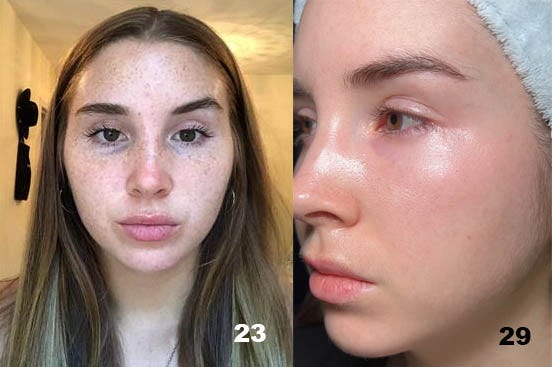
The visible early changes (smoother texture, fewer breakouts, less congestion) are surface-level changes from faster cell turnover. The real prize is happening deeper. Down in the dermis, your retinoid is slowly switching on collagen production and switching off the enzymes that break it down. New collagen is microscopic, and it takes months of consistent use before it shows up to the naked eye. You can’t rush this process no matter how hard you try.
I get so many questions on my retinoid videos about moving up in strength when somebody hasn’t even finished half of the tube of the product they’re currently using. So my first rule of thumb is to actually finish the bottle.
Not only is this less wasteful, but it just makes sense. My retinoid, no matter which one I’m using, can last me up to a year. At shortest, it might be more like six to nine months. This is the bare minimum amount of time you should give a retinoid before you think about what’s next.
These are my general guidelines:
You’ve finished the bottle and you can use it 3-4x a week without irritation. Ideally you’ve been using it for 6-12 months minimum.
You’re aware that moving up doesn’t always equal better results if it is your hormones, diet and lifestyle causing you hormonal acne. (PS I surveyed 7,000 people with hormonal acne to see what worked best for them here).
You’re using retinol or retinaldehyde. Maybe controversial, but I don’t think people on prescription-strength retinoids should feel a constant yearning to move upwards. If you’re not seeing the results you want, consider these factors:
You simply haven’t spent enough time in the game. Six months on a prescription retinoid will not give you the same results as four years on a prescription retinoid.
Your hormones are not optimised for skin health and you should spend some time on these instead of topicals: diet, lifestyle, supplements, medication
It’s highly possible your skincare routine is sabotaging you. Look at these before and after photos from cutting out a CeraVe moisturiser in this post I wrote on acne-prone skin types.
Who shouldn’t move up yet: you started a new bottle a few months ago, but you’re nowhere near finished it, or you are still only applying it 1-2x a week. Instead, aim to get to 3-4x a week before moving up.
Stay on the same strength if you haven’t finished the bottle yet, and you regularly still get irritation. This is the type of person who’s probably in a rush to get to prescription strength, but they don’t realise their skin has many more seasons of change before they see the results of other people who’re on prescription strength.
It’s not the prescription strength that gets you the results. It’s the months and years spent using a retinoid consistently.
The second scenario is someone who is happy with their results but believes retinoids are all about constantly moving up. This is the part that is a lie.
Again, think about the gym analogy. If you’re happy with your results, you can simply maintain them. There is nothing wrong with that. Going up in strength means some additional irritation, flakiness, and makeup not sitting right. You don’t have to continually put yourself through this. It is not a game of moving up in strength for no reason.
Using retinoids has turned into an online dick swinging contest - don’t be afraid to move down in strength to get better results. It’s not impressive to use a strong retinoid that you clearly don’t tolerate.
People will use prescription retinoids for years with persistent flakiness, trying to fix it with the right moisturiser. They rarely consider moving down in strength, which could fix their entire problem.
If you’ve had any of the below for more than 12 months, consider moving to a weaker retinoid:
Flakiness that doesn’t go away, no matter how you use it or with what moisturiser
Uncomfortable skin that is regularly irritated
You can only use it one to two times a week, anything more is too much
Retinoid results come from frequent weekly usage, consistently over many years. I’m talking 3, 4, 5x a week for a long time. If you can only get to 2x a week after several months, you need to move down.
For £6/month, you get the exact systems I’ve used to fix my skin, increase my income, and make better decisions - with detailed, brutally honest guides you won’t find anywhere else.
in the six years that I’ve been on retinoids, I’ve tried a few different versions. It’s led me to one conclusion: they all work more or less the same. The real goal is to have as much time in the game as possible.
This is why it’s better to use a slightly weaker retinoid more frequently and for longer periods of time than a stronger retinoid more sporadically, because you can’t handle it.
Below is my retinoid timeline:
Summer 2020: 0.1% retinaldehyde
Autumn 2022: I switched to 0.015% tretinoin by Dermatica, because my retinal became discontinued
Autumn 2023: I switched to 0.1% adapalene because I developed perioral dermatitis (from the dentist) and adapalene is less irritating
Now (summer 2026) I still use adapalene on my cheeks and chin, with the same tretinoin on my forehead (I don’t regularly recommend people use two different types of retinoids. I simply do it because using adapalene for me was initially an experiment to see if my perioral dermatitis would tolerate it, and then I just never changed my forehead routine. I probably wouldn’t do this if I wasn’t a skin care creator who thinks about skin care all the time)
All in all, I hope this article has inspired you to trust in the process of using a retinoid and understand that you cannot speed up your results. Time in the game matters, and there’s nothing you can do to shortcut that.
I’ll leave you with two free guides I’ve created: My Exact Skincare Routine and How to Use a Retinoid for Beginners. The retinoid guide is a product of six years in the game and all of my most asked questions from social media.
Natalie x
About the author:
Hey, I’m Natalie. I built an audience of over 1 million on TikTok talking about skincare, that quickly evolved into something much bigger here on Substack.
Now I write brutally honest, big-sister guides on skincare, finance and wellness for your 20s and 30s - breaking down what actually works so you can get ahead faster, learning from my mistakes and shortcuts.

💬 Follow on TikTok or Instagram for brutally honest skincare takes
💻 Ask me a question in the group chat
🧴Shop my recommendations here
Comments
Nothing yet. Say the first thing.
Sign in to join the conversation.