

© Natalie Bennett (Gel plate print)
Looking forward to returning to the wonderful Owl Bookshop in Kentish Town, North London, to talk about my new book Green Thinking: Unlearning Outdated Ideas in Science, Economics and Politics on June 10. That after a great event at the University of Swansea with the Medical Humanities Research Centre and Climate Action Research Network; it was billed as a public lecture but an almost entirely academic audience. Really enjoyed it and would love to do similar events at other universities and colleges.
And my other big book news is that, after years of telling people the audio book of Change Everything, my first book, would be out “soon”, it finally is! (After some 12 hours of recording - yes reading your own book to professional standard is quite a slog!) It should be available anywhere you get your audio books, and if you’d like to give the format a go, here’s one place offering a free trial.
No, I decided not to enter the (mostly Labour-Party) Substack “duel of the essays”. I’ve written a book on the Green vision. And as I said on Instagram, why get so excited about the words of a lobbyist for the fossil fuel and IT sectors (what Tony Blair has been for the last 20 years), who happens to have been prime minister before that.
Deadening conformism and “respectability”, identikit suburban culture built around consumption, rigid gender norms and fears of “Reds under the bed” - these are the stereotypes of the 1950s, in the UK and elsewhere. Their continuation were what my mother was rebelling against in early 1960s Australia. (Although for her that meant going out with boys and following pop stars; nothing in her experience pointed to political activties or collective organising.)
But that crunching repression of difference of the Fifties may be seen as a reaction against questioning of the status quo by many whose lives had been torn asunder by the Second World War, and acute awareness of the last violent spasms of Empire in Malaya, Kenya and Cyprus and the fearsome shadow of the A-bomb and H-bomb.
In The Radical Fifties: Activist Politics in Cold War Britain, Sophie Scott-Brown finds there was plenty of interesting, and occasionally impactful, radical politics going on through the period, presenting perspectives that might sound surprisingly contemporary to modern activists of the Occupy movement or those promoting prefigurative politics.
There are many fascinating stories of lives of the time, such as that of Colin Ward (remembered here by the Town and Country Planning Association), who after leaving school in Ilford at 15 worked under Sidney Caulfield, an architect who had trained under William Morris but ended up doing bomb repairs.
“In 1942, his talent as a draughtsman led to a posting with the Royal Engineers (where he spent time drawing latrines), and to Glasgow. One Sunday afternoon on Glasgow Green, he watched Eddie Shaw taunting communists in public debate and was hooked … drawn into the orbit of the GAG [Glasgow Anarchist Group], fascinated by what they had to say about Allied hypocrisy in the War, the authoritarianism of the Soviet Union, the limits of unionism, and the vitality of genuine workers’ control. Ironically, his involvement with the London FP group was only truly securied when he was called as a witness for the prosecution in the Freedom trial case (he was an example of a soldier who had been incited to sedition). When finally demobbed in 1947, and back in London,he joined the group as an editor. Ward had three objections to both [Herbert] Read and [Dr Alex] Comfort’s intellectual anarchism and faith in science. First, for an ideology preoccupied with liberty, he found it strange to define freedom as obedience to natural laws. Second, he doubted the capacity of science to determine those laws definitively, let alone extrapolate models of living from them… anarchy had to remain an aspiration of the heart… Ideas could be tools to encourage people, but they must not be instructions to compel them … the popular movement had to be anarchism’s moral and intellectual anchor; if not the whole enterpirse fell into the hopeless contradiction of forcing people to be free…. As he understood it, anarchism began from the assumption that people were capable of self-organization. They could resolve problems without force or intervention if given the chance to do so. Kropotkin’s Mutual Aid (1902) offered one account of cooperation as a driving factor in human evolution but there were plenty of others: the Jura watchmakers in La-Chaux-de-Fonds in the 1980s, the spontaneous formation of the Paris Commune in 1870-71, the leaderless communities of the Mexican peons in 1910-20, the Maknovist rebels in Ukraine 1917-22, the anarchists in Barcelona in 1936.” (pp. 23-5)
Ward’s view on education feels awfully relevant today. (Including a podcast I did this week with Teacher Talk Radio.)
“He believed cooperation was a human capacity but not an instinct. It required training through education. Unfortunately the formal education most people received taught and rewarded the most uncooperative, even anti-social, principles that people could have … from what was taught to how, a young person learned obedience and dependency: how to follow instructions, carry out allotted tasks, defer to those with more power. Instead of expanding students’ horizons, schools channelled them into a niche in the labour market. Even the comradery of classmates was tainted; instead of collaborators, children were competitors vying for grades, praise and attention.” (p. 99)
As do his social views.
“While it was true his own generation had ‘retreated from aestheticism into philistinism’, Labour’s modernizers were wrong to believe they would be satisfied by consumer power alone. Young people might be less sensitive to what was ‘cruel or wicked’, but they cared very much about what was ‘bogus or phoney’. The nuances of this mood escaped the politicians, but the period’s artists understood it. The cold rage of John Osbourne and Alan Stilltoe, the frankness of Samuel Selvon, and Doris Lessing, the prickly wit of Clint McInnes and Iris Murdoch, all captured the instrinctive nonconformism that made young people like him so wary of ‘normal’ politics. (p. 110)
But it was hard to keep optimism about change in a society seemingly focused on ploughing forward with a system of more of the same with a little added social mobility. So Scott-Brown reports on one contemporary view:
“Why do governments fail at change, even when they set out to achieve it? From his position as Chichele Professor of Social and Political Theory at Oxford, Douglas Cole surveyed the mid-fifties world uneasily. For the veteran socialist, it was not just the mounting tension with Russia, the escalating nuclear programme, or the incessant fighting on colonial frontiers. It was not even the fact that the Conservatives were back in power and Labour stranded in the wilderness. What worried him most was the lack of any serious left-wing alternative anywhere. The socialist imagination seemed drained, spent from ushering in the welfare state… In a New Statesman and Nation pamplet Is This Socialism? (1954), Cole assessed the situation. He was not writing for Labour Party supporters but for those who ‘feel a sense of frustration because Socialism means to them something radically different from the managerial welfare state’. The problem was that Labour had attacked unequal incomes but not property, which remained enshrined in the political system … the welfare state did not threaten the class system: it only generated more laters of stratification. Mobility had increased between the upper-lower and the lower-middle levels, but the structures of power at the top were unchanged."… Cole believed any Labour government worthy of the term should attack large inherited fortunes, constrain high incomes, abolish titles and promote comprehensive education that integrated academic and technical work. Above all they must revive industrial democracy.” (p. 56)
Sounds rather familiar in 2026 - if rather radical by today’s standards in any part of the Labour Party.
There were plenty of contemporary critics too of the place being envisaged for women in this new consumer society, one that my mother and her friends continued to suffer under in early 1970s Australia, when they’d describe themselves, without any irony, as “only a housewife”.
“As Alva Myrdal and Viola Klein argued in their study, Women’s Two Roles: Home and Work (1956), since the Industrial Revolution, work had become increasingly separated from home life with the effect of traditionally female forms of labour - crafts such as home baking, soap-making, or skills such as budgetting and thrift, losing both economic and social status. … Every time the housewife was urged to buy a kitchen appliance, a sliced loaf, or a can of soup, when she was encouraged to acquire something on hire-purchase rather than making do or budgetting accordingly, the ‘cash’ value of her contribution to the household economy diminished….As researchers at the Institute of Community Studies found, slum clearance initiatives, including relocation to New Towns, reduced the family to a core ‘nuclear’ unit… which, writer Jacquetta Hawkes remarked, made ‘fearful demands on human beings caught up in it; heavily weighted for loneliness, excessive demands, strain and failure.” (p. 33)
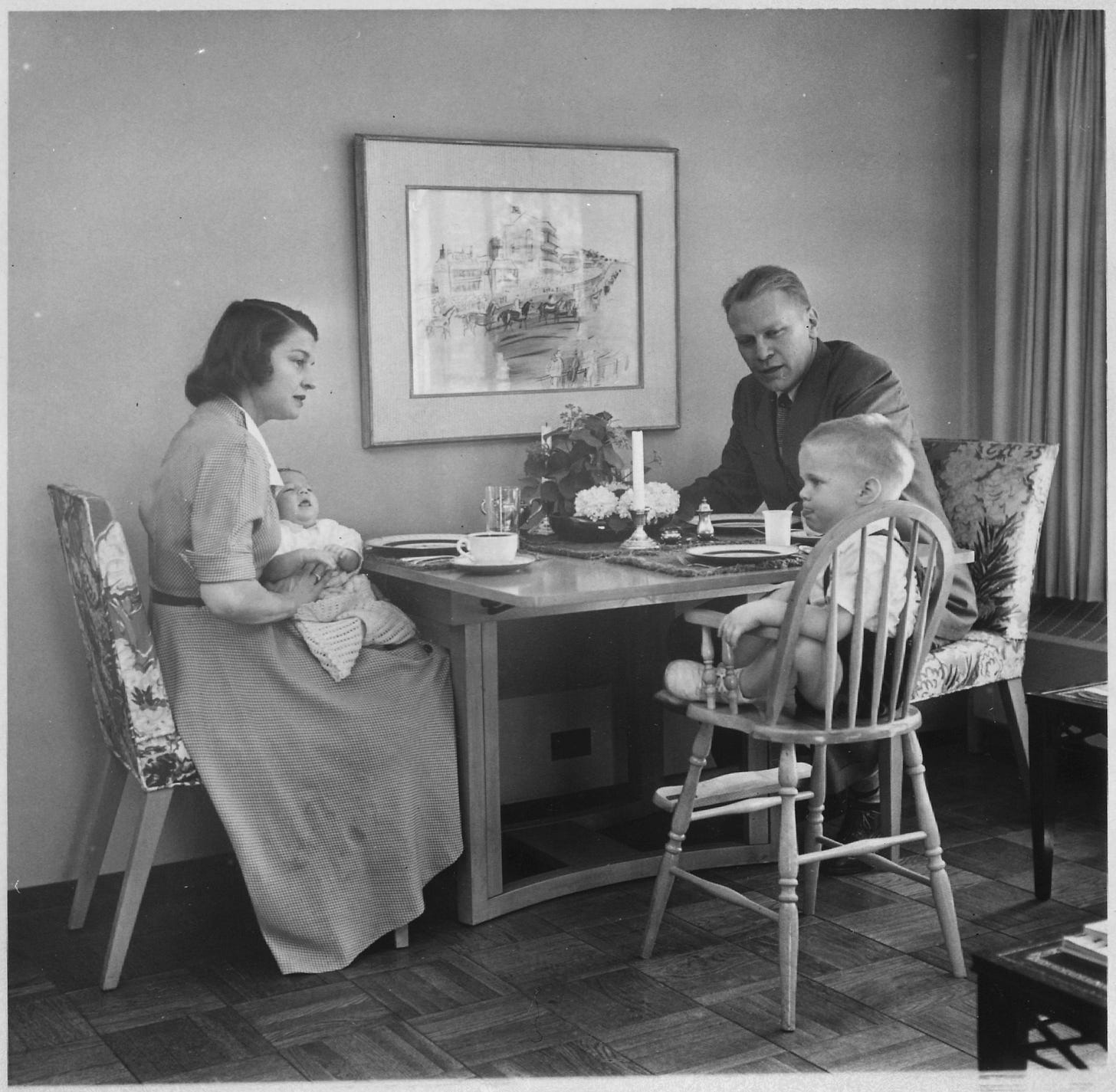
From the US: Betty Ford with Gerald (future president after Nixon), modelling family life. Source
And then of course there was the development of The Bomb, and the impact of nuclear testing.
In 1957 “the issue of fallout topped the political agenda. With an international test ban agreement on the horizon, the government was anxious for Operation Grapple - the testing phase of the British nuclear programme in the Pacific - to get underway quickly. Campaigners hopes rested on Labour, and indeed Labour MP Barbara Castle obliged by opposing the test in light of the probably harm posed to human an environmental health from radioactive fallout. But Castle spoke as an individual, not as a Party spokesperson. .. In October 1957, the Party rejected proposals to adopt unlilateral disarmament as policy at their annual conference. Aneurin Bevan - who formerly opposed the H-bomb but changed position after becoming Shadow Foreign Secretary - mobilized the Union members of the Party’s National Executive Committee … For activists, the idea that peace could be approached through conventional political channels, namely the Labour Party, was discredited. (p. 53-4)
A run through opinion polls shows a great deal of public concern, and understanding, although it “appeared to change according to what was asked and when… Following the bombing of Hiroshima and Nagasaki in 1945, polls reported high public concern about the use of nuclear weapons. In May 1954, the hydrogen bomb was ranked as the British government’s main problem, with people widely agreeing that an atomic war would destroy civilization... In February 1958 over half of poll respondents rejected a complete end to British nuclear testing, but by May 1958 over half believe US and UK tests should be stopped immediately or at the end of their present cycle. In May 1957 polls suggested widespread support for miltilateral nuclear disarmament and a cessation of testing but a lack of support for unlateral disarmament in Britain alone. At the same time, polls confirmed a majority believed that fears about the impact of radioactive fallout on human health were well founded.” (p. 88)
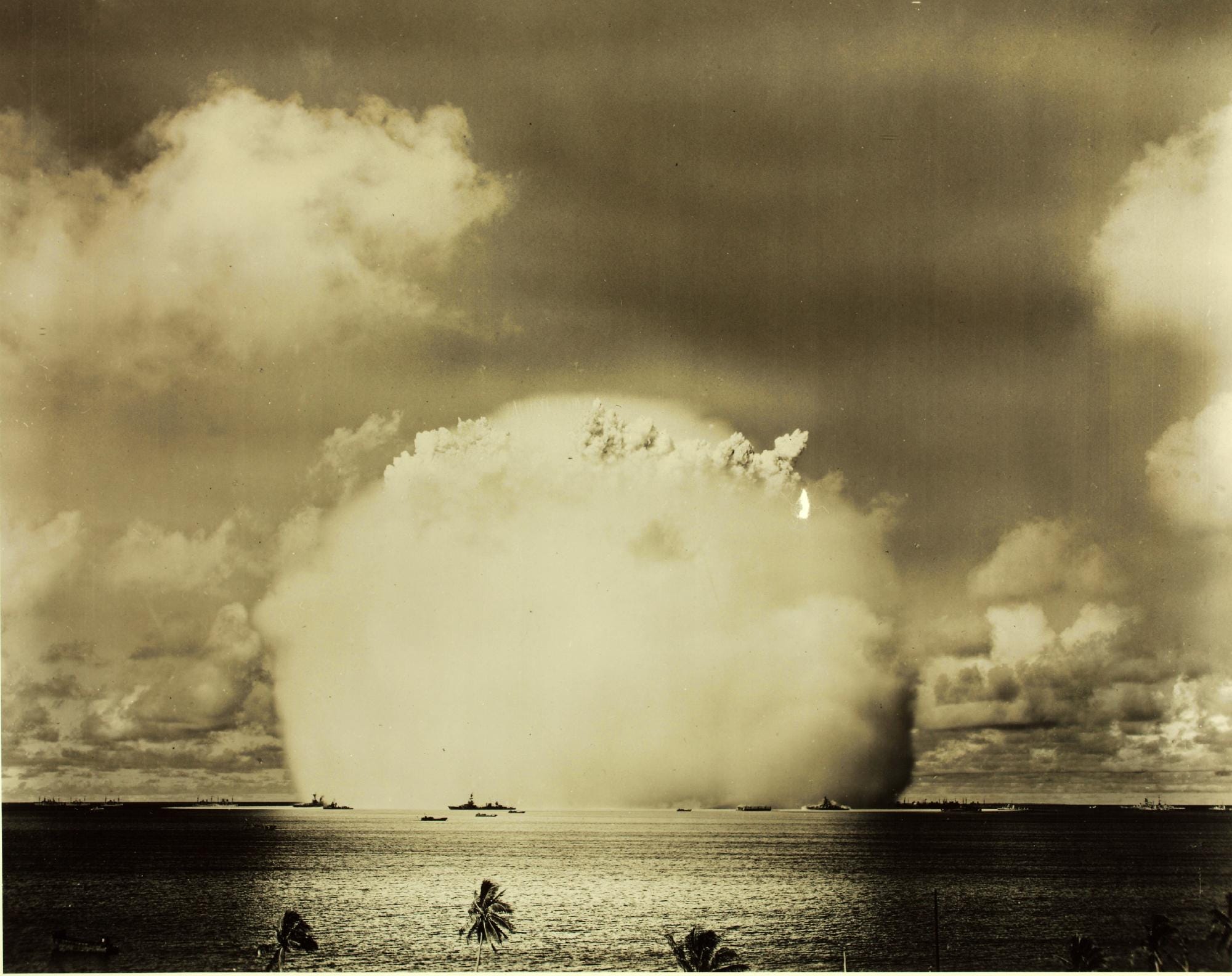
Bikini Atoll nuclear bomb test Source
Mention the nuclear facility at Aldermaston, and I immediately think of an action a decade ago of wrapping a handmade pink scarf around it. (It was the first crocheting I had done in some 30 years - mine was the really lumpy and uneven one), but it was fascinating to read about the tentative, brave first moves to develop a direct action campaign against nuclear weapons. And to hear so early the suggestion that the UK could have a special place in moving the world away from the nuclear weapons age.
“New Reasoner editor Edward Thompson echoed [Bertrand] Russell and [JB] Priestley in calling for Britain to take an international moral lead. ‘Every pointer indicates Britain as the nation best placed to take the initiative which might just succeed in bringing down the whole power-crazy system like a pack of cards. We are not a world power in terms of death dealing fireworks, but in terms of world influence.'“ (p. 78)
In the first march on Aldermaston, in Easter 1958, organised by people with no experience of similar events, and no real idea of how it would work out, there was an eclectic mix of people.
“Alongside CND founders Canon Collins and the Rev Michael Scott, there were other religious leaders and delegations from different faith groups. Trade union and guild groups, cooperative societies and the Women’s Institute all sent representative. Labour MPs Frank Allaun, Harold Davies and Stephen Swingler marched as did the Independent Labour Party MP Fenner Brockway…. Some were ‘eccentric’, dressed in ‘outlandish’ clothers (sandals and duffle coats!) and sporting long hair and even beards, which older organizers worried damaged the march’s respectability.” (p. 81)
I doubt many Extinction Rebellion participants knew about 29 April 1961, when the Committee of 100 held a second Whitehall sitdown, involving 2,500 people. “Squatters flatly refused to move onto the pavement when ordered to do so by police,. Holding their ground, they went limp when hauled from their positions and were duly packed into vans brought in for the purpose. In total 800 arrests were made; protesters filled up local custody cells overnight and magristrate courts in the morning.” One commentator said “It points to a new attitude to political action… it challenges the social democratic frame of mind which sets everything in terms of parliamentary manoeuvring.” (p. 136)
Saying that we need a world in which everyone makes politics what they do, not have done to them, is not new.
But Scott-Brown sees, as we have in recent years, the focus on activism shifting with events.
“The test Ban Treaty in 1963 allayed the worst of public fears, dropping nuclear weapons down the political agenda. Regional committees expanded to other campaigns - solidarity with Vietnam following the American invasion in 1965, solidarity with Greece following the 1967 - before finally dissolving themselves into the new grounsdwell of activity in 1968.” (p. 166)
A final thought from the book: we might learn again more broadly from the History Workshop movement.
“Although academically inexperienced, students had a practical knowledge of economics which, if cultivated, could illuminate or even challenge conventional interpretations of hits history… the Workshop was devised to encourage students to become ‘the producers, not merely the consumers, of their own history… proved immensely popular; by the end of the seventies they attracted hundreds of attendees without losing their happily makeshift atmosphere. Colin Ward described them as more like ‘carnivals of history’ than traditional academic conferences.” (p. 164)
The History Workshop wide-ranging online blog continues, as does an academic journal.
Enjoyed the episode of the Common Descent podcast on Burrowers, especially the focus on one of the great changes in history, at the boundary of the Ediacran and Cambrian, when burrowing started (in the sea floor). A huge change that opened up massive ecological opportunities, and also recycled nutrients that would previously have been buried and lost. But demonstrating how much ideas can change fast in paleolontology, just after I’d listened to the episode, I came across new research suggesting what had been thought to be some of the earliest evidence of worm-like creatures may in fact be structures created by bacteria and algae.
Also learnt about the paleoburrows of South America, constructed by now extinct megafauna, only recently really understood and yet to be properly protected. A reminder that humans are far from the only species to have engaged in mammoth construction projects.
Continuing on the theme of non-human animal capabilities, researchers have been looking at how tardigrades can survive astonishingly high temperatures. They adjust their thermal conductance, so the heat doesn’t reach their core. It is suggested this might be a model human inventors could try to replicate. No, we still can’t match the creativity of nature in many areas.
Got to comment, at least obliquely on this entirely unseasonal, record-smashing heat. With the thought of what it is doing to the high-altitutde cryosphere, specifically some stats from Switzerland, where “between 1973 and 2016, more than 1,000 glaciers vanished. Twenty major Swiss glaciers have lost one quarter of their volume since 2015.” That has major implications for the stability of mountains, and the survival of communities. (As it does in many other areas, often without the capacities Switzerland has to at least protect human lives.)
Was talking this week about the need to learn from historic farming and land-management practices in the UK, as we look to learn from continuing indigenous practices in other parts of the world, so was particularly taken by this History Workshop article on farming practices before the Highland Clearances, “many of which would now be described as ‘agroecological’… attuned to local conditions and informed by centuries of knowledge-making”. And how “modernisers” complained many of the practices reduced profit, even as they increased sustainable and farm security.
What did you think?
You can also find me on Bluesky, Instagram, Facebook, LinkedIn, TikTok and X.
Comments
Nothing yet. Say the first thing.
Sign in to join the conversation.