
© Natalie Bennett (Gel plate print)
On Wednesday I’ll be at Swansea University at a public talk with the Medical Humanities Research Centre & Climate Action Research Network, talking about both Green Thinking and Change Everything. All welcome! Book (for free) here. (And please share with anyone you know in the area.
And the following Tuesday, I’ll be returning to the wonderful Caper bookshop in East Oxford to talk about Green Thinking. Book here.
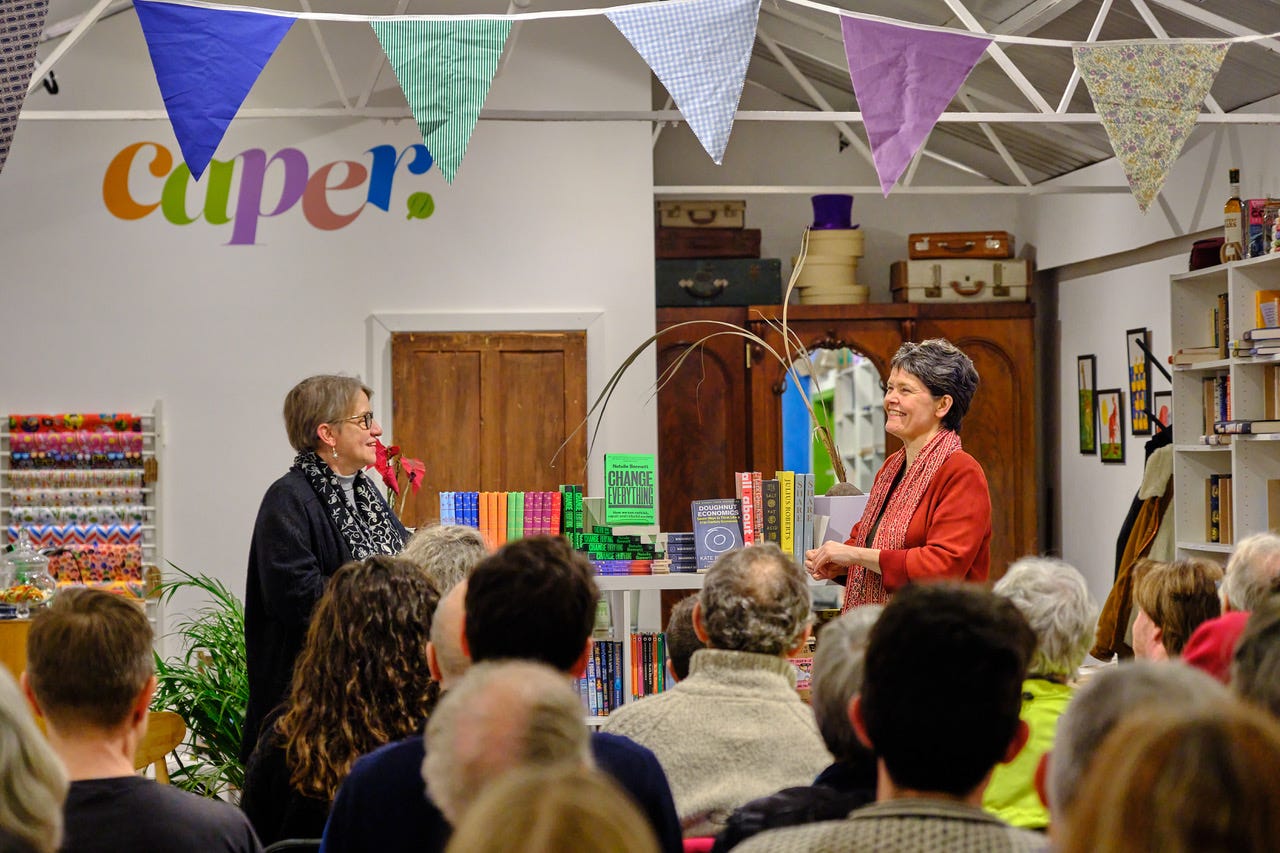
Kate Raworth and I talking Change Everything on my last visit: Photo: Hugh Warwick
Having just spent a week in Norway and Sweden on the Royal College of Defence Studies strategic studies course, my reading has slanted that way, particularly an excellent, varied volume edited by Peter Haldén, The Baltic Sea: A Geopolitical History. He’s from the Swedish Defence University, which we visited, reflecting the current military and political focus on the High North, and the place where trade, culture, and military strategy have continually interacted, as is highly evident today. And an area that has been intimately tied up with British history - much more than just the Hansa, or Hanseatic League (for which see an In Our Time podcast)
But also an enormously challenging sea, known for short high waves and the advantage, and risk that you are never more than 67 nautical miles (130km) from land, at a sailing speed of five knots only about 13 hours. And then of course there’s the cold and ice: “In 1403 the Hanseatic League introduced a ban on all shopping between 11 November and 22 February.” (p. 126)
Nonetheless, although not in the period covered by this book, Scandinavia has not been isolated from the rest of Europe for a long time. The amber trade in the Neolithic, and the bronze trade that followed, both had long trade links.
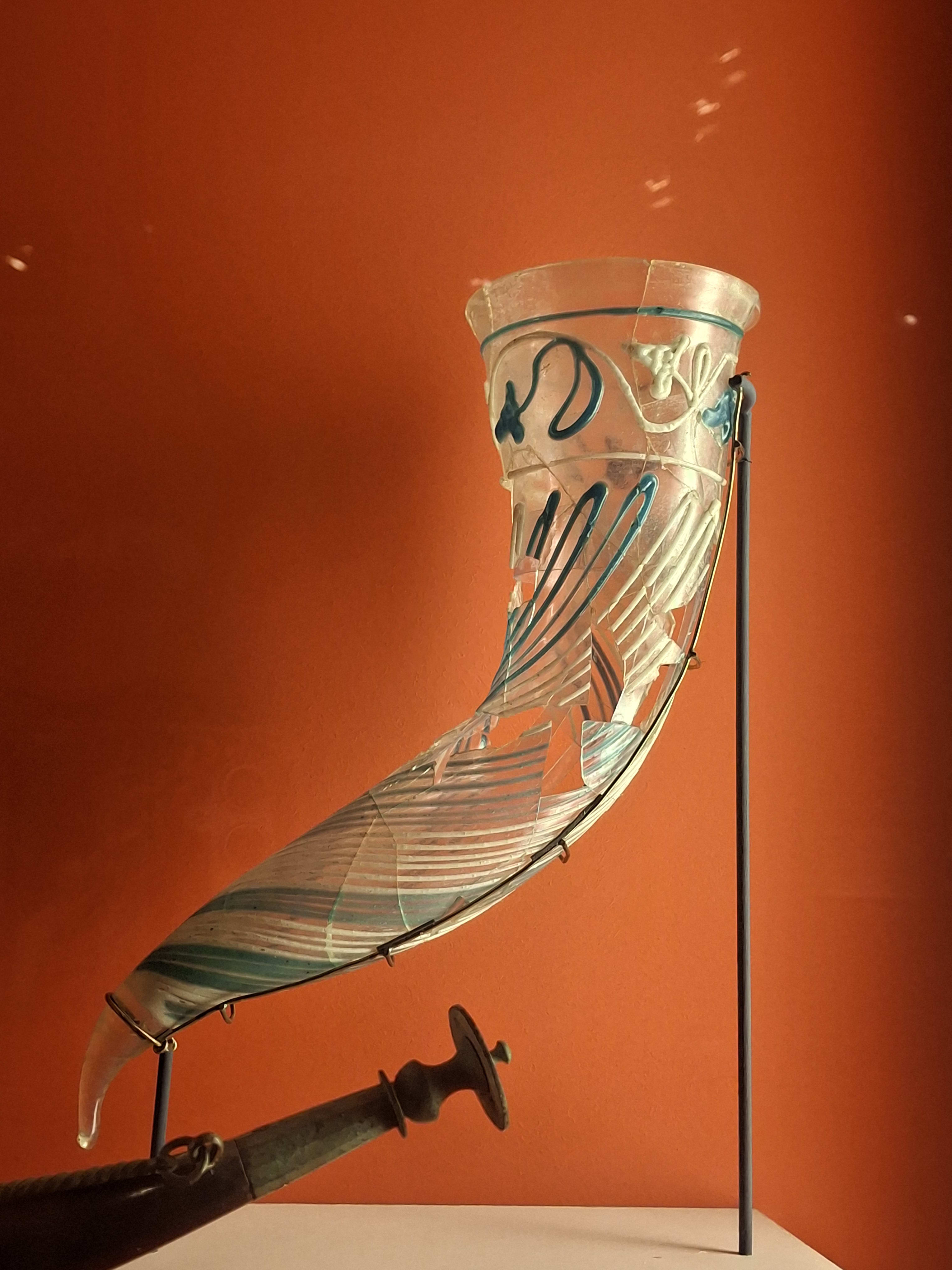
Not part of the Roman empire, but certainly plenty of contact: an Empire-era glass drinking horn, probably made by an Egyptian or Syrian glassblower, found in the grave known as that the man from Oremolla
Perhaps my favourite chapter in this book, for its intimate peek into lives both highly local and deeply global, was by Johan Rönnby, on the history of the remote island of Gotska Sandön, now an uninhabited national park but in the Middle Ages a key strategic site, something that is only gradually being understood, and important since the early Bronze Age around 2000BC, despite the fact that its waters were notoriously dangerous.
We mightn’t think of piracy in the context of the Baltic, but for much of its history the island was a natural haven for illegal, and quasi-legal (privateering) attacks on shipping.
In a letter to the city of Bruges from the year 1428, merchants and skippers going to Reval are warned of such attacks and urged to stick together for protection. The document also tells us that no fewer than nine ships loaded with salt were captured at Gotska Sandön in the summer of 1427…. In 1460, the new Danish governor on Gotland, Olof Axelsson Tott, complained that outlaws on ‘Sandaw’ had taken seven barrels of cod from him.” (p. 131)
But right at the end of its habitation, what a lovely piece of women’s history;
“Johanna Söderlund… came to the island in 1854 to work in logging with her husband. After his death and when the last private owner of Gotska Sandön, Jacob Paterseen, had closed down the business in 1857, everyone moved from the Gamla garden area to the new lighthouse village on the norhtern tip of the island. However, Madame Söderlund,as she came to be known, chose to stay at the old place, alone with her two youngest children. In addition to occasionally helping with certain chores, Madame Söderlund made a living collecting goods from wrecked ships. The small timber cottage where her sons grew up must have been full of peculiar foreign objects found along the island shore. The older son, Ferdinand, became a sailor when he grew up and travelled the great oceans, finally settling in Sydney Australia. The younger son, Hjalmar, stayed on his home island, became a lighthouse keeper and spent his free time diligently collecting old artefacts on the sandy beaches. The different fates of Madame Söderlund two sons thus reflect the dual nature of the remote maritime crossroads.” (p. 135)
While some today would seek to divide the world into “cosmopolitans” and people rooted in place, there’s a case study of how no one today is truly isolated and unconnected, a truth for centuries.
There’s a lot to be re-written too in our understanding of the medieval period.
“In Anglocentric Viking scholarship, the Viking age is often portrayed as starting with the raid on the monastery on Lindisfarne, on the coast of Northumbria, in 793. It is high time this notion is laid to rest. The first tangible, archaeological evidence of a Viking raid comes from near the Estonian village of Salme. It is dated to about 750, two to three generations earlier than the Lindisfarne raid. The finding consists of two boats, one presumably the first identified sailing ships from the Baltic Sea or other Sandinavian waters. Buried with the ships are 41 bodies, four of which are brothers and a fifth a close relative… Ample evidence of violence and violent death are present. All the bodies are males, ranging from adolescence to their thirties. Much care had been taken in the burial, indicating that they were buried not by the Balts they had raided but by their own… developments around the Baltic Sea from about 600 to 750 prefigure the Viking Age and apart from the intensity and scale of raiding and trading, there is not much to distinguish the Vendel and Viking periods from each other.” (p.27-28)
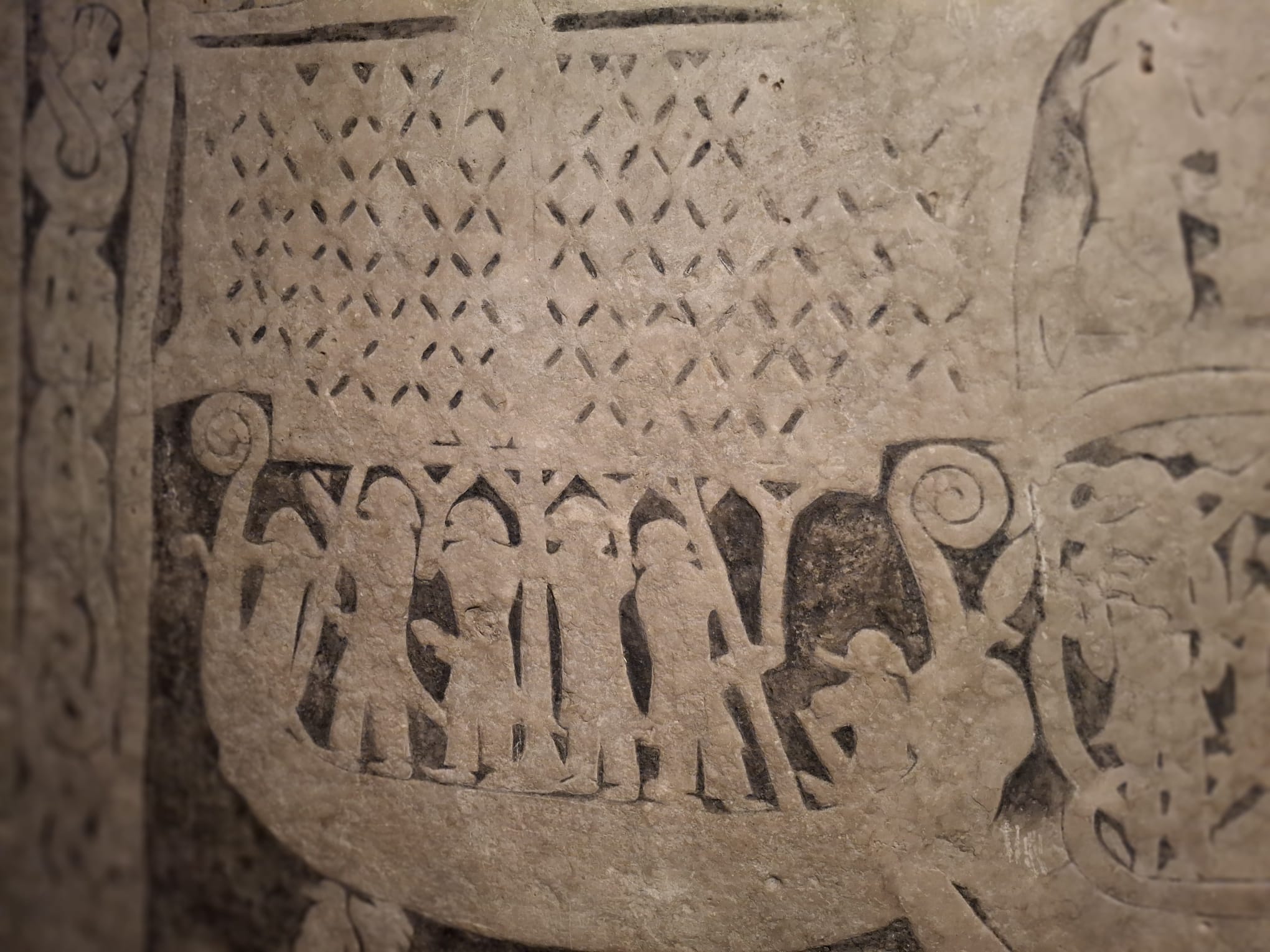
A sailing vessel on the Volund stone in the Stockholm History Museum. Recent historiography (and experimental archaeology) has started to acknowledge the enormous amount of female labour that went into the sails.
The political and military chapters are not perhaps the easiest to follow for the layperson, but the general overview is useful for today’s perspective. Even if sometimes the influences were very different.
“Before and after the 1649 Peace of Westphalia, England saw Swedish strength as an essential element of a pro-Protestant foreign policy that sought to protect the autonomy of the Protestant German princes. The parliamentarian leader Oliver Cromwell even remarked that England and Sweden were the ‘two columns’ of the Protestant cause on the continent and that a combination of the Royal Navy and Swedish land power together ‘might hold Europe in subjection”. (p. 275)
Sweden at various times has swallowed up Finland, Norway (although never completely, a bit like Scotland and England), and sometimes large parts of the facing Baltic Shore. While of course there was a period when Poland-Lithuania was dominant in the region, while Muscovy was long seeking to establish at least a strong foothold. But royal and aristocratic bickering, and religious and cultural differences, always got in the way of a single hegemon. So for example in the late 16th century:
“A lasting Polish-Lithuanian-Swedish union could have brought the dominion of the new empire over the Baltic region and that entire part of Europe. However… Sigismund III Vasa succeeded his father on the Swedish throne in 1592 but lost it due to a conflict with the Swedish aristocracy and with his uncle, Carl, Duke of Sodermanland. Furthermore, in 1600, the dispute over Estonia precipitated the outbreak of what became not a single war, but rather a whole series of Polish-Swedish conflicts. These hostilities emerged as pivotal events in the history of early modern Poland-Lithuania and undermined the Commonwealth’s international standing and significance.” (pp. 81-2)
Later, Russia scored a military victory that still resonates there - and is cause for contemporary concern.
“At the Peace of Nystad in 1721, Sweden lost Estonia, Ingria, Livonia and parts of Karelia… to Russia… Russia had gained a secure bridgehead into the Baltic and decisively emerged on the northern European scene. The victory at Poltava echoed long into the Russian historical consciousness. One of the major sections of the majestic Hermitage Museum in St Petersburg consists of paintings of episode from Russian history. In the first room of that significant showcase of national identity and pride hangs a gigantic canvas that signals the start of the journey. It is Alexander Evstafyevich Kotzebue’s The Victory at Poltava. In the painting, Peter I is respolendent on his war horse, while the Swedes lower their banners to the dust and, their heads bared, bow before the victorious emperor. In the foreground two Ukrainian Cossacks - allies of the Swedes - lie exhausted.” (p. 110) [Longterm close historical ties between Sweden and Ukraine is something we kept noticing again and again.]
But control of the sea was what really mattered.
“Looking at the history of the Baltic Sea region over the cerntuies we can see its history as a succession of powers that tried to control and close the sea: the Hanse, Denmark, Sweden, Imperial and then Nazi Germany, and finally the Soviet Union … [while other] powers … wanted to maintain an open sea, the Dutch Republic and England/Britain… essentially a conflict over the control of trade flows and maritime lines of communication. As memorably stated by Knud JV Jespersen: ‘In the 17th century, the Baltic played the same role for the two trading and shopping nations of western Europe, the Dutch Republic and England, as the Persian Gulf with its oil reserves plays for the industrial nations of the western world today.’ The region was a crucial supplier of timber, tar and hemp - resources upon which the maritime powers depended.” (p. 103)
Pine tar as a vital commodity was not something I’d come across before, but the material, derived from Pinus sylvestris, waterproofed ships, sealed rigging and preserved maritime infrastructure. It was produced in earth kilns by peasants in Finnish territories under Swedish rule. They also produced huge quantities of charcoal for iron production: “producing 1 ton of wrought iron required 80 to 100 forest acres”. (p. 182)
Politically, Muscovy was in many ways copying the Swedes, the “Swedish model” not just being the social democracy of the 1980s that led me to visit as an Australian backpacker with some kind of real expectations of equality and democracy in 1990. (With which I was rather disappointed. The level of expected social conformity seeming to me to be highly repressive, particularly on refugees.)
“Peter’s aim was to create a Russian administrative structure that was similar to the Swedish one. Peterson quotes the historian Klyuchevskii’s designation of Peter’s rule as ‘the epoch of Swedomania’: Russia was dressed up in a Swedish uniform. … Peter sent to Stockholm one Heinrich Fick from Hamburg, who had been in Swedish service from 1700 to 1710 and then had gone into the tsar’s service. Fick socialised in Stockholm’s upper circles and was able to receive detailed information about the Swedish administrative structure. He managed to acquire a book that contained 800 Swedish statutes from 1528 to 1701. He visited the Swedish administrative boards - ‘kollegier’ - and copied a great many documents… When he travelled in Europe in 1716-17, Peter studied the state structure in Denmark, Sweden, France and elsewhere … Many of the administrative developments in Russia were linked to the police regime and the custom of cruel punishments for breaking the new laws.” (pp. 120-121)
And this was whole-of-society repression.
“Peter abolished the patriarchate [severing from Byzantium] and supplanted it with the Holy Synod, a state institution… According to a decree from 1722, priests were obliged to report to the Secret Chancellery if a member of the community said something in confession that might be a crime against the state. From Peter onwards there were two Russian worlds, the dynamic, western Europe of Peter and the aristocracy - and from the 19th century the intelligentsia - and the stagnant Orthodox world of the people, the peasants.” (p. 122)
That takes us chronologically to two battles between the British and the locals that are almost totally forgotten in London, but not locally. So, the first battle of Copenhagen:
“When Napoleon Bonaparte seized power in France in November 1799, relations between Britain and her allies in the Second Coalition against France were deteriorating. Trade restrictions imposed by Britain were a particular point of contention, and Britain’s demand to search shipping in the Baltic Sea ultimately contribued to Russia’s departure from the coalition. Neutral powers were also angered by Britain’s increasingly broad definition of contraband and concomitant searches of their ships. This led to the formation in late 1800 of the League of Armed Neutrality, compising Russia, Prussia, Denmark-Norway and Sweden. In essence, the league was created to close the Baltic to Britain…. The vast majority of naval stores such as hemp, timber, pitch, tar and iron were imported to Britain from the Baltic region… The Royal Navy despatched 40 ships of the line to Danish waters and destroyed the Danish-Norwegian defences at Copenhagen on 2 April, 1802…the Royal Navy intended to extend its assault to Sweden. However the murder of Tsar Paul in St Petersburg on 23 March put the league in jeopardy; the Danish-Norwegian government seized the opportunity to negotiate a separate peace.” (p. 138)
Then the second battle of Copenhagen, as the tsar prepared to seize Finland from Sweden:
“The Royal Navy attached Copenhagen for essential the same reasons as six years previously. Suspecting that Denmark-Norway was about to cave in to Napoleon and leave her navy at his disposal to close the Baltic Sea to Britain, the Royal Navy was dispatched with nearly 30,000 troops. The charts made in 1801 enabled the British shops to cordon off Jutland, where the bulk of the Danish army was deployed. The British troops landed at Zealand on 16 August, whereupon they beseiged Copenhagen and bombarded the capital into submission. Following this ruthless display of force, the Royal Navy departed with the Danish-Norwegian navy in tow and 20,000 tons of naval stores, thus securing access to the Baltic Sea.” (pp. 140)
(The Bernard Cornwall novel Sharpe’s Prey is built around the siege, should you fancy a - well researched - fictional account.)
Amid all of the political upheaval of 1809 (part of it in Sharpe’s Rifles), there developed a political theory that states had to be large enough to survive. Prussia too was expanding into northern Germany, presenting a further threat.
“‘If Russia takes Sweden, they will take Norway later. If both are united, they can resist the whole world,’ propagandised the Swedish general and politician Georg Adlersparre. Hence several Swedish decisonmakers saw union with Norway and/or reconquest of Finland as imperative to Sweden’s survival. Finland was granted autonomy as a grand duchy, which divided the Finns over the question of reunification with Sweden. At the same time, the Danish state was beginning to crumble.” (p. 142)
But the volume doesn’t just stick to older history, but also takes us right up to today, with a tour via World War Two and its aftermath.
“The Baltic Theatre did not see any major naval battles … the war in the Baltic was largely one of mines. Classic naval thought distinguished between two major strategies of ‘sea control’ and ‘sea denial’… the Baltic is particularly suited to mine warfare. It is a sea of narrow straits, choke points and locks at both ends. The major aim of any enemy of the Soviet Union was - and still is to prevent its fleets leaving port, particularly from Kronstadt and St Petersburg. Another legacy is the enormous quantities of ammunition that were dumped in the sea after the end of the war. Normal ordinance - shells and cartridges - are a major problem even today as fishermen risk catching them in their nets or setting them off by dragging the seabed. There are an estimated 300,000 tonnes of ammunition in the German waters of the Baltic. An even more heinous problem, however, is the vast number of German chemical weapons that the Allies sought to neutralise by simply dropping them into the sea. Over time the metal containers of both conventional and chemical weapons corrode and toxic chemicals will be realeased into the water.” (p. 170)
But today’s concerns remain those of history also. The Baltic represents just 0.1 per cent of global marine ecosystems, although one of the largest brackish seas in the world. But 15% of global merchant shipping passes through it. (p. 287)
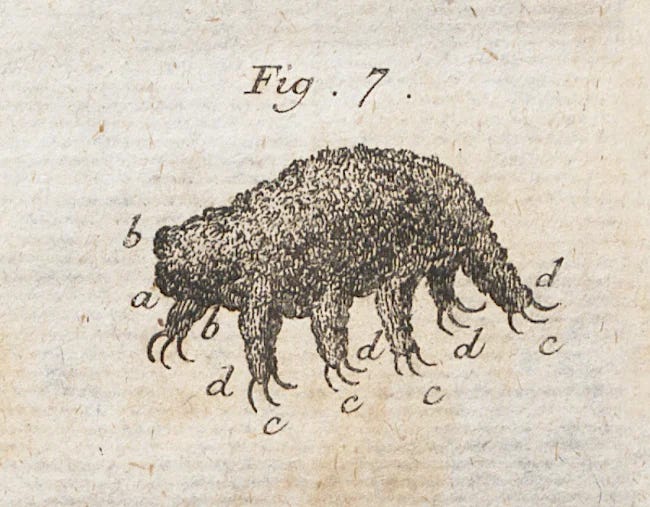
Having been the first person to use the word “tardigrade” in Hansard, I’ve got a bit of a soft spot for them (who hasn’t really), so got to point to this lovely little post about the first-ever published image of one, from 1773. It was by German pastor Johann August Ephraim Goeze, who called them kleiner Wasserbär, “little water bears”. “Tardigrade” came later in 1777, when Italian biologist Lazzaro Spallanzani acknowledged how slowly they moved.
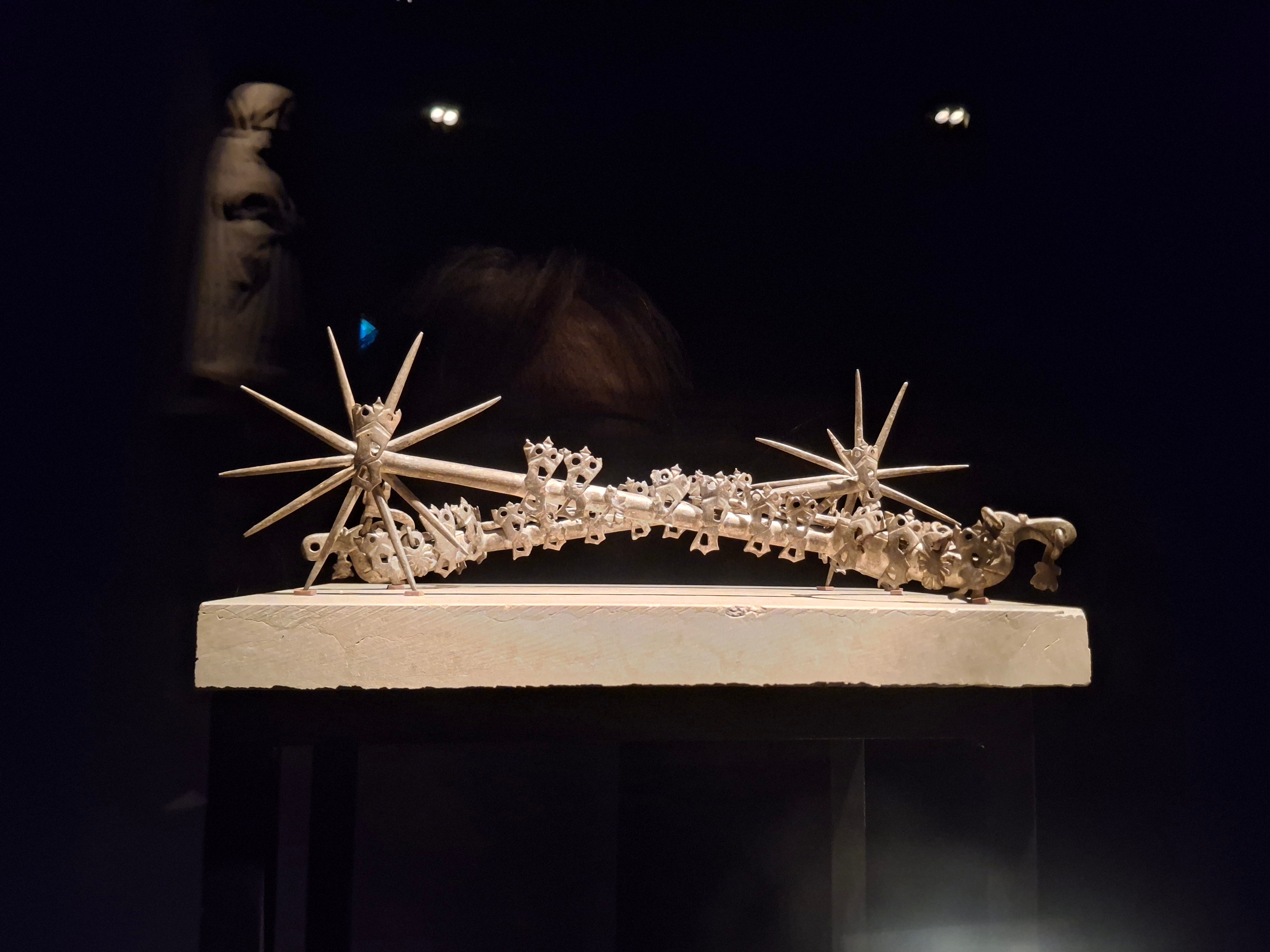
And a bit more fun from the Stockholm History Museum - Saint Olaf’s Spurs: oh no they weren’t: supposedly 11th-century but actually 15th-century. Certainly fancy!
What did you think?
You can also find me on Bluesky, Instagram, Facebook, LinkedIn, TikTok and X.
Comments
Nothing yet. Say the first thing.
Sign in to join the conversation.