
Hawthorn is one of my favorite herbs and teachers in times of grieving, an herb that protects the heart while teaching us to be patient. Hawthorn trees grow slowly, but can live for a long time, sometimes for centuries. The genus name for hawthorn, Crataegus, comes from the Greek word “kratos,” meaning strength, referring to the hawthorn’s durable branches. The wood of hawthorn is very hard and is considered an excellent tool wood, and hawthorn trees are sometimes grown close together to form a natural boundary, or living fence, for protection.
This powerful tree provides flowers, leaves and berries rich in antioxidants and flavonoids that tone and nourish the heart. Hawthorn leaves and flowers are often brewed into a cardiac nervine tea. Herbalist Juliette de Baïracli Levy writes that a poultice of the pulped leaves or fruits of hawthorn also has strong drawing powers, and people have long used hawthorn in the treatment of embedded thorns and splinters.
Hawthorn strengthens blood capillaries and supports the repair of muscles, tendons and ligaments, and people drink hawthorn tea to help heal their bruises. As herbalist Rosemary Gladstar writes: “Hawthorn works in part by dilating the arteries and veins, enabling blood to flow more freely and releasing cardiovascular constrictions and blockages. It strengthens the heart muscle while helping to normalize and regulate blood pressure. It also helps maintain healthy cholesterol levels. Hawthorn is outstanding both to prevent heart problems and to treat high or low blood pressure, heart disease, edema, angina, and heart arrhythmia.”
However, to enjoy hawthorn’s full healing potential as a heart tonic, it is important to take it on a daily basis over a long period of time, as it does not store in the body and is not accumulative in action.
Hawthorn is a member of the Rosaceae family, and a close relative of the rose, another herb with a strong affinity to the heart. In The Jewish Book of Flowers, I translated a romantic Sefardi ballad from Bosnia that describes a couple that died and were buried near each other. A rose bush grew over her grave, and a hawthorn bush grew over his:
De ella nació un rosal bianco, dél nació un espino albar;
crece el uno, crece el otro, los dos se van a juntar;
las ramitas que se alcanzan fuertes abrazos se dan,
y las que no se alcanzaban no dejan de suspirar.
From her was born a white rose bush,
From him a hawthorn;
One grew, and the other grew, the two will join together;
The branches that reach each other embrace tightly,
And the ones that cannot reach do not stop sighing.
I love to prepare a hawthorn and rose tea for supporting the heart in moving slowly through deep sadness and grief. This tea is most effective when taken every day over a long period of time, and can be enhanced with some homemade hawthorn elderberry syrup (See my recipe below).

Hawthorn and Rose Grief Tea for Av
Ingredients:
1 part dried hawthorn leaf and flower
1 part dried rose petals
Hawthorn elderberry syrup (optional)
Instructions:
Heat up your water. Once it is almost at the boiling point, remove from heat.
Pour the hot water into your cup containing your herbs (I recommend using a strainer to avoid having many plant particles in your tea).
Allow your tea to steep for 5-10 minutes, then strain.
Once your tea is strained and ready, add a spoonful of hawthorn elderberry syrup, and mix in. Among Jews, adding fruit syrup or fruit jam to herbal tea is a popular way to sweeten it.
Hawthorn & Elderberry Syrup
Elderberry syrup is a popular natural remedy believed to support the immune system, especially around flu season. I like to add hawthorn berries to my homemade elderberry syrup for extra heart support.
Ingredients:
3½ cups of water
⅓ cup of dried hawthorn berries
⅓ cup of dried elderberries
Instructions:
Pour the water into a saucepan and add the hawthorn berries and elderberries. Bring to a boil.
Uncover the pot and reduce the heat to a simmer for about 45-60 minutes, or until the liquid has reduced by almost half.
Remove from heat and let it cool until it can be handled.
Carefully mash the berries using a potato masher, spoon, or other flat utensil.
Pour the mixture through a strainer or cheesecloth into a glass jar or bowl. Compost the berries and let the liquid cool to lukewarm.
Once the liquid is no longer hot, add the honey and stir well until it is well mixed into the berry mixture.
Pour the syrup into a jar or other glass bottle, and label it with the date.
Store the syrup in the fridge.
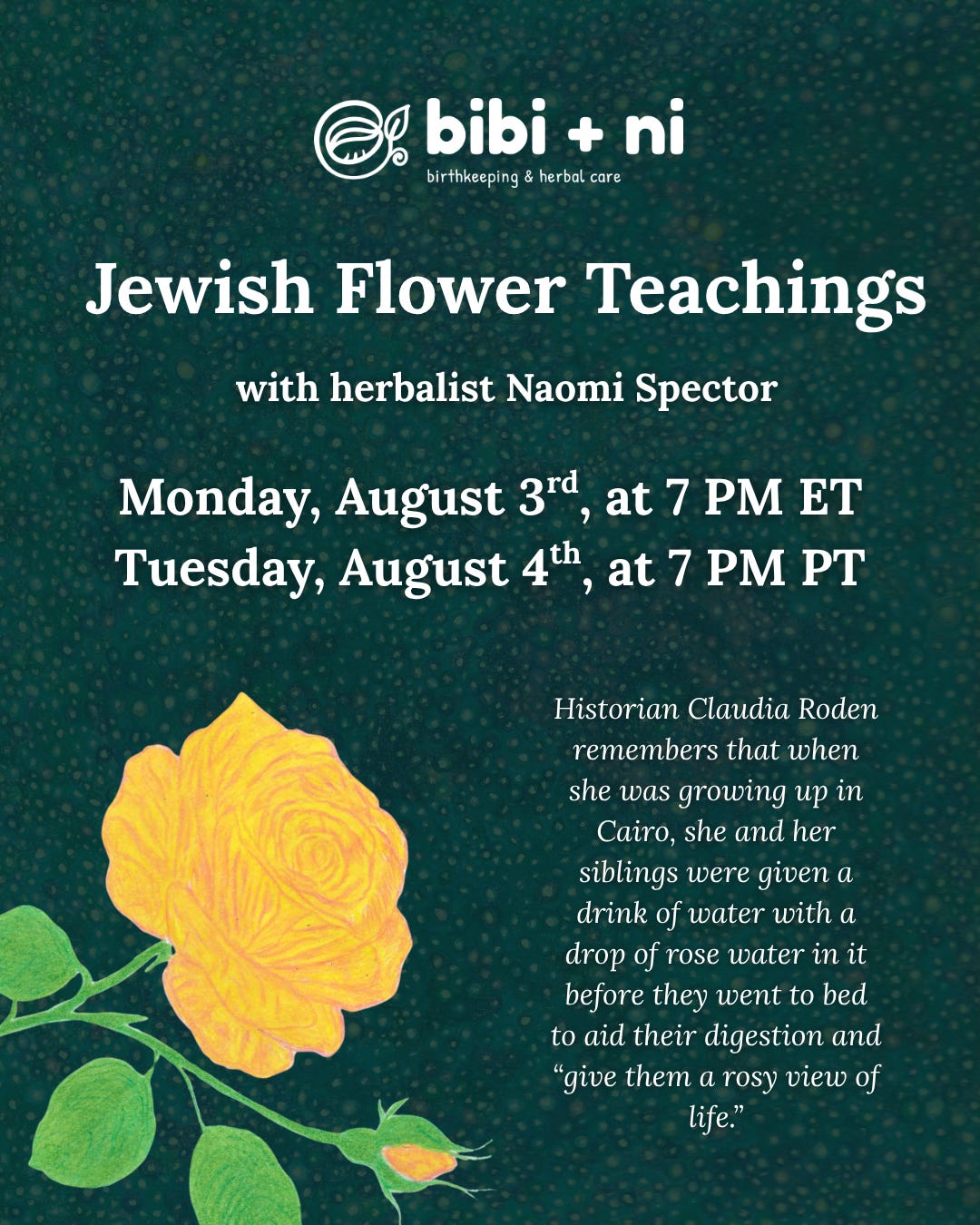
This class will take place on zoom on two different dates to accommodate folks in different time zones: Monday, August 3rd, at 7 PM ET, OR Tuesday, August 4th, at 7 PM PT
Sources:
Common Herbs for Natural Health by Juliette de Baïracli Levy
Rosemary Gladstar’s Medicinal Herbs: A Beginner’s Guide: 33 Healing Herbs to Know, Grow, and Use by Rosemary Gladstar
The Jewish Book of Flowers by Naomi Spector
To learn more about…
Rose and elder in Jewish herbalism, read my book, The Jewish Book of Flowers
Fruit syrups and preserves in Ashkenazi folk medicine, read my Gashmius article: Raspberry Medicine from the Shtetl: Two Recipes and a Brief History
Disclaimer: The information in this article is intended for general informational purposes only and does NOT constitute medical advice. Always consult with a qualified healthcare professional before making any decisions about your health or treatment. The information provided is not a substitute for professional medical advice, diagnosis, or treatment.
No posts
Comments
Nothing yet. Say the first thing.
Sign in to join the conversation.