
Please click on the little heart in the upper left corner—it builds my creds with the bosses.
July is usually a splendid month: Summer flourishes as cherries yield to peaches and the grapes start to think about taking on a little color. On farm stands and markets, early tomatoes begin to appear, still tentative, still streaked with green, but that’s okay. In Italy, slightly immature tomatoes are what we seek out for our salads, their acidity tamed by a richly generous glug of extra-virgin and a crunch of coarse Sicilian sea salt. And the anticipation of what’s to come is another part of July’s appeal—corn first of all, and then all those beloved Mediterranean fruits, lush ripe tomatoes, eggplant, sweet peppers, dewy young onions, the kind of flavors that are never better than when straight from the garden and we so seldom get the rest of the year. (Any time you doubt me, try an eggplant in January, imported from Mexico or Peru, tightly packed, refrigerated, flown with all its kin to some southern emporium, then trucked straight to your local supermarket produce section—and then try to tell me I’m wrong.)
But this year, for me, July was different and without going into too much detail, it has been a trying month, physically with a lingering bug that might be going away (although I touch wood with both hands as I say that) plus the mental distress over what is happening in my country, my state, and even my little home town, riven by discord and ill-concealed hatreds. I say ill-concealed but locally most of the haters make no attempt at covering their sins and simply express their vilest opinions in public on Facebook for the whole world to see. And it’s all about whether or not to have paid parking downtown—with the Middle East in flames, it’s kinda hard to get my head around that.
Why is it so difficult to disagree without casting aspersions on the honesty and credibility of other people? Why is it so hard to see a different opinion as anything but a conspiracy? The Fauci “hearings” only compounded my distress. The despicable behavior of Republican senators toward one of our most distinguished citizens, a man who should be honored rather than reviled, was quite simply loathsome. Yes, Dr. Fauci was sometimes wrong in his conclusions, in his recommendations, but scientists very often are. Science, after all, is a progressive process that relies on an accumulation of facts, of knowledge, and scientific truths that can be mutable. To suggest that it is or was a conspiracy on Dr. Fauci’s part betrays profound, I would go so far as to say, depraved ignorance. Rand Paul and his colleagues should hang their heads in shame.
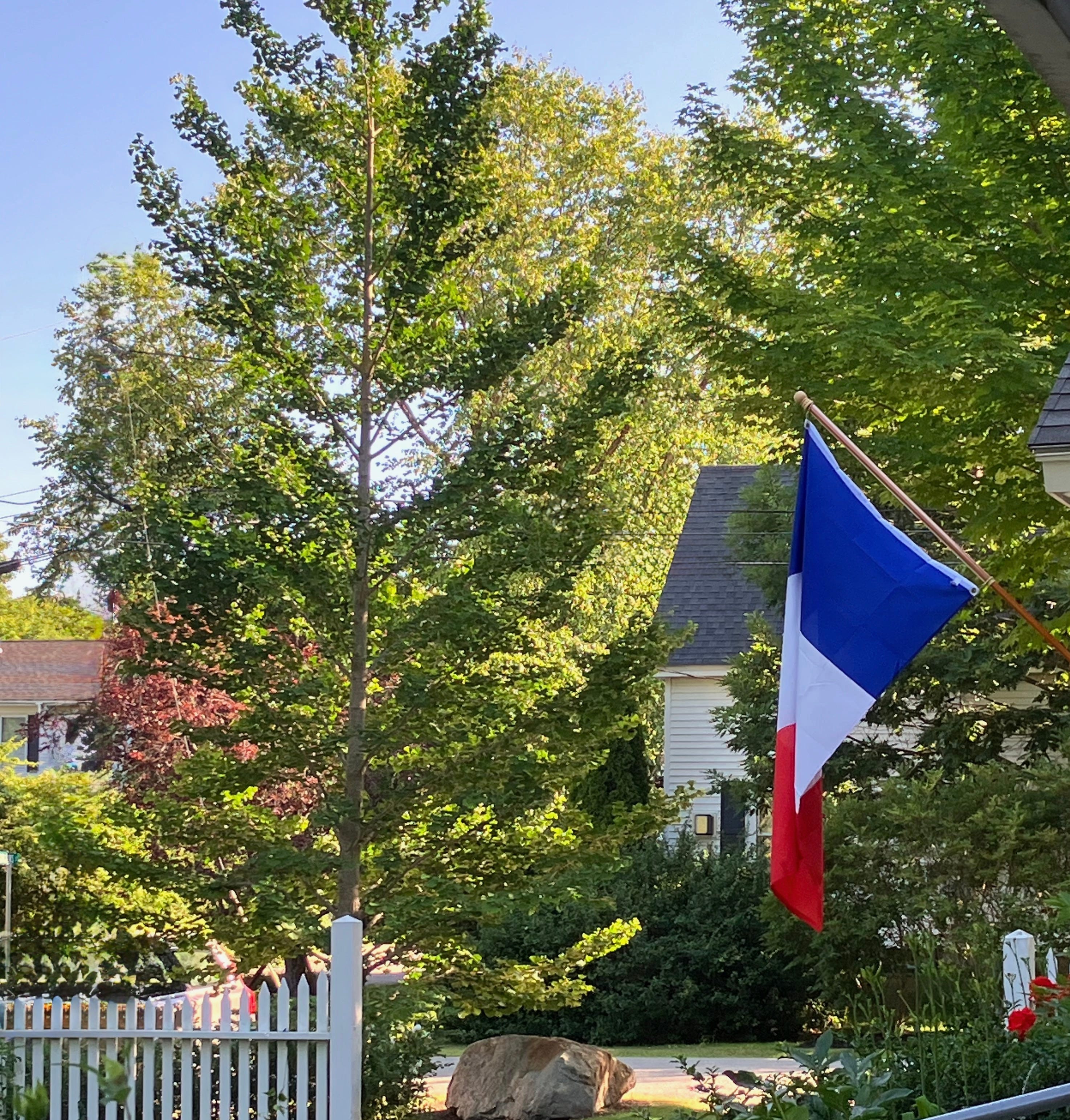
It wasn’t Bastille Day--it was Sunday, July 12th, and Bastille Day, the French national holiday, is actually the 14th, le quatorze juillet. But my neighborhood was having its monthly get together and why not, said Allison who had lived in France, why not celebrate French style with the anniversary of the revolution just two days away? As it was my turn to host the gathering, I found online a French tricolore to hang from the flagpole by my front door and planned on providing plenty of well-chilled Provençal rosé.
Briefly I thought of kir, that nearly magical combination of black currant liqueur (crème de cassis) and dry white wine (at its best, with champagne, it becomes a kir royale) but there was no crème de cassis to be found within a hundred-mile radius, and gas prices being what they are, I could not justify driving to Boston for a single bottle of booze.
My Maine neighborhood is a street of mostly single-family homes that curves gently uphill to Mt. Battie, a rocky hump of a mountain, just 240 meters above sea level, hovering like a giant boulder over our town. A year or more ago two enterprising neighbors, Allison and Vicki, set out to organize monthly meetings, get-togethers, not for any purpose beyond knowing our neighbors better and understanding when and why folks might need or lend a helping hand.
Allison had shown herself to be a champion planner of just about anything and Vicki had several years of experience as our town’s representative to the state legislature. It turned out to be a good and popular idea, one way to take back a sense of community that was still unsteady from the effects of CoVid and its implications. In the event, it has become a solace against all the meanness that surrounds us these days, and I recommend it to all of you who live in a neighborhood, even an urban neighborhood, a city apartment block, or a rural terrain of scattered farmsteads. Start small, with the folks on either side of you, and gradually spread out to include more and then more. Community is something we humans, like most mammals, cherish and it is what makes us stronger, much stronger, than individuals on their own. Ask Odysseus, if you don’t believe me! It took him ten years to get home to Ithaca, to the community that he knew, but he pursued it beyond all temptation otherwise.
Since we began these communal get-togethers, different households, different people, different families, have pitched in to host. And so, for Bastille Day, it was my turn. But what to serve? Something in keeping with the spirit of the holiday, something that would easily feed at least 30 people, something delicious on a warm July Sunday afternoon, and something that would go as well with chilled rosé as with iced tea or even with the gimlets that one guest brought in a thermos.
How about. . . pissaladière? Yes!
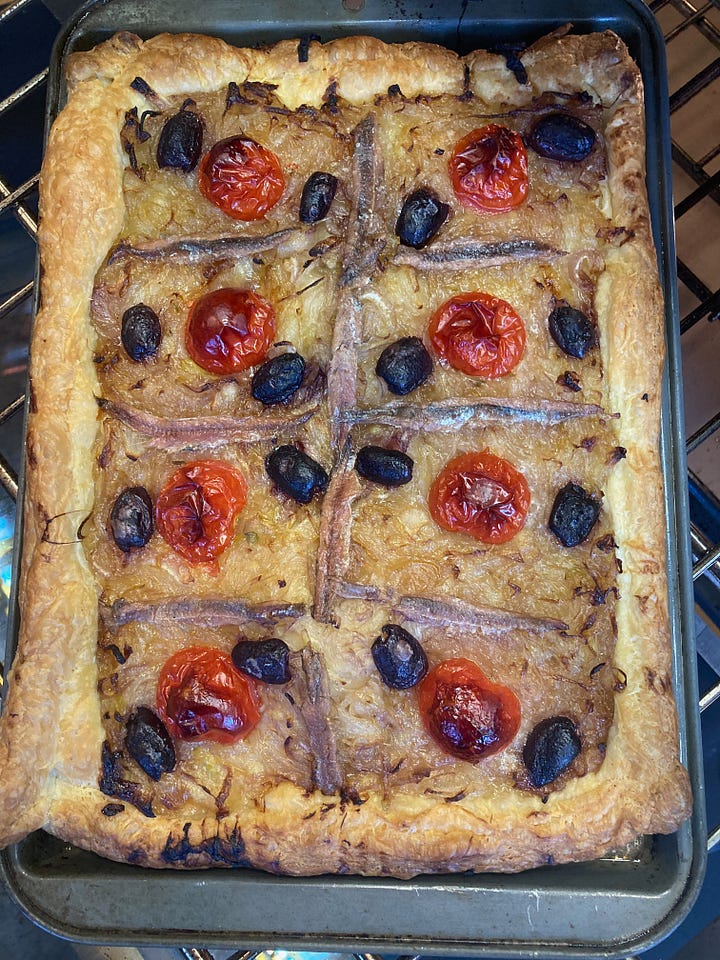
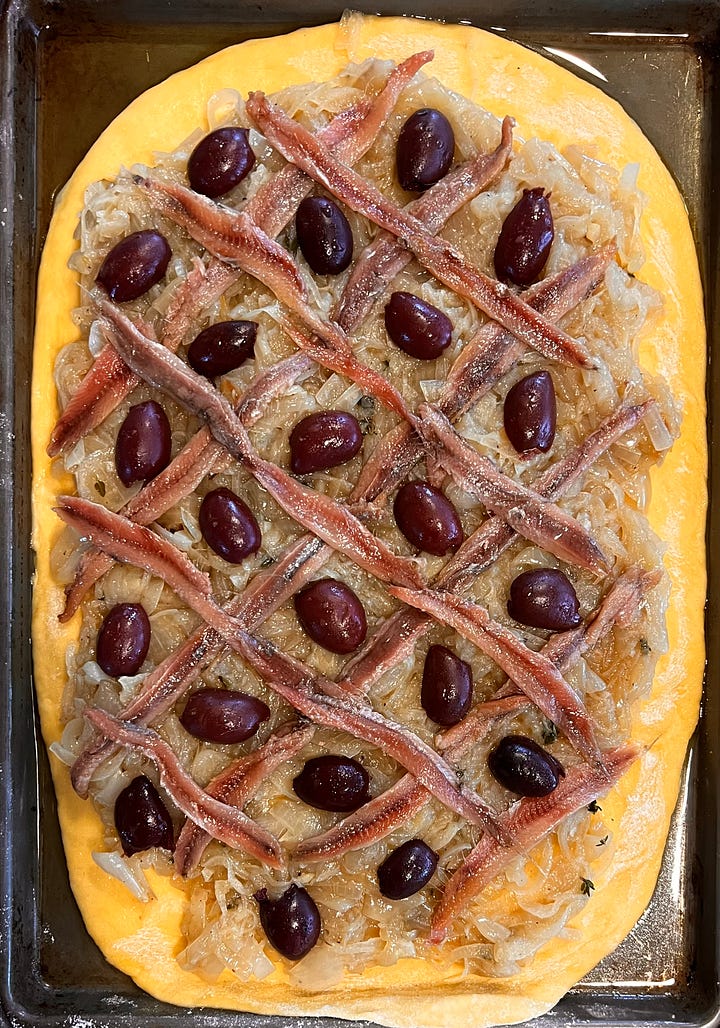
I’ve made the savory Provençale onion tart many times in many different ways but never for a crowd. That would require a considerable increase in ingredients, which led me to consult a little recipe book I acquired some time ago, La cuisine niçoise d’Hélène Barale. Years earlier I had visited Hélène Barale’s small, unassuming restaurant, not quite a hole-in-the-wall, on an obscure side street in the oldest part of the old Mediterranean town of Nice, not far from the Vieux Port with its constant hum of water traffic. It was called Chez Barale or sometimes Chez la Mère Barale. The restaurant over which la mère presided with strict but genial authority was actually the house in which she had been born and raised. It had the established look of a comfortably tidy, old workshop, walls hung with fading photographs and framed paintings, shelves holding a clutter of kitchen tools and farm implements as well as antique radios and the odd coffee mill or mortar, often missing its accompanying pestle. I liked to think Madame Barale herself used that ceramic mortar to pound out the garlic and basil sauce to garnish her soupe au pistou (lou pistou en soupa) or the aïoli that was the focus of a traditional grand aïoli with morue, salt cod, poached and served at the center of a platter, surrounded by little new potatoes, fat leeks and carrots, fennel, celery, and hard boiled eggs, all to be consumed with lavish scoops of that creamy yellow aïoli in its green-glazed bowl.
Pissaladière was one of an array of such time-honored dishes, all part of the great tradition of la cuisine niçoise, of which Mme Barale was a rigorous defender. She was, according to her daughter Paule Laudon, writing in the introduction to the cookbook, “la mémoire de Nice,” the memory of this great city. Her repertoire, which varied only with the seasons and very little from one dinner to the next, always included pissaladière as well as socca, a thin pancake of chickpea flour quickly baked in a very hot oven, preferably wood-fired, that is similar (I daresay identical) to farinata (sometimes called cecina) from Liguria, the neighboring Italian region--yet another clue to the way modern political frontiers fail to jibe with true cultural borders. Of all these dishes, Mme Barale’s pissaladière was the most memorable, truly “la meilleure du monde,” according to her daughter, “the best in the world.” My recipe, below the pay wall, is based on hers and on what I ate that remarkable evening when I finally got to her restaurant.
What else did we have? It’s hard at this distance to recall and the notebook in which I kept my records of that visit has disappeared. But we surely had a pasta dish, probably the ravioli she made filled with finely minced chard, a favorite Nice vegetable, mixed with the meaty juices from the stuffed veal shoulder that was the main course—also filled with chard chopped with rice and onion, ham, eggs, and fromage de Fribourg, a sort of gruyère of which Mme Barale was very fond.
Alas, the restaurant is no more and Madame Barale herself died more than 20 years ago. I won’t encourage you to look for that cookbook because it is devilishly hard to find and I cannot remember how I came by it. It was published in 2006, a few years after her death, by Èditions Gilletta Nice-Matin. The good folks at Kitchen Arts & Letters were not encouraging but it might be worth exploring on the internet to see if a copy is lying about, forgotten in some library somewhere.
This has taken me a long way from our Bastille Day celebration but let me just add that the pissaladière was a huge success—not a crumb was left. And I never got to taste it myself!
I have Regime Change loaded on my Kindle. That’s the devastating examination of Trump and his current administration by Maggie Haberman and Jonathan Swann and it is deservedly a best-seller. Asking around among all my friends, colleagues, followers, old boyfriends, and ex-husbands, I guarantee you almost everyone is reading it or has read it or is going back for a second look. I try to read a little before bed every night but honestly it is distressing and disturbing and requires a breather every 15 minutes or so, every time Trump reverses himself and veers off in another crazy direction.
When that happens, I turn to Jill Lepore’s wonderful Book of Ages: The Life and Opinions of Jane Franklin. How to describe this “biography” of Jane Franklin, Benjamin’s adored younger sister, who seldom left her home in what’s now (and was then) the heart of downtown Boston where she married at 15, raised nine or ten children, lost many of them to accidents and diseases, made soap and took in boarders to support her family, and led a life that was utterly the opposite of her glamorous elder brother’s. And yet, because of him and because of the times, she was fully involved in everything that was happening in those dramatic revolutionary years when our country was taking shape. Lepore is the absolutely finest kind of historian, dead accurate as far as the facts go, yet willing to deal with the kinds of ambiguity that the best historians uncover, and withal a gifted writer who brings immediacy to the picture, plunging the reader right into that amazing almost lost world.
Well, I’m not watching MSNBC or whatever it’s called, nor am I watching the latest Criterion on Netflix output. What I’m watching with utter fascination is the hummingbirds, the dragon flies, and the bumble bees that are delirious over the blossoms of my slightly blighted bee balm, aka monarda, aka wild bergamot. Look sharp and you’ll see the hummingbird, almost in the center of this shot, which I am proud to have managed as the tiny critters are almost too fast for my lens.
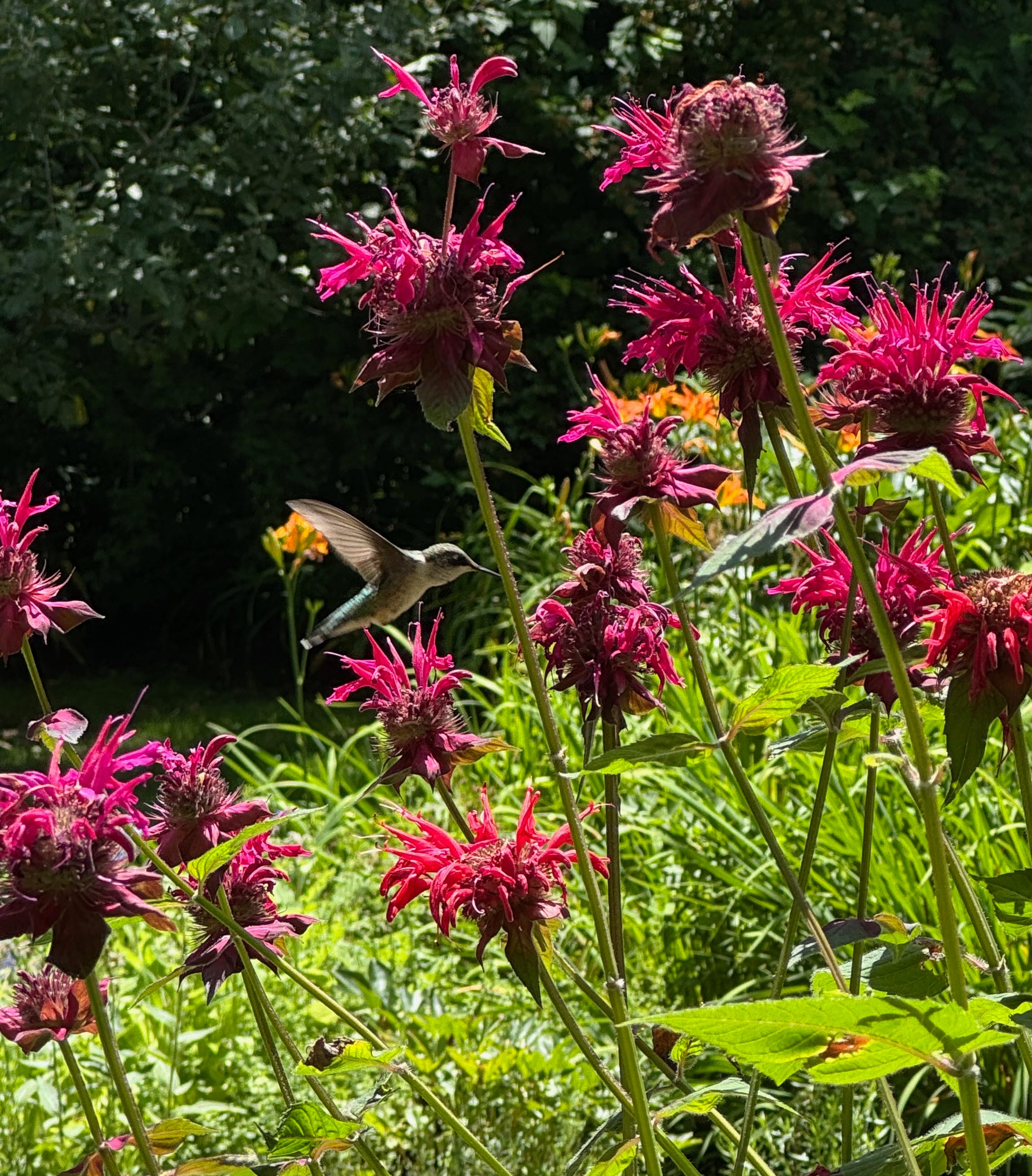
What astonishing creatures, and no, I don’t give them sugar water in feeders. If sugar water is bad for me, I figure it can’t be good for the birds.
As for the bee balm, it is, like hummingbirds, an American native. This scarlet variety is Monarda didyma, according to my favorite plant authority John Forti, whose book, The Heirloom Gardener, I consult whenever a question comes up, whether in the garden, in the woods, or along the roadsides. A further boon, the book is illustrated by Mary Azarian, an artist whose work I’ve admired for decades.
And just to link this to the Revolution (American this time, not French), Forti tells us that bee balm was widely used by colonists as a Liberty Tea when black tea was embargoed after the Boston Tea Party. I have yet to make myself a cup of bee-balm tea but maybe some cold day in January it will be just what’s needed.
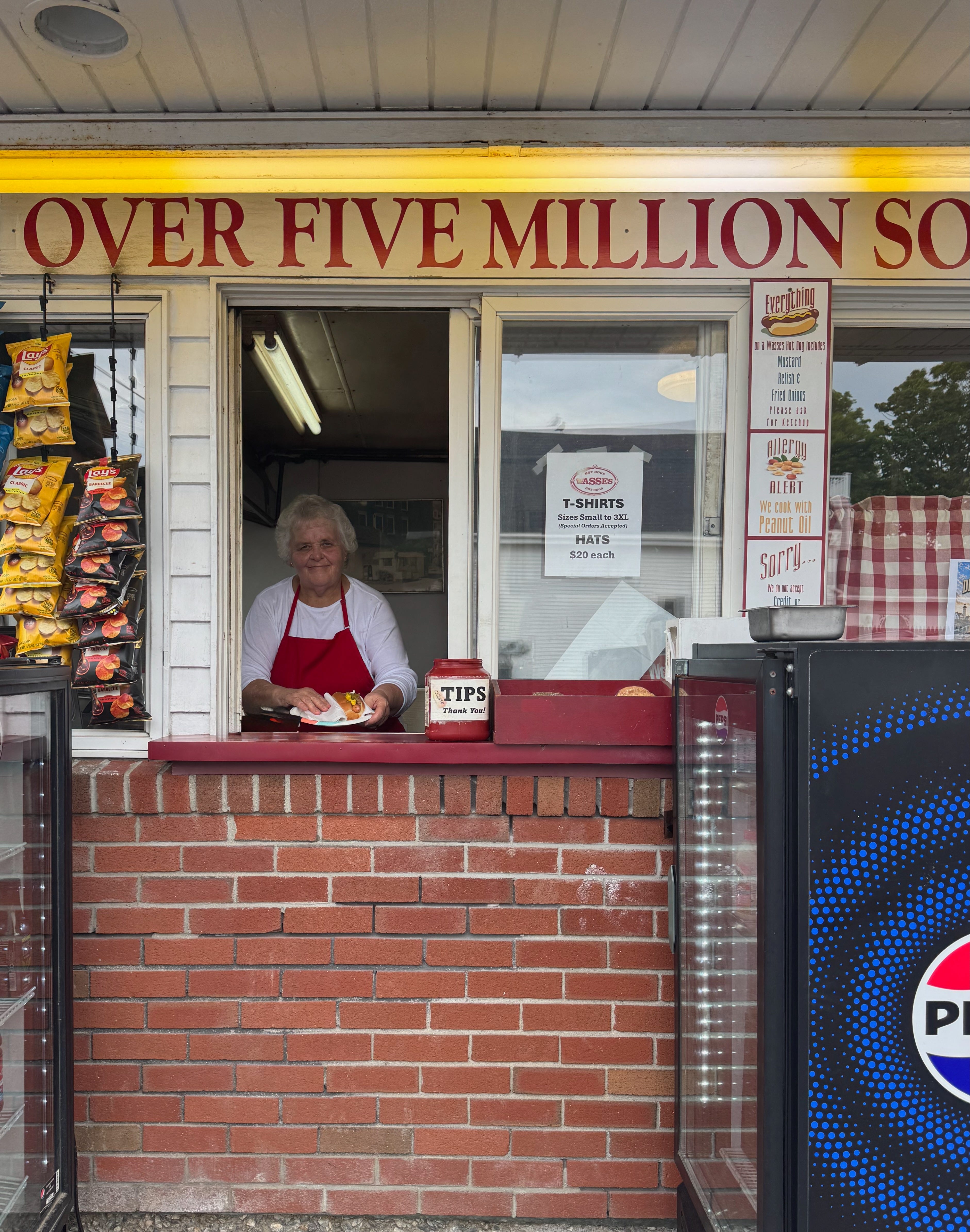
On the lighter side of July, I somehow totally missed National Hot Dog Day which was July 15th. It was barely acknowledged, least of all by a food media that is otherwise ravenous for content. Too bad because hot dogs are, when you come right down to it, our national culinary icon. You can have your shawarma wrap, your tacos al pastor, your deep-dish pizza, your sweet-and-sour pork, even your chicken tikka masala. According to the National Hot Dog and Sausage Council (my imagination soars at the thought of their annual convention), Americans consume 20 billion hot dogs a year, or about 70 hot dogs each, man, woman, and child. And July is unquestionably the peak of the season.
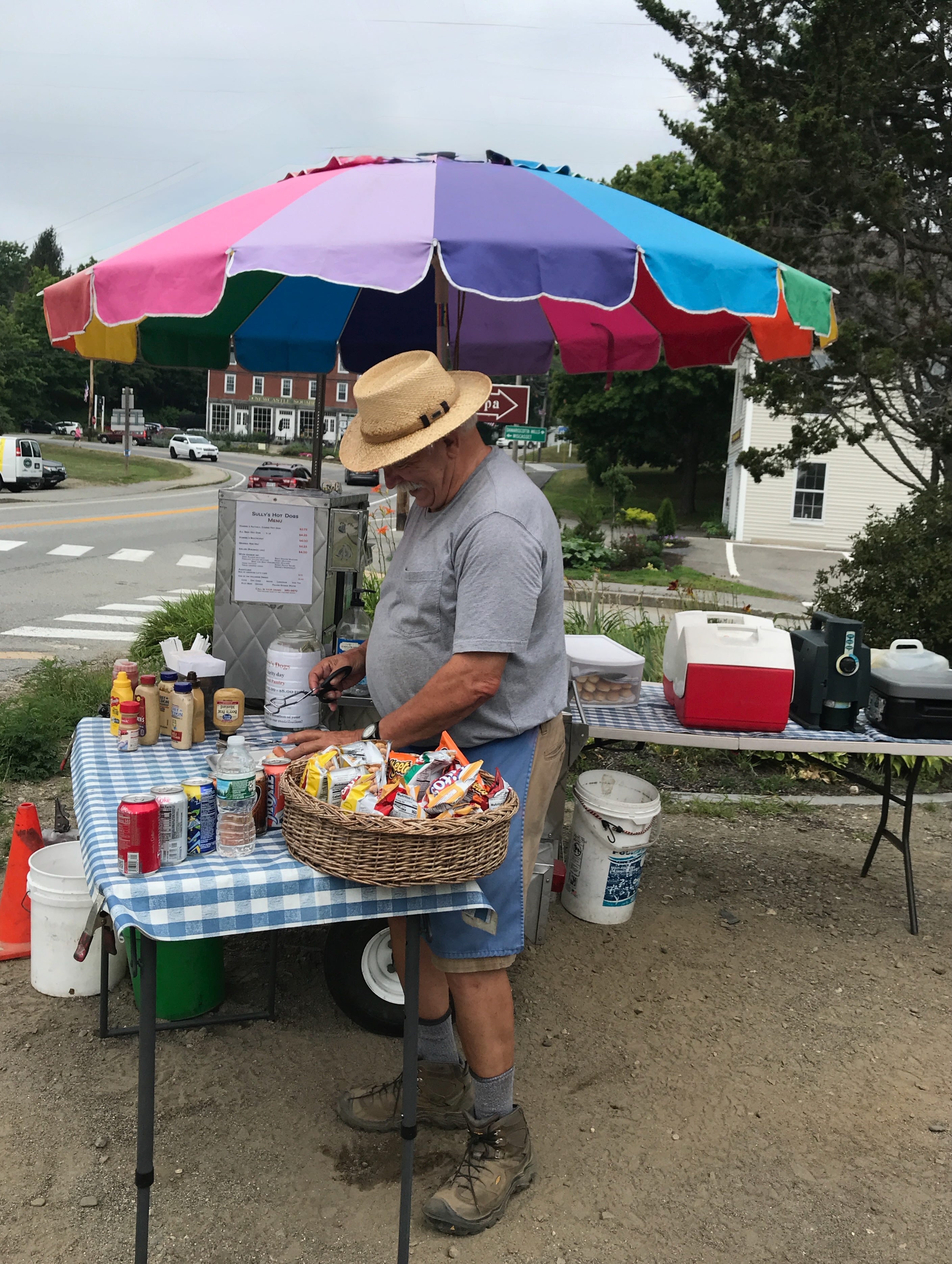
Maine, surprisingly, ranks very high in hot dog consumption. Nationally, we are Number 9 (again according to the NHD&SC) and consequently we have a variety of top-of-the-charts hot dogs from which to choose. My personal favorite is Wasses’ Wagon, a historic spot in Rockland’s North End, not far from where the island ferries dock, but I have it on good authority that Flo’s in southernmost Cape Neddick is an equally high winner. I’ve never had a Flo’s dog but a friend sent me a jar of Flo’s famous relish and just based on that, I’m planning a stop next time I head to Boston. And then there’s Scott’s Place in the Reny’s Plaza in Camden. Reny’s, as Maine’s most Mainely department store, is also worth a visit for a sense of how we locals live. (And how we vote—which seems to have bewildered the national press, but that’s a theme for another time.)
Comments
Nothing yet. Say the first thing.
Sign in to join the conversation.