
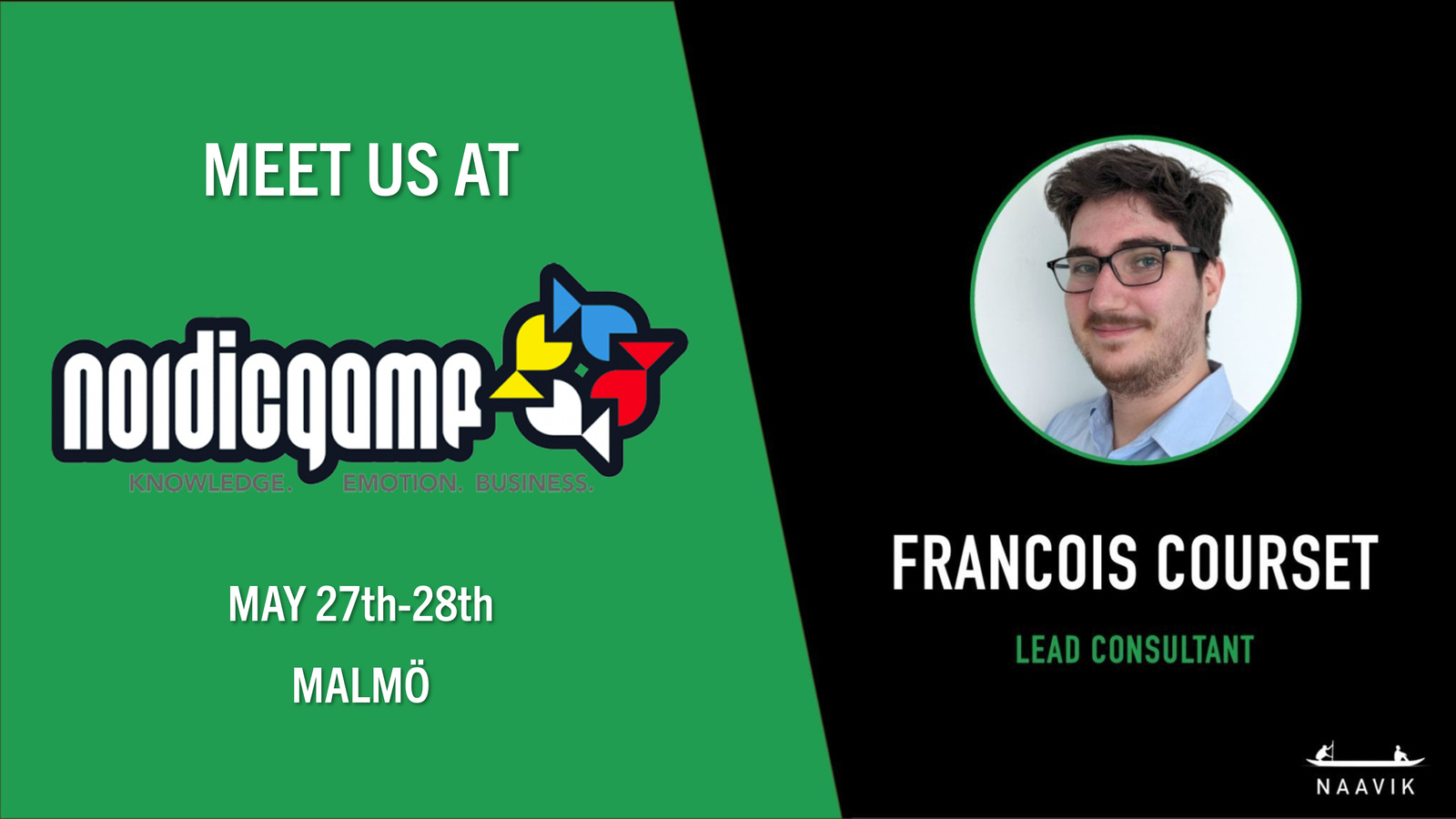
Hi everyone! Naavik’s team will be at Nordic Game 2026 in Malmö on Wednesday and Thursday, May 27-28. If you’d like to discuss ways to work with Naavik — partnerships, consulting, advisory, fractional talent, sponsorships, and more — or discuss the AI x Gaming landscape, please let us know by filling out this form. We’d love to chat!
This week, we're diving into Astrocade's landmark $56M raise and what it signals for the future of AI-enabled UGC platforms. For further context on AI and UGC, our latest podcast episodes feature conversations with the founders of Dorian, a no-code UGC platform, and Lemonade, which builds AI tools for creator workflows — both worth a listen.

AWS for Games gives you everything you need to build, run, and grow innovative gaming experiences. Leaders across the gaming industry rely on AWS’s more than 16 years of games expertise to launch and run some of the world’s biggest games, including Fortnite, Roblox, and League of Legends.
AWS and over 300 AWS Games Partners offer the broadest and deepest set of purpose-built services and pre-built solutions for cloud game development, content creation, game backend and infrastructure, and player acquisition, retention, and monetization. These empower game developers to build healthy global player communities, gain player insights, personalize and monetize player experiences to build lifelong fans. 750 million gamers each month, around the world, play games built on AWS.
Learn how AWS can help you build, run, and grow innovative gaming experiences.
Written by Francois Courset, Lead Consultant at Naavik
On May 6th, Astrocade announced a $56M Series B, the largest disclosed funding round for a consumer-facing AI gaming platform, supported by proven consumer traction (5M MAUs). Astrocade’s mission is simple: “Create games with AI instantly: The first platform that makes the creation of games and interactive experiences easy enough for a world of creators to share their ideas in minutes.” Behind the scenes, Astrocade’s trajectory is impressive. The AI-enabled UGC platform pulled off the round only eight months post-launch and just over two years after its seed round.
Let’s dig in to explore what’s catalyzing Astrocade’s growth, what challenges lie ahead, and whether lowered creation barriers could allow a new entrant to meaningfully compete with Roblox’s decade-long head start in UGC.
Astrocade offers a glimpse into a radical evolution where AI has its fingerprints on everything — thumbnails, art, music, gameplay — in a familiar though slightly unsettling way. The content library showcases bite-sized experiences that draw liberally from recognizable genres, games, and IP.
Astrocade functions as a UGC platform in which anyone can prompt a game into existence, share it instantly, and explore an ever-expanding library of peer-created experiences. The platform is currently available on the web and a recently launched Android app.
Differentiators lie in the games’ format (short, vertical, casual-hypercasual style experiences) and in a technology stack built to minimize creation barriers. Users describe a game in natural language; Astrocade’s proprietary orchestrator model — branded “AstroBrain” — then coordinates a suite of specialized AI agents that handle visuals, UI, gameplay logic, animation, music, and sound. The output is a playable game runnable in-browser.
For players, game discovery is architected around three paths, largely borrowing from social media:
The home page functions as a curated storefront, surfacing featured and recommended titles alongside genre-based categories — Horror, Incremental, Meme, Rhythm — with total play counts displayed to provide social proof.
The feed page is where the platform’s social media DNA is most visible: a vertically scrollable, TikTok-style interface that pairs one-click play with standard social actions — likes, comments, shares, and favorites.
Creator pages allow players to follow individual developers and explore their creation catalog.
For creators, Astrocade’s Studio tab is straightforward: describe the game you want, review the AI’s content suggestions, and with one click, let the platform handle the rest. What follows is approximately ten minutes of computation that produces a fully playable game that can be tested and shared with other players, including full-fledged gameplay, audio, and art assets. The outputs are then editable, either through engaging with the chatbot again or directly through a set of adjustable parameters generated for each game (Unit costs, Lives, etc.), allowing for finer control on the end product. There is also an option to start from an existing game and remix what other players have created.
Once satisfied with their creations, developers can publish directly with pre-filled descriptions and thumbnails, then track performance through Astrocade Studio's analytics dashboard. Astrocade puts a significant emphasis on developing its community of creators through an active Discord channel, a learning “academy” program, regular game jams, and contests. Most critically, Astrocade has introduced significant creator incentives, committing $10M to a creator fund distributed to games hitting at least 100K significant plays in 30 days, with $50K already distributed.
What stands out about Astrocade is the variety of games the orchestration model can generate: from Mario-like platformers to Minecraft ersatz with a more complex set of controls. The speed of creation, supported by an extremely intuitive user experience, is also impressive: a ~10-minute wait time for each game generation and ~2 minutes for subsequent edits. Additionally, the model’s breadth when it comes to types of gameplay it can handle, as well as the level of control for edits, suggests potential for a platform with real depth of content.
However, two meaningful friction points can be noted. First, the publishing process can take up to a week before a game surfaces in user feeds (working against the platform’s claim of instantaneity). Second, the platform currently feels like an aggregation of game demos, often with clunky controls and limited progression depth. The question of fun on the player-facing side will be central: can prompt-based generation create experiences able to meaningfully attract and retain players?
Monetization remains another open question: the platform has yet to disclose any virtual currency, in-game purchase system, or subscription tier, while currently offering unlimited creation prompts besides a more powerful premium AI model currently available to selected Discord members. Given the short, hypercasual DNA of its experiences and the platform’s apparent emphasis on play volume over session depth, advertising feels like the most natural revenue layer — though ad alone may struggle to offset the substantial AI compute costs. Like all consumer platforms, though, building network effects is the paramount first order of business, and monetization coming later is fine as long as breakout engagement occurs.
Astrocade is an evolution of UGC platforms, layering AI-assisted creation onto familiar mechanics. Everything hinges on solving the cold start problem first, which is why the company is so focused on catering to its early creator community.
AI-enabled UGC platforms aren’t new, with AI-native companies like Yahaha, Bitmagic, Spellscaper, Endless Adventures, as well as incumbents like Roblox all leveraging AI to streamline UGC creation. However, Astrocade stands out in a few ways.
First, Astrocade’s raise is a first of its kind for a content-oriented AI gaming startup. It provides the user acquisition firepower and developer payout runway that will allow it to be one of the first AI-native gaming experiences with the means to actually scale. It’s happening quickly, with over 5M MAUs, 75K creators, and ~140M plays per month.
Another unique aspect of Astrocade lies in the team’s DNA. The two co-founders come from careers in AI research, and most of the core team largely comes from non-gaming sectors. This lack of gaming experience is compensated by standout angel investors, including (surprising?) Roblox CEO David Baszucki, former EA and Unity CEO John Riccitiello, as well as Sea Limited’s (Garena) investment. This may help explain why the positioning is closer to a social media platform than a pure gaming one.
In Naavik’s 2026 State of UGC Games, we emphasized the winner-take-most network effects at play in the UGC economy. When considering Astrocade’s future, we need to question whether its AI layer provides meaningful enough advantages to compete with the incumbents, namely Roblox.
Astrocade will need to prove that lowering creation barriers results in a markedly different UGC ecosystem. The key belief is that AI tools can help expand the number of creators from a small minority to a sizable share of the platform’s user base. Two elements contradict this thesis: First, creativity is only one of many player motivations, and not everyone wants to create as a hobby. A 2024 survey suggests that only 46% of gamers list self-expression as their main gaming motivation. Second, Astrocade’s creator share doesn’t radically differ from regular UGC platforms. With 75K experiences created for 5M MAUs, there is most likely <1% of users actually creating games, in line with Roblox’s 3.6M creators for ~380M MAUs.
However, Astrocade could stand out through the nature of its creators. As it leans even farther away from professional developers than Roblox, it might create its own niche of creators, similar to how other smaller-scale UGC platforms like Dorian have built. Or it could look more like a TikTok, in which consumption still far outweighs creation despite low barriers to creation.
Additionally, Astrocade will eventually need a sustainable monetization model. Roblox has demonstrated that even a dominant UGC platform with deep IAP penetration can struggle to cover its global infrastructure and R&D costs. Advertising might seem like an option, but here again, Roblox’s own ad ambitions have been persistently constrained by its young-skewing audience and the attached regulatory and brand-safety complexities. Lastly, Generative AI inference is not free, and given the multi-modal orchestration needed to create a game, Astrocade will face compounding costs as its audience grows, especially since its AI agents have to fill the shoes of an audience of casual creators. Between AI costs, creator incentives, and platform operation costs, Astrocade will have to deal with a structurally high burn rate and a potentially constrained margin profile.
Astrocade is also at risk of incumbents iterating on AI-enabled creation while benefiting from significant scale and R&D budget advantages. As Roblox is already deploying its own agentic AI initiatives, what are Astrocade’s remaining competitive advantages in the medium term?
Of course, we could be wrong about some of this! But from what we see, unless Astrocade is truly able to unlock a legion of new game makers and have its AI system get better at creating novel, fun, and deeper experiences, it will likely face strong competition on the creator network side. However, what will matter most is the platform’s ability to aggregate demand.
To assess Astrocade’s potential, an essential success determinant will be whether it is differentiated on the demand side. First, Astrocade could benefit from unique audience differentiation, allowing it to avoid competing with Roblox for the same user base. As David Cahn states: “The target user for this company is very unintuitive. Women between 20 and 40 are the best users. You’d think it’s younger boys—10 to 15, that classic gaming segment—but that’s not really who this is… In that sense, I think it competes more against Instagram, where it’s just a fun way to spend time.”
Astrocade also benefits from a mobile-first design, allowing for native creation and distribution on mobile platforms, which could set it apart from competitors with fragmented experiences across platforms. To that end, tracking the success of Astrocade’s mobile app, released in April 2026, will be central to assess whether Astrocade can carve out an edge on that platform. Similarly, the platform’s social-media DNA, virality built into its feed, and sharing functionalities could result in new distribution advantages.
The supply side — specifically how appealing and differentiated the player experience is — will be critical to its success. UGC platforms typically grow thanks to differentiated, breakthrough experiences. Astrocade has some noteworthy initiatives on the supply front. The remix feature is a novel way of engaging with UGC content, in which the player can consciously tailor the experience to their own preferences. Astrocade is also investing in a recommendation engine able to address AI-generated content’s unique discoverability challenge. This could result in defensibility, as well as a radically improved player-facing experience.
Looking at the platform’s current most popular games, there are reasons to be doubtful about the platform’s uniqueness on the gameplay side. But it is still early to judge: technical improvements will further refine the models’ output, and users still have to experiment with the available tools before fully realizing the platform’s potential. It should only improve from here.
Astrocade is one of the first scaling experiments for an AI-enabled game experience, and this alone warrants paying close attention to its future path. While the immediate focus seems to be on improving creation, expanding the social platform, and scaling the underlying AI stack, what will be key to track will be the platform’s success on mobile, its ability to meaningfully retain an audience of players, and whether its AI-native content will be perceived as substantially different from what’s already on the market. We’re excited to watch and see!
Written by Devin Becker, Consultant at Naavik
Unity launched Unity AI into open beta on May 4th, available to all developers on Unity 6 and above. Rather than just a chatbot bolted onto the side, it’s a project-aware agent built directly into the editor and purportedly trained on 20+ years of Unity-specific workflows. It’s capable of generating C# scripts, converting design references into playable scenes, and driving editor actions. It operates in three modes (Ask, Agent, and Plan) and is grounded in the project context: scene graph, GameObjects, components, and packages. Unity also shipped an AI Gateway that lets developers plug in their own preferred models (Claude, GPT, etc.) without consuming Unity credits, plus an MCP Server for connecting external coding agents from an IDE. This replaces the now-deprecated Unity Muse. Pricing is included for Pro/Enterprise users; Personal users get a free trial, then $10/month.
Unity is positioning itself as an open platform where any AI tool can operate with full engine context. By letting developers use whatever 3rd party model they want, while Unity provides the structured project data, it avoids the trap of betting on a single model provider and instead becomes the connective tissue between AI tools and the game production pipeline. For studios evaluating Unity’s AI stack, this dramatically lowers the switching cost of experimenting. Ultimately, it’s another step towards reducing coding labor in game development.
GameMaker (beginner-friendly 2D engine with visual and script-based editing) announced a major platform update on April 30th, launching a new runtime (GMRT) alongside a command-line toolchain (GM-CLI) that integrates Claude Code directly. Developers can now work entirely outside GameMaker’s traditional IDE, querying project structures, hunting bugs, and managing build configurations through natural language prompts in the terminal. Project files are now stored as plain text to enable proper Git integration and automated pipelines. GameMaker head Russell Kay framed it as meeting developers where they are: “We wanted to give users who might benefit from AI the option to do so.” The integration is opt-in, and GameMaker doesn’t run any servers for embedded AI tools, keeping the architecture lightweight.
What’s notable here isn’t just the AI integration; it’s the strategic repositioning. GameMaker has long been the “accessible 2D engine,” but this update is a bid to be taken seriously by larger teams and professional studios. This is further proof that AI-native development tooling is no longer the exclusive territory of the big engines. Smaller platforms can leapfrog on AI by partnering with model providers rather than building from scratch, and that could reshape the competitive dynamics of the engine market faster than most expect. Open source Godot and Cocos have been accumulating AI tool integrations as well, ensuring there are plenty of options for developers.
Roblox unveiled Roblox Reality, a hybrid architecture that combines its existing game engine with cloud-based Video World Models to transform standard Roblox visuals into photorealistic output. The system keeps the engine as the authoritative source of truth for game logic, physics, and multiplayer state, while an AI “Super Upsampler” generates high-fidelity textures, lighting, and environmental detail on top of the raw geometry. Think of it as NVIDIA’s DLSS 5 concept but cloud-rendered and tightly integrated with the engine’s 3D spatial data rather than running on a local GPU. Roblox is targeting an early version for late 2026 or early 2027, but the company acknowledges it doesn’t run in real time yet and that the compute costs required to scale to millions of concurrent players remain unsolved.
This is an ambitious bet, but it’s so far more of an interesting demo that showcases AI R&D to shareholders than something developers or players have said they really want. Theoretically, this allows a small team to deliver a “photorealistic multiplayer experience” by bypassing AAA budgets and heavy hardware requirements; however, someone must still shoulder the underlying costs. Also, much like the recent DLSS 5 concerns, the generated imagery risks clashing with established art direction and player expectations. Perhaps it will help attract older players over time as the technology matures, but it’s important to remember that visuals are usually tertiary to what makes games successful, especially for Roblox.
Xbox CEO Asha Sharma announced that Microsoft will wind down Copilot on the Xbox mobile app and halt all development of Copilot for Xbox consoles. The feature, first unveiled at GDC 2025 as an AI gaming companion that could offer contextual gameplay advice and personalized recommendations, lasted roughly 14 months from announcement to cancellation. Sharma framed the decision as retiring features that “don’t align with where we’re headed,” while emphasizing that Xbox needs to “move faster” and “address friction for both players and developers.” Sharma herself came from Microsoft’s CoreAI division, and several of her new hires are also CoreAI veterans, suggesting this is a rejection of the specific Copilot-as-chatbot approach. She pointed to Automatic Super Resolution (AutoSR), which optimizes performance in the background, as the kind of AI integration Xbox will pursue instead. We question whether that’s the right focus either.
Consumer-facing AI assistants don’t automatically create value just because the technology exists. Copilot for Gaming was a solution looking for a problem. Gamers already have a sprawling support ecosystem of wikis, YouTube walkthroughs, Discord communities, Reddit threads, and a chatbot overlay. AI in gaming will more likely succeed where it’s invisible and functional (graphics upscaling, matchmaking, testing, dev tools) and fail where it’s branded, visible, and competing with well-established player behavior. We’ll see if other companies like Google and Razer will continue pushing in the AI game assistant/coach direction or take the cue from Xbox.
Istanbul-based mobile studio Mindtail closed a $2 million pre-seed round to support what Mindtail calls an “AI-native production model,” using AI tooling across the entire development pipeline to dramatically lower per-iteration costs in the hybrid casual puzzle category. Mindtail plans to triple its headcount and announce its first game soon, with the explicit thesis that a team of seven can produce the output of a 20-person studio by building AI into the production architecture from day one.
Hybridcasual is a hit-driven category where the economics reward rapid iteration, and the more concepts a team tests cheaply, the higher its probability of finding one that scales. If AI-native production genuinely compresses iteration costs the way Mindtail claims, it changes the competitive math of the entire category. We’ve already seen this dynamic play out in hypercasual, where studios that mastered rapid prototyping dominated until the market matured. The question is whether AI-native pipelines can deliver the same speed advantage in categories where art quality and depth actually matter. We think they can.
Magic: The Gathering Arena Devs Unionize, Seek GenAI Protections
Spotify launches “Verified by Spotify” badge to confirm artists aren’t AI
Grok’s new open canvas is a playground for AI-generated cinema
The new Cursor SDK is a massive threat to custom coding tools
Claude can now plug directly into Photoshop, Blender, and Ableton
SAG-AFTRA secured new AI guardrails in its four-year studio deal
Navigating the AI Future (Gamecraft): “I think the thesis that I’d like to operate under for this episode is that AI is going to hollow out the middle, the big middle of the game development cost stack. And it’s going to leave the top tier of developers, publishers, creatives and platforms more valuable than before. And this may have the effect of further eroding the opportunity for middle tier games because it’s going to essentially pull the ladder up to a certain extent when it comes to distribution, funding, publishing opportunities, etc.”
The New Designer Value Proposition: How to Reposition Your Design Services in the Age of AI Art (Design Work Life): “If you feel anxious about AI replacing you, you’re not alone. As I’ve seen AI get more advanced, I’ve felt that fear myself. The key is repositioning yourself from executor to strategic director: someone who knows when to leverage AI and when human expertise is nonnegotiable.”
How Artificial Agency’s AI companion puts personality in the hands of the player (Gamesbeat): “The demonstrations showcased the wide variety of personalities that players can easily program into Artificial Agency’s AI agent technology, including the ability to program a robot companion selfish and wily enough to leave the player character behind in a life-or-death situation.”
AI’s Economics Don’t Make Sense(Where’s your Ed At): “If you’ve got an IT budget that was agreed at the beginning of last year, you’re getting probably 25% fewer machines for every pound spent than you were previously. The speed at which the increases have come makes it all the more difficult to bear.”
Naavik’s team of experts has helped over 300 companies — publishers, studios, tech companies, and investors — better succeed across the video game industry. We’d love to work with you too! Here’s what we offer, spanning all platforms, genres, and regions:
Strategy Consulting: Projects covering market research, corporate strategy, game and economy design, gamification, LiveOps strategy, AI strategy, product management, brand and performance marketing, and more.
M&A and Investment Advisory: Expert commercial due diligence for buyers, fundraising support for sellers, and fractional CFO/CSO services.
Fractional Talent: The one-stop shop for top-tier fractional talent covering dozens of game industry roles — analytics, design, marketing, art, QA, and more.
Check out the links above for more details. If you’d like to chat about how Naavik can serve your team, click the box below or send us a note at consulting@naavik.co.
No posts
Comments
Nothing yet. Say the first thing.
Sign in to join the conversation.