
Hi everyone!
This week, we dive into one of the most mature use cases for AI: Ad Creative production, from Sett AI’s $30M raise to some of the current implementation strategies, as well as the long-term transformative potential for mobile games’ operations.
As always, we are interested in hearing from you, including your perspectives and experiences deploying these tools — let us know! Naavik’s team will also be attending VivaTech in Paris between June 17th and June 20th. Reach out directly if you’d like to meet.

AWS for Games gives you everything you need to build, run, and grow innovative gaming experiences. Leaders across the gaming industry rely on AWS’s more than 16 years of games expertise to launch and run some of the world’s biggest games, including Fortnite, Roblox, and League of Legends.
AWS and over 300 AWS Games Partners offer the broadest and deepest set of purpose-built services and pre-built solutions for cloud game development, content creation, game backend and infrastructure, player acquisition, retention, and monetization. These tools empower game developers to build healthy global player communities, gain player insights, personalize, and monetize player experiences, to build lifelong fans. 750 million gamers each month, around the world, play games built on AWS.
Learn how AWS can help you build, run, and grow innovative gaming experiences.
Written by Francois Courset, Lead Consultant at Naavik
With fully AI-generated creatives flooding the market across mobile games of all sizes, it has become pretty clear that ad creative production has been one of the most promising verticals for AI adoption. In a 2025 survey from Appsflyer covering 700 mobile marketers, over half of the respondents reported that creative production and optimization were the two areas where studios benefited most from AI. As a multitude of specialized tools have emerged, Sett’s landmark $30 million Series B in March 2026 has further cemented interest in this area of application.
Why is there such a need for AI applied to ad creatives? How mature is the technology and associated toolset? Essentially, how will ad creative automation affect the broader mobile gaming landscape? Let’s dive in!
For most of the last decade, mobile game user acquisition relied on finding the right user, but this has gotten considerably harder with privacy frameworks (ATT) gaining ground. Today, the balance has shifted to making the right ad — and making enough of them. Publishers have leaned more into "spray and pray" by testing and deploying a larger volume of ad creatives to maximize targeting surface area, in hopes of finding and acquiring the "right users." Production volume has exploded as a direct consequence. Currently, top gaming spenders are producing 2,400–2,600 creative variations per quarter, up 25–30% YoY.
This is further compounded by:
Platform automation: The algorithmic side of mobile UA, which covers bid optimization, targeting, and budget pacing, has largely been absorbed by ad networks, leaving little room for publishers to manually optimize UA. Therefore, publishers are focused on the one variable they can still largely control — creative strategy.
Creative trends acceleration: Creative isn’t a static medium. Winning formats cycle quickly (UGC ads, fake ads, mini-game hooks, etc.), forcing publishers to continuously test new formats to stand out from competitors. With competition increasing, more creatives hit the market, making trends evolve faster, while ad fatigue further compounds the need to refresh materials constantly. This creates a self-reinforcing loop, explaining the continuous spike in creative production.
Localization: Rising requirements for localization to address secondary markets further amplify the need to expand production output. A single concept must be multiplied across formats (video, playable, UGC, static), channels (Meta, TikTok, AppLovin, Google, each rewarding different executions), and markets. A handful of “ideas” becomes hundreds of “assets” before a campaign even launches.
Creative production at scale has become a core competitive advantage, allowing teams to secure more attractive CPIs. In this context, AI-assisted production, faster iteration, and automation have become essential tools that enable smaller advertisers to compete more effectively and bigger ones to further expand output more cost-effectively. In digital video advertising, whose learnings can largely carry over to a mobile-specific context, 51% of advertisers already use AI-assisted workflows for digital video ad creation, with an additional 34% planning to use it. According to IAB, 39% of all digital video ads will be created using Generative AI this year.
AI creatives (where the video content is entirely AI-generated) have simultaneously emerged as a trend in itself, further accelerating tool adoption. 56 of the top 100 grossing mobile games used AI-generated ad creatives in 2025, with various implementations.
AI implementation in ad creative pipelines covers a variety of use cases, resulting in the entire production stack being AI-enabled. Key applications include:
Ideation and Storyboarding: In line with any creative process, AI tools can help brainstorm new concepts, draft ideas, and generate early concepts and storyboards that can then be iterated upon.
Localization: AI handles the translation of ad copy, automated voiceover generation across languages, and the adaptation of on-screen text and cultural references, allowing a single master creative to be duplicated for multiple markets.
Resizing: AI automatically reformats a core asset into the many aspect ratios and dimensions that platforms demand, intelligently recomposing layouts so key elements (logo, call-to-action, character) stay in frame.
Iteration: To feed the need for extensive A/B testing, generative tools spin up dozens or hundreds of variations of a concept by swapping sequence, hooks, color palettes, influencers used in UGC ads, music, copy, and CTAs.
Video Asset Generation: Video creation now spans the full spectrum from AI-generated UGC-style ads (synthetic avatars, AI voiceovers, and script generation that mimic authentic creator content) to fully AI-produced cinematic spots built from text or image prompts.
Playables Production: Playables can increasingly be generated and iterated on with AI assistance, which can generate gameplay hooks or replicate competitors’ mini-games faster than hand-coding each one.
Insights Layer: Performance data from live campaigns (click-through rates, install rates, retention) is fed back into the system so the agents learn which creative attributes drive results, surface actionable insights and trend patterns, and power an ideation engine that proposes new concepts grounded in what's actually winning. This creates a continuous loop where every campaign more intelligently makes the next batch of creatives.
These use cases revolve around a core intelligence → generation → deployment → feedback loop that allows teams to generate multiple creative assets, as well as test, monitor, and identify winning concepts. A comprehensive range of solutions has emerged, tackling one or more of these use cases.
Key differentiation angles lie in three main vectors. First is the depth of stack coverage (e.g., Sett, Reforged Labs) versus more specialized creation tools (Poolday, PlayableMaker, MakeUGC) as showcased on the map below. Second is the user journey from a simple prompt-based interface (Poolday) to more hands-on workflows. Finally, the technological moat is typically concentrated in the agentic orchestration layer (Sett) as asset generation models tend to become commoditized.
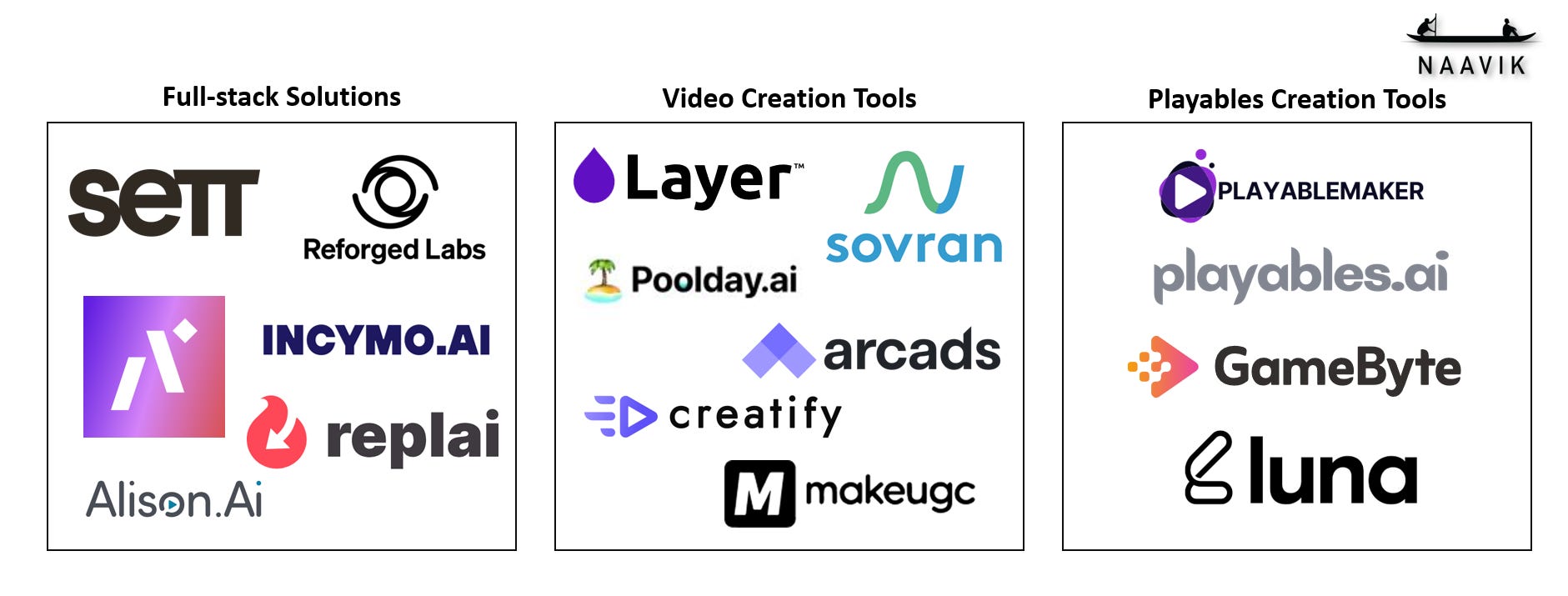
What makes ad creatives uniquely suited to this new AI stack is the importance of iteration. Creative testing has always been a numbers game, and rather than marginal efficiency gains, AI workflows can now exponentially grow the output by an order of magnitude, which perfectly aligns with the A/B testing requirements in mobile UA. Reforged Labs claims to increase the speed of ad conception and storyboarding by 5x; Layer similarly claims the ability to produce 50-100 creative concepts per day per strategist, compared to 5-10 with traditional methods; Sett improved output quantity and quality for Supersonic, driving clear Share of Voice impacts; Creatify reports up to 97% time saved in creative production, 90% lower production cost, and up to 50x more videos (1,000+ creatives/month) vs. legacy workflows; Admiral Media reports +45% ROAS, +55% CTR, -18% CAC for Star Chef 2; Incymo provides a detailed case study in AI-enabled creatives reaching top-performing ranks versus benchmarks. Proven impact results in a quick adoption pace, as shown by Axon’s proprietary data below:
A look at client adoption reveals that all major mobile publishers have already adopted AI solutions, from Poolday (Voodoo, Tapnation, Madbox, Million Victories …) to Reforged Labs (Supercell, DeNa, Wildlife). Sett currently stands out with the most comprehensive client roster, likely contributing to its $30 million Series B round, turning it into one of the top-funded game AI startups.
AI-enabled production in ad creatives has crossed the threshold from experiment to infrastructure. The capability is mature because the backend now runs on genuinely production-grade video models (Sora, Higgsfield, Runway, etc.) that render coherent motion, controllable style, and brand-consistent assets at a quality bar advertisers can actually ship alongside similarly mature text and voice models. The agentic layer pushed the potential further by enabling the insights layer on top of the pure production output. Gaming’s dominance in UA spend makes it a fertile ground for tool makers to ship and then expand to adjacent categories.
Looking ahead, tool improvements will come from expanding to the full UA stack by combining existing insights and creation capabilities with UA optimization agents. The self-reinforcing nature of owning the insights, creative, and distribution layers suggests that full-stack companies are best positioned to lead the ecosystem. Sett is already working on ad deployment agents, while companies like Kohort are building toward a complete UA operating system. In this context, incumbents (ad networks and distribution platforms) are bound to play a growing role as they bundle creative production into distribution. Google has already added AI-powered creative tools in its asset studio, while Meta is working toward a fully AI-automated ad stack: “Using the ad tools Meta is developing, a brand could present an image of the product it wants to promote along with a budgetary goal, and AI would create the entire ad, including imagery, video, and text. The system would then decide which Instagram and Facebook users to target and offer suggestions on budget, people familiar with the matter said.” This creates healthy exit prospects for tool makers like Sett, likely contributing to its current valuation, though defensibility for third-party providers will be in question once ad networks internalize more creative production and optimization capabilities. Publishers, on the other hand, will have to navigate the future relationship between ad networks and third-party service providers as they build their AI-enabled UA creative stacks for long-term stability.
Additionally, as AI-powered creatives become more common, end consumer perception becomes a critical concern. An extensive research corpus already hints at lower trust, emotional response, and purchase intent from AI creatives. According to NIQ, AI-generated video ads were consistently judged more “annoying,” “boring,” and “confusing” than traditionally produced ads, and IAB reports that only 45% of these consumers feel positive about AI‑generated ads, compared to 82% of ad execs who think they’re positive. While consumer perception is likely to evolve, assessing this consumer fatigue will be key, as pure cost-saving and output gains won’t offset the requirements for ad creative to give users a proper reason to play a game. Longer term, we will also have to see whether AI-enabled workflow can evolve toward providing consumers with an authentic reason to download through increasingly personalized, adaptive, and optimized materials.
Another risk will come from saturation. By collapsing the marginal cost of producing variations toward zero, AI removes the natural brake that production cost used to impose on creative output. Competitors can now flood the same auctions, so the volume needed to differentiate keeps ratcheting up. Simultaneously, AI makes it trivially easy to generate superficially different creatives that create fatigue faster than genuinely distinct concepts. The result is a denser, noisier ecosystem where differentiation gets harder to sustain. We can also wonder about long-term equilibrium, as AI adoption becomes ubiquitous, short-term CPI improvements we are seeing right now might vanish due to the auction-based nature of the UA environment. ROAS gains, however, might stick as a result of lower production costs and potentially higher-quality users acquired.
Lastly, with AI-enabled automation having a high chance of taking over a majority of the UA stack in the not-so-distant future, where will long-term bottlenecks and competitive advantage for publishers start to accumulate? As ad networks increasingly become the operating system for UA, we could see publishers’ role being limited to merely supplying budgets and creative concepts. Alternatively, publishers will have to embrace ideation (creative differentiation), change management (velocity in adopting and adapting AI-enabled processes), and signal extraction (data interpretation, internal model fine-tuning, etc.).
As creative production velocity increases, studio-wide coordination across disciplines will be required to align fast-changing winning creatives with in-game activities and user onboarding to maximize retention. This ultimately repositions the role of marketing as an even more central part of a mobile game’s product strategy. As such, it is unclear at this stage whether creative team sizes in publishers will radically change. However, the nature of the work will undoubtedly have to evolve.
As it stands, the technology maturity and pace of adoption make mobile ad creatives one of the most fertile grounds for AI deployment. AI-enabled workflows in marketing creatives are bound to become a staple to reach the required velocity and output to compete in this evolving creative environment. With the evolution, the central question will become who, between publishers, networks, and third-party service providers, captures value in a world where the creative generation itself becomes commoditized? The industry seems to be moving from a world constrained by creative production to one constrained by creative intelligence.
Written by Devin Becker, Consultant at Naavik
Hasbro partnered with ElevenLabs to launch Sixth Wall, an AI studio built around a new concept called “Behavioral Licensing.” The idea is to codify how a character thinks, speaks, and acts, and license that behavioral identity to third parties via software called CharacterOS. At launch, 12 Hasbro characters will be available, including Optimus Prime, Megatron, Cobra Commander, and the cast of Clue. AI behavior models are built from authorized source material and human voice performances, with a compensation structure for participating talent. Hasbro is accepting partnership pilots across interactive storytelling, conversational games, connected products, robotics, and AI brand ambassadors.
Behavioral Licensing represents a potentially significant new revenue stream for any IP holder sitting on deep character libraries. It can potentially drive both an extension of existing forms of character licensing as well as an increased depth through interactive/generative content beyond standard skinning, both of which can increase licensing revenue. Dungeons & Dragons is an example of how Hasbro could further monetize its IP through this approach. If CharacterOS can standardize NPC personalities and let them interact with players via voice at the table, that opens a microtransaction layer for individual character AI packs and a new form of licensed tabletop content. If Hasbro can prove the model, expect other major licensors to follow with their own behavioral IP frameworks. The strategic bet here is that in an AI-saturated world, owning the canonical version of a character’s personality becomes as valuable as owning their visual likeness.
Tripo AI, a China-based company building AI 3D foundation models, closed nearly $200 million across its Series A+ and A++ rounds. The company’s latest models (Tripo H3.1 and P1.0) generate production-ready 3D meshes within seconds. Alongside the funding, Tripo introduced Project Eden, a world model research initiative that separates persistent world state from visual rendering. Unlike video generation models that hallucinate frame-by-frame, Project Eden maintains a structured 3D state layer and renders from it, enabling environment persistence, editable worlds, and concurrent multiplayer interaction. The company has also released native 8K AI textures and upgraded its intelligent part segmentation tools for game and film pipelines. Chief scientist Yanpei Cao emphasized that the tech is meant to augment creators, not replace them.
The asset pipeline getting dramatically faster and cheaper would benefit game studios significantly, and the approach to persistent world models could help reshape how multiplayer environments are built and maintained. However, Project Eden is early stage and likely a year or more away from developer availability. In general, China has been moving much quicker to embrace AI in game development from both the developer and gamer standpoints. With that in mind, this is more likely to impact China first, with a significant lag before Western developers get any AI world model traction. In the growing arena of world models, the architectural distinction between state-aware world models and pixel-predicting video models is an important one to track. Studios evaluating AI world-building tools will need to monitor a fragmenting set of possible solutions going forward.
MapleStory Universe developer Nexpace has partnered with AI game creation platform Verse8 to launch Vibe Camp, a three-week creator competition (June 8-29) with $60,000 in prizes. Participants use Verse8’s text-based AI development tools to build experiences connected to the MapleStory Universe ecosystem. The initiative is part of Nexpace’s broader “Infinite IP Playground” strategy, which treats MapleStory assets, characters, items, and economic activity as reusable building blocks that extend beyond the core MMORPG. Verse8 lowers the technical barrier by letting users generate and iterate on game concepts through AI tooling rather than traditional programming.
This is an experiment in whether AI tools can meaningfully expand a UGC creator base beyond traditional modders and developers. Platform competition isn’t just about who has the most players, but who can mobilize the most creators. AI tools could become a lever to dramatically expand that pool.
Artificial Agency builds a behavior engine that powers agentic AI characters in games. The company is fine-tuning Meta’s open-source Llama models against a 70B performance baseline, using Amazon SageMaker and EC2 infrastructure. The goal is to create small, game-specific models that run in real time at a fraction of the cost and latency of larger models. Early results are promising. Supervised fine-tuning reduced parse error rates from roughly 79% to about 1%, pass rates on gameplay scenarios jumped from 6% to 51%, and looping behaviors were cut in half. The fine-tuned 1B model, 70 times smaller than the baseline, is beginning to approach comparable game-specific performance. The engine integrates directly into Unity and Unreal, with a cloud platform managing agent state, memory, and character evolution over time.
If a 1B parameter model can deliver game-quality AI behavior, it can run on consumer hardware. That eliminates the per-interaction cloud cost that currently makes always-on AI characters financially impractical for most studios. Co-founder Alex Kearney stated that studios want intelligent characters but don’t want to become machine learning experts. Artificial Agency is betting that the winning approach is distilling large model capabilities into small, specialized models owned by the studio, avoiding model drift and surprise updates from third-party providers. Live playtests comparing fine-tuned models against the 70B baseline are still ahead, but the trajectory is hopeful. If this approach scales, the cost barrier that currently limits AI NPCs to experiments and demos could shrink, making them a viable feature in future games.
FIFA and Lenovo tout the AI-powered technology behind the World Cup
Niantic Spatial and Spexi partner to turn drone imagery into intelligence for physical AI
Rambus enables AI PC memory at a time when memory pricing is soaring
Roblox announce the acquisition of Morpheus AI Inc for building video world models
Ayaneo reveals yet another Game Boy remake but this one has AI
Netflix Recasts Growth Story Around AI Tools Live Events And Gaming
CRSR Stock Jumps Overnight: Corsair Gaming’s AI Server Strategy Fuels Buzz
TinyBytes Leans on Data, AI, and Global Hiring to Navigate Mobile Games Pressure
The Next Frontier of Visual AI Is Code (a16z): “The most interesting visual AI tools today have stopped trying to generate the final output. Instead, they’re generating the source code behind it. This change is unlocking editability, iteration, and a feedback loop that pixel-native models can’t match.”
GDC Trends Report 2026: As use of generative AI rises, devs face “infrastructure problem” (GamesIndustry.biz): “The report found consistent support for using generative AI in planning and routine tasks, especially among older professionals and neurodivergent individuals. Professionals emphasised that AI tools should support rather than replace the development process, though some expressed concerns about potential layoffs. The report also noted that agentic AI could reduce AAA development costs by managing bugs, coding, or player support.”
Holy Grail, or Poison Chalice? (Gamecraft): “We’re starting to see a new crop of companies that are trying to build this almost like a prompt per game. We’ve used vibe coding, we’ve used agentic engineering, we’ve used all the terms. But these platforms, each of these that we’ll discuss are all trying to basically act as the aggregator and the creation platform for these games. And there’s a few that I’ve been pitched, dozens in the past year.”
When AI Enters Gameplay, the Craft of Making Games Changes (Game Bakery): “Our team is three to four students doing part-time work. Five years ago, this game would have required several times that many people, full-time. AI didn’t replace anyone on our team; we wouldn’t have existed without it.”
Why Moritz Baier-Lentz has doubled down on the intersection of gaming and AI (GamesBeat): “Companies like General Intuition take it a step even further, where it’s not just about how AI can make games better. It’s literally about how games can make AI better. To some extent, the game-based data set of Medal now helps us build spatial-temporal models that push the frontier of AI models, period. Not for gaming, but just in general.”
Coming Soon to a Roblox Game Near You: Strange AI-Generated Machines and Creatures (CNET): ‘”We don’t use the word metaverse anymore, but let’s think about what the metaverse is. It is an entire complex scene, which you can jump into and interact,” says Singh. “World models are invariably single player. But what if [everyone] could be in the same world and, when you change the world state, I would be able to see it. That multiplayer collaboration is what will make world models interesting.”’
Naavik’s team of experts has helped over 300 companies — publishers, studios, tech companies, and investors — succeed across the video game industry. We’d love to work with you too! Here’s what we offer, spanning all platforms, genres, and regions:
Strategy Consulting: Projects covering market research, corporate strategy, game and economy design, gamification, LiveOps strategy, AI strategy, product management, brand and performance marketing, and more.
M&A and Investment Advisory: Expert commercial due diligence for buyers, fundraising support for sellers, and fractional CFO/CSO services.
Fractional Talent: The one-stop shop for top-tier fractional talent covering dozens of game industry roles — analytics, design, marketing, art, QA, and more.
Check out the links above for more details. If you’d like to chat about how Naavik can serve your team, click the box below or send us a note at consulting@naavik.co.
No posts
Comments
Nothing yet. Say the first thing.
Sign in to join the conversation.