
“Each new advance in speed seems to bring us closer to that magical moment of being able to do everything just as fast as we’d like,” says Oliver Burkeman. “But we never actually get there.” He’s telling us to ditch the efficiency racket.
“Just as fast as we’d like.” Does anything indicate that “we” would settle for any slower than instantaneous? If our time on earth is finite, then each advance in efficiency is a step toward infinitude. To be productive is to carve out a little more space between yourself and death. To inch closer to immortality. To infinity.
As I said in Artificial Infinitude #1, this—infinitude, eternal life, immortality—used to be the promise of God; now it’s the promise of AGI. Both rely on faith and promise deliverance. Both pick at the same longing.

Contemporary philosopher Martin Hägglund proposes a different kind of faith, one that does not involve commitment without thought but a deepening of experience and an acknowledgment that what matters will disappear—otherwise, it would not matter. He argues in This Life: Secular Faith and Spiritual Freedom1 that living in acknowledgment of the reality of death is the essential path to finding meaning in life:
To keep faith in mortal life, then, is to remain vulnerable to a pain that no strength can finally master. Mortality is not only intrinsic to what makes life meaningful, but also makes life susceptible to lose meaning and become unbearable. The point is not to overcome this vulnerability but to recognize that it is an essential part of why our lives matter and why we care.
Hägglund allows that we have a natural antipathy towards death. Keeping “faith in mortal life” is not lusting for death but allowing the reality of death to inform how we live our lives. His concept of “living on” reconciles the apparent paradox of fighting to extend life while accepting that it cannot be infinite. Bioethicist Leon Kass touches on this paradox in the inaugural issue of The New Atlantis:
Living with our finitude is the condition of many of the best things in life: engagement, seriousness, a taste for beauty, the possibility of virtue, the ties born of procreation, the quest for meaning. Though the arguments are made against the case for immortality, they have weight also against more modest prolongations of the maximum lifespan, especially in good health, that would permit us to live as if there were always tomorrow.
Elsewhere in this article, Kass writes that “recent gains in health and longevity have produced not contentment but an increased appetite for more.” He portrays the longevity racket similarly to how Burkeman portrays the efficiency racket. Indeed, finitude is such a difficult opponent in large part because each step we take against it re-confirms its unshakeable dominion over us. Just as “gains in health and longevity” create the flawed perception that we are making progress against our own mortality, we are tricked into thinking that we might be able see all, hear all, and ultimately know all—in other words, achieve omnipotence—by the twenty-four hour news cycle and the seemingly limitless modes through which we consume media. We have the ability to be more aware of what’s going on in the world than we ever have before, and yet this ostensibly significant victory has proven itself to be Pyrrhic for our mental and emotional health.
Those working to defeat death—even the Altmen—presumably draw their motivation from a perception that what they are doing is virtuous (or at least right in some other way). In reply to this objection, Kass might argue that it is precisely their sense of finitude that drives them to engage with their subjects. Though they define their objectives in opposition to it, he could posit, finitude is still the essential condition of their work. What gives their work meaning is exactly the thing they wish to eradicate.
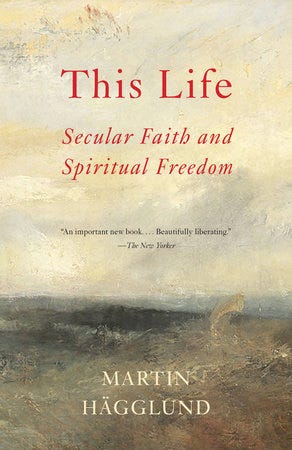
Hägglund and Kass urge us to swim in the pool of that meaning, the weight which death gives to every moment of life. Although life is wonderful, it does not follow we should want it to be endless. Life is wonderful because it not endless. Our tactical retreat from its end—our human project to defeat death—creates an atmosphere of antispiritual falsehood. The flashes of infinitude we glimpse are artificial. Hägglund opens his book with a reading of C.S. Lewis’s A Grief Observed, kindly but firmly showing why Lewis’s Christian comfort in the aftermath of his wife’s death is unreasonable. Any paradigm that pits us against death—whether it’s purportedly God on our side or AGI—grates upon our humanity. Better to accept our fates, better to live on, better to keep faith in mortal life.
For those like Ray Kurzweil who insist infinitude is reachable—he terms infinitude the “Singularity”—true AGI and infinitude are nearly synonymous. I think there is good reason to doubt this equivalence, though. Artificial Infinitude #3 will question whether it makes any sense at all to think of AGI’s achievements as our own.
This Life has impacted my life at least as much as any other text I’ve read, and I wholeheartedly recommended it. It was introduced to me by my good friend (and MMM subscriber!) Jake Burton, a man of uncommonly good taste.
Works Cited or Referenced
Hägglund, M. (2019). This life: Secular faith and spiritual freedom. Anchor.
Harris, Sam. “Time Management for Mortals: A Conversation with Oliver Burkeman (Episode #289).” YouTube, 19 July 2022, www.youtube.com/watch?v=nCHd6aM9Rlo. Accessed 7 Sept. 2025.
Kass, Leon. “Ageless Bodies, Happy Souls.” The New Atlantis, 2003, www.thenewatlantis.com/publications/ageless-bodies-happy-souls.
Ray, Kurzweil. “The Singularity Is Near Homepage.” Singularity.com, 2025, www.singularity.com/. Accessed 7 Sept. 2025.
McLaughlin, B., Gotlieb, M. R., & Mills, D. J. (2022). Caught in a Dangerous World: Problematic News Consumption and Its Relationship to Mental and Physical Ill-Being. Health Communication, 38(12), 2687–2697.
Walsh, Dylan. “Study: Social Media Use Linked to Decline in Mental Health.” MIT Sloan School of Management, 14 Sept. 2022, mitsloan.mit.edu/ideas-made-to-matter/study-social-media-use-linked-to-decline-mental-health.
All art used under Fair Use Doctrine and/or in accordance with licenses.
No posts
Comments
Nothing yet. Say the first thing.
Sign in to join the conversation.