
I quit my job as the Director of Business Development at the Northeastern University Institute for Experiential AI (EAI) in July 2023, just over two years ago. By and large, my colleagues were interesting people who wanted to discuss and debate fascinating ideas. Friendly, intelligent, compassionate humans. Good hangs. A typical day saw me learn an incredible amount of new facts and ways of thinking. Among its faculty, the EAI had experts on AI’s use in hundreds of disciplines, from genomics and disease modeling to ethics and philosophy to climate and beyond. So many of them were incredibly generous with their time and more than willing to engage deeply with me on the subjects they were paid to teach and conduct research within. They were neither blind to nor sanguine about the very real threats artificial intelligence poses. ChatGPT had been released during my time at the EAI, immediately throwing everything we were doing under a white-hot spotlight. Which is all to say: the work was rewarding, fulfilling, complex, and challenging; I was working with many people I liked and respected; what I was doing felt important.
But it’s fair to say that I was pretty miserable by the time I quit. Along with a slew of serious difficulties that I and my most cherished colleagues had with the work environment, I had developed broader concerns about the people, systems, and incentives governing the development of advanced technologies. I had been naive to think that the intersection between academia, corporate power, and state power would not be as disenchanting as it was. This particular loss of innocence cut deep. For myriad reasons ranging from the personal to the existential, I had to get out.
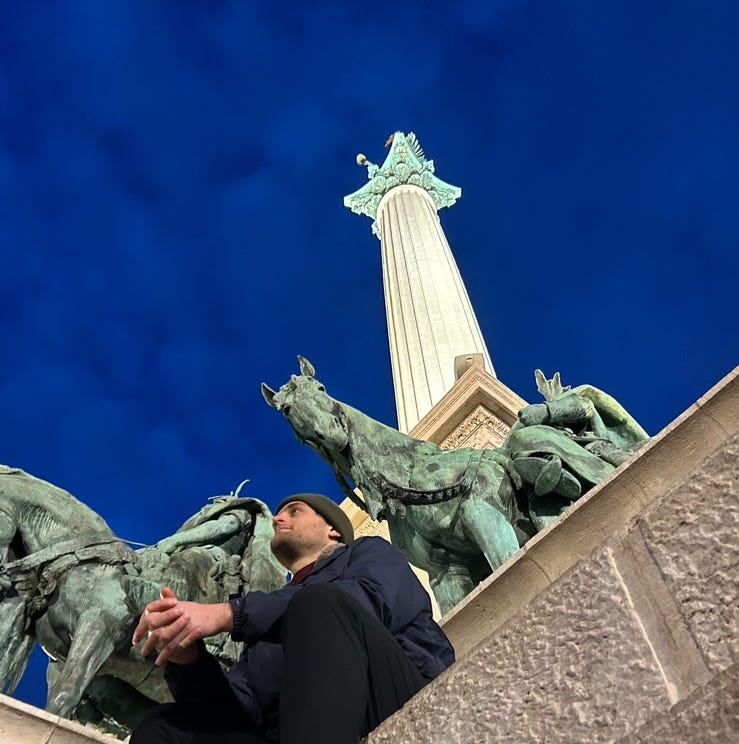
In the 2022-2023 winter, about nine months before I quit, I’d begun writing a novel. I wrote every morning between five and seven-thirty AM before going to work at the EAI. I started daydreaming again about somehow making fiction writer my job, my most constant ambition since childhood but one I had just kind of figured, especially as my career grew divergently, was impossible. (I have written stories ever since I was a kid, a practice which continued through my twenties, even during the years when I didn’t think I’d make another go at it. I’d applied to MFA programs once, in 2016, at age 24; I was rejected from every single one.)
The novel began to take shape as the situation at work deteriorated further. Over the course of the spring and early summer of 2023, I would with few exceptions come home from work as a deeply unpleasant version of myself, inhabiting a distracted rage, lost in a myopic bitterness. It sounds melodramatic, and much of the fault is mine for “bringing work home with me,” as they say. The particulars of this specific work environment certainly played a role, at least for me—though many of my colleagues did tell me they were afflicted with similar symptoms, that their own families were urging them to leave their jobs because of who our workplace seemed to turn them into—but I also wonder how much of the difficulty came from immersing myself in the world of artificial intelligence and other advanced computing. I worked right at the intersection of how these philosophies and technologies interact with both corporate power and a national and global politics that uses existential doom as currency. How could that not have a deleterious effect on my mental and emotional wellbeing?1
Whatever the cause, wherever lay the blame, I was often rendered intolerable to my wife, Mary. Multiple times over the course of that spring and summer, she said, “You know, you can just quit. Work on your novel, do some freelance writing on the side. We can make it work.” At first the idea seemed ludicrous, but it lodged somewhere in my consciousness and started to grow. She worked full-time (still does); I’d been mostly working full-time for the last ten years; we had a friendly mortgage from 2019 that seems unbelievable now. Mary was absolutely right that it could work logistically/financially, and she meant what she said—as in, she was willing to be the breadwinner for a year—and suddenly, at age 31, it seemed like I had a chance to not only escape a miserable job but actually take a shot at becoming the thing I’d forever told myself I wanted to be.
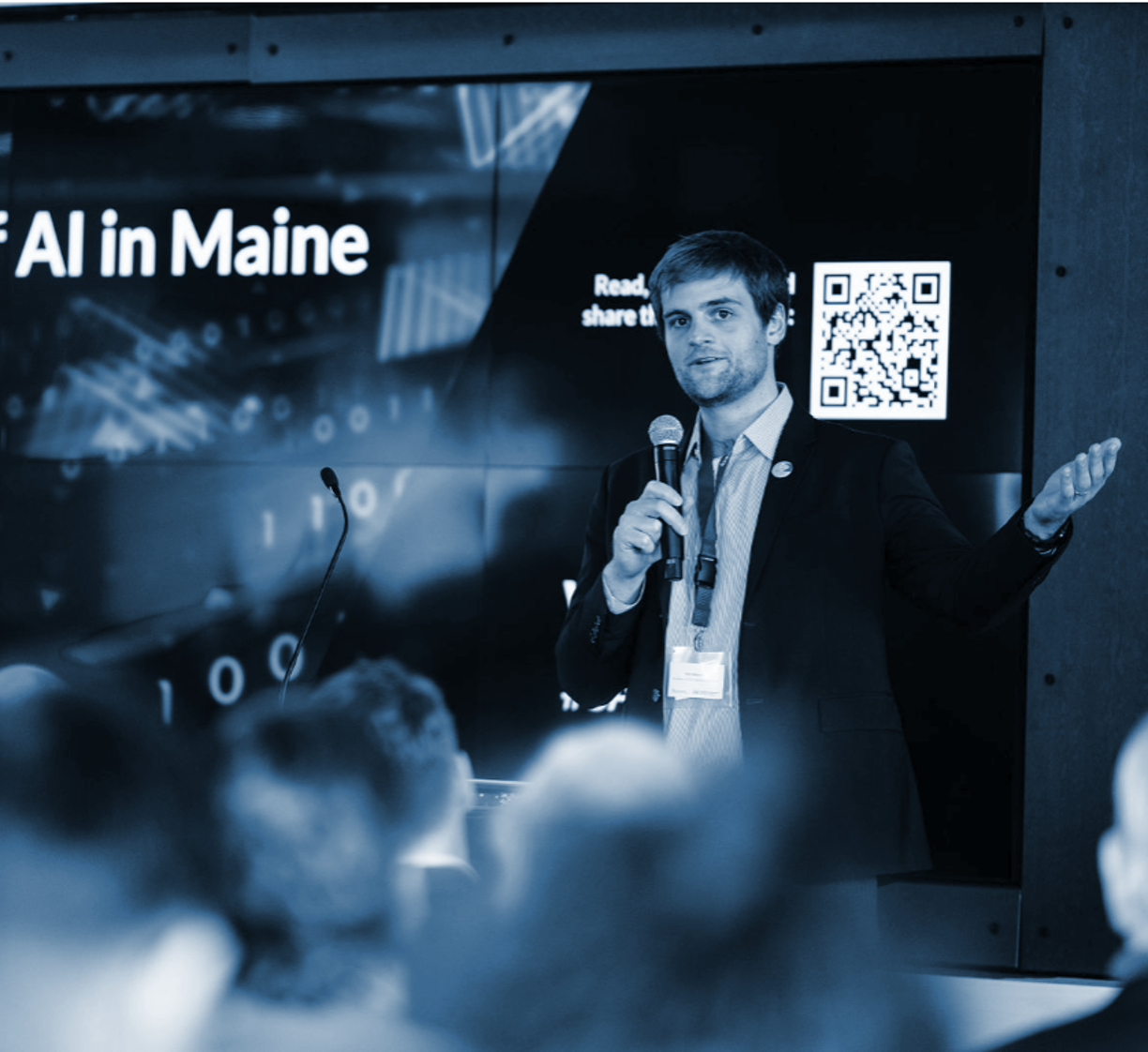
I resigned under somewhat strained but mostly good (I think) terms. After my boss announced my departure to the rest of the EAI—he said, “Miklos will be leaving us so he can write his novel”—he followed it up with a deep and scornful-sounding chuckle, but I’ve never been sure if he laughed because he didn’t believe me or because he thought my decision was ridiculous.
The prospect of a year to work on my novel only made the desire to write metastasize within me; by the fall, I’d decided to apply to MFA programs again. This time around, I got into a few, including Cornell, the place from which I’d gotten my bachelor’s in 2013. We sold the house and moved—Mary still incredibly supportive, but perhaps a little leery of what she’d gotten herself into—from South Portland, ME to Ithaca, NY in August of 2024, almost exactly a year after I’d quit the EAI.
At a remove from the data industry during its time of unprecedented, unrestrained, Tatari-gami-like growth, I wrote a novel that strives to place our relationship with artificial intelligence in the mythological, religious perspectives from which I think it is most helpfully viewed. And it wasn’t that good, so I wrote it again, and that wasn’t that good, so I started over about two-thirds of the way through, and that wasn’t that good, so I started over about two-thirds of the way through again, and that was kind of close to what I wanted, so I wrote another draft of it, mostly from scratch. That has pretty much been the writing process so far. I drafted my novel five times over the course of three years until I thought it was good enough to share with a few people. Mary first, then a member of my cohort and a thesis adviser. That’s where I’m at now.
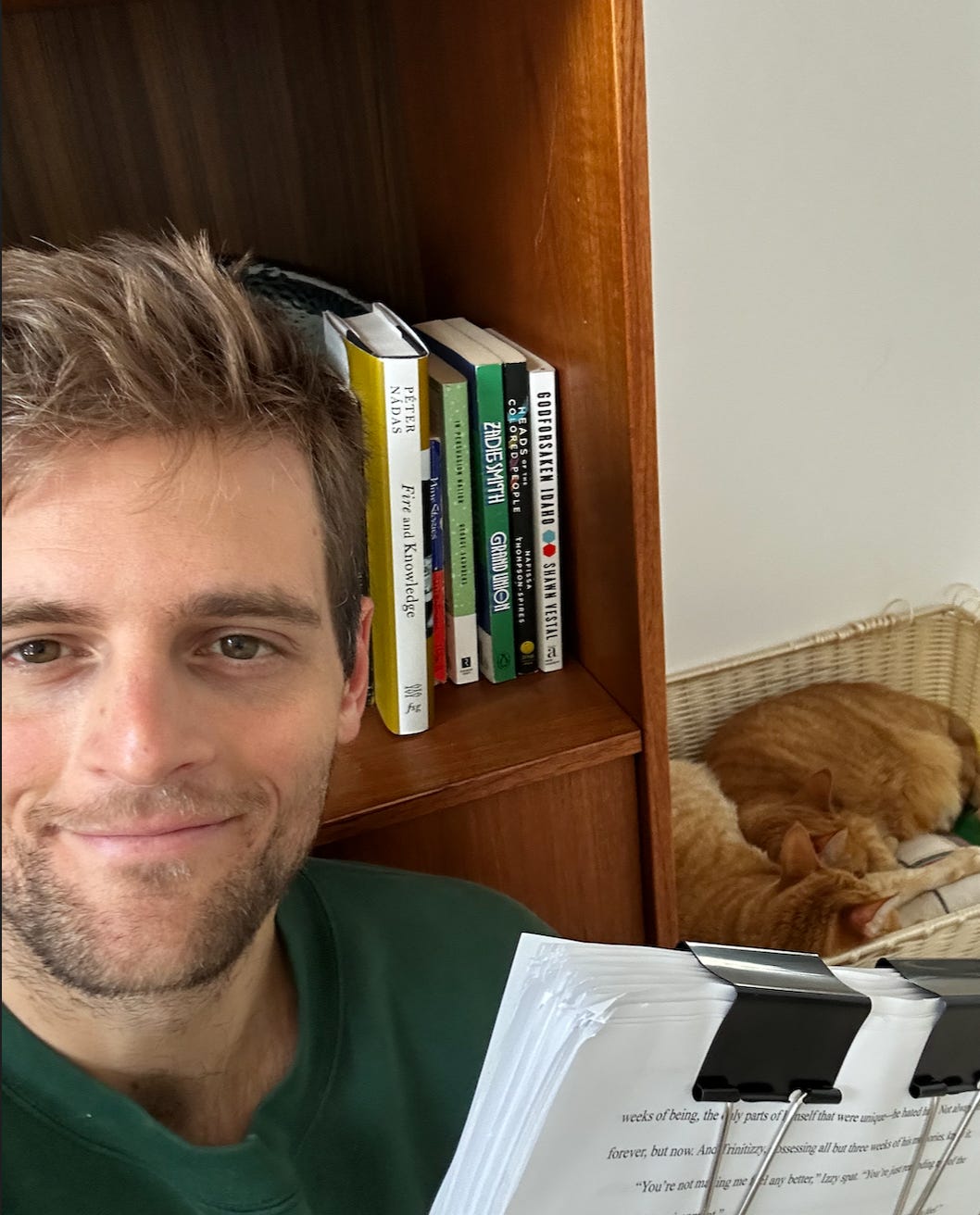
Once they give me feedback, I’ll draft it again and share it with a few more readers. Besides the name of the main character, the first draft and the fifth are hardly recognizable as the same book. It was a very inefficient way to get here. Not optimized at all. But I’m really excited about where the novel is now and where I hope it is going. One of the many great things about writing a novel or story is that its quality need not bear any relation to how efficiently it was made.
My age and experience, as well as my 90-degree turn from a previous career, has made the privilege2 of being in a well-resourced MFA program obvious to me and lent a kind of focused desperation to my approach to work. I’ve tried to treat July 2023-July 2025 as a time when I could work my ass off in a manner I may not be able to ever again. In addition to drafts four and five of the novel as well as the academic work of the first year, I’ve written a number of short stories, two of which have been accepted for publication.
An even bigger contributor to my work ethic was the deadline of impending fatherhood. Mary gave birth to twin girls in August. My goal, which I accomplished, was to get my novel in my first readers’ hands by then. Our daughters are now 16 days old; in due time, I’ll start plugging away at the next draft. I’m continuing to write and submit stories. The hope is that sometime around the beginning of next summer I’ll have two books to sell, some fiction publications to my name, and a community of readers and writers who recognize my name and are interested in the topics I write about.
Finding my way to such a community is the objective of this post and, really, of Myth, Man, Machine. I’ve been a Substack reader for a while, and I trust the main thrust of pieces like these from Ross Barkan and Haili Blassingame, which I take to be, essentially: you gotta hustle if you want to make it as a writer. It’s pretty clear that the odds of making money as a fiction writer are incredibly long—but increase if you make an effort to grow your readership. To quote Barkan:
DeLillo and Pynchon can afford to be gnomic (or absent), but you can’t. In truth, with few exceptions, writers always had to be hustling, whether it was Whitman hawking poems door-to-door or the Modernists self-creating their own mythos in real-time. It is very tough to talk about a work of art. Fiction doesn’t lend itself to soundbites, and never will. Yet there’s a bit of wisdom from an old baseball Hall of Famer, Bob Feller, that I’ve sought to follow, at least in my thirties. Feller, known for relentlessly signing baseballs and talking up his exploits, used to tell reporters—or anyone who’d listen, really—that he was the greatest ever. If you’re not going to promote yourself, he asked, who will? For anyone to believe in me, I’ve got to believe in me. Readers are a distracted bunch. Bashful writers will have a harder time catching them.
This is the third of three introductory posts I’ve made to launch of Myth, Man, Machine. The other two explain what I’m trying to do with this Substack and why I’m trying to do it. I’ve also posted two other pieces, “From a ‘Bed of Soft Emptiness’” and “Artificial Infinitude #1.” As you’ll see from them, and my subsequent posts, I don’t plan on putting my own identity/story front and center. I want Myth, Man, Machine to be occasionally valuable or thought-provoking as well as experimental, esoteric, weird, unpredictable. I want it to exist within the capacious and fascinating overlap between the realms of spirituality, humanism, narrativity, and technology. I hope that most of what you learn about me comes through in the work; I don’t intend to make myself its subject very often. But I thought it would be helpful to know where the posts come from.
As will become apparent, I am not an AI doomer, and though I am much more pessimistic and on-guard about the role of AI in our [future] lives than some, especially many of those who research its capabilities and work in tech, I do not see the issue as black and white. But I do think this most recent AI boom has drastically grown the number of people who now have no choice but to be conscious of how profoundly the interaction between technology, capitalism, and politics affects every single facet of their lives—and this knowledge has rarely changed them for the better.
It’s worth it to say that I don’t mean to discount the multitudes of challenges faced by graduate students here and throughout the country, especially those whose status as immigrants means they’re being fucked with fascistly. Also, the institutional sicknesses that caused me to flee my old job are no doubt present here; they’re damn near ubiquitous at large institutions. I occupy a different space at Cornell than I did at Northeastern, but this is not a narrative in which I travel from a land of evil to a land of good. Such broad strokes can never be accurate.
No posts
Comments
Nothing yet. Say the first thing.
Sign in to join the conversation.